

Peeling paint on a Toronto house looks cosmetic, but it often means moisture is reaching the trim, siding or sills of an older brick or frame house. The home insurance exterior paint question usually starts when a North York or Etobicoke homeowner spots flaking fascia and checks the fine print. In most Ontario policies, gradual paint failure counts as wear and tear, so the repaint stays the owner's job and the owner's cost. The real risk is what neglected paint lets in, because slow water damage from rotted wood can complicate a later insurance claim. This page belongs to the house painting guide from Home Painters Toronto, backed by 1,200+ positive reviews and 20,000+ GTA homes painted since 1991.
No. Home insurance in Ontario does not usually pay to fix peeling exterior paint, because insurers treat gradual deterioration as maintenance. Peeling paint rarely cancels a policy on its own. It can weaken a later water damage claim if an adjuster finds that rot or failed caulking let the water in. Your policy wording and your broker settle the details.
Does Home Insurance Cover Peeling Exterior Paint?
Home insurance does not usually cover peeling exterior paint, because insurers treat slow paint failure as wear and tear. The Insurance Bureau of Canada explains that a home insurance policy does not act as a maintenance contract. It is not a sudden or accidental loss. Peeling, chalking, fading and cracked caulk all build up over years of sun, rain and freeze-thaw cycles. An adjuster reads that pattern as normal ageing of the building envelope.
Most policies only respond when a covered peril causes the damage. Hail that cracks paint film, a branch that gouges siding, or a fire are the usual examples. When one of those events damages paint, repainting the affected area may form part of the claim. When the paint simply wore out, the cost stays with the homeowner.
| Situation | Likely treatment | What helps |
|---|---|---|
| Paint peeling on sunny trim after many summers | Wear and tear, not covered | Plan a repaint before bare wood shows |
| Hail cracks the paint film on one side of the house | Often covered as storm damage | Dated photos and a written estimate |
| Water stain inside, below a rotted window sill | Often disputed; the rot itself is excluded | Records that show recent upkeep |
| Caulk dried out and split around windows | Maintenance, not covered | Recaulk during the next exterior repaint |
| Branch strikes and gouges siding in a windstorm | Often covered under the windstorm peril | Report quickly and keep the debris |
Wear and Tear Exclusions in Ontario Home Insurance Policies
A wear and tear exclusion is policy wording that removes gradual deterioration from coverage. Ontario wordings often list it beside rust, corrosion, rot, mould and continuous seepage of water. Exterior paint is a sacrificial coating, so insurers expect it to need renewal on a regular cycle. Look for "Exclusions" or "Loss or damage not insured" in your own policy to see the exact terms.
Sudden Damage vs Gradual Wear: How Insurers Draw the Line
Insurers draw the line by asking whether the damage came from one sudden event or built up over time. The Financial Consumer Agency of Canada notes that insurers exclude events they consider predictable or tied to home maintenance. Peeling paint fails that test because it develops slowly and anyone can see it from the street. A windstorm that tears off a fascia board passes it, because the date and the cause are clear.
Adjusters look for physical evidence that matches the story. Fresh, sharp-edged damage on the storm-facing side points to a sudden event. Grey, weathered wood under old paint points to years of exposure. Mixed cases are common on older Toronto homes, which is why your records matter so much.
| Signal an adjuster checks | Points to sudden damage | Points to gradual wear |
|---|---|---|
| Edge of the damaged paint | Sharp, clean breaks | Curled, chalky or layered edges |
| Wood under the paint | Bright, fresh fibres | Grey, soft or stained fibres |
| Pattern on the house | One elevation, facing the storm | Several walls, sunny sides or low areas |
| Caulk and sealant | Intact beside the damage | Shrunk, cracked or missing |
| Interior staining | One fresh stain after a storm | Tide-line rings from repeated wetting |
How Neglected Paint Can Complicate a Water Damage Claim
Neglected paint can complicate a water damage claim because an adjuster may trace the water to a maintenance failure. A covered event has to be the cause for the claim to pay. The paint itself is rarely the claim. The problem is the chain of failures that starts once paint and caulk stop shedding water. Policies differ, so "may" is the honest word here.
- The paint film cracks at joints and end grain, so rain soaks straight into bare wood.
- Sealant at window and door frames shrinks and splits, which opens a path behind the trim. Fresh exterior caulking around windows and doors closes that path.
- The wood stays damp through Toronto's wet spring and fall. Decay research from the U.S. Forest Products Laboratory treats 20% wood moisture content as the safe upper limit against fungal rot.
- Rot softens sills, fascia and siding, and water starts reaching sheathing or drywall.
- A stain appears inside, and the homeowner files a claim for the interior damage.
At step five, the adjuster traces the water back to its source. Say the source is a rotted sill under paint that failed years ago. The insurer may then treat that sill repair as maintenance. Some insurers also question the interior damage when a leak was continuous or long-standing. A clean maintenance record helps show the leak was sudden and not ignored.
Where Failed Paint Lets Water Into Toronto Homes
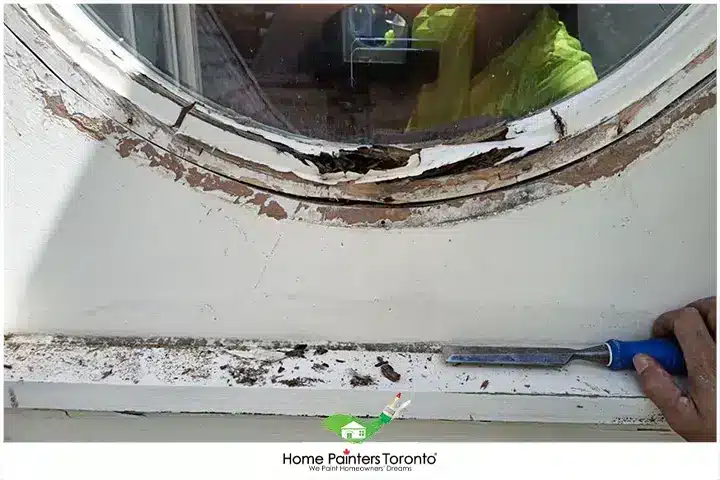
Failed paint lets water in at the same few spots on most Toronto houses. Window sills, fascia boards, the lowest siding boards and porch columns top the list. Sills hold standing water after rain, which is why window wood repair is one of our most common pre-paint tasks. Fascia sits behind gutters that overflow, so soffit and fascia repairs often go hand in hand with repainting. The bottom siding courses take splash-back from walkways and snowbanks, and wood siding replacement and repairs usually start there.
Storm Damage and Maintenance: Why One Wall Can Get Two Answers
One wall can get two answers because an insurer may cover fresh storm damage and exclude the older paint failure beside it. A hailstorm might crack paint on the west side of a house that was already peeling at the sills. The adjuster can approve the hail damage and leave the sills to the owner. Our guide to storm damage and exterior paint insurance claims covers that claim process step by step.
The practical lesson is to keep storm repairs and upkeep separate on paper. Ask your contractor for an itemized painting estimate that splits storm-related items from routine maintenance. Mixing the two on one line can slow a claim or shrink the payout. A clear split also shows the adjuster you are not asking the policy to fund upkeep.
Timing matters too. Report storm damage soon after the event, while the evidence is fresh and easy to date. Hold off on repainting the damaged area until the adjuster has seen it or approved the work. Temporary protection, like a tarp over an open seam, is usually fine and shows you acted to limit further damage.
Some policy wordings add a twist called resulting damage. The rot stays excluded, yet sudden water damage that follows from it may still be covered in certain wordings. Other wordings exclude both the cause and the result. Only your own policy and your broker can tell you which version you hold.
What Repainting on Schedule Costs Compared With Repairing Rot
Repainting a standard Toronto exterior on schedule typically costs $2,000 to $10,000 plus HST, based on Home Painters Toronto's published project pricing. Waiting until rot sets in adds carpentry on top of the same repaint. Insurance rarely pays for either line when the cause is age. The table below shows where neglect tends to add work at each project size.
| Exterior project size | Typical range (CAD + HST) | Where neglect adds cost |
|---|---|---|
| Small | $2,000–$4,000 | Spot rot repair on sills or trim before priming |
| Medium | $4,000–$8,000 | Fascia, soffit or lower siding boards replaced |
| Large | $8,000–$10,000 | Failed caulk and bare wood on several elevations |
| XL | $12,000–$30,000 | Multi-storey access plus widespread wood repair |
Ranges depend on size, height, access and surface condition. Our carpenters price rotted wood separately after an inspection. The true extent of rot only shows once a carpenter opens up the soft wood. Damaged aluminum, vinyl or wood boards can go through siding repair before the repaint starts. The lowest-cost exterior is almost always the one repainted before bare wood appears.
Repaint timing depends on the surface, its exposure and the last coating system. South- and west-facing walls take the most sun, so they usually fail first. A walk-around each spring tells you more than a fixed date on the calendar. Every exterior painting project we complete carries a 3-year warranty, and the paperwork doubles as a maintenance record.
A professional exterior inspection checks four things before anyone opens a can of paint. Our estimators test film adhesion on the worst-looking walls and probe sills and fascia for soft wood. They check every caulk joint around windows and doors and take moisture readings where staining shows. Those notes go into the written quote, so you hold a dated record even if you wait a season to book.
Records That Help Your Policy: Inspections, Invoices and Photos
The records that help most are dated photos, itemized invoices and written inspection notes from before any claim. Together they prove you maintained the exterior. Adjusters work from evidence, and a homeowner with a clear file has a far easier conversation. Keep these items together with your policy documents:
- Dated photos of every side of the house each spring, plus close-ups of sills, fascia and caulk joints.
- Itemized invoices that name the products, sheen, number of coats and areas painted.
- Moisture readings or inspection notes from your painter or carpenter.
- Your contractor's WSIB clearance certificate and proof of liability insurance. An injured worker without coverage may lead to a claim against you.
- Written warranty terms, so a coating defect points back to the contractor. Our home painting warranty page sets out what each warranty covers.
Store digital copies off-site or in cloud storage, so a fire or flood cannot destroy the proof. The same file helps when you sell, because a buyer's inspector will ask the same questions an adjuster does. You can also see how GTA homeowners rate our documentation in our client reviews.
Questions to Ask Your Insurance Broker About Exterior Upkeep
Ask your broker these five questions before you ever need to file a claim, and write down the answers.
- Which section of my policy excludes wear and tear, rot and continuous seepage?
- Is water damage covered if it enters through a gap that a storm opened suddenly?
- Do I need to report known exterior rot or an active leak before renewal?
- Should I send you photos or invoices after I repaint or replace exterior wood?
- Does my policy pay to match undamaged walls after a covered loss?
Home Insurance and Exterior Paint FAQs
Home insurance does not pay to repaint a house because of age, fading or peeling. It may pay to repaint areas damaged by a covered event such as hail, fire or a windstorm. Whether it also pays to match undamaged walls depends on your policy wording and the adjuster's assessment.
Peeling paint does not usually void a home insurance policy on its own. An insurer may still ask for repairs or decline to renew if an inspection shows serious neglect. The bigger impact is on claims where rot or failed caulk helped water get inside.
Wear and tear means gradual damage from age, weather and normal use. Faded paint, chalking, dried caulk and slow rot all fit that definition. Insurers exclude it because it is expected and preventable with regular upkeep.
Coverage for interior water damage depends on your policy and on how the water got in. Insurers usually classify the rotted sill itself as maintenance. Many policies also exclude damage from a continuous or long-standing leak. Call your broker before you start repairs.
Routine peeling paint is not usually something you need to report to your insurer. Most policies do ask you to report a material change in risk. Serious rot or an active leak could count. Your broker can tell you what the conditions section of your policy requires.
Yes, keep every painting and carpentry invoice, ideally with dated photos. These records show the home was maintained if an adjuster questions the cause of a loss. A digital copy stored outside the house protects that proof from the same fire or flood.
Protecting Your Policy: Home Insurance and Exterior Paint
The best way to protect your policy is to treat exterior paint as scheduled maintenance. Insurers will not pay for paint that simply wore out. Repaint before bare wood shows, fix rot early and keep a dated file of the work. When a storm does hit, that file helps separate covered damage from upkeep. Home Painters Toronto is WSIB compliant and fully insured with $5M general liability coverage. Every crew member passes a criminal background check.
This article is general information, not insurance or legal advice. Confirm the details of your own policy with your broker.

Seeing peeling trim or soft wood around your windows this fall? We offer fast, free quotes and warranty-backed work, with estimates available seven days a week.
Contact Home Painters Toronto