

Soffit and fascia repair in Toronto usually takes anywhere from a few hours to three full days, depending on how much of the roofline needs attention. A homeowner in Scarborough with one rotted fascia board faces a very different schedule than a family in Etobicoke replacing an entire roofline after decades of weather exposure. The soffit fascia repair timeline hinges on project size, material choice, hidden rot, and how many crews are working the job at once. Most GTA homeowners want a firm number before they commit to a contractor, and that number depends on what our crew finds once the ladders go up. This guide breaks the timeline down by project size so you know what to expect before you book an assessment.
A single soffit or fascia patch typically takes 2 to 4 hours, a standard single-family home runs 1 to 2 days, and a full roofline replacement on a large or custom home can take 3 to 5 days. Weather, hidden rot, and special-order materials are the main factors that push a project past its original estimate.

The soffit fascia repair timeline hinges on project size, material choice, hidden rot, and how many crews are working the job at once
Soffit and Fascia Repair Timeline by Project Size
A soffit and fascia repair timeline in Toronto breaks into three general bands: a small patch, a standard single-family home, and a large or custom property. Most homeowners fall into the standard-home category, where our soffit and fascia repair service crews replace fascia boards and soffit panels along one or two sides of the house. Larger or architecturally complex homes take longer because of steeper roof pitches, custom trim profiles, and more linear footage to cover. The table below reflects typical scheduling windows our crews use when quoting exterior carpentry work across the GTA.
| Project Size | Scope | Typical Timeline |
|---|---|---|
| Small patch | One rotted board or a few feet of soffit panel | 2 to 4 hours |
| Standard single-family home | Full fascia and soffit on one or two elevations | 1 to 2 days |
| Large or custom home | Full roofline, multiple storeys, or custom profiles | 3 to 5 days |
| Full property with siding tie-in | Roofline plus related exterior wood siding repair | 5 to 7 days |
Crew size scales with the scope, not just the square footage of the home. A small patch usually needs one carpenter for a half-day visit, while a full roofline replacement brings a two- or three-person crew to keep material moving between ground-level cutting stations and the roofline itself. Homes with steep rooflines or third-storey dormers often need an additional day just for safe scaffolding setup, separate from the actual carpentry and finishing work. Toronto's older housing stock, especially century homes in neighbourhoods like Riverdale and the Annex, tends to fall into the large-or-custom category because original trim profiles rarely match modern stock lumber sizes.
Soffit and Fascia Repair Timeline for a Single-Storey Home
A single-storey bungalow with straightforward aluminum soffit and fascia typically finishes in one working day. Crews remove the damaged sections, inspect the fascia board and rafter tails underneath, and install new material before closing up the work area. Two-storey homes add scaffolding or extension-ladder setup time, which can push the same scope of work to a day and a half. Homes with wood soffit and fascia instead of aluminum need extra time for priming and painting once the carpentry is finished, which is one reason material choice matters when comparing aluminum vs vinyl vs wood soffit options before a repair.
What Happens on Day One
Day one of any soffit and fascia repair starts with an on-site assessment, not demolition. A crew lead inspects the visible damage, checks for signs your soffit and fascia need repair beyond what prompted the call, probes suspect areas with a screwdriver to check for soft or rotted wood, and photographs anything hidden behind the current soffit panels. That assessment feeds directly into a written quote that sets the real schedule, since the visible damage rarely tells the full story. Homeowners who skip this step and accept a phone-only estimate often see their timeline slip once a crew opens the roofline and finds more rot than expected.
The On-Site Assessment and Written Quote
The written quote lists material type, linear footage, and any structural repair needed to the rafter tails or fascia backing board. It also states a start date and an estimated completion window based on current crew availability and weather. Homeowners should expect this quote within 24 to 48 hours of the assessment for most standard residential jobs. A same-day estimate is possible for straightforward jobs, which is why same-day estimates remain part of HPT's standard process across the GTA.
The assessment also determines whether the existing fascia backing board can stay in place or needs full replacement. Substrate preparation matters here: a backing board with surface rot but sound core wood can sometimes be treated and capped, while a board with rot running through its full thickness has to come out entirely. Skipping this check is how homeowners end up with a repair that fails again within a year or two, since new paint or aluminum capping over compromised wood does not stop the underlying moisture problem.

Factors That Extend the Repair Timeline
Four factors most often push a soffit and fascia repair timeline past its original estimate, and several of the same factors also drive soffit and fascia replacement cost up or down: hidden rot, material availability, roofline access, and weather. Hidden rot is the biggest culprit, since a fascia board that looks fine from the ground can hide months of moisture damage behind the paint. Special-order materials, like a custom wood profile for a century home, add days or weeks to a schedule that would otherwise move quickly. The table below breaks down how each factor typically affects the schedule.
Hidden rot is worth explaining in more detail because it is the single biggest source of timeline surprises. A fascia board can look structurally sound from the ground while the wood behind the paint film has already absorbed months of moisture through hairline cracks, sometimes made worse by poor attic ventilation pushing warm, moist air out through the soffit itself. Crews check for this with a screwdriver probe test, pressing into suspect areas to feel for soft, spongy resistance instead of solid wood. When a probe test reveals rot, the repair scope typically grows to include the rafter tail behind the fascia, which adds structural carpentry to what may have started as a simple cosmetic patch request.
| Factor | Typical Impact | Details |
|---|---|---|
| Hidden rot | Adds 1 to 3 days | Rafter tails or backing boards need extra structural repair |
| Material availability | Adds 3 to 10 business days | Custom colours or discontinued profiles must be special-ordered |
| Roofline access | Adds half a day to 1 day | Steep pitches or tight lot lines need extra scaffolding setup |
| Weather delays | Adds days to weeks | Rain, high wind, or sub-zero temperatures halt exterior work |
Can Soffit and Fascia Repair Be Done in a Single Day?
Yes, a single-day soffit and fascia repair is realistic for a small patch or a one-elevation job on a single-storey home, but the marketing phrase "same-day repair" oversells what most projects actually need. Same-day work applies to the visible carpentry and installation, not to the full process, which includes an assessment, a written quote, and material ordering that happen before the crew arrives. A homeowner who calls expecting a contractor to show up and finish everything within hours is setting up an unrealistic comparison. What contractors mean by same-day service is usually a same-day estimate, followed by a scheduled repair date once materials are confirmed. Understanding this distinction helps homeowners compare quotes accurately instead of choosing a contractor based on an inflated promise.
A genuinely same-day job usually meets three conditions: the damage is limited to one elevation, the material matches standard stock sizes and colours, and the weather forecast allows a full finish coat to cure before evening. When any one of those conditions is missing, a realistic quote should say so upfront instead of promising a same-day turnaround that depends on ideal circumstances. Homeowners comparing multiple quotes should ask each contractor what specifically qualifies their project for same-day service, since the answer often reveals how thorough the initial assessment actually was.
Why Toronto's Freeze-Thaw Weather Controls Your Repair Window
Toronto's freeze-thaw cycle limits exterior soffit and fascia work to a roughly eight-month window each year, from early spring through late fall, and the same cycle is behind most ice dams and soffit damage we see reported each winter. According to the Climate Atlas of Canada, the Toronto region experiences dozens of freeze-thaw transitions each winter, which makes cold-weather paint adhesion and caulking cure times unreliable below certain temperatures. Most exterior paints and sealants need surface and air temperatures above 10 degrees Celsius to cure properly, based on manufacturer technical data sheets from Benjamin Moore and Sherwin-Williams. That means a repair booked in November can still happen, but the finishing coat may need to wait for a warmer stretch in spring. Homeowners who need urgent winter repairs can still get structural carpentry done, with paint or sealant finishing scheduled once temperatures allow it.
Dew point matters as much as air temperature for exterior finishing work. If the surface temperature of the fascia board sits close to the dew point, moisture can condense on the wood during application and cause adhesion failure even when the air feels dry enough to work in. This is one reason crews check both air and surface temperature before starting a finish coat instead of relying on a single weather app reading. Elastomeric coatings and higher-build exterior paints generally tolerate a slightly wider temperature window than standard latex, but they still need a clear multi-day forecast to cure fully before rain or frost returns, the same scheduling logic our exterior painting services crews use on full house repaints.
Freeze-Thaw Cycles and the GTA Repair Window
Freeze-thaw damage is also why so many Toronto soffit and fascia repairs get booked in spring, right after a winter of ice and moisture cycling through cracks in old caulking. Crews see a predictable spike in fascia rot discovered each April, once melting snow reveals staining and soft wood that was invisible under ice. CMHC's seasonal home maintenance guidance recommends checking exterior wood siding and trim for signs of deterioration each spring, which lines up with when most GTA homeowners first spot the damage that ends up on our schedule. Booking an assessment in late winter, before the spring rush, usually means a shorter wait for a scheduled repair date.
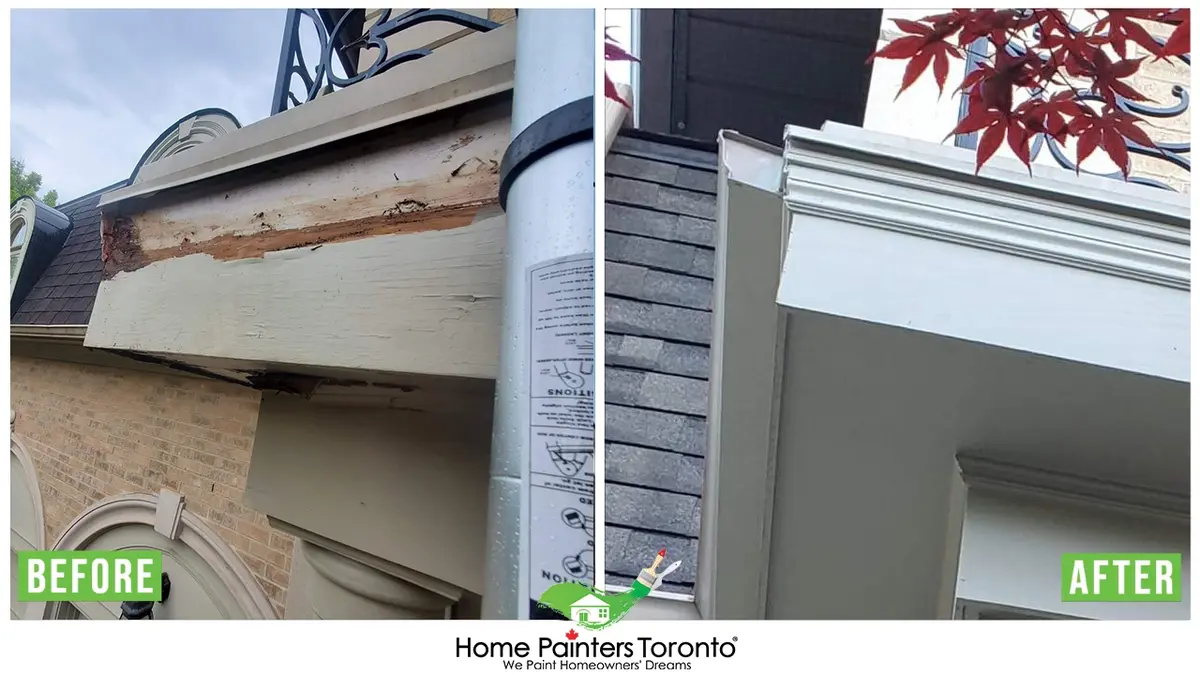
The full job took two and a half days because the paint needed two dry, above-15-degree days to cure between coats
A Recent Soffit and Fascia Repair Timeline in Leslieville
- At a recent fascia repair in Leslieville, our crew found soft, rotted fascia board hidden behind aluminum fascia capping on a century semi-detached home.
- The homeowner had noticed peeling paint below the roofline for two seasons before booking an assessment, and capping had hidden the extent of the damage.
- Once we pulled the aluminum back, moisture readings on the exposed wood came in above 24 percent, well past the roughly 20 percent threshold that building science research identifies as the point where exterior wood begins to decay.
- We replaced roughly 40 linear feet of fascia board and matching soffit panel, then primed and finished the new wood fascia with Benjamin Moore Aura Exterior in Low Lustre, applied at a 4 mil dry film thickness to match the manufacturer's coverage specification.
The full job, from teardown to final coat, took two and a half days because the paint needed two dry, above-15-degree days to cure between coats. That project is a good example of why a fascia repair timeline can shift once hidden rot and weather both come into play on the same job. The homeowner had originally budgeted for a single day of work based on a phone estimate from a different contractor, so the revised timeline came as a surprise until we walked through the moisture readings and explained why the aluminum capping had made the damage worse instead of protecting the wood underneath.
Frequently Asked Questions About Soffit and Fascia Repair Timelines
These are the timeline questions GTA homeowners ask us most often, alongside our frequently asked painting and repair questions page for broader project questions.
Replacing a single fascia board usually takes 2 to 4 hours once a crew is on site, including removal of the damaged section and installation of the new board. Full drying and finishing time can add a day if the wood needs primer and two coats of exterior paint. Homes with multiple damaged boards along the same elevation often get grouped into a single half-day or full-day visit.
Small patches and single-elevation jobs on single-storey homes can often be completed in one day. Larger homes, multi-storey properties, or jobs with hidden rot typically need one to three additional days once the full scope becomes clear. The written quote issued after the on-site assessment gives homeowners a realistic day count for their specific project.
Yes, cold temperatures can delay the paint and sealant portion of a repair, since most exterior coatings need air and surface temperatures above 10 degrees Celsius to cure. Structural carpentry, like replacing rotted fascia board, can still proceed in colder weather when needed for urgent issues. Final finishing coats are then scheduled for the next stretch of suitable weather.
Booking two to four weeks ahead is a reasonable target during spring and fall, when demand for exterior carpentry peaks across the GTA. Urgent issues, like active water intrusion or pest entry, are usually prioritized ahead of routine bookings. Winter and midsummer generally have shorter wait times for a scheduled assessment.
Gutters typically come down and go back up the same day as the soffit and fascia work beneath them, so homeowners are rarely without gutters for more than a few hours. On larger jobs spanning several days, crews usually sequence the work section by section to avoid leaving gutters detached overnight. Confirm the sequencing plan with your crew lead if a storm is forecast during your repair window.
Urgent issues like active leaks, exposed wiring near a soffit vent, or storm damage can usually be prioritized ahead of routine bookings. Structural safety concerns move to the front of the schedule, even during a busy spring or fall season. Rushing a job still requires enough dry weather for any needed finish coat, so an emergency repair may proceed in two phases: an immediate structural fix, followed by finishing work once conditions allow.

Plan Your Soffit and Fascia Repair with Confidence
A realistic soffit and fascia repair timeline starts with an honest on-site assessment, not a guess over the phone. Home Painters Toronto has been fully insured and WSIB-compliant while serving GTA homeowners for 40+ years, with warranty-backed results on every completed roofline repair, backed by our client reviews from across the GTA. Whether your project is a single rotted board or a full roofline replacement, our crews build a schedule around your home's actual condition and Toronto's weather windows, not a one-size-fits-all promise, a big part of why homeowners choose HPT year after year. A seasonal soffit and fascia maintenance checklist can also help you catch small issues before they turn into a longer repair. Fast, free quotes and warranty-backed work are available across Toronto and the GTA.
Get a Free Estimate