

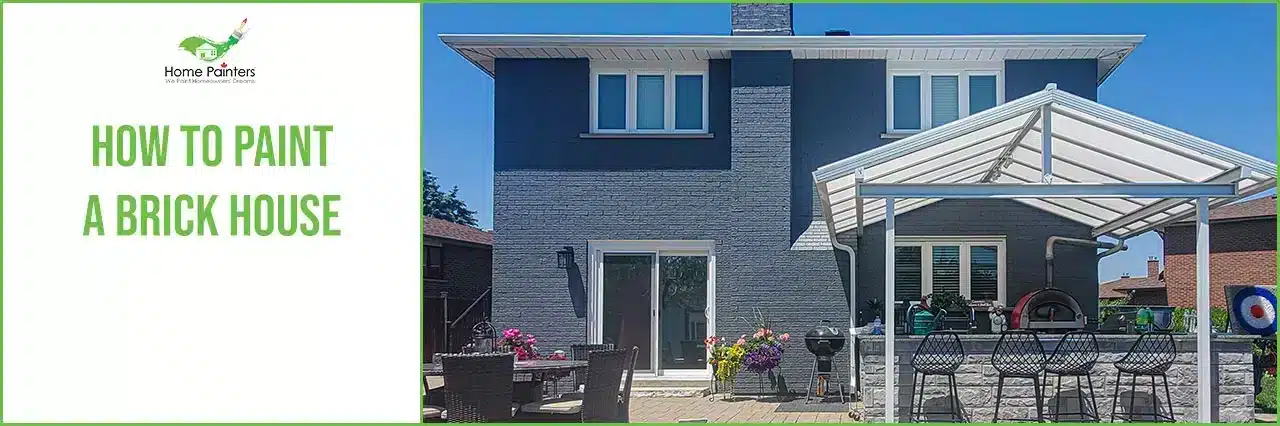
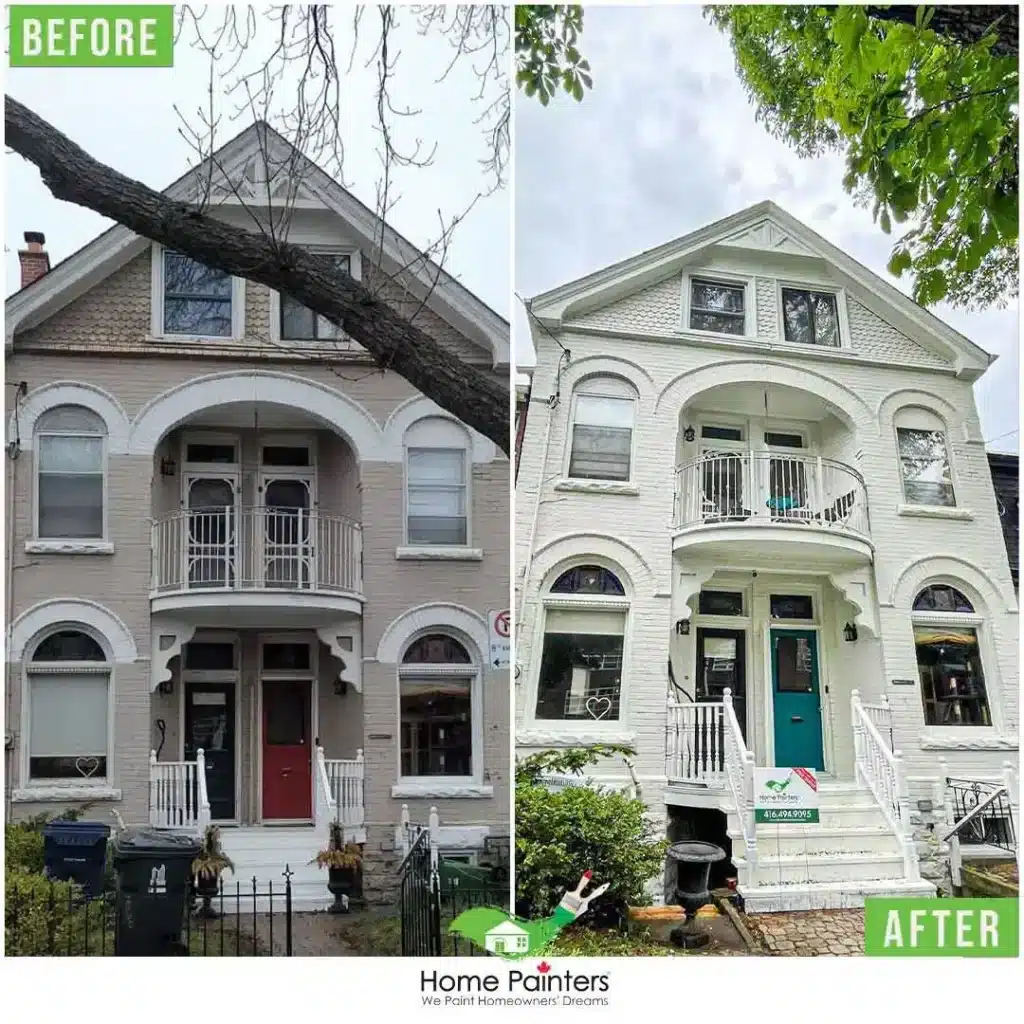
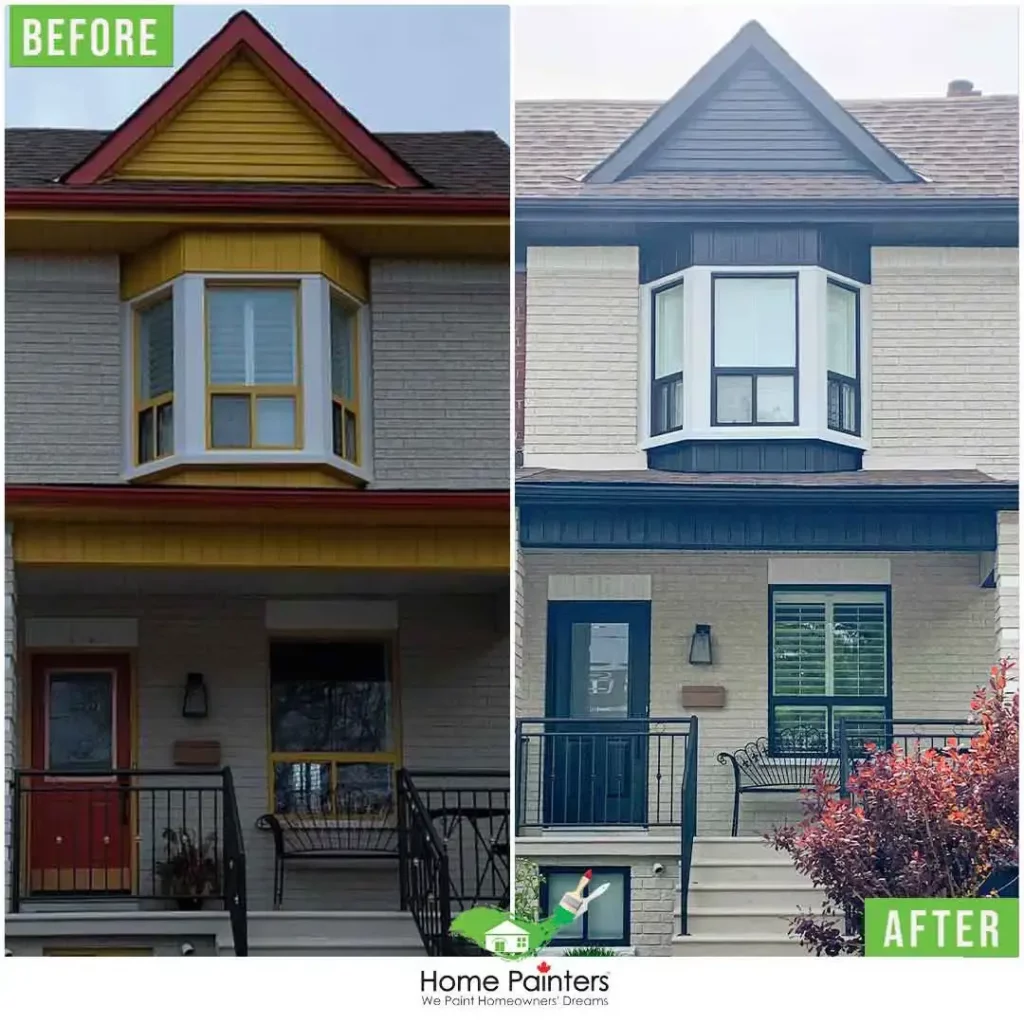
Brick painting is one of the most dramatic exterior transformations a Toronto homeowner can make, and one of the most permanent decisions you will face when refreshing your home's exterior. Get it right and you add years of protection and a completely refreshed look to your home. Get it wrong, and you are looking at peeling, spalling, and a recoat cycle every few years, often at greater cost than the original job.
This complete guide covers everything you need to know before you start: whether painting or staining is the right call for your brick, what products to use, the exact prep and application sequence, common mistakes to avoid, what the job costs in Toronto in 2026, and answers to the questions homeowners ask most often.
- Why brick painting is a permanent decision and what that means for Toronto homeowners
- Brick painting vs. brick staining: an honest, side-by-side comparison
- Why Toronto's climate specifically affects how painted brick performs
- Step-by-step prep and application process
- Best paint for brick exterior including specific product recommendations
- How to choose the best colour to paint a brick house
- What brick painting costs professionally in Toronto
- A real project case study from a Toronto neighbourhood
- FAQ answers covering the most common homeowner questions
Ready to get started on your brick? Get a free quote for exterior brick painting in Toronto.
Exterior Brick House Painting Techniques, a brick house looks so beautiful and offers strength and stability to the comfort of your home. But what if you decide to paint over your exterior brick? Painting a brick house requires a lot of patience, effort and accuracy. But don't let those things stand in the way of accomplishing your goal! A Toronto brick house that has been freshly painted will last for years! Maintain it, keep it clean and it will last for as long as you like looking at the colour! Exterior Brick is durable and if you have the time for it, it's very paintable! There are many ways to paint a brick exterior. All of them have their own pros and cons. I'll give you a rundown of the most popular methods used by brick house painters in Toronto. I'll also share the best paint for brick exterior and teach you how to choose the best colour to paint a brick house to perfection!
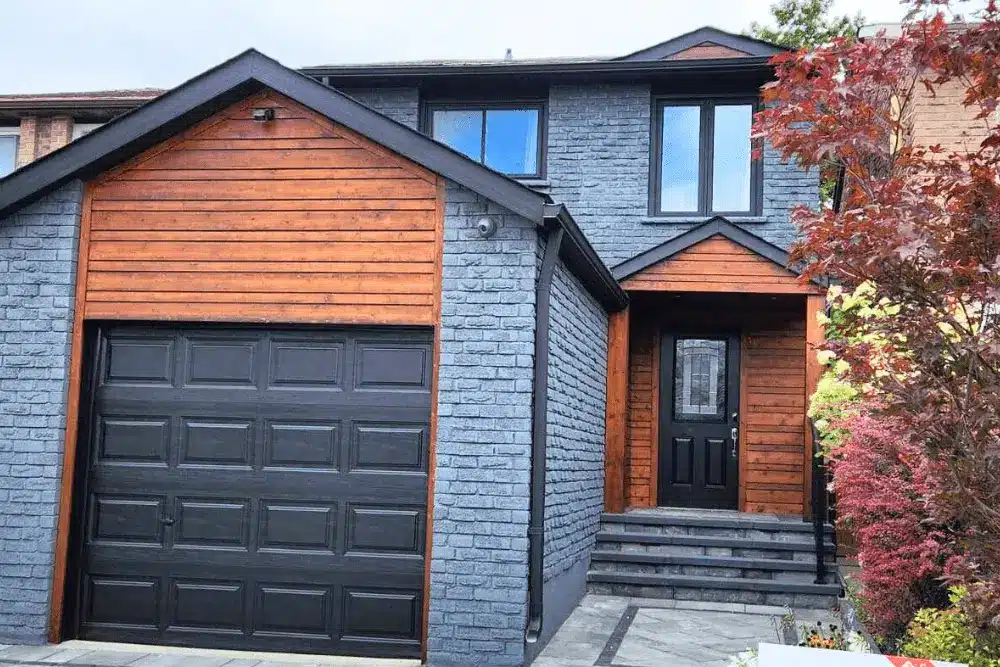
Painted brick is one of the most dramatic exterior transformations available to Toronto homeowners — and one of the most permanent decisions on any home.
Before You Paint: Why Brick Painting Is a Permanent Decision
Most homeowners approach brick painting the way they would approach painting siding or trim, but brick painting is not the same decision. Painted brick is extremely difficult and expensive to reverse. Chemical stripping of paint from brick is labour-intensive and rarely achieves a clean result. Sandblasting can remove paint but risks damaging the brick face, particularly on older softer brick common in Toronto homes built before the 1960s. Once you paint brick, you are committing to repainting it on a regular cycle for the life of the building.
That does not mean painting is the wrong choice. It means you should make the decision with full information, and understand the maintenance commitment that comes with it.
Brick Painting vs. Brick Staining: Which Is Right for Your Home?
The most important decision before any brick project is whether to paint or stain. These are not interchangeable options. They work differently on the brick surface, produce different visual results, and have fundamentally different maintenance profiles. Here is the full side-by-side breakdown.
| Feature | Brick Painting | Brick Staining |
|---|---|---|
| How it works | Sits on top of the brick as a film coating | Penetrates into the brick and bonds chemically |
| Appearance | Opaque, uniform, covers brick texture | Semi-transparent, preserves natural brick texture |
| Breathability | Low, traps moisture if wrong products used | High, allows moisture vapour to escape through brick |
| Risk of peeling | High over time, especially with freeze-thaw | Very low, stain does not form a film to peel |
| Lifespan in Toronto | 8 to 12 years with quality products and proper prep | 15 to 25 years, sometimes described as near-permanent |
| Maintenance cycle | Repaint every 8 to 12 years | Minimal, no recoating cycle required |
| Reversibility | Difficult, chemical strip or sandblast required | Effectively permanent, cannot be unstained |
| Works on previously sealed brick | Yes | No, stain cannot penetrate sealed or painted brick |
| Upfront cost | Lower per sq ft | Slightly higher upfront, lower lifetime cost |
| Home Painters Toronto warranty | 3 years on exterior painting | 15 years on brick staining |
| Best for | Brick that is already painted, sealed, or where full opaque colour is required | Unpainted, unsealed brick where a natural look and low maintenance are priorities |
The practical decision rule our team uses with Toronto homeowners is straightforward. If the brick has never been painted or sealed, staining is almost always the better long-term investment. The 15-year warranty we back it with reflects that confidence. If the brick has already been painted or has a sealant coat, staining is not possible because the stain cannot penetrate through an existing film coating. In that case, brick painting is the right path forward, and doing it properly with the right masonry primer and product system is what determines how long it holds up. For a detailed breakdown of why staining outperforms painting on most Toronto brick surfaces, see our full brick staining vs. painting guide.
Why Toronto's Climate Makes Brick Painting More Demanding
Brick painting in Toronto is far more challenging than many homeowners realize because the city's climate is extremely hard on painted masonry surfaces. Toronto experiences more than 100 freeze-thaw cycles per year, which means brick walls are under repeated stress from moisture expansion and contraction. Brick is a naturally porous material designed to absorb and release moisture as conditions change. When paint is applied on top, it creates a film on the surface of the brick. If moisture from inside the wall or from rain and condensation gets behind that film, which it inevitably does over time through hairline cracks in the mortar or the paint film itself, that moisture freezes in winter, expands, and forces the paint off the brick from behind. The result is bubbling, peeling, and in severe cases, spalling of the brick face itself.
This is not a product failure. It is a fundamental physical incompatibility between a sealed film coating and the way brick naturally manages moisture. The way to manage it is through product selection, specifically using masonry-specific, vapour-permeable primers and elastomeric topcoats that flex with the brick rather than forming a rigid, sealed film, and through correct surface preparation before any paint goes on.
According to the Canada Mortgage and Housing Corporation's guidance on masonry and moisture in Canadian homes, masonry walls in Canadian climates require coatings that allow vapour transmission rather than trapping moisture behind a sealed surface. The choice of primer and topcoat on Toronto brick is therefore not a cosmetic decision. It is a structural one.
Homes in older Toronto neighbourhoods like Riverdale, The Annex, Cabbagetown, Leslieville, North York, and Etobicoke are particularly relevant here. Many of these homes have older, softer brick from the 1940s through 1970s that is more porous and more susceptible to moisture damage than modern brick. The same prep and product discipline applies but with even less margin for error.
How to Paint a Brick House: Step-by-Step
- Alkali-resistant: Brick is highly alkaline, and paint or primer not rated for alkali contact will fail at the adhesion level before the topcoat ever gets tested.
- Vapour-permeable: The primer must allow moisture to move through it rather than creating a sealed vapour barrier.
- Penetrating: A good masonry primer soaks into the brick surface rather than sitting on top, creating the chemical bridge the topcoat needs to bond to.
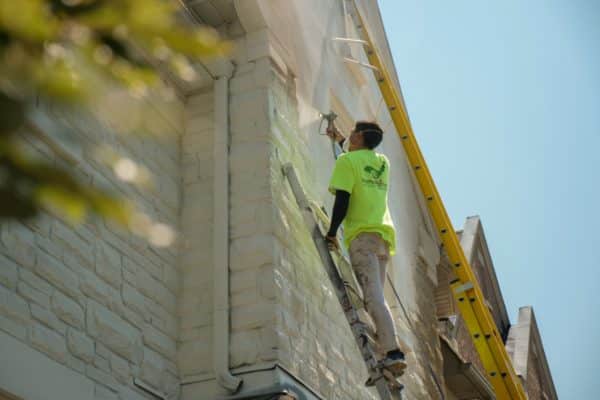
Masonry-specific, alkali-resistant primer applied to properly cleaned and repaired brick is the step that determines how long the finished paint job holds up in Toronto's climate.
Best Paint for Brick Exterior: Product Recommendations
Choosing the right topcoat for exterior brick painting in Toronto is not a question of brand preference. It is a question of product category. The paint must be formulated specifically for masonry, must be vapour-permeable, and must have the elasticity to flex with the brick through freeze-thaw cycling without cracking.
| Product | Type | Key Features | Best For |
|---|---|---|---|
| Benjamin Moore Elastomeric Masonry Waterproof Coating | Elastomeric masonry | Fills hairline cracks, highly flexible, water-repellent | Older brick with minor cracking, full exterior repaints |
| Sherwin-Williams Loxon Elastomeric Coating | Elastomeric masonry | Excellent adhesion, vapour-permeable, UV stable | New and previously painted brick in good condition |
| Benjamin Moore Ultra Spec Masonry Interior/Exterior | Acrylic masonry | Good for cleaner, modern masonry surfaces | Newer brick in good condition, lighter colour applications |
| Sherwin-Williams Masonry Conditioner | Masonry prep/primer | Deep penetrating, stabilizes chalking and porous surfaces | Heavily weathered or chalking brick before any topcoat |
| CMHC-recommended vapour-permeable masonry coatings | Vapour-permeable acrylic | Allows brick to breathe, reduces peeling risk | All exterior brick in Canadian climates |
How to Choose the Best Colour to Paint a Brick House
Colour Trends for Painted Brick in Toronto in 2026
Painted brick gives Toronto homeowners the most dramatic range of colour choices available on any exterior surface, because paint is fully opaque and can take any colour on the spectrum. The most popular directions our team sees across Toronto and the GTA in 2026 reflect the broader trend toward sophisticated neutrals and high contrast combinations.
White and off-white painted brick remains the single most requested colour, particularly on homes in Roncesvalles, South Etobicoke, and the Annex where owners want a fresh, modern look while keeping the architectural character of the brick beneath. Benjamin Moore White Dove and Chantilly Lace are both consistently popular choices for Toronto brick homes.
Dark painted brick, specifically charcoal, near-black, and deep grey tones, has been gaining significant momentum. Homes in Leslieville, Riverdale, and East York where owners want a bold, contemporary statement are increasingly choosing colours like Benjamin Moore Kendall Charcoal, Sherwin-Williams Iron Ore, and Benjamin Moore Wrought Iron for full exterior brick painting. These dark tones absorb more heat from direct sunlight than lighter colours, which is worth considering on south-facing brick elevations.
For warm neutral options that read as updated without going fully dramatic, greige and warm greige tones (a blend of grey and beige) work well on the red and orange brick tones common on Toronto homes built between 1940 and 1980. Benjamin Moore Revere Pewter and Sherwin-Williams Accessible Beige are reliable choices in this category.
Tips for Choosing a Brick Painting Colour
- Consider the fixed elements of your home that you are not changing: roof colour, stone or concrete details, window frame colour, and driveway material. Your brick paint colour needs to work with all of these.
- Look at the neighbourhood. Most Toronto neighbourhoods have a general character, and a colour that is dramatically at odds with the surrounding streetscape can affect resale value.
- Order large paint samples or a peel-and-stick test patch before committing. Brick absorbs paint differently than smooth surfaces, and colours always look different at full scale on a textured exterior than they do on a small chip.
- Dark colours on brick require careful quality control on prep. Any mortar patches or repairs will absorb paint differently from the surrounding brick and may show more obviously under dark colours than light ones.
For a full exploration of exterior colour combinations and current trends, see our exterior paint colour guide.
Common Brick Painting Mistakes to Avoid
After working on brick homes across Toronto and the GTA for over 37 years, our team has seen the same mistakes on DIY and unprepared contractor jobs repeatedly. Here are the ones that matter most.
- Skipping the masonry primer or using the wrong primer. This is the single most common reason painted brick jobs fail early. Standard exterior primers are not alkali-resistant and do not penetrate brick adequately. A masonry-specific primer is not optional.
- Painting over damp or freshly washed brick. Brick retains moisture far longer than its surface suggests. Allow a minimum of 48 to 72 hours of dry weather after any washing before priming or painting.
- Painting over efflorescence without treating it first. The salts will continue migrating to the surface and will push the paint off from behind. Efflorescence must be removed and the source of moisture migration addressed before painting.
- Using standard exterior latex instead of elastomeric masonry paint. Standard latex lacks the flexibility and masonry adhesion required for exterior brick in Toronto's freeze-thaw climate. It is not a suitable substitute regardless of how premium the brand.
- Applying one heavy coat instead of two proper coats. A thick single coat on rough brick creates an uneven film with air pockets and is more susceptible to early cracking than two properly applied thinner coats.
- Not repairing mortar joints before painting. Unfilled mortar cracks allow water infiltration behind the paint film from the first rain after application. All mortar gaps must be addressed before any paint goes on.
How Much Does It Cost to Paint Brick Exterior in Toronto?
DIY Cost Estimate
- Masonry alkali-resistant primer (Benjamin Moore Fresh Start or Sherwin-Williams Loxon): $60 to $90 per pail, covering approximately 30 to 50 sq ft per coat on rough brick
- Elastomeric masonry topcoat: $80 to $130 per pail
- Masonry cleaner, efflorescence remover, bleach solution: $30 to $60
- Acrylic caulk for crack and mortar repair: $15 to $30
- Thick-nap rollers, brushes, drop cloths, masking tape: $50 to $90
- Pressure washer rental: $60 to $90 per day
- Total DIY materials for an average Toronto semi-detached or detached home front elevation (approximately 400 to 600 sq ft of brick): $400 to $750 CAD
For a full exterior repaint of a Toronto detached home (1,000 sq ft of brick or more), DIY material costs will run $700 to $1,400 CAD before any tool rental or repair costs are factored in.
Professional Cost Estimate
Professional exterior brick painting in Toronto typically ranges from $2,500 to $7,500 CAD for a full residential exterior, depending on the size of the home, the condition of the brick and mortar, the number of elevations being painted, whether scaffolding or lifts are required, and whether repair work is needed before painting begins.
The premium for professional work is concentrated in two areas: surface prep and product knowledge. An elastomeric masonry system applied over a correctly prepared and primed brick surface will perform significantly better over the full repaint cycle than the same product applied over inadequate prep. Home Painters Toronto backs all exterior brick painting work with a 3-year warranty and exterior brick staining with a 15-year warranty, reflecting the difference in expected performance between the two options.
For a precise quote based on your specific home, request a free estimate from Home Painters Toronto. For broader exterior painting cost context, see our exterior painting cost guide.
Real Project: Exterior Brick Painting on a Toronto Home
Leslieville Semi-Detached: Full Brick Repaint with Mortar Repair and Elastomeric Topcoat
The situation: The homeowner of a semi-detached brick home in Leslieville wanted to repaint the front and side elevations of their home, which had been painted approximately ten years prior. The existing paint had begun to show surface peeling in several areas near the mortar joints and along the base of the front elevation where splash-back moisture from the front walkway had accelerated deterioration. The homeowner had selected a deep charcoal colour and wanted a clean, modern result.
What the job involved: Our team began with a full inspection of all brick and mortar surfaces. Several mortar joints required repointing before any prep or painting work could begin, and those repairs were handled by our exterior carpentry team in advance of the painting crew. The full front and side elevations were pressure washed, treated with a bleach solution for mould and biological growth, and allowed to dry for 72 hours before work continued. All remaining loose and flaking paint was scraped back. Efflorescence deposits around the base and near several window openings were treated with a masonry cleaner and removed before priming. A full coat of Sherwin-Williams Loxon Masonry Primer was applied by roller to all brick surfaces, with particular attention to the mortar joints and previously peeling areas. Two coats of Benjamin Moore Elastomeric Masonry Waterproof Coating in the homeowner's chosen charcoal tone were then applied over the full elevation, with a brush used on all mortar joints and edges.
The result: A clean, uniform deep charcoal finish across both elevations with no visible peeling and sharp edges at all window and door openings. The homeowner noted a dramatic change in the home's street presence, which read as significantly more contemporary and deliberate than the previous light beige paint job. The mortar repair work done before painting was not visible in the finished result, as the elastomeric topcoat's flexibility and fill characteristics smoothed over the repaired areas seamlessly.
For more completed projects, visit our Toronto painting projects page.
Frequently Asked Questions About Brick Painting
It depends on the condition of the brick and what outcome you are looking for. For brick that has never been painted or sealed, staining is usually the better long-term investment because it allows the brick to breathe, lasts 15 to 25 years, and does not require a maintenance recoat cycle. For brick that has already been painted, or where a fully opaque colour change is required, painting with the right masonry primer and elastomeric topcoat is a perfectly viable option and will hold up well in Toronto's climate when done correctly. The key is using masonry-specific products and doing the prep work properly, particularly mortar repair and efflorescence treatment before any primer goes on.
Exterior brick requires an elastomeric masonry paint or a vapour-permeable 100% acrylic masonry coating specifically formulated for brick and masonry surfaces. Standard exterior latex wall paint is not appropriate for brick. It lacks the alkali resistance, flexibility, and vapour permeability that brick requires in a Canadian freeze-thaw climate. Products like Benjamin Moore Elastomeric Masonry Waterproof Coating and Sherwin-Williams Loxon Elastomeric Coating are the professional-grade options our team uses regularly on Toronto brick homes.
With proper prep, the right masonry primer, and an elastomeric topcoat, a quality exterior brick paint job should last 8 to 12 years in Toronto conditions. Without proper prep, particularly without masonry-specific primer and without addressing efflorescence and mortar cracks before painting, paint on brick can begin failing within 2 to 4 years. The single biggest variable in how long painted brick holds up is how well the surface was prepared before the first coat went on, not the brand of paint used.
Paint forms a film coating on the surface of the brick. It is opaque, covers all of the brick texture and mortar, and produces a dramatic, uniform colour change. Paint traps moisture if wrong products are used and requires repainting every 8 to 12 years. Stain penetrates into the brick and bonds chemically with the masonry. It is semi-transparent, preserves the natural texture and character of the brick, allows the brick to breathe, and lasts 15 to 25 years. Staining is only possible on brick that has never been painted or sealed. If the brick already has a paint or sealant coat, painting is the only option.
Yes. If the existing paint is adhering well and is not peeling extensively, you can paint over previously painted brick after cleaning, treating any problem areas, and applying a fresh coat of masonry primer before the topcoat. If the existing paint is peeling significantly, all loose paint must be removed before repainting. Because brick is porous and irregular in texture, complete removal of all existing paint is not always achievable without damaging the brick face, which is why preserving the integrity of each paint coat for as long as possible is preferable to repeated strip-and-repaint cycles.
Yes, without exception. A masonry-specific, alkali-resistant primer is required before any topcoat is applied to exterior brick. The alkali content of brick and mortar will attack standard exterior paint primer, causing adhesion failure from the bottom of the paint system upward. A masonry primer penetrates the brick surface, neutralises the alkali, and creates the adhesion base the topcoat needs. Skipping primer on brick is one of the most reliable ways to produce a paint job that fails within a single freeze-thaw winter.
The simple test is to splash a small amount of water onto the brick surface. If the water is absorbed into the brick within a few seconds, the brick is porous and unsealed. Staining is possible. If the water beads on the surface and runs off without being absorbed, there is a sealant or previous paint coat on the brick. Staining is not possible because the stain cannot penetrate through the existing film. In that case, painting with a masonry primer and elastomeric topcoat system is the right approach. Our team performs this assessment as part of every brick exterior estimate consultation.
More Interesting Blogs Related to Exterior Brick House Painting Techniques
Ready to Transform Your Brick Exterior?
Get a free quote for exterior brick painting in Toronto. Home Painters Toronto has been painting and staining Toronto brick homes since 1987. Call 416.494.9095 or email [email protected] for a FREE quote.