

What a Licensed Exterior Painting Contractor Does Differently
Most homeowners across the GTA assume all painters work the same way. They show up, roll on paint, and leave. But that is not what a licensed exterior painting company actually does. A licensed contractor follows a system built around substrate assessment, product specification, and documented compliance that an unlicensed crew simply does not have. In Toronto and across the GTA, that difference is visible within two winters. With over 1,200 positive reviews on HomeStars, Google, and Houzz and a HomeStars Best of Award 2026 win, Home Painters Toronto has spent 38 years refining a process that most homeowners only understand after a cheaper job has already failed.
A licensed exterior painting company differs from an unlicensed crew in four measurable ways: mandatory substrate assessment before any coating is applied, written product specification using breathable or elastomeric coatings matched to the surface, WSIB compliance and liability insurance, and a documented warranty on all completed work.
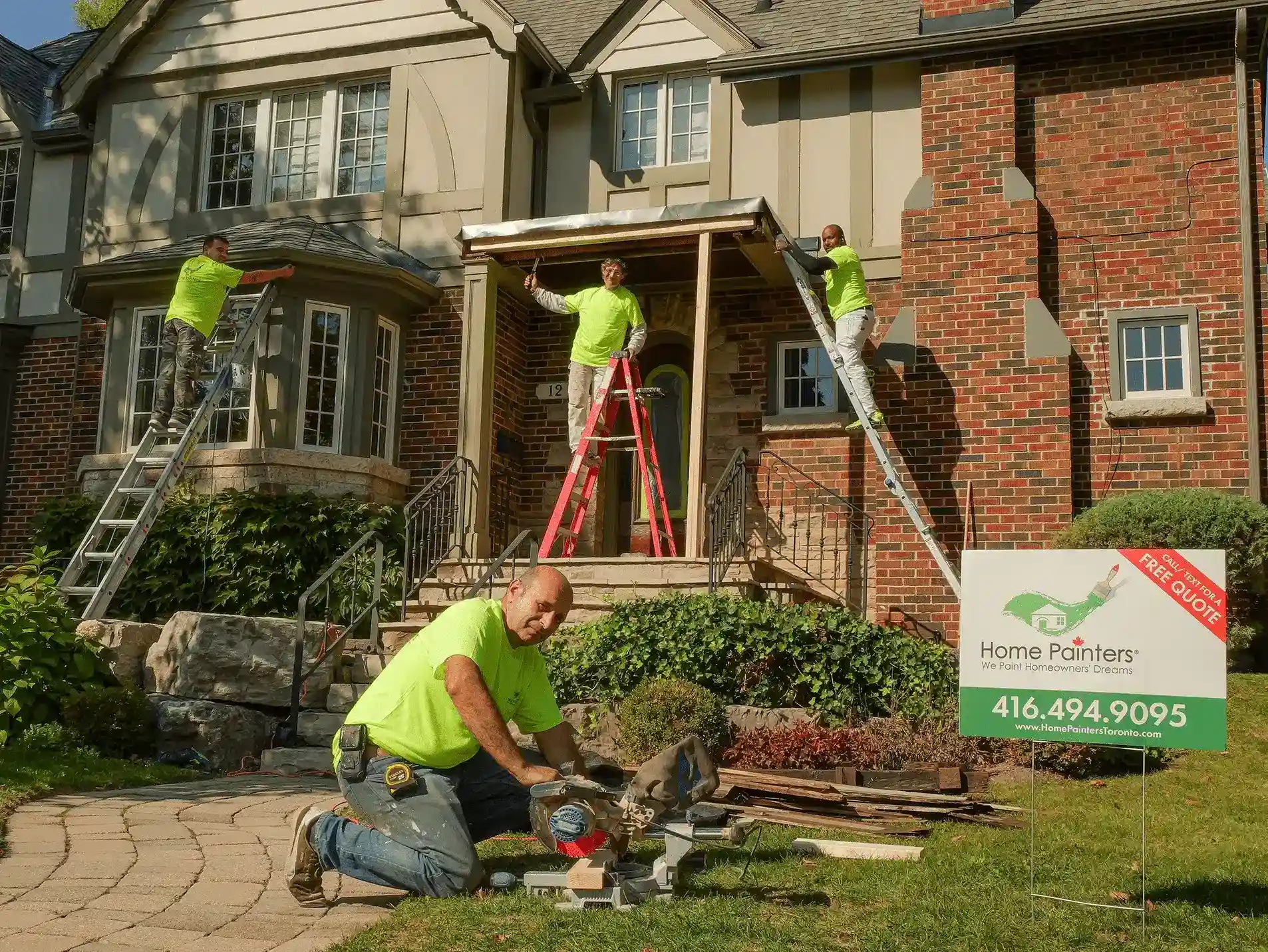
A licensed contractor reads the home before touching a brush — moisture content in wood substrates must test below 15% before any primer is applied, masonry requires a carbonation check and efflorescence assessment, and stucco needs a tap test to locate delaminating sections
Licensed Exterior Painting Companies Start With Substrate Assessment, Not a Brush
A licensed crew reads the home before touching a brush. Substrate assessment means inspecting the existing coating film, measuring moisture content in the substrate, and identifying any structural concerns that will cause a fresh coat to fail. Skipping this step is the single most common reason exterior paint peels within 18 months on Toronto homes.
Wood substrates must test below 15% moisture content before any primer is applied. Masonry surfaces require a carbonation test and a check for active efflorescence. Stucco cladding needs a visual tap test to locate delaminating sections before any coating is committed. These are not optional steps. They are the foundation of every project estimate a licensed contractor produces.
How a Licensed Exterior Painting Company Reads Your Home's Moisture Levels
Moisture metres are standard equipment for any licensed exterior painting company in the GTA. A reading above 15% in wood siding means the surface needs at minimum one week of drying time, or a breathable primer must be specified to allow vapour transmission. Applying a film forming alkyd primer over wet wood traps moisture inside the substrate. That moisture expands during freeze and thaw cycles, fractures the paint film from below, and produces the bubbling and peeling Toronto homeowners see every spring.
Brick and mortar present a separate moisture risk. Older Toronto homes built between the 1920s and 1960s commonly use a single wythe of brick with no interior vapour barrier. Moisture migrates outward through the masonry continuously. A licensed contractor accounts for this by specifying a mineral silicate coating or a penetrating silane siloxane sealer before any topcoat. An unlicensed crew applies standard latex paint and creates a moisture trap that produces spalling within three seasons.
Surface Preparation Is Where Most Unlicensed Crews Cut Corners
Preparation accounts for roughly 70% of what determines how long an exterior paint job lasts. A licensed contractor follows a documented prep sequence. An unlicensed crew typically pressure washes and starts painting. Those two approaches produce dramatically different results by year two.
The standard prep sequence for a licensed exterior paint project in Toronto includes pressure washing at a minimum of 2,500 PSI, hand scraping all failing paint to a firm edge, mechanical sanding to open the wood grain and create adhesion profile, spot priming all bare substrate, and applying a full primer coat before any topcoat is rolled. Each stage must be completed and inspected before the next begins. Licensed contractors document this sequence. Unlicensed crews rarely do.
The Mechanical Sanding Step Cheap Contractors Skip
Pressure washing alone does not prepare bare wood for paint. Water swells the wood grain, raises fibres, and creates an uneven surface that reduces coating adhesion. Mechanical sanding with 60 to 80 grit abrasive levels the raised grain, removes any remaining loose material, and produces a surface profile the primer can grip. Without sanding, primer sits on top of swollen, irregular fibres rather than bonding to the substrate. The result is a paint job that looks acceptable for one season and then begins lifting at the edges by spring.
According to PDCA surface preparation standards, proper surface preparation is the single most critical factor in determining the longevity of any exterior coating system. A licensed contractor trains crew members to meet these standards. The prep work is not an afterthought. It is the service.
The table below shows the key preparation steps and what each one prevents:
| Preparation Step | What It Prevents | Tool Required |
|---|---|---|
| Pressure washing at 2,500 PSI | Dirt and chalk contamination under the new coat | Commercial pressure washer |
| Hand scraping to a firm edge | New paint bridging over unstable old paint | Stiff scraper and putty knife |
| 60 to 80 grit mechanical sanding | Adhesion failure on bare wood | Orbital sander or hand block |
| Spot priming bare substrate | Tannin bleed and uneven sheen in the topcoat | Shellac or oil based spot primer |
| Full primer coat application | Topcoat soaking into substrate unevenly | Airless sprayer or roller |
| Caulking all penetrations | Water intrusion behind the paint film | Siliconized acrylic caulk |
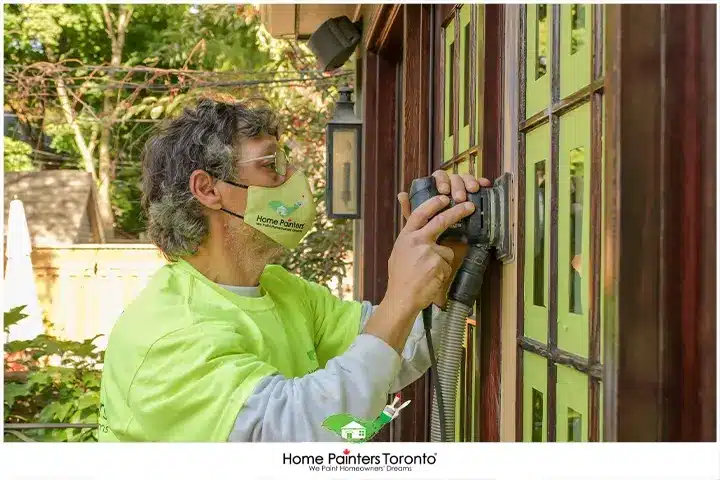
Pressure washing swells wood grain — mechanical sanding at 60 to 80 grit levels the raised fibres and creates the surface profile the primer needs to grip. Without this step, primer sits on swollen irregular fibres rather than bonding to the substrate and begins lifting at the edges by spring
Product Selection: Why a Professional Exterior Painting Company Specifies Coatings, Not Just Colours
A licensed exterior painting company does not pick a colour and grab any paint off the shelf. Product specification means selecting the correct coating chemistry for the specific substrate, the direction the surface faces, and the environmental conditions that surface will encounter. In Toronto, that means accounting for freeze and thaw cycling, UV exposure intensity, and high humidity in spring and fall.
South facing cladding in the GTA receives significantly more UV exposure than north facing surfaces. That means a UV sensitive pigment on a south wall will fade noticeably faster than the same colour on a north wall. A licensed contractor specifies a fade resistant 100% acrylic topcoat with high opacity pigment for south facing surfaces and adjusts sheen level accordingly. Lower sheen finishes such as satin or low lustre scatter light and hide surface imperfections better on aged wood siding and board and batten cladding.
Products like Benjamin Moore Aura Exterior use a proprietary Colour Lock technology that binds pigment tightly within the paint film, reducing UV fading and maintaining colour depth through multiple Toronto freeze and thaw seasons. A licensed contractor specifies the sheen, the finish, and the number of coats in writing before the job begins.
For brick and masonry, the product specification must address breathability. Standard latex paint has a very low moisture vapour transmission rate. Applying it to brick locks moisture inside the masonry. Mineral silicate paint, by contrast, bonds chemically with the silica in the brick through a process called silicification. It becomes part of the brick rather than sitting on top of it. That is why mineral silicate coatings on Toronto brick carry longevity estimates of 20 to 30 years versus 3 to 5 years for standard latex on the same surface.
Why Latex Paint on Brick Is a Structural Risk, Not Just a Cosmetic One
Applying standard latex paint to exterior brick does not just create a paint job that will fail. It creates a moisture management problem that can damage the masonry itself. Toronto brick homes built before 1970 were designed to breathe. Moisture that enters the brick from rain and condensation was intended to evaporate outward through the face of the brick. Standard latex paint forms a film forming barrier that blocks that outward vapour movement.
When that moisture cannot escape, it accumulates in the brick and mortar. In winter, that trapped moisture freezes. Water expands by approximately 9% when it freezes. That expansion creates internal pressure inside the brick that fractures the masonry face in a process called spalling. Spalling looks like the face of the brick is flaking away in thin sheets. It is not a cosmetic issue. It is structural damage that requires tuck pointing or full brick replacement to correct.
A licensed exterior painting company identifies this risk before quoting. If the substrate is solid fired clay brick from before 1970, the specification will call for a penetrating silane siloxane sealer, not a film forming topcoat. If colour is required, a mineral silicate paint is specified. This is information an unlicensed crew will not have and will not provide.
The distinction between breathable and non breathable coatings on masonry is well documented in building science research. PDCA surface preparation standards and coating manufacturer technical data sheets both identify substrate breathability as a primary variable in exterior coating selection. A licensed contractor reads and applies these specifications. An unlicensed crew does not.
Here is how the two approaches compare on a Toronto brick home:
| Factor | Licensed Contractor | Unlicensed Crew |
|---|---|---|
| Coating specified | Mineral silicate or silane siloxane sealer | Standard latex or acrylic topcoat |
| Vapour transmission | High — coating breathes with the masonry | Low — film forming barrier traps moisture |
| Risk of spalling | Minimal with correct product selection | High within 2 to 4 winters |
| Expected longevity | 15 to 25 years on solid brick | 2 to 5 years before visible failure |
| Warranty offered | Yes — 15 year warranty on brick staining | Rarely offered or not documented |
What Licensed Contractors Do That Speeds Up Turnaround Without Sacrificing Quality
Speed and quality are not opposites when the process is structured correctly. A licensed exterior painting company runs a documented project schedule that minimises delays caused by weather holds, dry time gaps, and unplanned prep discoveries. The result is a faster project with no shortcuts.
The schedule begins with a pre project site visit to assess substrate conditions and confirm product availability. Paint is ordered and on site before the crew arrives. Prep is completed on day one as a discrete stage. Primer goes on as soon as the prep is signed off. The topcoat follows once the primer has reached full cure, typically 24 hours in normal GTA summer conditions. Each stage is logged. The client knows exactly where the project stands at every point.
Home Painters Toronto is open seven days a week and offers same day estimates across the GTA. That means a homeowner in Mississauga, Scarborough, or Markham can have a licensed contractor on site within 24 hours of calling. Compare that to an unlicensed crew that quotes verbally, starts when materials arrive, and has no documented schedule at all.
Typical exterior painting costs with a licensed contractor in the GTA:
| Home Size | Estimated Cost (CAD + HST) | What Is Included |
|---|---|---|
| Small (up to 1,200 sq ft) | $2,000 – $4,000 | Full prep, primer, and two coat finish |
| Medium (1,200 – 2,500 sq ft) | $4,000 – $8,000 | Full prep, spot repairs, primer, topcoat |
| Large (2,500 – 4,000 sq ft) | $8,000 – $10,000 | Full prep, caulking, primer, two coat finish |
| Extra large / multi unit | $12,000 – $30,000 | Full scope including masonry and trim work |
Full prep, primer, and two coat finish
Full prep, spot repairs, primer, topcoat
Full prep, caulking, primer, two coat finish
Full scope including masonry and trim work
For a detailed cost breakdown by home size and surface type, see our guide to the cost of painting a house in the GTA.
What We Found at a Recent Exterior Painting Project in Etobicoke
21% Moisture in Soffits, 8 mm Caulk Gaps at Six Windows, Four-Day Drying Delay — Zero Call Backs in 14 Months
At a recent project on a two storey detached brick home in the Islington area of Etobicoke, our crew arrived for the pre project assessment and flagged two issues the homeowner had not noticed. First, our moisture metre read 21% at three points along the north facing wood soffit boards, well above the 15% threshold for safe coating application. Second, the caulking at all six window surrounds had failed, with visible gaps up to 8 mm wide allowing water ingress behind the brick veneer.
We delayed the primer application by four days to allow the soffit boards to dry down below 15%. We reapplied a siliconized acrylic caulk at all window penetrations and allowed a 48 hour cure before any paint was applied over the joints. The topcoat specified was Benjamin Moore Aura Exterior in Low Lustre finish, applied at 4.5 wet mils per coat in two passes. The homeowner had received a competing quote from an unlicensed crew that proposed starting the same day of the quote with no mention of moisture readings or caulking replacement.
The project completed in three working days. There have been zero call backs in the 14 months since completion. That outcome is not accidental. It is the direct result of following a documented process that a licensed contractor is trained and obligated to execute.
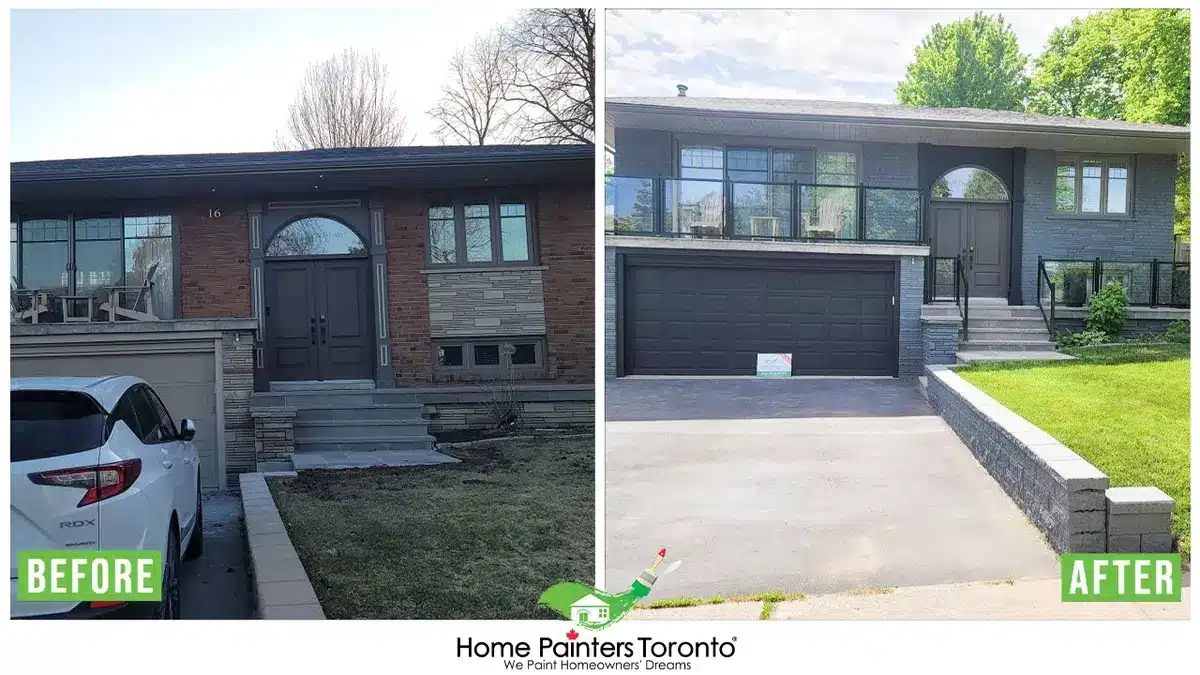
Islington project: 21% moisture in north-facing soffits (threshold 15%), 8 mm caulk gaps at 6 windows allowing water ingress, 4-day drying delay, siliconized acrylic caulk with 48-hour cure, Benjamin Moore Aura Exterior Low Lustre at 4.5 mil WFT in two passes — zero call backs in 14 months
Why Toronto Homeowners Trust HPT's Credentials, Insurance, and Warranty
Home Painters Toronto has served 17,000 satisfied clients across the GTA over 38 years as a family owned and operated business. Every crew member has passed a criminal background check. The company is fully WSIB compliant, meaning all workers are covered under Ontario workers compensation. General liability insurance is carried at $5 million, protecting homeowners from any property damage or injury liability during the project.
Warranty terms are documented and specific. Interior painting carries a lifetime warranty. Exterior painting carries a 3 year warranty. Brick staining carries a 15 year warranty. Cabinet spraying carries a 5 year warranty. All work is covered by a 100% satisfaction guarantee. These are not marketing claims. They are written commitments that a licensed exterior painting company stands behind.
| Service | Warranty |
|---|---|
| Interior painting | Lifetime warranty |
| Exterior painting | 3 year warranty |
| Brick staining | 15 year warranty |
| Cabinet spraying | 5 year warranty |
| All work | 100% Satisfaction Guaranteed |
Read what GTA homeowners say about these standards on our client reviews page, or browse completed projects in our project portfolio to see the finish quality on brick, wood siding, aluminum siding, and stucco across the GTA.
A licensed contractor is also accountable in ways an unlicensed crew is not. If something goes wrong, there is a WSIB registration number, a business registration, a documented insurance policy, and a written warranty to reference. Hiring an unlicensed crew leaves the homeowner with no recourse when the paint fails.
Beyond full exterior repaints, HPT's licensed crews handle:
- Exterior brick staining and brick painting for heritage and modern brick homes across Toronto
- Deck and fence staining with solid stain specification for south facing decks exposed to intense UV
- Aluminum siding painting using adhesion primer specified for non porous metal substrates
- Exterior wood siding coating including cedar, pine, and fibre cement siding systems
- Caulking windows and doors as a standalone service or integrated into a full exterior repaint
Frequently Asked Questions
A licensed contractor conducts a substrate assessment before applying any product. This includes measuring moisture content in wood substrates (must be below 15%), inspecting brick and masonry for active efflorescence and carbonation, checking all caulking at windows and doors for failures, and identifying any rot or structural damage that needs to be repaired before coating begins. This assessment is what separates a professional quote from a verbal estimate.
Ask for three things before signing anything: proof of WSIB registration (this is a Ministry of Labour requirement in Ontario), a certificate of general liability insurance with a minimum of $2 million in coverage (HPT carries $5 million), and a written contract that includes product specifications, the number of coats, prep steps, and warranty terms. A licensed company will provide all three without hesitation. An unlicensed crew typically cannot.
Toronto exterior painting costs reflect three GTA specific factors. First, the freeze and thaw cycling here is severe, requiring higher grade elastomeric or 100% acrylic coatings with greater flexibility than products used in milder climates. Second, the age of the housing stock means more prep work is needed on surfaces that have accumulated multiple layers of old paint. Third, WSIB compliance and liability insurance are mandatory costs that licensed GTA contractors carry but unlicensed crews typically avoid, and those costs are reflected in an honest quote.
For wood siding and trim, a 100% acrylic topcoat in satin or low lustre finish is the standard specification for GTA conditions. Benjamin Moore Aura Exterior and Sherwin Williams Emerald Exterior are both high performing options at the premium tier. For brick, a mineral silicate paint or a penetrating silane siloxane sealer is the correct specification. Standard latex paint on brick is the wrong product for Toronto masonry regardless of price point. A licensed contractor will specify the right product for each substrate in writing.
Yes. HPT provides a 3 year warranty on all exterior painting work. Brick staining carries a 15 year warranty. All work is covered by a 100% satisfaction guarantee. Warranty terms are written into every contract and are backed by 38 years of operating as a licensed, insured contractor in the GTA. These warranties are meaningful because the company has a physical presence, a documented business history, and the credentials to stand behind them.
A standard two storey detached home in Toronto or Mississauga typically takes three to five working days from prep start to final coat completion, weather permitting. The timeline depends on how much prep work is needed, drying time between coats, and weather conditions. A licensed contractor will provide a written project schedule as part of the contract. Same day estimates are available across the GTA, so the planning stage can begin within 24 hours of your call.

Ready to Hire a Licensed Exterior Painting Company in Toronto?
The difference between a licensed exterior painting company and an unlicensed crew is measurable, documented, and visible within two winters. It shows up in substrate moisture readings before a brush is picked up. It shows up in the product specification written into the contract. It shows up in the warranty that stands behind the work when January freezes arrive.
Home Painters Toronto has delivered warranty backed results for 17,000 homeowners across the GTA over 38 years. We are WSIB compliant, fully insured, and available seven days a week. Get fast free quotes and warranty backed work when you Contact Home Painters Toronto today.
Get Fast Free Quotes From a Licensed Exterior Painting Company in Toronto
Contact Home Painters Toronto today for fast free quotes and warranty backed work. WSIB compliant, $5M insured, HomeStars Best of 2026. Same day estimates available seven days a week across the GTA.
Contact Us for a Free Quote