

What Are the Signs Your Home Siding Needs Repair in Mississauga?
Mississauga homeowners often notice a problem with their siding only after it has gotten worse. Cracked panels, warped boards, and stains that will not wash off are common signs that your home needs siding repair. Ontario's freezing and thawing cycles put constant stress on exterior walls, and small cracks can let moisture behind the cladding long before you see damage on the surface. Catching these signs early protects your walls, your insulation, and your budget. This guide breaks down the exact signs to watch for, what causes them, and when a repair is enough versus when you need a full replacement.
The main signs your home siding needs repair in Mississauga are visible cracks, warping, bubbling, faded or chalking paint, gaps at the seams, and soft spots that feel spongy to the touch. Moisture stains, mould growth, and rising energy bills also point to hidden damage behind the panels that a visual check alone will miss.

Cracking, warping, and chalking are among the most common early signs that siding needs repair
What Are the Most Common Signs of Siding Damage in Mississauga?
As the HomeStars Best of Award 2026 winner, Home Painters Toronto has inspected siding on hundreds of Mississauga homes, and six signs come up again and again: cracking, warping, bubbling, fading, gaps at the seams, and soft spots you can press with a finger. Cracks usually start small, often near nail heads or corners, and widen as panels expand and contract with temperature swings. Warping shows up as a wave or ripple across a flat panel, and it often means heat built up behind the siding or moisture softened the material underneath.
Bubbling points to trapped air or water pushing the surface outward, which is common on walls that face direct sun for most of the day. Fading and a white powder residue called chalking signal that the surface coating has broken down and no longer protects the material below it. Gaps at the seams let wind driven rain behind the panels, and once water gets in, it rarely finds its way back out on its own. Soft or spongy panels almost always mean rot or saturated wood sheathing underneath.
- Cracking near nail heads or panel edges
- Warping or rippling across flat sections
- Bubbling or blistering on sun exposed walls
- Fading and chalking residue
- Gaps or separation at seams and corners
- Soft, spongy panels near the base of the wall
Semi detached and older two storey homes across neighbourhoods like Streetsville, Port Credit, and Erin Mills often carry the original aluminum or vinyl siding installed decades ago, and that age is exactly why these signs show up more often in Mississauga than in newer subdivisions. A quick walk around the exterior after a windy week is usually enough to catch the early stages of most of these problems.
Homeowners who read our client reviews often mention that our crew caught a hidden issue during a routine estimate, well before it turned into a bigger repair. That kind of early detection is part of why homeowners trust our team with siding work across the GTA.
Why Do Vinyl and Wood Siding Crack in Ontario Winters?
Vinyl and wood siding crack in Ontario winters because the materials expand and contract with every swing in temperature, and repeated movement eventually fatigues the panel at its weakest point. According to a Vinyl Siding Institute technical bulletin, vinyl panels can expand or contract by about 0.3 to 0.4 percent for every 50 degree Fahrenheit change in temperature. Over a Mississauga winter, siding can swing from well below freezing to summer highs near 35 degrees Celsius, and that adds up to a wide range of movement across a single season.
If a panel was installed too tightly, or if a past repair used the wrong fastener spacing, that movement has nowhere to go, and the material cracks under the strain. Wood siding behaves differently. It absorbs and releases moisture from the air, swelling across the grain in humid weather and shrinking again once it dries out. Repeated swelling and shrinking loosen paint film and open small checks in the surface, which then trap water and start the cycle of freezing and thawing damage.
Homeowners with exterior wood siding often need repainting on a shorter cycle than vinyl for exactly this reason. Aluminum siding moves less than vinyl but dents easily, and once the factory finish is compromised, aluminum siding painting is usually the more practical fix compared to full panel replacement.
Proper substrate preparation and an intact moisture barrier behind the panels make a real difference here. A wall with a sound moisture barrier sheds the small amount of water that gets past any siding, while a compromised barrier lets that same water sit against the sheathing and start the cycle of freezing and thawing damage described above.
A moisture meter reading gives an exact answer instead of a guess about what is happening behind the panels
How Can You Tell If Moisture Is Trapped Behind Your Siding?
You can tell moisture is trapped behind your siding when you see peeling paint on interior walls, a musty smell near baseboards, soft drywall, or a moisture meter reading above the normal range for wood. A moisture meter is the most reliable tool for this job because it gives an exact reading instead of a guess. Interior signs often show up before anything looks wrong outside, since water travels down inside the wall cavity before it reaches a spot you can see from the street.
Gaps around window and door trim are one of the most common entry points, which is why caulking around windows and doors matters as much as the siding itself.
Moisture Meter Readings and Rot Detection
According to InterNACHI moisture meter guidelines, readings up to 17 percent are generally considered acceptable in wood framing, while readings above 20 percent point to a real risk of decay and mould growth. Our technicians carry a pin type moisture meter to every Mississauga inspection, and any reading in the twenties tells us the sheathing behind that section of siding likely needs to be opened up for a closer look. Left alone, trapped moisture leads to rot in the wall sheathing, and repair costs climb once the framing is involved instead of just the exterior cladding.
What Does Faded or Chalking Siding Really Mean?
Faded or chalking siding means the surface coating has broken down under ultraviolet exposure, and the material underneath no longer has a protective layer against rain, snow, and ice. Chalking shows up as a white powder residue that rubs off on your hand when you touch the wall, and it usually appears first on south and west facing walls that get the most summer sun in Mississauga. Chalking on its own is mostly a coating problem, and it is not always a sign the panel itself has failed.
Once chalking reaches the substrate, water absorption increases, and panels become brittle in cold weather, which raises the chance of cracking. A homeowner who repaints over heavy chalking without proper cleaning and a bonding primer will often see the new coat peel away within a single season, since the residue prevents proper adhesion. In many cases, vinyl siding painting with a proper cleaning and primer step restores the finish without the cost of full panel replacement.
Some homeowners ask about elastomeric coatings as a heavier duty alternative to standard exterior paint on chalky surfaces. These coatings bridge small surface cracks and add a thicker, flexible film, though they still need a clean, primed substrate to bond correctly. Every product our crew uses meets current low VOC compliance standards for residential exterior work in Ontario.
How Much Does Home Siding Repair Cost in Mississauga?
Home siding repair in Mississauga typically costs between $2,000 and $10,000 CAD plus HST for most residential projects, depending on the size of the affected area, the type of siding, and whether hidden moisture damage turns up once the panels come off. Small jobs limited to a panel or two cost far less than a project that uncovers rotted sheathing across an entire wall. You can book a free quote before any work begins, and our estimate will flag likely cost ranges based on what our crew can see during the inspection.
Home Siding Repair Cost Factors
| Repair Scope | Estimated Cost (CAD + HST) |
|---|---|
| Small area, one or two panels | $2,000 – $4,000 |
| Medium area, one wall section | $4,000 – $8,000 |
| Large area, multiple walls | $8,000 – $10,000 |
| Full siding replacement | $12,000 – $30,000 |
Several factors push a project toward the higher end of these ranges. Matching an older colour or discontinued profile takes extra time and sourcing. Homes with two or more storeys need staging or lift equipment, which adds labour. Hidden rot found once panels are removed always increases scope, since sheathing and insulation may need attention before new siding goes back on. You can compare these figures against our guide to the cost of painting a house if you are weighing a full exterior refresh alongside repair work.
Our Recent Siding Repair Project in Mississauga
- At a recent siding repair project in Streetsville, Mississauga, our crew found several sections of aluminum siding with paint failure and bubbling near the ground floor.
- A moisture meter read 22 percent inside the wall cavity next to a failed seam, well above the acceptable range for wood sheathing.
- We removed the damaged panels, completed wood frame repair on the rotted sheathing underneath, and refinished the repaired sections using Benjamin Moore Aura Exterior in Low Lustre finish to match the existing colour.
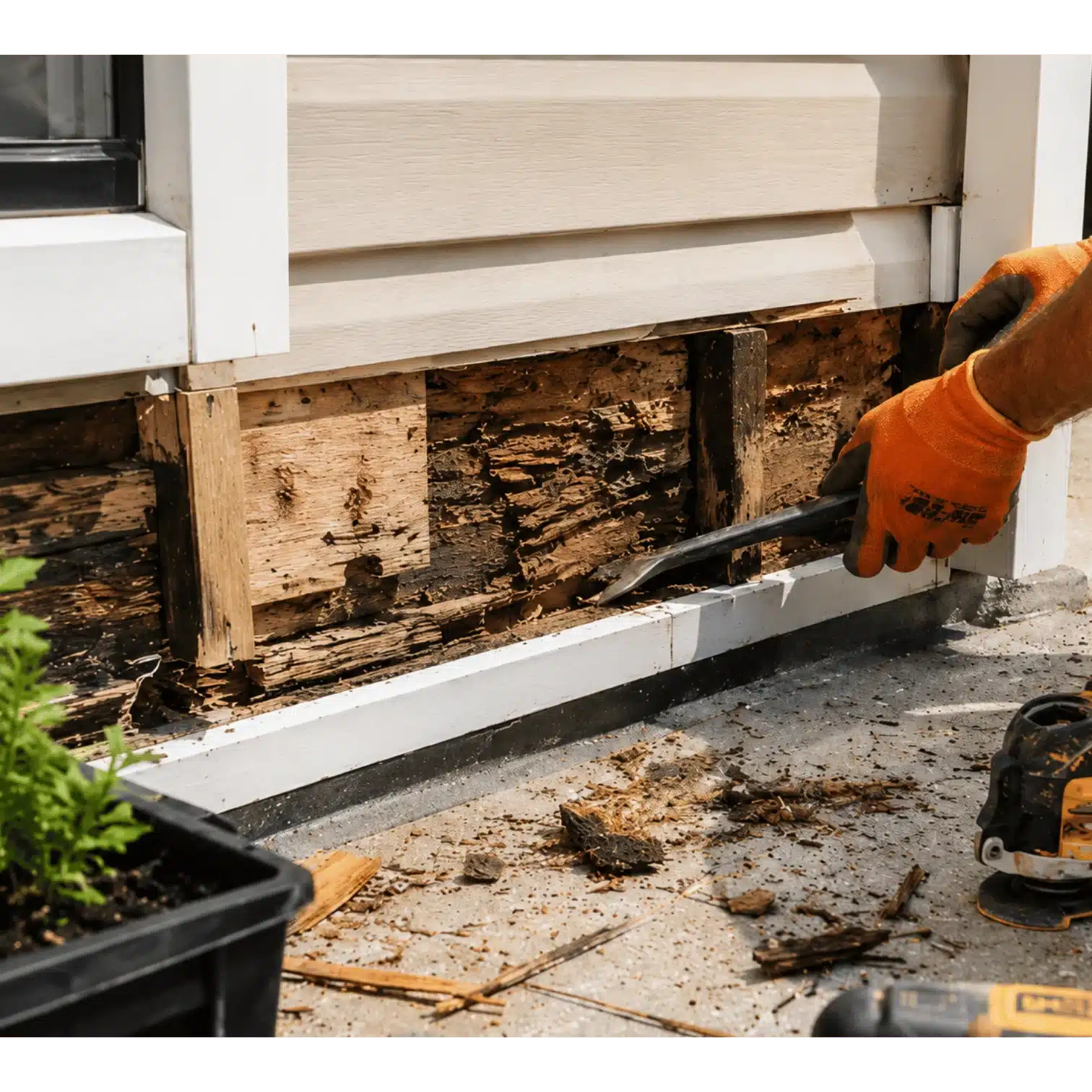
- The homeowner had waited almost two years after first noticing a small crack, and what could have stayed a small panel replacement turned into a sheathing repair as well.
- Every job like this is completed by a fully insured, WSIB compliant crew, and the finished work carries a warranty backed by a guarantee.

Waiting on a small crack allowed a two year old problem to spread into the wall sheathing behind the panels
Can Damaged Siding Be Repaired or Does It Need Full Replacement?
Damaged siding can often be repaired instead of replaced when the problem is limited to a few panels, the frame underneath is dry, and the existing material is still available to match. Repair keeps costs down and avoids disturbing sections of the wall that are still performing well. Full replacement becomes the better option once damage spreads across multiple walls or the same section keeps failing. Our estimators walk the full exterior during every visit, since a panel that looks fine from the driveway can still be hiding a soft spot around the corner or along a lower course near grade.
Signs You Need Full Siding Replacement
Widespread cracking across more than one wall is one sign, along with a discontinued colour or profile that cannot be matched to existing panels. Moisture readings above the acceptable range in more than one area point to a bigger problem than a single leak. Siding at or past its expected service life is another signal, along with repeated repairs to the same spot within a few years. While our crew inspects siding, we also check soffit and fascia since problems in one area often affect the other.
| Situation | Repair | Full Replacement |
|---|---|---|
| Damage limited to one or two panels | Recommended | Not needed |
| Moisture trapped behind multiple wall sections | Sometimes possible | Often required |
| Siding profile no longer manufactured | Difficult to match | Recommended |
| Siding near or past expected service life | Temporary fix only | Recommended |
If your home needs a full wood siding replacement instead of a patch, our crew can walk you through material options during the same estimate visit.
How Long Should Siding Last Before It Needs Repair?
Siding should last between 20 and 40 years before it needs major repair, though the exact number depends on the material, the installation quality, and how much direct sun and wind the wall receives. Industry lifespan guides put vinyl, wood, and aluminum siding in that same 20 to 40 year range, with fibre cement and steel siding often lasting longer. Wood siding usually needs a fresh coat of paint or stain every five to seven years to hold up through Ontario weather, while aluminum siding often needs repainting once the factory finish starts to fade, generally within 15 to 20 years.
We recommend a visual check every year and a closer look after any major storm, especially if you also have exterior house painting due for the rest of the home.
A siding problem left unaddressed does not just risk cosmetic damage. Gaps and cracked panels let conditioned air escape, and many Mississauga homeowners notice a jump in heating costs before they ever spot a crack on the wall itself. Booking a fall inspection before the first freeze is one of the simplest ways to avoid a mid winter emergency repair.
Frequently Asked Questions
The earliest sign is usually a small crack near a nail head, panel edge, or corner, since these points move the most as panels expand and contract with temperature. A second early sign is a musty smell or a soft spot on an interior wall near an exterior corner, which can appear before any damage is visible from outside. Catching either sign within the first year keeps the repair limited to a panel or two instead of a full wall section.
Yes, in most cases, a single damaged section can be repaired without touching the rest of the wall, as long as the sheathing behind it is dry and a matching panel or colour is still available. Home Painters Toronto matches the panel profile, colour, and finish during the estimate so the repaired section blends with the surrounding siding. Full wall replacement is only needed when damage has spread across several panels or the framing underneath has been compromised.
Home insurance typically covers siding repair caused by a sudden event such as wind, hail, or a fallen tree branch, but it usually does not cover damage from normal wear, age, or lack of maintenance. Insurers generally require photos of the damage, a written estimate, and sometimes a moisture reading before approving a claim. Check your policy wording or speak with your adjuster before booking work, and keep your estimate and inspection photos on file in case documentation is requested later.
A moisture meter reading gives the clearest answer. A reading concentrated in one section, especially near a seam, corner, or window, usually points to a leak or trapped water behind that specific area. Fading and chalking spread evenly across an entire wall, without any localized soft spots, usually point to age and years of sun exposure instead of a moisture problem. Elevated readings above 20 percent in more than one spot suggest the damage has already reached the wall sheathing.
Most single wall repairs are completed within one to two days, including removal of the damaged panels, any sheathing repair, and reinstalling matching siding. Larger jobs that involve replacing rotted sheathing across multiple wall sections can take about a week, depending on how much framing needs to dry or be replaced before new panels go back on. Weather can extend the timeline slightly, since panels install best in mild, dry conditions.
Chalking on its own is mostly a cosmetic sign that the surface coating has broken down under ultraviolet exposure, and it is not automatically a structural problem. Left unaddressed for several years, heavy chalking increases water absorption into the material and makes panels more brittle in cold weather, which raises the risk of cracking. Before repainting over chalked siding, the surface needs a thorough cleaning and a bonding primer, since paint applied directly over chalk residue typically fails within a single season.

Get Your Siding Checked Before Small Damage Spreads
Catching these signs early keeps a small siding repair from turning into a bigger, more expensive project. Home Painters Toronto has served Mississauga and the rest of the GTA for more than 38 years, and every siding inspection comes with fast, free quotes and warranty backed work. Browse our frequently asked questions page for more details, or reach out directly.
Contact Home Painters Toronto today to book your free siding inspection and get a clear plan for your home.
Get a Free Siding Inspection for Your Mississauga Home
Fast, free quotes and warranty backed siding repair from a WSIB compliant, family owned GTA contractor with 38+ years of experience.
Get Your Free Estimate