

Homeowners in Toronto often get two quotes for the same house, where one painter plans to spray and the other plans to roll. The house painting spray vs roller question matters because the method changes how thick the paint film ends up, how much masking your property needs, and how the finish looks up close. Home Painters Toronto has painted 20,000+ homes across Toronto and the GTA since 1991 and holds 1,200+ positive reviews, and our crews carry all three tools to almost every job. A sprayer lays paint down fast, a roller works it into the surface, and a brush handles edges and detail. This guide explains how professionals match each method to each surface, and what to ask before you hire a company for house painting in Toronto.
Professional painters do not pick spray or roller for the whole house. They spray large, grooved or textured exterior surfaces, back-roll the wet coat on porous ones, roll occupied interior walls, and brush trim. Ask any painter which method goes on each surface, how many full coats you get, and how film thickness gets checked.
House Painting Spray vs Roller: The Short Answer
Professional house painters use a sprayer for speed and an even film on large or textured surfaces, a roller for control in lived-in spaces, and a brush for trim and edges. Most quality jobs combine all three. The surface decides the method, and the painter's habit should not.
An airless sprayer forces paint through a small tip at high pressure and breaks it into a fine fan. That fan reaches grooves, siding laps and texture that a roller cover skips. A roller presses paint into the surface and leaves a light stipple, which hides small flaws and accepts touch-ups well. A brush gives the most control at the slowest pace.
| Method | Best Suited To | Finish | Prep and Masking | Main Risk |
|---|---|---|---|---|
| Airless spray | Siding, soffits, shutters, cabinets, empty rooms | Smooth and uniform, no stipple | Heavy: windows, fixtures, roofs, plants and cars covered | Overspray drift, or a coat that is too thin |
| Spray and back-roll | Stucco, rough wood, bare or porous surfaces | Uniform with a light texture | Heavy, same as spraying | Needs two painters working while the coat is wet |
| Roller | Occupied interior walls, ceilings, small or sheltered exterior walls | Light, even stipple | Light: drop sheets and cut-in lines | Lap marks, and missed grooves on textured surfaces |
| Brush | Trim, window sashes, doors, cut-in lines, end grain | Fine brush texture | Minimal | Slow pace, and visible marks on wide flat areas |
Neither tool guarantees quality on its own. Film thickness, surface preparation and coat count do that work. A careful crew can deliver a long-lasting finish with any of the three tools. A rushed crew can ruin a job with any of them too.
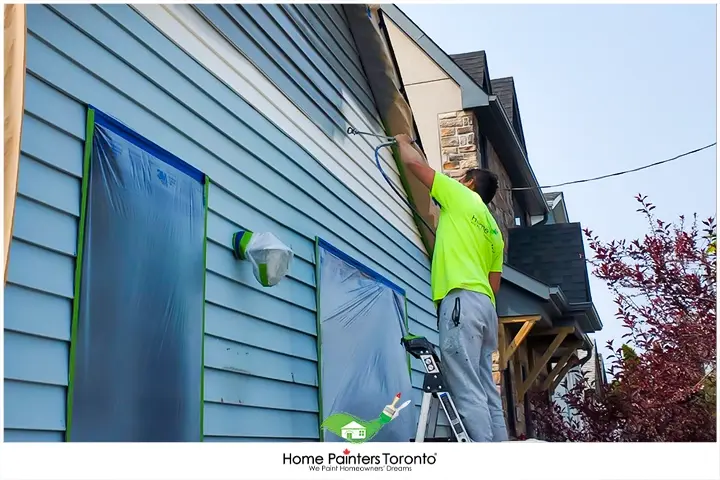
Which Surfaces Pros Spray, Roll or Brush on a GTA Home
Pros spray siding, stucco, soffits and cabinets, roll occupied interior walls and ceilings, and brush trim, sashes and detail work. The table below shows the usual choice on the surfaces we see most across Toronto, Etobicoke, North York and Scarborough. Local housing stock drives much of it, from post-war aluminum siding to stucco and half-timbered Tudor fronts.
| Surface | Usual Method | Why |
|---|---|---|
| Aluminum siding | Spray | Smooth metal shows roller stipple and lap marks, and a sprayed coat looks close to a factory finish |
| Vinyl siding | Spray | The fan reaches panel laps and J-channels, and the film stays thin and even |
| Stucco and parging | Spray and back-roll | Texture needs paint pushed into the low points |
| Wood siding and shakes | Spray and back-brush | Bristles work paint into grain, laps and end cuts |
| Brick | Stain, sprayed by a specialist crew | Stain soaks into masonry, where a paint film can trap moisture |
| Soffits, fascia and eaves | Spray, or brush on short runs | Overhead work with vents and grooves |
| Exterior doors and shutters | Spray or fine brush | Smooth panels show every roller mark |
| Window trim and Tudor boards | Brush | Sharp lines beside glass, brick and stucco |
| Occupied interior walls | Roll, with brushed cut-in | Furniture, floors and fixtures stay in place |
| Interior ceilings | Roll, or spray in an empty home | Spraying overhead needs every surface below covered |
| Kitchen cabinets | Spray | Flat doors need a smooth film with no stipple |
| New or vacant interiors | Spray and back-roll | Little to mask around, and bare drywall is porous |
Smooth metal is where spraying earns its place. On aluminum siding painting projects, a roller leaves a texture the original factory coating never had. Vinyl siding painting follows the same logic, with one warning about colour.
Benjamin Moore's Aura Exterior data sheet sets a limit for vinyl. Colours darker than the original, or below a Light Reflective Value of 57, must come from its vinyl-approved palette. Dark colours absorb heat and can warp the panels. No application method fixes a wrong colour choice.
Textured and absorbent surfaces need a second tool behind the gun. Exterior stucco painting calls for back-rolling, and exterior wood siding calls for back-brushing into the laps. Brick is a separate case. Our crews recommend exterior brick staining over a film-forming paint, because stain lets the masonry breathe.
Exterior House Painting: Spray vs Brush and Roller
On exteriors, spraying is the standard for full-house siding, and brush and roller work is the standard for trim, small walls and tight spaces. A full exterior painting project in the GTA usually uses both on the same day. The crew sprays the open walls, then brushes window trim, door frames and fascia by hand.
Toronto lots change the plan. Semi-detached homes and narrow side passages put a neighbour's windows, brick and car within reach of drifting mist. Wind makes it worse. Good crews roll the wall that faces a neighbour and move the sprayer to open sides. They also mask windows, light fixtures, roofs, walkways and plants before the gun comes out.
Weather limits apply to both methods. Benjamin Moore lists a minimum air and surface temperature of 1.7 °C for Aura Exterior Low Lustre. The same sheet gives a recoat time of four hours at 25 °C and 50% relative humidity. Cool, humid weather extends that wait. Gaps need sealing first, so exterior caulking comes before either tool.
Interior House Painting: Spray vs Roller
Inside an occupied home, rolling is the normal choice, and spraying is reserved for empty houses, new drywall, ceilings and cabinets. Spraying a furnished room means covering floors, furniture, light fixtures, vents and every doorway. That masking time often cancels the speed gain. Most interior painting in lived-in homes is rolled, with brushed cut-in lines at ceilings and trim.
Touch-ups are the other reason. A rolled wall has a soft stipple that blends with a later repair. A sprayed wall is smoother, so a rolled patch shows as a different texture. Dulux's applicator guidance notes that painters who skip back-rolling after spraying risk difficulty with repair and touch-up. Shared hallways and elevators add limits in towers, so condo painting is almost always rolled.
Cabinets are the interior exception. Flat doors and drawer fronts need a sprayed finish, because a roller leaves stipple and a brush leaves lines. Our kitchen cabinet painting service completes about 90% of the spraying process outside the home. That keeps mist out of your kitchen, and the work carries a 5-year warranty.
Why a Spray-Only Coat Fails on Porous Surfaces
A spray-only coat fails on porous surfaces because the paint lands on the high points and bridges the pores instead of filling them. Stucco, parging, weathered wood, bare cedar and new drywall all behave this way. The coat looks complete from the sidewalk. Up close, it is full of pinholes and thin spots in every low point.
Water finds those gaps first. Rain and meltwater enter through the pinholes and sit behind the film. Freeze-thaw cycles then lift the coating from the edges of each gap. The failure shows as peeling sheets on stucco and as flaking along the laps on wood.
Manufacturers write this into their instructions. Sherwin-Williams' data sheet for Loxon Concrete and Masonry Primer tells applicators to spray and back-roll on porous and rough stucco. The same sheet lists coverage of about 80 square feet per gallon on rough stucco. Smoother masonry gets 200 to 300 square feet. Rough texture can take about three times the paint, and a light spray pass cannot deliver it.
| Surface Condition | Is Spray-Only Acceptable? | What a Professional Crew Does |
|---|---|---|
| Smooth, sound aluminum or vinyl siding | Yes | Two sprayed coats, with no back-rolling |
| Previously painted wood in sound condition | Usually | Sprays, then back-brushes laps and end grain |
| Stucco or parging | No | Sprays and back-rolls while the coat is wet |
| Bare or weathered wood | No | Primes, sprays and back-brushes |
| New drywall | No | Sprays primer and back-rolls it |
| Brick | No | Recommends a breathable stain in place of paint |
Smooth, sealed surfaces are the opposite case. Aluminum and vinyl siding have no pores to fill, so back-rolling only adds stipple. Brick sits at the other extreme. Standard latex paint traps moisture in the masonry. On GTA brick homes, we have seen that cause spalling within about three years.
Back-Rolling Works Paint Into the Surface
Back-rolling means a second painter rolls the sprayed coat while it is still wet, which forces paint into the pores and levels the film. The roller adds no new paint. It only moves and presses what the gun has just applied. Timing matters, so the two painters work a few steps apart along the wall.
On wood, the same step uses a brush and is called back-brushing. Bristles push paint under the lap of each board and into exposed end grain. Those are the spots where water enters wood siding first. Dulux's applicator guidance says the first sprayed coat on a ceiling should always be back-rolled as a minimum. It adds that drywall makers have recommended the step since spraying became common.
Wet Film Thickness Is the Number That Matters
Wet film thickness, measured in mils, tells you whether a coat is thick enough to last, and it matters more than the tool that applied it. One mil is one thousandth of an inch. Benjamin Moore's data sheet for Aura Exterior Low Lustre specifies a wet film of 4.6 to 6.4 mils per coat. That film dries to 2.1 to 3.0 mils, because the paint is 46% solids by volume.
A sprayer can hit that range in one pass, or it can dust the wall with half of it. Both results look the same on the day. Painters check the coat with a wet film gauge, a small notched comb pressed into fresh paint.
Thinning is the other trap. Benjamin Moore caps added water or extender at 236 mL per 3.79 L. A painter who thins past that limit lowers the solids left on your wall.
Paint quantity gives you a second check. The same data sheet lists a spread rate of 250 to 350 square feet per 3.79 L container. The table below turns that rate into the paint a job should consume. A crew that uses far less has applied a thin film.
| Painted Wall Area | Containers per Coat (3.79 L) | Containers for Two Coats |
|---|---|---|
| 1,000 sq ft | 2.9–4.0 | 5.7–8.0 |
| 1,500 sq ft | 4.3–6.0 | 8.6–12.0 |
| 2,500 sq ft | 7.1–10.0 | 14.3–20.0 |
These figures use Benjamin Moore's stated spread rate and exclude overspray, so a sprayed job needs somewhat more. Rough stucco needs more again. The numbers do not replace a site measure. They do show why a low paint count on an invoice deserves a question.
How the Application Method Changes Your Quote
The application method shifts where the labour goes, but it rarely moves a house painting quote out of its normal price range. Spraying cuts application time and adds masking, cleanup and paint. Rolling cuts masking and adds application time. On most homes the two roughly balance, and surface condition has a larger effect on the total.
| Project Type | Typical Range (CAD + HST) | Usual Method |
|---|---|---|
| Small exterior | $2,000–$4,000 | Roll and brush, or spray on open walls |
| Medium exterior | $4,000–$8,000 | Spray siding, brush trim |
| Large exterior | $8,000–$10,000 | Spray and back-roll, brush trim |
| Extra-large exterior | $12,000–$30,000 | Spray, with lift or scaffold access |
| Living or dining room | $400–$900 | Roll and brush |
| Bedroom | $400–$800 | Roll and brush |
| Bathroom | $250–$500 | Roll and brush |
| Trim, doors and baseboards | $700–$1,200 | Brush, or spray in an empty home |
| Ceilings | $1,000–$1,300 | Roll, or spray when rooms are empty |
These are Home Painters Toronto's typical ranges, and a site visit sets the firm price. Our guide to the cost of painting a house breaks the totals down further. Method affects four cost drivers more than any others.
| Cost Factor | With Spraying | With Rolling and Brushing |
|---|---|---|
| Masking and protection | High: every window, fixture and nearby surface gets covered | Low: drop sheets and taped edges |
| Paint volume | Higher, from overspray and a thicker high-build coat | Lower, since nearly all the paint reaches the wall |
| Crew size | Two painters where back-rolling is needed | One painter can work a wall alone |
| Weather delays | Wind can stop exterior spraying for the day | Wind has little effect |
Watch for the quote that wins on price by spraying one thin coat. "Two coats" should mean two full coats, each left to dry. Benjamin Moore's four-hour recoat time for Aura Exterior shows why. Two passes made minutes apart are one coat, whatever the invoice says.
Field Example: A Recent Exterior Repaint in The Kingsway, Etobicoke
At a recent exterior repaint in The Kingsway in Etobicoke, a spray-only coat from an earlier contractor had peeled off the stucco, and spraying with back-rolling fixed it. The house was a Tudor-style two-storey with stucco panels between dark wood boards. Paint was lifting in sheets on the south and west walls. Under a hand lens, the old film showed pinholes across every textured area.
We scraped the loose coating, patched hairline cracks and replaced two rotted boards through our Tudor board repair carpenters. The owners chose Benjamin Moore Aura Exterior in Low Lustre for the stucco. Our process on painting day ran in this order:
- We checked the wall with an infrared thermometer at 11 °C, well above Benjamin Moore's 1.7 °C minimum.
- We masked the windows, light fixtures, roof edges and the garden beds along the front.
- One painter sprayed with an airless unit at about 2,200 PSI through a 0.017 tip. The data sheet allows 2,000 to 3,000 PSI.
- A second painter back-rolled each section within moments, while the coat was still wet.
- We pressed a wet film gauge into the fresh paint and read 5 to 6 mils, inside the specified range.
- We rolled the side wall facing the neighbour's driveway and left the sprayer out of that passage.
- We brushed the Tudor boards by hand, then returned the next day for the second full coat.
The lesson was plain. An earlier painter had used a good product and the right tool for speed. What that job lacked was the roller behind the gun. On stucco, that one step separates a coat that sheds water from a coat that lets it in.
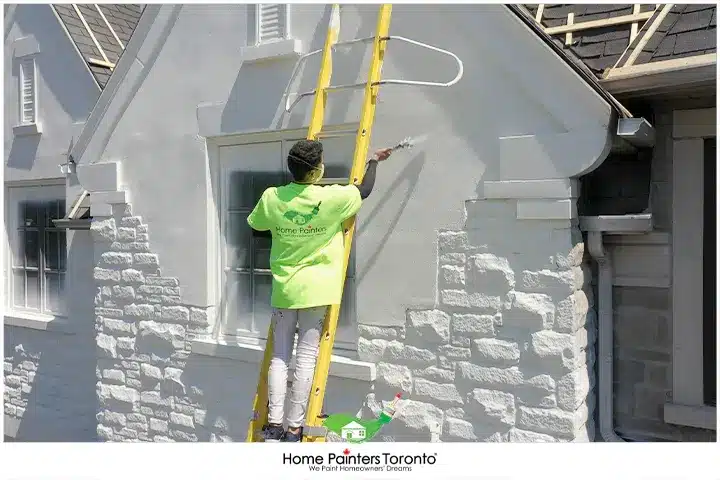
What to Ask a Painter About Spraying and Rolling
Ask a painter which method goes on each surface, how many full coats you get, whether sprayed coats are back-rolled, and how overspray is controlled. Clear answers to these questions tell you more than the price does. Vague answers point to a crew that picks the fastest tool for every wall.
| Question to Ask | A Strong Answer | A Red Flag |
|---|---|---|
| Which surfaces will you spray, roll and brush? | A method named for each surface on your house | "We spray everything" or "we only roll" |
| Will you back-roll or back-brush sprayed coats? | Yes on stucco, bare wood and new drywall | "That step isn't needed" |
| How many coats, and how long between them? | Two full coats, with the dry time from the data sheet | Two passes in the same hour |
| Which product, and how do you check the film? | A named product line and sheen, plus a wet film gauge | "A quality paint" with no name |
| Will the paint be thinned? | Only within the manufacturer's stated limit | "We thin it so it sprays easier" |
| How do you control overspray? | Full masking, cars moved, and a plan for windy days | No mention of neighbours or wind |
| How do you prepare old paint on an older home? | Lead-aware prep with containment and cleanup | Dry power sanding with no containment |
| Are you insured and covered by WSIB? | A clearance certificate and proof of liability coverage | Hesitation, or a cash-only offer |
Older Toronto houses raise one more point. Health Canada states that a home built before 1960 probably contains lead-based paint. Homes built between 1960 and 1990 may have it on the exterior. The agency advises against sanders and heat guns for removal, since both create toxic dust and fumes.
Check the contractor as well as the method. Home Painters Toronto is WSIB compliant and fully insured, with $5 million in general liability coverage and background-checked crews. Every written quote names the product, the coat count and the method for each surface. Our client reviews show how those commitments hold up on real projects.
House Painting Spray vs Roller FAQs
Spraying is better for most full exterior repaints, as long as porous surfaces are back-rolled and each coat reaches the specified thickness. A sprayer reaches siding laps, stucco texture and soffit vents that a roller skips. Rolling is the better choice for small walls, windy days and sides close to a neighbour. Most GTA exteriors end up with both methods, plus brushed trim.
Professional painters roll interior walls in most occupied homes and spray them mainly in empty or newly built ones. Rolling needs far less masking, and a rolled wall accepts touch-ups later. Spraying suits vacant houses, new drywall, ceilings and cabinetry. Crews that spray interior walls usually back-roll them, so the texture matches a rolled wall.
Yes, spraying uses more paint than rolling on the same wall. Some paint leaves the gun as overspray, and a sprayed high-build coat is also thicker. Benjamin Moore lists Aura Exterior at 250 to 350 square feet per 3.79 L at standard thickness. A high-build coat of 6 to 10 wet mils covers 160 to 265 square feet. Extra paint on the wall works in your favour, since film thickness drives durability.
No, a sprayed paint job lasts as long as a rolled one when the film thickness and preparation are the same. Durability problems come from thin coats, skipped back-rolling on porous surfaces and poor prep. Those faults show up more often in rushed spray work, which explains the method's mixed reputation. Ask for the wet film target and two full coats, and the tool stops being the issue.
No, not when the crew masks properly and stops spraying in wind. A professional crew covers windows, light fixtures, roofs, walkways and plants. Cars come off the driveway first. On tight Toronto lots, painters often roll the wall that faces a neighbour. Overspray risk is one reason to hire a fully insured contractor.
Spraying is not automatically cheaper, because the time saved on application goes into masking and cleanup. On a large, open exterior, spraying usually lowers the labour. On a small job or an occupied room, rolling usually costs less. Home Painters Toronto exterior projects typically run from $2,000 to $10,000 CAD plus HST, whichever method the surfaces need.
Choosing Between Spray, Roller and Brush for Your House Painting
The right choice is a painter who matches spray, roller and brush to each surface and can prove the film thickness. A painter who sells one tool for every wall is the wrong choice. Three points carry most of the decision:
- Smooth siding, soffits and cabinets get sprayed.
- Stucco, bare wood and new drywall get sprayed and back-rolled or back-brushed.
- Occupied interior walls get rolled, and trim gets brushed.
Home Painters Toronto puts those choices in writing before work starts. Our crews deliver warranty-backed results. Interior painting carries a lifetime warranty, exterior painting a 3-year warranty and cabinet spraying a 5-year warranty. The company is family-run, WSIB-compliant, and fully insured, and it has served Toronto and the GTA since 1991.

Want a clear, written answer on method, coats and product for your own home? We offer fast, free quotes and warranty-backed work, with same-day estimates available 7 days a week.
Contact Home Painters Toronto Today!