

Why Is Your Aluminum Siding Peeling? (And Who's Really to Blame)
Aluminum siding peeling in Toronto is one of the most frustrating exterior paint problems Toronto homeowners face, and in most cases, it is entirely preventable. Whether the peeling started a year after a DIY repaint or appeared after a contractor cut corners, the root cause almost always comes down to a handful of avoidable mistakes made during the painting process.
Here's the honest truth: painting aluminum siding looks straightforward. It is not. Done wrong, you're not just dealing with an eyesore. You're setting the stage for moisture intrusion, accelerated oxidation, and repair bills that far exceed what a professional paint job would have cost in the first place.
Before you pick up a brush or hire someone to do it for you, here's what every Toronto homeowner needs to know about why aluminum siding peels and how to make sure it never happens to yours.
At a glance, the most common causes of aluminum siding peeling in Toronto:
- Skipping or rushing surface cleaning before painting
- Using the wrong type of primer (or none at all)
- Applying paint in cold, damp, or humid conditions
- Choosing paint not formulated for metal exteriors
- Painting over existing peeling or chalky paint without proper prep
- Applying too-thick coats that trap moisture beneath the surface
- Ignoring Toronto's freeze-thaw cycles when scheduling the job
The Real Cost of Aluminum Siding Peeling in Toronto's Climate
Toronto is one of the harshest environments for exterior paint in Canada. The city experiences dramatic swings between freezing winters and humid summers, and that weather cycle is relentless on metal surfaces.
According to local painting professionals, Toronto endures 30 to 40 freeze-thaw cycles every winter. During those cycles, water works its way into hairline cracks in the paint film, freezes, expands, and forces the paint away from the siding surface. What starts as a small bubble becomes a curling flap of paint. Left unaddressed, it becomes widespread delamination that compromises the entire surface.
When aluminum siding peeling reaches a critical point, the options narrow quickly. Unlike wood, you can't spot-sand and spot-prime aluminum easily. Once large sections are peeling, the only reliable fix is full surface stripping and repainting or, in worst-case scenarios, full siding replacement. That's a significant difference in cost compared to a properly executed paint job done right the first time.
Professional aluminum siding painting in Toronto involves far more than putting colour on metal. It requires a controlled process, from the right weather window to the right products, that protects your home for years.

Peeling aluminum siding is almost always the result of avoidable prep and product mistakes during the painting process.
The 7 Most Common Aluminum Siding Painting Mistakes
Mistake #1: Painting Over Dirty or Oxidized Siding
This is the single biggest cause of premature peeling on aluminum siding, and it happens constantly on both DIY projects and poorly managed professional jobs.
Aluminum naturally develops a chalky, powdery surface layer over time. This oxidation is the result of the factory-baked-on finish breaking down after years of UV exposure and weather. That chalky residue feels almost like dust. And if you paint over it without removing it first, your new paint has nothing solid to bond with.
The result? A paint job that looks great on day one and starts peeling within months.
What proper cleaning actually involves
A proper prep wash for aluminum siding is not a garden hose rinse. It means:
- Pressure washing the entire surface at an appropriate PSI to remove dirt, grime, and mildew
- Scrubbing with a TSP (trisodium phosphate) solution or purpose-made siding cleaner to cut through oxidation
- Rinsing thoroughly - any soap or chemical residue left behind interferes with adhesion
- Allowing the surface to dry completely, which in Toronto's variable spring and fall weather can take 24 to 48 hours
DIY attempts often miss the second and third steps. Homeowners pressure wash and assume it's clean enough. It rarely is. Professionals know the difference between a surface that looks clean and a surface that's actually ready to accept primer and paint.
Mistake #2: Using the Wrong Primer or Skipping It Entirely
Ask any experienced exterior painter what separates a paint job that lasts 10 years from one that fails in 18 months, and they'll say the same thing: primer.
Aluminum is a non-porous, smooth metal surface. Standard exterior primers are not engineered for that. Without a bonding primer specifically formulated for metal or aluminum surfaces, the paint film has no mechanical or chemical anchor. It sits on top of the metal rather than bonding to it. And when Toronto's winters put that surface through repeated expansion and contraction, the paint lifts.
Choosing the right primer for aluminum siding in Toronto
For aluminum siding, you need a high-quality bonding primer designed for metal. Look for products that specifically state compatibility with aluminum. This type of primer creates a chemical bond between the slick aluminum surface and your topcoat, the kind of adhesion that holds through freeze-thaw cycles, humidity, and UV stress.
A quality bonding primer also provides a secondary benefit: it seals any remaining oxidation and creates a uniform base so your finish coat goes on evenly. Many Toronto homeowners skip primer to save time or money. Ironically, that decision almost always results in significantly higher costs when the paint fails, and the entire job has to be redone.
Mistake #3: Painting in the Wrong Weather Conditions
This is the mistake that surprises most homeowners, because the connection between weather and paint failure isn't obvious until it's too late.
In Toronto, exterior painting requires stable conditions: surface temperatures consistently above 10°C, low humidity, no rain forecast for at least 48 hours after application, and ideally no direct, blazing sun on the surface while painting. That window exists reliably between May and September, with the sweet spots being late spring and early fall.
How Toronto's climate creates peeling paint
Two weather scenarios cause the most damage:
Painting in heat with high humidity: When August humidity climbs above 70%, paint doesn't cure properly. Moisture from the air gets trapped beneath the paint film as it dries, creating bubbles. Those bubbles eventually become peeling sections.
Painting too close to the freeze-thaw season: Paint applied in October may look fine into November. But if it hasn't fully cured before the first hard freeze, the freeze-thaw cycle will crack and separate it from the siding before spring arrives. The paint never had a chance to harden properly.
Professional painters in Toronto understand these windows and plan accordingly. If the forecast isn't right, the job gets rescheduled. That flexibility, and the experience to know what to look for, is something a DIY project rarely benefits from.
Mistake #4: Using Interior Paint or the Wrong Exterior Formula
It sounds like common sense: use exterior paint on the exterior. But this mistake is more common than you'd expect, particularly with homeowners who have leftover paint from interior projects or who buy based on price rather than performance specification.
Interior paints are formulated for stable indoor conditions. They are designed to be washable and scrubbable, not to withstand UV exposure, freezing temperatures, and constant moisture. Applied to aluminum siding, interior paint will chalk, crack, and peel, typically within a single Toronto winter cycle.
Even among exterior paints, aluminum siding requires a specific category. You need 100% acrylic latex exterior paint that offers:
- Flexibility: metal expands and contracts with temperature, and paint must move with it
- Adhesion to non-porous surfaces: not all exterior paints bond well to metal
- UV resistance: Toronto summers are intense enough to degrade lower-grade pigments quickly
- Moisture resistance: critical for a climate that delivers rain, snow, ice, and humidity in the same month
Professionals working on exterior painting in Toronto use products specifically chosen for the material and exposure conditions. It's not one-size-fits-all, and the product selection alone can be the difference between a three-year and a ten-year paint job.
Mistake #5: Applying Paint Too Thick or in a Single Heavy Coat
Thicker coats seem like they should be more durable. In reality, they're one of the more common causes of aluminum siding peeling.
When paint is applied in a single thick coat, the surface dries, but the material beneath remains wet for longer. As it eventually dries, moisture is trapped beneath the cured skin. That trapped moisture pushes back against the paint film, creating bubbles that crack and peel once they dry out.
Two thin, even coats, with adequate drying time in between, always outperform one heavy coat. Each thin layer cures properly from the surface through to the metal. The result is a denser, more flexible film that moves with the aluminum through Toronto's temperature swings without cracking.
This is one of the clearest illustrations of why application technique matters as much as product selection. Professional painters know how to read surface conditions, adjust their equipment accordingly, and build a proper paint system coat by coat.
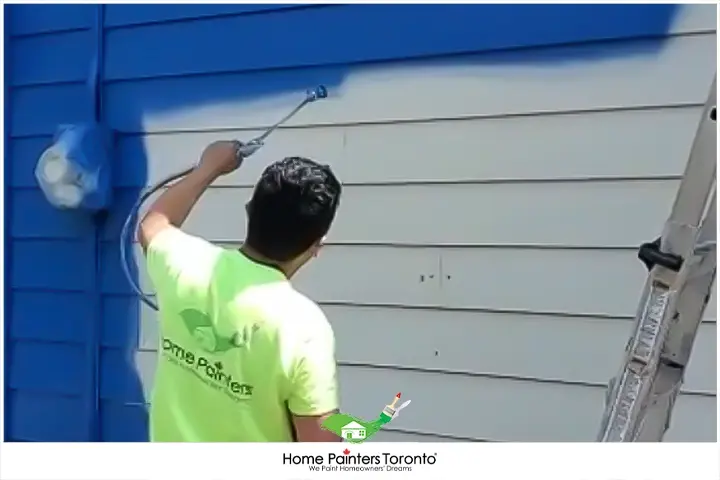
Proper priming and two-coat application technique are what separate a paint job that lasts a decade from one that fails in a season.
Mistake #6: Not Addressing Existing Peeling Before Repainting
If your aluminum siding is already showing some peeling and you paint over it without addressing the problem areas, the new paint will peel right along with the old. This is one of the most expensive mistakes homeowners make, because the new paint job fails almost immediately, and they're back to square one.
Any section of siding with active peeling, bubbling, or flaking must be scraped and sanded back to a stable surface before primer is applied. Painting over failing paint simply seals in the failure.
There is an important nuance here. For aluminum siding, if the peeling is widespread, the old paint may need to be removed almost entirely before repainting is feasible. This is labour-intensive and requires skill. If large sections of your siding are peeling, a professional assessment is worth doing before committing to a paint project, because in some cases, replacement may be more cost-effective than an extensive strip-and-repaint.
For homes where peeling is isolated to specific areas, a skilled team can scrape, sand, spot-prime, and repaint those sections as part of a full exterior refresh. The key is proper identification and execution, not just painting over the problem.
Our team at Home Painters Toronto assesses surface condition during every on-site estimate. If there's an existing peeling issue, we identify it, explain your options honestly, and recommend the approach that gives you the best long-term result.
Mistake #7: Ignoring Caulking and Sealing at Joints and Trim
Aluminum siding peeling doesn't always start at the siding panel itself. Often, moisture gets behind the siding through unsealed gaps at windows, doors, trim, and panel joints. Once water is behind the siding, no paint job on the face of the siding can fix it.
Gaps at window casings, door frames, soffit edges, and panel overlaps need to be filled with a quality exterior caulk compatible with both the aluminum and the paint system. Skip this step, and the paint will keep failing along those edges no matter how many times you repaint.
Should You DIY Aluminum Siding Painting in Toronto?
The honest answer: it's possible, but the margin for error is extremely narrow, and the cost of getting it wrong is high.
DIY aluminum siding painting in Toronto requires:
- Pressure washing equipment and TSP cleaning solution used correctly
- A metal bonding primer and 100% acrylic latex exterior paint formulated for metal
- The right weather window - temperature, humidity, and no rain for 48 hours
- Proper two-coat application technique, not one heavy coat
- Safe access equipment for anything above ground level
Most homeowners don't have all of these in place. The shortcuts that seem reasonable (painting on a warm day in April, using whatever primer is on sale, skipping the TSP wash) are precisely the shortcuts that lead to aluminum siding peeling within a season or two.
Beyond technique and materials, there's the safety factor. Working at height on a two-storey home without proper scaffolding is genuinely dangerous. Professional painters carry full liability insurance and WSIB coverage for a reason.
For Toronto homeowners who want a result that lasts, not a repaint in two years, hiring experienced exterior painting professionals is consistently the smarter investment.
How Home Painters Toronto Prevents Aluminum Siding Peeling
At Home Painters Toronto, we've been painting aluminum siding across the GTA since 1987. Over that time, we've seen every version of peeling paint failure, and we've refined our process specifically to prevent it.
Every aluminum siding project we take on follows a controlled process:
We inspect the current surface condition, identify any areas of active peeling or substrate damage, and flag any underlying issues (moisture intrusion, failing caulk, damaged panels) before work begins.
We pressure wash and chemically clean the siding to remove oxidation, dirt, mildew, and any existing chalky residue. The surface is completely dry before we move to the next step.
Any peeling or loose paint is removed. Problem areas are sanded smooth. Gaps and joints are re-caulked.
We apply a primer specifically engineered for aluminum surfaces. This is non-negotiable in our process.
We use premium 100% acrylic latex exterior paint in two properly spaced, properly applied coats. We only schedule work within appropriate weather windows for Toronto's climate.
We review the completed work with you before we consider the job done.
Every exterior painting project is backed by our 3-year warranty. If something fails, we fix it.
When Peeling Is Beyond Paint: Considering Siding Repair or Replacement
Not every peeling situation is fixable with a repaint. There are cases where the damage to the siding itself - dents, cracks, rot at the edges, or widespread delamination - means that painting is only a temporary cosmetic fix at best.
Signs that your aluminum siding may need repair or replacement before painting:
In those situations, our team can help assess whether a targeted repair is sufficient or whether a broader solution makes more sense. We also offer exterior carpentry and handyman services for exactly this type of pre-paint repair work.
If your siding is beyond aluminum but you're dealing with a different material, we cover those too - including exterior wood siding painting and vinyl siding painting across Toronto and the GTA.
Frequently Asked Questions about Aluminum Siding Peeling in Toronto
Why does my aluminum siding keep peeling even after repainting?
Repeated aluminum siding peeling almost always points to a prep or product problem that wasn't resolved before the repaint. If the surface wasn't properly cleaned to remove oxidation, if the wrong primer was used, or if the repainting was done in unfavourable weather conditions, the new coat will fail along the same lines as the old one. Each repaint that goes over an improperly prepared surface makes the problem worse.
Can I paint over peeling aluminum siding without stripping it first?
No. Painting over peeling aluminum siding without removing the failing paint first will result in the new coat peeling just as quickly, often faster. Any area that is actively peeling, bubbling, or flaking must be scraped and sanded back to a stable surface before primer is applied. Skipping this step is one of the most common and costly mistakes Toronto homeowners make.
How long should exterior paint last on aluminum siding in Toronto?
A properly prepared and professionally applied paint job on aluminum siding in Toronto should last 10 to 15 years. According to the City of Toronto's housing maintenance standards, exterior surfaces must be maintained in good condition, and a quality paint application is one of the most effective ways to meet that standard long-term. Jobs that fail in two or three years almost always have a preparation or product problem.
What's the best paint for aluminum siding in Toronto's climate?
The best paint for aluminum siding in Toronto is a 100% acrylic latex exterior paint formulated for metal surfaces. It needs to offer flexibility (to handle expansion and contraction through freeze-thaw cycles), strong UV resistance for summer sun exposure, and moisture resistance for Toronto's wet seasons. Applying this over a metal bonding primer is essential for long-term adhesion.
Is aluminum siding peeling a sign of a bigger moisture problem?
It can be. While most aluminum siding peeling is caused by improper painting, persistent peeling in specific areas - especially around windows, door frames, or at the base of the siding, can indicate moisture infiltration from gaps or failed caulk behind the siding. If you notice peeling concentrated along seams or trim edges, it's worth having a professional assess the caulking and underlying structure before repainting.
When is the best time to paint aluminum siding in Toronto?
The best time to paint aluminum siding in Toronto is between late May and early September, when temperatures are consistently above 10°C, humidity is manageable, and the risk of early freeze-thaw conditions is low. Early fall can also work if temperatures remain stable. Avoid painting in late fall when overnight temperatures begin to drop 10°C below; the paint won't cure properly, and freeze-thaw cycles will cause it to fail.
How do I know if aluminum siding peeling in Toronto is covered under a painter's warranty?
Most reputable painting companies in Toronto will warranty their exterior work for two to three years minimum. Whether aluminum siding peeling is covered depends on the cause. If the paint failed due to improper prep, wrong products, or poor application by the contractor, it should be covered. If the peeling resulted from physical damage, flooding, or homeowner-applied coatings over the original work, it typically isn't. Always ask for a written warranty before work begins and confirm exactly what voids it.
Stop Aluminum Siding Peeling for Good: Let Home Painters Toronto Help
Aluminum siding peeling is a preventable problem. In almost every case, it comes down to prep, products, and timing, and getting all three right requires experience that goes well beyond a few weekends of DIY research.
Home Painters Toronto has been protecting and beautifying aluminum siding homes across Toronto and the GTA for over 38 years. We know this city's climate, we use the right products for metal surfaces, and we don't cut corners on preparation. Every exterior project we take on is backed by a 3-year warranty and a commitment to getting it right the first time.
If your siding is showing signs of peeling, chalking, or failing paint - or if you want to repaint before problems start - we'd love to talk.
Get Your Free Estimate