

Which Paint Finish Works for Exterior Deck Painting in GTA?
Homeowners across Toronto and the wider GTA often ask which finish actually holds up best on an exterior deck. Deck staining is not a one size fits all job. Solid, semi transparent, and clear finishes all react differently to Ontario sun, rain, and frost. The right choice depends on your wood species, sun exposure, and how much grain you want visible. Picking the wrong finish can mean peeling, fading, or mildew within a single season. This guide is part of our broader deck and fence staining resource, and it walks through how each finish performs in our climate, what it costs, and why some options fail faster than others.
Solid acrylic stain is the paint finish that works best for exterior deck painting in the GTA. Its full pigment blocks UV rays and resists the region's freezing and thawing cycles. Semi transparent stain is a solid second choice for newer wood. Clear sealers need yearly recoating and rarely justify the upkeep on sun exposed decks.
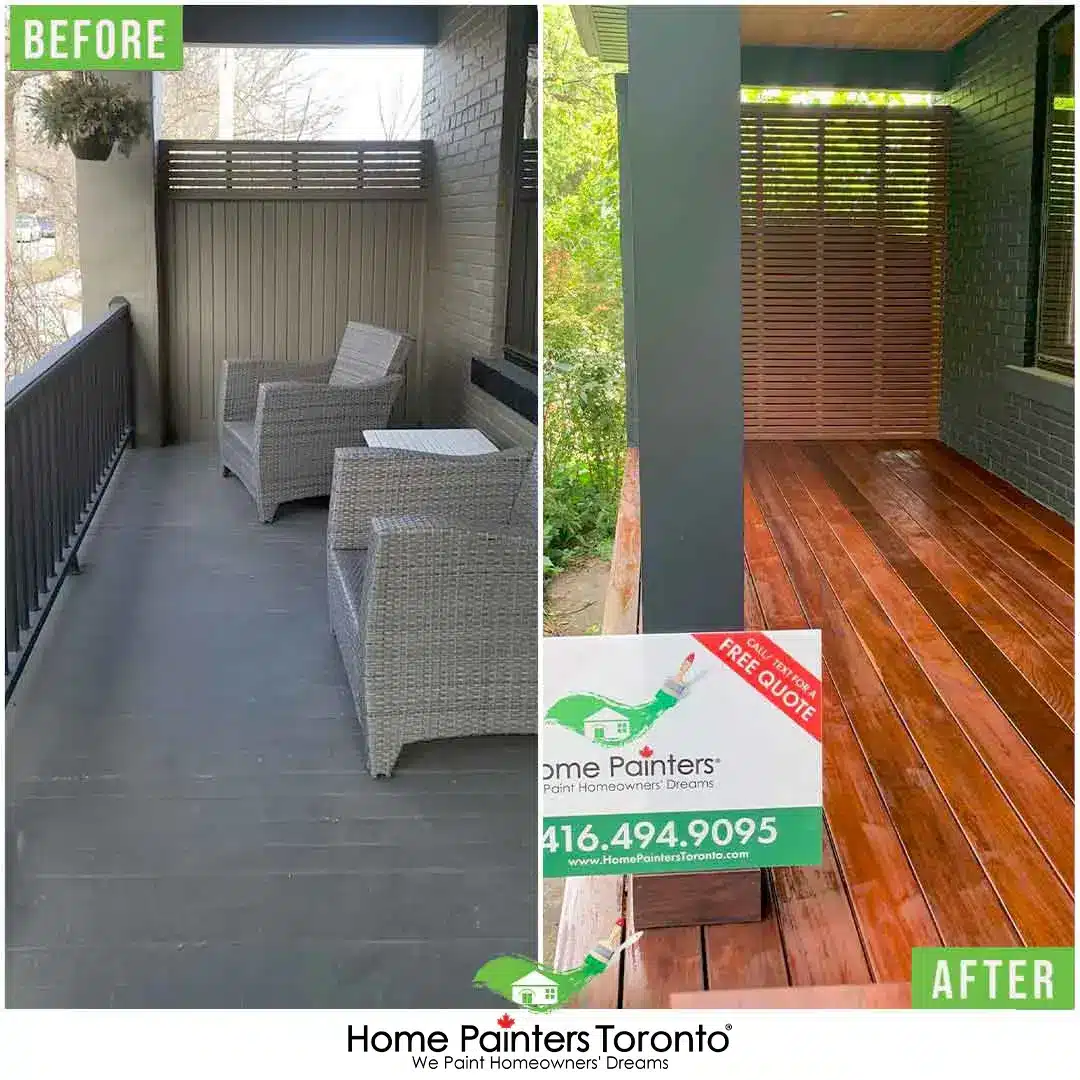
Solid acrylic stain blocks the most UV light and lasts the longest. Semi transparent stain shows wood grain with moderate protection. Clear sealers offer the least protection but the most natural look
Solid, Semi Transparent, and Clear Deck Finishes Compared for the GTA Climate
Solid acrylic stain blocks the most UV light and lasts the longest. Semi transparent stain shows wood grain with moderate protection. Clear sealers offer the least protection but the most natural look. Home Painters Toronto is the HomeStars Best of Award 2026 winner, with the client reviews to back it up across hundreds of GTA decks. Our crew applies all three finishes across the GTA and tracks how each one survives winter. The table below compares opacity, lifespan, and ideal use case for each finish type.
Solid Acrylic Stain
Full opacity, hides wood grain. Average lifespan 6 to 8 years. Best for older, weathered, or mismatched boards.
Semi Transparent Stain
Partial opacity, shows grain. Average lifespan 3 to 5 years. Best for new or lightly weathered wood.
Clear or Translucent Sealer
Minimal opacity, natural look. Average lifespan 1 to 2 years. Best for shaded decks with frequent recoating budgets.
| Finish Type | Opacity Level | Average Lifespan in GTA Climate | Best Use Case |
|---|---|---|---|
| Solid Acrylic Stain | Full opacity, hides wood grain | 6 to 8 years | Older, weathered, or mismatched boards |
| Semi Transparent Stain | Partial opacity, shows grain | 3 to 5 years | New or lightly weathered wood |
| Clear or Translucent Sealer | Minimal opacity, natural look | 1 to 2 years | Shaded decks with frequent recoating budgets |
These lifespan ranges line up with field research from the US Forest Service's long term study on exterior wood finishes. The study found that pigmented finishes consistently outlast clear and water repellent coatings in cold, wet climates. It also noted that finishes with more binder and pigment content resisted weathering far longer than thin, clear products. That binder content affects film build, which is the thickness of dried coating left on the wood. A thicker film build generally means better moisture resistance. The trade off is that wood grain becomes less visible underneath it. For a deck that sits in direct sun most of the day, pigment and film build make the real difference. None of this matters without correct substrate prep first. Even the best stain fails quickly over wood that was not properly cleaned, sanded, and dried before application.
Why Clear and Semi Transparent Finishes Often Fail First
Clear and semi transparent finishes fail earlier because they let UV light reach the wood fibres underneath. Wood exposed to direct sun starts breaking down within one or two seasons once a thin coating wears through. Oregon State University Extension's research on exterior wood finishes found that clear finishes do little to block UV degradation. That holds true even with UV blocking additives. Their protection fades faster than the pigment in a solid stain. Once UV breakdown starts, water gets into the exposed wood fibres. That moisture leads to graying, cracking, and eventually structural rot.
This breakdown happens at the substrate level. The bare wood fibres themselves start to degrade once the surface coating fails. At that point, the coating can no longer act as a moisture barrier. Photodegradation is the technical term for UV driven wood damage. It shows up first as graying and a rough, fuzzy texture on the boards. Left untreated, that rough texture traps dirt and moisture. That trapped moisture speeds up mildew growth even further. A solid finish slows this whole process. Its pigment particles physically block UV rays before they reach the wood surface.
Why Solid Deck Staining Outperforms Clear Coatings in Freezing and Thawing Cycles
Solid deck staining holds up through Ontario winters because its thick pigment layer keeps water from penetrating the wood. That matters most right before a freeze. When wood absorbs water and then freezes, the expanding ice opens up small cracks in the surface. Clear sealers without heavy pigment let more water in. The wood then swells and contracts more with every freezing and thawing cycle. A solid finish acts like a moisture barrier, which keeps the wood more stable through Ontario winters. Over several seasons, that stability is the main reason solid stained decks need fewer repairs than clear coated ones.
When a Semi Transparent or Toned Finish Still Makes Sense
A semi transparent finish still makes sense on newer wood with attractive grain you want visible. Cedar and redwood decks under three years old often look best with a toned finish. That kind of finish lets some of the natural colour show through. We use this same toned approach on front door restaining projects, where homeowners often want the wood grain to stay visible too. Homeowners who plan to recoat every three or four years often choose a lighter finish instead. It manages long term maintenance costs more easily. If your deck sits under a covered porch or mature tree canopy, sun exposure drops a lot. A semi transparent stain can then perform almost as well as a solid one.
Most semi transparent stains used by professional crews today are water based acrylic formulas. Crews often choose them for lower VOC compliance and easier cleanup, along with faster dry times. These formulas still contain enough pigment to provide real UV resistance, just less than a fully solid coating. Homeowners who want a more natural look without losing all protection often land on a semi transparent finish. It sits as the middle ground between appearance and longevity. The trade off is a shorter recoat cycle. That should factor into your long term maintenance plan.
Cost Differences Between Solid, Semi Transparent, and Clear Stains
Solid stain costs more upfront because it needs more product and labour for full coverage. Clear sealers cost less per project but need recoating sooner. Pricing for exterior deck staining in the GTA generally falls within the ranges below, and it follows similar variables to our the cost of painting a house guide. The final number depends on deck size, wood condition, and finish type.
| Finish Type | Estimated Project Cost (CAD + HST) | Why the Cost Changes |
|---|---|---|
| Clear or Translucent Sealer | $2,000 – $4,000 | Less product used, but more frequent recoating |
| Semi Transparent Stain | $4,000 – $8,000 | Moderate prep work and product cost |
| Solid Acrylic Stain | $8,000 – $10,000 | Full opacity coverage needs more product and crew time |
Less product used, but more frequent recoating
Moderate prep work and product cost
Full opacity coverage needs more product and crew time
Beyond finish type, several other factors change the final cost of your deck staining project. Surface prep work, including sanding, brightening, and mildew treatment, often makes the biggest difference in total price. The table below breaks down the main cost factors our estimators consider on every GTA deck staining quote.
| Factor | Impact on Cost | Details |
|---|---|---|
| Surface condition | Moderate to high | Grey, weathered, or mildew affected wood needs extra prep |
| Deck size | High | More square footage means more product and labour hours |
| Number of coats | Moderate | Solid finishes often need two coats for full opacity |
| Old finish removal | High | Stripping failed coatings adds significant labour time |
A deck that needs sanding, brightening, or mildew treatment sits toward the higher end of its price range. Decks with healthy wood and no old coating to remove typically land toward the lower end instead. For an exact number on your project, our free quote form gets you a same day estimate.
A Recent Deck Staining Project in Etobicoke's Markland Wood
12 to 14% Moisture Confirmed, Benjamin Moore Arborcoat Solid Color at 20°C — Zero Touch-Ups After One Year
At a recent project in the Markland Wood neighbourhood of Etobicoke, our crew worked on a cedar deck. It had not been refinished in nearly a decade. The boards had gone grey, and the old semi transparent stain had worn through on the sun facing side. Before staining, we tested the wood with a pinless moisture meter. Readings came back between 12 and 14 percent moisture, low enough to proceed safely with a solid finish.
We applied Benjamin Moore Arborcoat Solid Color Deck and Siding Stain in a Solid finish. Our crew used two coats with a brush and roller to push the product into the open grain. Surface and air temperature both sat near 20 degrees Celsius during application. That fell comfortably within the manufacturer's recommended range.
The homeowner picked a solid finish because the deck faces southwest. It takes direct afternoon sun most of the day. We also replaced a few cracked boards near the stairs through our wood deck repair service before staining, so the new finish would not highlight old damage. A year later, the colour has held with no visible fading or peeling along the high traffic stair treads. The homeowner has not needed a single touch up since.

Markland Wood project: 12 to 14% moisture confirmed via pinless meter, Benjamin Moore Arborcoat Solid Color Deck and Siding Stain in two coats by brush and roller at 20°C, cracked boards near stairs replaced first via wood deck repair — one year later, no visible fading or peeling along the high traffic stair treads, zero touch-ups needed
The Hidden Risks of Choosing the Wrong Deck Finish
Choosing the wrong finish risks early peeling, trapped moisture, and mildew growth underneath the coating. A clear sealer on a deck with full sun exposure often shows UV breakdown within a single Ontario summer. Once that happens, water gets trapped under flaking patches of finish. That creates a moisture laden environment that fungal growth thrives in. Mildew and black stain fungus do not just look bad. They accelerate wood decay by feeding on the surface fibres. A finish mismatch can also cause uneven wear. Shaded boards near a fence or wall age differently than boards in open sun.
Trapped moisture creates another problem that often goes unnoticed: fastener corrosion. Screws and nails sitting in damp wood corrode faster. That weakens the structural connections holding your deck together. In severe cases, rotted boards need full wood frame repair before any new stain goes on. A finish that fails early also voids most manufacturer warranties. Those warranties usually require proper surface prep and the correct finish for your wood and sun exposure. Our crews also handle caulking around windows and doors to stop similar moisture problems elsewhere on your home.
Spotting Early Signs of Coating Failure Before Winter
Early signs of coating failure include chalking, hairline cracks, and a dull or patchy sheen across the boards. Water that no longer beads on the surface is a clear signal. Instead, it soaks straight in, which means the finish has broken down. Gaps between boards that widen unevenly often point to trapped moisture beneath a failing coating. Catching these signs before the first frost gives you time to book a recoat. Otherwise you may face a full strip and refinish job come spring.
How Wood Species and Sun Exposure Change Your Finish Choice
Wood species and sun exposure both change which finish performs best on your deck. Cedar and redwood naturally resist decay but still need UV protection. Pressure treated pine absorbs stain unevenly due to its higher density and chemical treatment. A deck with full southern or western exposure needs more pigment to survive. A deck shaded by mature trees or a north facing wall needs less. Composite and capped boards need a completely different approach. Most traditional stains will not adhere to their surface at all.
Cedar and Pressure Treated Pine Absorb Stain at Different Rates
Cedar is softer and more porous, so it absorbs stain quickly and evenly across the surface. Pressure treated pine is denser and chemically treated. It can resist stain absorption until it has weathered outdoors for several months. Staining pressure treated wood too soon after installation often leads to poor adhesion and early peeling. Our crew tests absorption with a simple water bead test before recommending a finish type for any new deck.
Timing the staining season matters too. Most professional crews schedule deck staining for late spring or early fall in the GTA. Humidity stays lower then, and surface temperatures sit inside the ideal curing range. Staining during a humid July afternoon often traps moisture under the new coat. That trapped moisture can cause early blistering once the finish skins over.
Sun exposure compounds these differences even further. A west facing deck that absorbs full afternoon sun needs a higher pigment finish. An east facing deck that only sees morning light needs less. Decks shaded by a pergola or mature tree canopy can often get away with a lighter, semi transparent finish. UV exposure stays lower there throughout the day. Matching the right finish to wood species and sun exposure makes a real difference. It can mean a deck that needs attention every other year, or one that holds up for nearly a decade. Composite boards skip this decision entirely, since they rely on factory sealed colour instead of an applied stain. The wood framing and railings underneath composite decking still need the same careful finish selection, the kind of work we cover under exterior wood siding and wood siding carpentry repairs.
Why GTA Homeowners Choose a Professional Crew for Deck Staining
GTA homeowners choose a professional crew because correct surface prep and product selection determine how long a finish actually lasts. Home Painters Toronto is WSIB compliant and fully insured. Criminal background checks are completed on every crew member before they step onto your property, which is one reason why homeowners choose HPT for projects across the region. Every exterior staining project comes with warranty backed results. Our team has served more than 17,000 clients across the GTA over 38 plus years in business.
Over 1,200 positive reviews across HomeStars, Google, and Houzz back this up. Homeowners consistently point to correct prep work and finish selection as the main reason. That choice is often why a deck lasts for years instead of failing within one season. Our team also earned a Three Best Rated 2025 distinction and a Best of Houzz 2025 award. From deck staining to full exterior house painting, same day estimates are available seven days a week, so you can get a clear plan before the next freezing season arrives. Our crews also carry $5 million in general liability insurance, which protects your property throughout every stage of the project.
Frequently Asked Questions
Here are the questions GTA homeowners ask most before booking a deck staining project. For more answers, visit our full frequently asked questions page.
Solid acrylic stain is generally the best choice for GTA decks. It blocks more UV light than semi transparent or clear finishes. It also resists Ontario's freezing and thawing cycles better, which extends its lifespan well beyond other finish types. Homeowners with older, sun exposed, or mismatched wood usually get the most even, longest lasting results from a solid finish. Newer decks with attractive grain may still do well with a semi transparent option instead.
Solid stain is better suited to decks with heavy sun exposure or older wood that needs full coverage. Semi transparent stain works better on newer wood with attractive grain you want to keep visible. The right choice depends on the wood's age, current condition, and how much direct sun the deck gets each day. A professional assessment can confirm which option fits your specific deck.
Deck staining typically lasts between one and eight years depending on the finish type and sun exposure. Solid stain tends to last the longest, often six to eight years. Clear sealers may need recoating after a single season of direct sun. Shaded decks generally outlast decks with full day sun exposure regardless of finish type. Proper surface prep before staining also has a major effect on how long the finish holds up.
Water based stains have become the more common professional choice. They dry faster and contain lower VOC levels. Oil based stains penetrate deeper into the wood grain but take longer to cure. They often carry stronger odours during application too. Most professional crews in the GTA now use water based acrylic formulas for performance and indoor air quality reasons. Either option can perform well when applied correctly over properly prepped wood.
Solid stain can go over an old semi transparent stain once the surface is properly cleaned and prepped first. Any flaking, mildew, or worn patches need full removal before the new coat goes on. Skipping this prep step often leads to uneven colour and early peeling in patches where old stain residue remains. A proper inspection before staining helps confirm whether a full strip is needed.
Solid acrylic stain hides imperfections best because its full pigment covers stains, discolouration, and minor surface damage. Semi transparent and clear finishes show every flaw in the wood. They let the natural grain and colour show through completely. For decks with mismatched boards, old stain residue, or visible repairs, a solid finish gives the most even final result.

Get the Right Finish on Your Deck This Season
Choosing the right finish for your deck comes down to sun exposure, wood condition, and how much grain you want visible underneath the coating. Solid acrylic stain remains the strongest performer across most GTA properties. Semi transparent and clear finishes still suit specific situations like shaded decks or newer wood. Our crew handles everything from surface prep and moisture testing to the final coat, the same standard we bring to every professional painting contractor project across the GTA.
Contact Home Painters Toronto for fast, free quotes and warranty backed work on your next deck staining project.
Get a Fast, Free Quote for Deck Staining in the GTA
Contact Home Painters Toronto for fast, free quotes and warranty backed work on your next deck staining project. Same day estimates available seven days a week across the GTA.
Contact Us for a Free Quote