

Toronto homeowners face a product decision every few years: oil based or water based stain for exterior deck staining in Toronto? Both products look similar in the can, but they perform very differently on a GTA deck exposed to hard winters, humid summers, and relentless UV. Making the wrong choice costs you a full strip and recoat job within two seasons. Home Painters Toronto has completed deck and fence staining projects across the GTA for over 38 years, with more than 1,200 reviews on HomeStars and Google backing our process.
For exterior deck staining in Toronto, water based stain is the better long term choice for most pressure treated and newer hardwood decks. Oil based stain outperforms on raw, uncoated aged wood in low traffic shaded areas. Climate, wood species, and prior coating history are the deciding factors, not brand preference.
Water Based Stain
Flexible acrylic film moves with wood through freeze and thaw cycles. Retains elasticity down to -20°C. Lifespan 3 to 5 years. Easy to recoat with light sand and overcoat. Best for pressure treated, hardwood, and south facing decks built after 2010.
Oil Based Stain
Deep penetration on raw, uncoated aged softwood. Rigid alkyd film becomes brittle below -10°C. Lifespan 1 to 3 years on most Toronto decks. Requires full mechanical strip when it fails. Best for shaded, low traffic areas only.
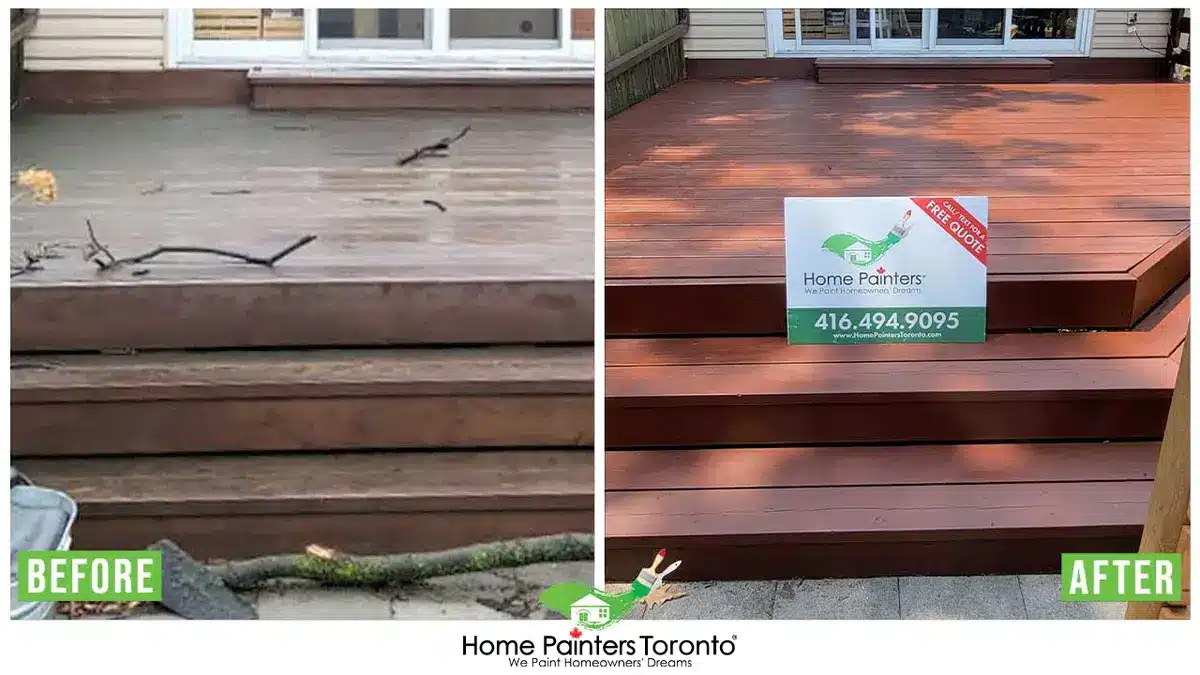
Water based acrylic resin retains elasticity down to -20°C — it moves with the wood through Toronto's 34 annual freeze and thaw cycles instead of cracking against it like the rigid alkyd film of an oil based stain
Oil vs Water Based Deck Stain: Which Survives Toronto's Climate?
Water based stain outperforms oil based stain on most Toronto decks because it expands and contracts with the wood during freeze and thaw cycles without cracking the film. Oil based stain forms a rigid alkyd film that becomes brittle below -10°C, which is a temperature Toronto reaches many times each winter. The gap in performance is most visible on south facing decks and decks built after 2010 with kiln dried pressure treated lumber.
How Toronto's Freeze and Thaw Cycles Destroy the Wrong Stain
Toronto averages 34 freeze and thaw cycles per year according to Environment Canada climate normals. Each cycle pushes moisture into the wood grain, then contracts it as temperatures drop. An oil based alkyd film cannot flex with that movement. The result is micro cracking that starts at end grain cuts and spreads across the deck surface within 18 months. Water based acrylic resins, by contrast, retain elasticity down to -20°C. This is why coating manufacturers like Benjamin Moore now recommend water based formulations for all above grade wood surfaces in Zone 6 climates.
| Factor | Oil Based Stain | Water Based Stain |
|---|---|---|
| Film forming behaviour | Rigid alkyd film, brittle in cold | Flexible acrylic film, moves with wood |
| Freeze and thaw performance | Cracks and peels after 1 to 2 seasons | Holds integrity through 30+ cycles |
| Dry time (Toronto summer, 22°C) | 24 to 48 hours between coats | 2 to 4 hours between coats |
| VOC content | High (250–450 g/L typical) | Low VOC (under 100 g/L) |
| Recoatability | Difficult — requires full strip after failure | Easy — light sand and overcoat |
| UV resistance | Moderate — oil oxidises and greys | High when pigmented (semi transparent or solid) |
| Best suited for | Raw aged softwood, shaded decks | Pressure treated, hardwood, south facing decks |
| Typical lifespan in Toronto | 1 to 3 years | 3 to 5 years |
Why Oil Based Stains Fail on Toronto Decks Faster Than You Think
Oil based stains penetrate raw wood fibre deeply, which is their main advantage on fresh, uncoated softwood. The problem is that modern pressure treated lumber is kiln dried after treatment (KDAT), meaning the cells are already compressed and dense. KDAT lumber resists deep penetration, so the oil stain sits at the surface and forms a thin film that behaves like paint, not like a true penetrating stain. The USDA Forest Products Laboratory research on wood moisture and coating adhesion confirms that coating adhesion on kiln dried surfaces drops significantly when moisture content exceeds 19% at time of application, a condition common on GTA decks after spring thaw.
Recoating an Oil Based Deck Stain: Why It Becomes a Trap
Once an oil based stain begins to fail, you face a difficult choice. Applying a fresh oil coat over a cracked film traps moisture beneath the new layer and accelerates peeling. Water based stain will not bond properly over a degraded oil film either, because the alkyd residue repels the acrylic emulsion. The only correct repair is a full mechanical strip using a pressure washer at 2,800 to 3,200 PSI, followed by oxalic acid brightening to restore surface pH to between 6.0 and 7.0. That process adds $300 to $600 in labour to any recoat job. Many homeowners repeat this cycle every two years without realizing the original product choice created the problem.
Oil based stain also has a critical UV limitation. The oil component oxidises under solar radiation and turns grey, a process called photodegradation. On a south facing Toronto deck that receives direct sun from 10 a.m. to 5 p.m. in summer, a clear or natural tone oil stain can grey out within a single season. A semi transparent water based stain with a pigment load of at least 8% will block UV far more effectively, because pigment is the active UV blocking agent in any coating.
When Water Based Stain Is the Smarter Choice for GTA Decks
Water based stain is the correct product for the majority of Toronto decks built in the last 15 years. It bonds reliably to KDAT pressure treated pine, Trex composite fascia boards, cedar, and ipe. It cleans up with water, dry times allow a second coat the same day, and its acrylic resin remains flexible through Ontario winters. The low VOC formula also makes it easier to work with in urban neighbourhoods where air quality bylaws may restrict solvent emissions during peak application periods.
Surface Preparation: The Step That Decides Stain Longevity
No stain, oil or water based, will perform well on a poorly prepared deck. Thorough preparation is the single most important factor in stain longevity. The correct process has four stages: power washing at 2,500 to 3,000 PSI to remove dirt, mould, and mill glaze; oxalic acid brightening at a 4 to 6 oz per gallon dilution to open wood fibres and neutralise tannins; 60 grit mechanical sanding of raised grain on high traffic boards; and a final moisture reading to confirm the substrate is below 15% before any coating goes down. Skipping any of these stages guarantees premature failure, regardless of which stain you choose.
Water based stain also rewards good prep more visibly than oil based products. A properly brightened cedar deck accepts water based acrylic evenly across the grain, producing a clean, consistent tone. Oil based stain applied to the same surface without brightening tends to blotch, especially on tight grain cuts near knots where absorption varies by up to 40%. That blotching is permanent and cannot be corrected without stripping the board.
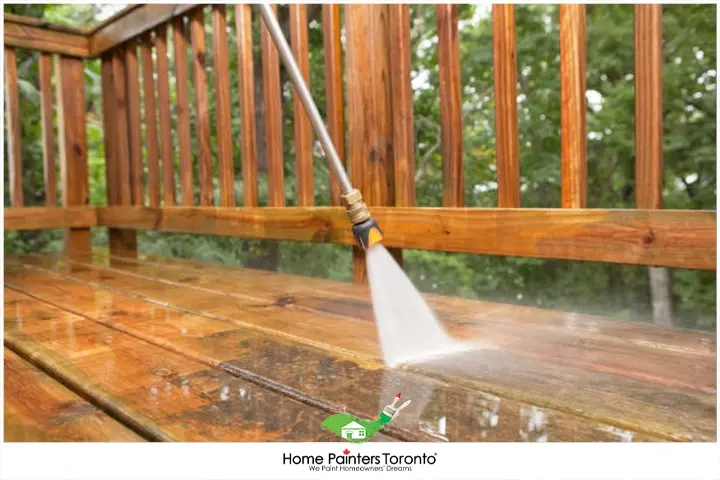
Four stage prep — 2,500 to 3,000 PSI wash, oxalic acid brightening at 4 to 6 oz per gallon, 60 grit sand on high traffic boards, moisture reading below 15% — the process that separates a stain that lasts 3 to 5 seasons from one that fails in 18 months
Cost of Exterior Deck Staining in Toronto
Exterior deck staining in Toronto typically costs between $2,000 and $8,000 CAD plus HST, depending on deck size, wood condition, the number of coats required, and the stain product selected. For a full breakdown of what drives painting and staining costs across different exterior surfaces, see our guide to the cost of painting a house in Toronto.
| Deck Size | Estimated Cost (CAD + HST) | Notes |
|---|---|---|
| Small deck (up to 200 sq ft) | $2,000 – $4,000 | Single storey, good condition, 2 coats |
| Medium deck (200 – 500 sq ft) | $4,000 – $8,000 | Multi level or significant prep required |
| Strip and recoat (any size) | Add $300 – $600 | Full mechanical strip of failed oil stain |
| Stair treads (per flight) | Included in deck quote | Counted as high traffic surface |
| Railing spindles and posts | Included or quoted separately | Spray application adds efficiency |
Single storey, good condition, 2 coats
Multi level or significant prep required
Full mechanical strip of failed oil stain
| Cost Factor | Impact | Detail |
|---|---|---|
| Deck size (sq ft) | Primary driver | More surface area means more product and labour |
| Wood condition | High | Damaged or raised grain adds prep time |
| Prior coating type | High | Failed oil stain requires full strip |
| Stain grade | Moderate | Premium water based stains cost $80 – $120 per gallon vs $40 – $70 for standard |
| Number of coats | Moderate | Two coats always recommended on bare or stripped wood |
| Deck height and access | Low to moderate | Elevated decks require additional setup |
The Solid vs Semi-Transparent Debate: What Most Toronto Homeowners Get Wrong
Most homeowners focus on oil vs water based when they should also be asking whether to use solid or semi transparent finish. Solid stain hides wood grain completely and delivers the longest lifespan of any deck coating, typically 4 to 6 years in Toronto, because the high pigment load provides full UV blocking. Semi transparent stain preserves wood grain but allows some UV penetration, which means it needs recoating every 2 to 3 years on south facing decks. The Benjamin Moore Arborcoat exterior stain system publishes documented test data showing that solid formulations in their line provide significantly higher UV resistance than semi transparent options, measured in direct radiation exposure hours before colour degradation begins.
The common mistake is choosing semi transparent stain for aesthetic reasons on a deck that faces south and receives more than 6 hours of direct sun per day. Clear and natural tone stains have almost no UV protection because they carry no pigment. A clear stain on a south facing Toronto deck will grey and peel within 12 months. Pigment is the only thing that blocks UV radiation. A solid or semi solid water based stain will protect the substrate and hold its colour 3 to 4 times longer in those conditions.
There is one case where semi transparent wins: a deck built from premium hardwood like ipe, teak, or mahogany, where the natural grain is worth preserving. In that situation, a semi transparent water based stain applied every 2 years is the correct approach, supported by a strict annual cleaning and inspection schedule. For pressure treated pine or cedar, which represent the majority of Toronto residential decks, solid or semi solid coverage delivers a much better return per dollar spent.
A Recent Deck Staining Project in Long Branch, Etobicoke
Two Oil Based Failures in Three Years — Corrected with Water Based Acrylic and Proper Prep
A homeowner in Long Branch, Etobicoke called us after two consecutive failures with an oil based penetrating stain on their pressure treated pine deck. The deck was approximately 320 sq ft, south facing, and had been stained twice in three years. Each time, the coating greyed and began peeling by the second summer. Our crew assessed the surface and found extensive film cracking along the end grain cuts, and our Delmhorst BD 10 pin moisture meter read 17% moisture content, just below the 19% threshold. The prior product was an alkyd based penetrating stain applied without a brightening step, which left the surface pH high (above 8.0) and the grain partially closed. For full details on what we look for before any exterior staining project, see our exterior painting projects portfolio.
We stripped the deck completely using a 3,000 PSI pressure wash, followed by an oxalic acid brightening treatment at 5 oz per gallon. After drying for 48 hours, moisture content dropped to 11%. We then sanded all high traffic boards with 60 grit to open the grain and applied two coats of Armstrong Clark Semi Transparent Mahogany at a wet film thickness of 4 to 5 mils per coat. Ambient temperature on application day was 22°C with 55% relative humidity, ideal conditions for water based penetrating stain. The deck absorbed both coats evenly with no blotching, and the client confirmed there was no sign of peeling or greying after the following winter.
That project is typical of what we see across Etobicoke, Scarborough, and Mississauga. The failure pattern is almost always the same: wrong product, skipped prep, no moisture check. Fixing it costs more than doing it right the first time. For related exterior wood surfaces, our team also handles full wood deck repair before staining, which is especially important when boards show cupping, splitting, or rot at joist connections. We also carry out exterior wood siding staining and front door restaining and refinishing as companion services during the same project visit, which reduces total mobilisation costs for homeowners.

Delmhorst BD 10 reading 17% before strip, 11% after 48-hour dry — 3,000 PSI wash, oxalic acid at 5 oz per gallon, 60 grit sand, Armstrong Clark Semi Transparent Mahogany at 4 to 5 mil WFT per coat — no peeling or greying after the following winter
Why Toronto Homeowners Trust HPT for Exterior Deck Staining
Home Painters Toronto has delivered warranty backed results on exterior wood surfaces since 1987. We are a family owned and operated contractor serving the GTA, fully WSIB compliant, and carry $5M in general liability insurance. Every crew member passes a criminal background check before entering any residential property. Our deck staining work is backed by a 3 year exterior warranty and a 100% Satisfaction Guarantee. Read what clients say on our HomeStars and Google reviews page, we hold over 1,200 verified reviews and have earned the HomeStars Best of Award 2026 and Three Best Rated 2025.
We offer same day estimates seven days a week, which means you can get a firm written quote before committing to any product or schedule. Our estimators identify whether your deck requires a strip job, a spot repair, or a clean preparation before we quote, so there are no surprises on site. To understand the broader scope of what we handle on exterior surfaces, visit our exterior house painting services page or learn why Toronto homeowners choose HPT.
We also handle related exterior surfaces including exterior brick staining, wood siding staining, and caulking around windows and doors, all of which are commonly bundled with deck staining projects to maximise the efficiency of a single site visit.
Frequently Asked Questions
A water based solid or semi solid stain on a properly prepared deck lasts 3 to 5 years in Toronto's climate. A semi transparent water based stain on a south facing deck lasts 2 to 3 years. Oil based stain on pressure treated lumber typically fails within 1 to 2 years due to film brittleness in freeze and thaw conditions.
No, not without stripping the surface first. Water based acrylic stain will not bond over a degraded oil alkyd film. The alkyd residue repels the acrylic emulsion, causing adhesion failure within one season. The correct process is a full mechanical strip using 2,800 to 3,200 PSI pressure washing, followed by oxalic acid brightening, before any water based product is applied.
A semi transparent or solid water based acrylic stain is the correct product for pressure treated pine in Toronto. Pressure treated lumber is typically kiln dried after treatment, which makes it dense and resistant to deep oil penetration. Water based acrylics bond well to KDAT surfaces, flex with seasonal wood movement, and recoat easily without stripping when the time comes.
Deck staining in Toronto costs between $2,000 and $8,000 CAD plus HST, depending on size, wood condition, and whether a full strip is needed. A small deck in good condition falls in the $2,000 to $4,000 range. A larger deck requiring mechanical strip and full prep can reach $4,000 to $8,000. All estimates are written and firm before any work begins.
New pressure treated lumber must be allowed to dry to below 19% moisture content before staining. In Toronto, that typically means waiting 6 to 12 weeks after installation, depending on weather conditions. Applying stain to wet lumber causes adhesion failure and premature peeling. Always confirm moisture content with a pin meter before applying any coating.
Bare or stripped wood generally does not require a separate primer before staining, because most penetrating stains act as their own sealer on the first coat. However, any areas showing bare end grain cuts or porous knots benefit from a spot application of a tannin blocking wood conditioner to prevent bleed through. Decks transitioning from oil to water based products always need a full strip before the first coat.

Get Fast Free Quotes and Warranty-Backed Deck Staining in Toronto
The oil vs water based question has a clear answer for most Toronto decks: water based acrylic stain outperforms in every category that matters in this climate. It flexes with the wood, holds colour under UV, recoats without stripping, and lasts 3 to 5 years on a properly prepared surface. Oil based stain still has a role on raw aged softwood in shaded low traffic areas, but that describes very few residential decks in the GTA. Choosing the wrong product does not just mean a shorter lifespan, it means a costly strip and restart that costs more than the original job. For companion exterior services, see our work on interior and exterior painting contractor services.
Home Painters Toronto has served 17,000+ satisfied clients across the GTA, earned the HomeStars Best of Award 2026, and backs every deck staining project with a 3 year exterior warranty and a 100% Satisfaction Guarantee. We are WSIB compliant, fully insured, and available 7 days a week. Get fast free quotes and warranty backed work by reaching out to Contact Home Painters Toronto today.
Get a Fast Free Quote for Deck Staining in Toronto
Contact Home Painters Toronto today for fast free quotes and warranty backed work on your exterior deck staining project. We are available 7 days a week with same day estimates across the GTA.
Contact Us for a Free Quote