

Exterior Fence Staining vs Painting in Toronto: Which Lasts Longer?
Toronto homeowners face a real choice every time a wood fence starts to look tired. Staining and painting are both valid options, but they behave completely differently on an exterior wood substrate exposed to Ontario's brutal seasons. The wrong choice leads to peeling film, trapped moisture, and a redo job in as little as two years. Home Painters Toronto has completed deck and fence staining projects across the GTA for over 38 years, and our 1,200+ reviews on HomeStars and Google reflect what actually holds up. This article gives you an honest comparison so you can make an informed decision before spending a dollar.
For most Toronto fences, penetrating stain outlasts paint by three to five years because it soaks into the wood fibres rather than sitting on top as a brittle film. Paint is only the better choice when the fence is smooth, pre primed, and sheltered from direct moisture exposure, conditions rare on standard cedar or pressure treated board fences in Ontario.
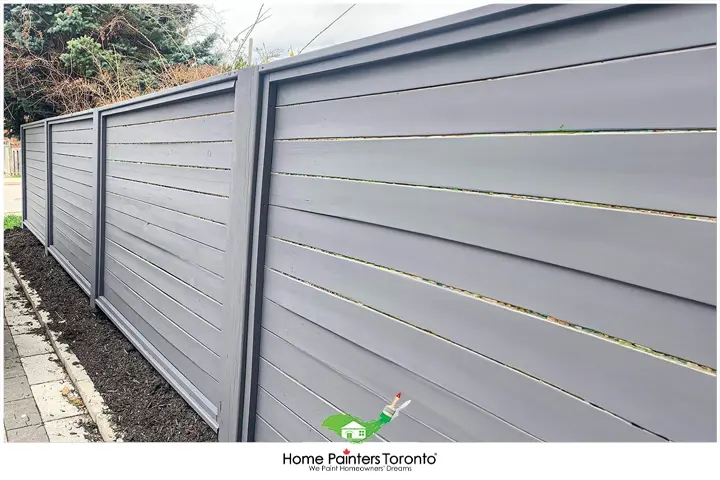
Penetrating stain bonds with wood lignin at the cellular level — when it weathers, it fades gradually and evenly. Paint forms a rigid film above the grain that Ontario's freeze-thaw cycles crack open within two winters, creating capillary pathways for snowmelt to enter and blister from within
Staining vs Painting: The Core Difference for Toronto Fences
Stain penetrates wood fibres at the cellular level, while paint forms a solid film on top of the surface. That distinction determines everything — longevity, maintenance cycle, failure mode, and total cost over a ten year period. On cedar and pressure treated pine, which are the two most common fence materials in Toronto, a penetrating semi transparent stain bonds with the lignin inside the wood. A latex based paint cannot do the same because it sits above the grain and cures into a hard shell.
When that shell meets Ontario's freeze and thaw cycling, it cracks. Water enters the crack, sits under the film, and begins the process of blistering. Stain has no film to crack. When it wears, it fades gradually and evenly, requiring a light recoat rather than a full strip and-repaint project.
Penetrating Stain
Bonds inside the wood fibre. Typical lifespan 3 to 7 years. Fails by gradual fading — no peeling. Maintenance is a light recoat when faded. High moisture tolerance. Semi transparent to solid tones. Best on cedar, pine, pressure treated wood.
Exterior Paint
Forms a film on the surface. Typical lifespan 1 to 4 years on an unprimed fence board. Fails by blistering, cracking, full film lift. Maintenance requires full strip, sand, and repaint. Low moisture tolerance — traps vapour behind the film. Best on smooth composite or primed hardboard only.
| Feature | Penetrating Stain | Exterior Paint |
|---|---|---|
| Adhesion Mechanism | Bonds inside the wood fibre | Forms a film on the surface |
| Typical Lifespan (Toronto) | 3 – 7 years depending on exposure | 1 – 4 years on an unprimed fence board |
| Failure Mode | Gradual fading, no peeling | Blistering, cracking, full film lift |
| Maintenance Cycle | Light recoat when faded | Full strip, sand, and repaint |
| Moisture Tolerance | High — breathable substrate | Low — traps vapour behind the film |
| Colour Range | Semi transparent to solid tones | Full opacity, any colour |
| Best Substrate | Cedar, pine, pressure treated wood | Smooth composite or primed hardboard |
Why Painted Fences in Toronto Fail Faster Than You Expect
A painted fence in Toronto faces a physics problem that most homeowners do not know about until the damage is already done. Wood expands in summer heat and contracts in winter cold. In Ontario, that range can span from minus 30°C to plus 35°C over twelve months. A latex based paint film expands and contracts at a different rate than the wood beneath it. That mismatch creates micro fractures at the surface, usually within the first two winters after application.
How Toronto's Freeze and Thaw Cycles Destroy a Painted Fence Surface
Once a micro fracture forms, it acts as a capillary pathway for snowmelt. Water enters and freezes inside the crack. The ice expands at roughly 9% greater volume than liquid water, a mechanical force no paint film can resist. The crack widens, the surrounding film lifts, and you now have an active blister. Left untreated, that blister spreads laterally and the entire panel begins to peel. This is not a product failure. It is a thermodynamic certainty on any fence board that was not prepared, primed, and sealed with a system designed for wood movement.
The problem is compounded by the fence's position. A fence sits at grade level, meaning it intercepts ground splash, lawn irrigation overspray, and snow accumulation directly. These are the highest moisture load conditions on any residential property. Paint film and high moisture load is a poor combination on an exterior wood surface.
According to moisture content thresholds for exterior wood finishing, wood should measure below 15% moisture content before any coating is applied. At the base of a fence board near the soil line, readings of 20% or higher are common in spring. Applying paint over wet wood is one of the most frequent causes of early paint failure in Toronto fence projects.
When Fence Staining Outperforms Paint in Ontario's Climate
Penetrating stain excels on any fence substrate where wood movement, moisture exposure, and UV radiation are all present at the same time. Cedar, western red cedar, pine, and pressure treated lumber all fall into this category. Stain works by depositing pigment and preservative resins inside the wood fibres. Because there is no film above the surface, there is nothing to crack, blister, or peel. When the stain eventually weathers, it does so uniformly and the surface simply needs a thorough cleaning and a fresh recoat.
Solid colour stains, a category that many homeowners do not consider, deliver near paint opacity while retaining the breathable, penetrating behaviour of a stain. They are the right choice when you want a bold, opaque finish on a cedar fence but cannot accept the maintenance demands of a film forming paint system. For fences that face south or southwest and receive six or more hours of direct sun per day, solid pigment load also matters. UV radiation degrades the lignin in exposed wood and causes greying. Stain pigment blocks UV rays at the surface and slows that degradation significantly.
The Right Stain Products for Exterior Fence Staining in Toronto
Product selection makes a significant difference in how long a stain job holds up in the GTA. Benjamin Moore's Arborcoat exterior stain technical data sheet shows a water repellent, mildewcide treated formulation designed specifically for freeze and thaw climates. For a cedar board fence, the semi transparent formula in a satin finish gives the best balance of UV protection and wood grain visibility. Application at the correct wet film thickness, 3 to 4 mils on a properly absorbent substrate, is where most contractors cut corners. Too thin and the mildewcide coverage is insufficient. Too thick and the stain puddles at the grain and does not penetrate fully.
Cabot Australian Timber Oil is another high performance penetrating option suited to the dense grain of pressure treated pine fence boards. On smooth or tight grain substrates, a lightly sanded surface at 80 grit opens the grain and dramatically improves product absorption. Skipping that step is a common field error that cuts stain longevity by up to two years on a south facing fence.
Cost Comparison: Fence Staining vs Painting in Toronto
The upfront cost of painting a fence can appear lower because labour time for rolling on latex paint is fast. The true cost comparison only becomes clear over a full maintenance cycle. A painted fence typically needs a full strip, sand, and repaint every three to four years in Toronto's climate. A stained fence needs cleaning and a recoat every four to seven years depending on sun exposure and wood condition. Over a ten year period, the total cost of a painted fence is consistently higher than the total cost of a stained fence on the same structure.
See our detailed breakdown on the cost of painting a house page for a broader context on exterior project pricing in the GTA.
| Project Type | Typical GTA Cost (CAD + HST) | Expected Lifespan | 10 Year Total Cost (est.) |
|---|---|---|---|
| Fence Staining — Small yard (up to 100 linear ft) | $2,000 – $4,000 | 5 – 7 years | $4,000 – $6,000 |
| Fence Staining — Medium yard (100–200 linear ft) | $4,000 – $6,000 | 5 – 7 years | $6,000 – $9,000 |
| Fence Painting — Small yard (up to 100 linear ft) | $1,800 – $3,500 | 2 – 4 years | $5,400 – $10,500 |
| Fence Painting — Medium yard (100–200 linear ft) | $3,500 – $6,000 | 2 – 4 years | $10,500 – $18,000 |
| Full Strip and Repaint (existing painted fence) | $2,500 – $5,000 | 2 – 3 years | Ongoing cycle cost |
These ranges follow the same pricing structure used across our exterior services. Fences with existing paint that is peeling require mechanical stripping before any new coating is applied. That adds labour time and cost and is a step that cannot be skipped without compromising the new finish. Staining a fence that has never been painted requires no stripping, only a thorough pressure wash, a brightness treatment, and a light sand on tight grain areas.
A Recent Fence Project in East York: What We Found Under the Old Paint
East York Project: Substrate Moisture, Film Failure, and the Fix
Last autumn, our crew took on a cedar board fence in the Danforth and Woodbine area of East York. The homeowner had painted the fence white three years prior using a standard latex exterior paint. By the time we arrived, roughly 40% of the surface showed active blistering and the lap joint areas were lifting completely. Before we touched a brush, we took pin type moisture meter readings at five points along the fence line.
Four of the five readings came back between 19% and 23%, well above the 15% safe threshold for coating application. The paint film had been sealing that moisture inside the boards for three seasons, accelerating the wood degradation underneath. We stripped the fence mechanically using a 3,500 PSI pressure wash at a 15 degree fan tip angle, followed by an oxalic acid brightener application to neutralise the pH and lift the grey oxidation from the cedar fibres. After 48 hour drying time, moisture readings dropped to 12%.
We applied Cabot Australian Timber Oil in Natural finish at 3.5 mils wet film thickness, working the product into the grain with a brush rather than a roller to ensure full penetration at the board edges and end grain. Two seasons on, the fence shows zero blistering. The neighbour's re painted fence, done by a different contractor the same month, had already begun blistering at the lap joints by the following spring. The substrate and the product type made all the difference.
You can view similar results across our fence and exterior projects portfolio for reference.

4 of 5 readings at 19–23% moisture, 3,500 PSI wash at 15-degree fan tip, oxalic acid brightener, 48-hour dry to 12% moisture, Cabot Australian Timber Oil Natural at 3.5 mil WFT by brush — two seasons, zero blistering. Neighbour's repainted fence had begun blistering at lap joints by the following spring
Why Toronto Homeowners Trust HPT for Fence and Exterior Wood Work
Home Painters Toronto has been a family owned painting contractor since 1987, 38 years of exterior wood work across every GTA neighbourhood. We are WSIB compliant, carry $5M general liability insurance, and every crew member passes a criminal background check before stepping onto your property. Our client reviews show over 1,200 verified ratings on HomeStars, Google, and Houzz, and we are proud to hold the HomeStars Best of Award 2026 and Three Best Rated 2025.
Fence staining and painting both come with our warranty backed results. All exterior staining work carries a 3 year warranty. We also provide same day estimates, open seven days a week, so you are never waiting a week for someone to show up and give you a number.
Our exterior wood experience extends to exterior wood siding, wood siding, wood frame repair, and wood deck repair. If we spot a structural issue on a fence post or board while scoping a staining project, we will flag it and advise you before the coating work begins.
Find out more about why homeowners across Toronto choose HPT or browse our frequently asked questions page for more detail on our process and standards.
Frequently Asked Questions
A well prepared and correctly applied penetrating stain on a cedar or pressure treated pine fence lasts between four and seven years in Toronto's climate. Fences with southern or western exposure that receive direct sun for most of the day will sit at the lower end of that range because UV radiation degrades the pigment load faster. Fences in shaded or sheltered yards can exceed seven years before a recoat is needed. The condition of the wood at the time of application is the single biggest variable.
No. A penetrating stain cannot absorb into a surface that has an intact paint film sitting on top of it. If your fence has been painted, the paint must be fully stripped before staining is an option. On a fence where the paint has already begun to peel, mechanical stripping followed by a pressure wash and brightener treatment is the standard preparation sequence. Attempting to apply stain over loose or flaking paint results in a failed coating within one season.
The upfront material cost for latex paint is often slightly lower than premium penetrating stain. The labour cost for both is comparable. Over a full maintenance cycle of ten years, staining a fence is consistently more cost effective because it avoids the expensive strip and repaint cycle that a painted fence requires every two to four years. The total cost difference over a decade can be substantial on a medium sized yard fence.
For cedar fences in the GTA, a penetrating semi transparent or solid colour stain with a built in mildewcide and UV absorber is the professional standard. Benjamin Moore Arborcoat and Cabot Australian Timber Oil are both field proven performers in Ontario's climate. The finish sheen matters too, a satin or low lustre finish sheds water more effectively than a flat finish on a horizontal or near horizontal surface like a fence cap or top rail.
If the wood is structurally sound — no soft spots, no rot at the post bases, no significant cracking through the board thickness — it is a staining or painting candidate. Insert a screwdriver tip firmly into the wood at the base of several boards. If it penetrates more than 6 mm with moderate pressure, the wood has begun to decay and that board needs replacement before coating. Our team assesses fence substrate condition as part of every estimate at no charge. We also flag any issues that may require wood frame repair before the coating work begins.

Make the Right Call for Your Toronto Fence
Exterior fence staining vs painting in Toronto is not a close contest on most residential wood fences. Stain penetrates, breathes, and tolerates the moisture cycling that Ontario's climate demands. Paint forms a film that Ontario winters are very good at destroying. On cedar, pine, and pressure treated lumber, the most common fence materials across the GTA, a quality penetrating stain applied over a properly prepared substrate will outlast paint by years and cost less to maintain over the long run.
If your fence needs a refresh, an assessment, or a full restoration project, our team covers all of Toronto and the surrounding GTA. We also handle exterior house painting Toronto, exterior brick staining, caulking windows and doors, and a full range of exterior carpentry services as a licensed painting contractor Toronto.
Contact Home Painters Toronto today for fast free quotes and warranty backed work on your fence staining or painting project. We are available seven days a week and can have someone at your property for a same day estimate.
Get a Fast Free Quote for Fence Staining in Toronto
Contact Home Painters Toronto today for fast free quotes and warranty backed work on your fence staining or painting project. Available seven days a week with same day estimates across the GTA.
Contact Us for a Free Quote