

How to Match Exterior House Paint on a Toronto Home
Toronto homeowners face a specific challenge every time they repaint a section of their exterior: matching the existing colour on wood, stucco, brick, or vinyl siding while accounting for years of UV exposure and Ontario climate stress. Whether you're repainting after a repair in Etobicoke, touching up storm damage in Scarborough, or refreshing trim on a heritage home in Rosedale, a bad colour match stands out immediately. At Home Painters Toronto, we've completed over 17,000 projects across the GTA and hold over 1,200 positive reviews on HomeStars, Google, and Houzz. Our crews handle exterior house paint matching on substrates that have faded, chalked, or shifted over decades. This guide explains exactly how professional colour matching works and what determines a successful result on a Toronto exterior.
To match exterior house paint on a Toronto home, professionals use a spectrophotometer to scan the existing colour, then account for sheen level and substrate fading. The process involves surface cleaning, moisture testing, and primer selection before a matched topcoat is applied. Same day colour analysis is available across the GTA.
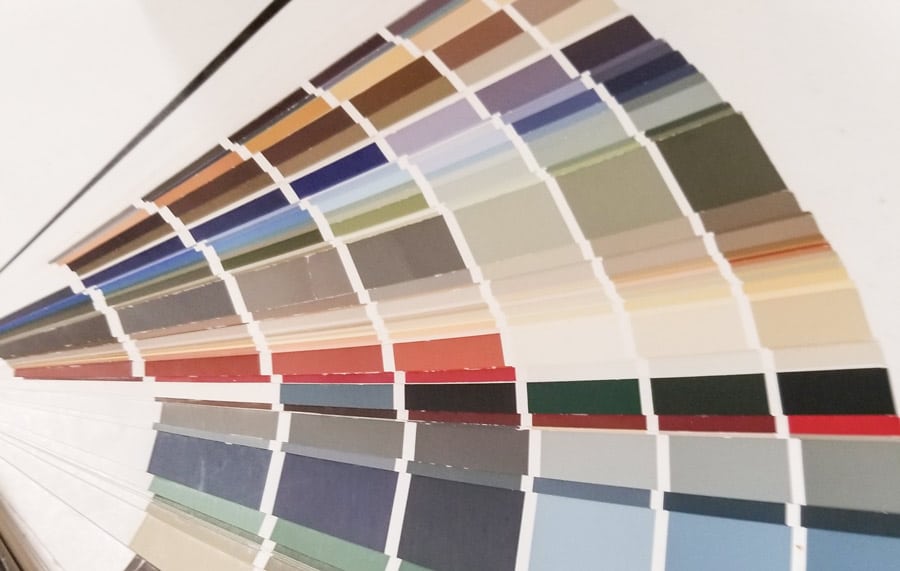
What Exterior House Paint Matching Actually Means for Toronto Homes
Colour matching on a Toronto exterior is not simply picking a similar shade from a paint chip. It requires reading the actual light reflectance value (LRV) of the existing surface and accounting for how that surface has changed since it was first painted. Painted substrates fade, chalk, oxidise, and shift in hue at different rates depending on sun exposure, moisture cycling, and the original paint chemistry.
A south facing wall in North York will have faded far more than the north facing wall on the same house, so a single formula match will rarely work across both surfaces. Professional painters treat each elevation as its own colour problem. The goal is not to reproduce the original formula but to produce a result that reads as visually consistent to the human eye from the street.
Three things affect how a colour reads on your exterior once applied: the spectral data of the existing surface, the sheen level of the new paint, and the substrate texture. Rough stucco absorbs light and makes a colour appear darker. Smooth fibre cement reflects light and makes the same formula appear slightly lighter. Professionals compensate during the matching process by adjusting LRV targets.
| Factor | Effect on Perceived Colour | Professional Response |
|---|---|---|
| UV fading | Shifts warm tones toward grey or beige | Spectrophotometer scan to capture current state |
| Substrate texture | Rough surfaces absorb light, darken colour | LRV adjustment in formula |
| Sheen level change | Higher sheen increases contrast and colour depth | Match sheen as well as colour formula |
| Chalking | Creates a white film over original colour | Clean and prime before scan |
| Age of existing paint | Oxidisation shifts hue over 5 to 10 years | Blend target with slight tone correction |
The Science Behind Paint Adhesion and Colour Shift in Ontario Winters
Ontario's freeze and thaw cycles put unique stress on exterior paint film. Toronto sees average lows of around -10 degrees Celsius in January and rapid temperature swings in spring, which cause acrylic films to contract and expand repeatedly across a single season. This mechanical stress is what causes micro cracking, and micro cracking is what allows moisture to penetrate the substrate and accelerate colour fade and substrate damage.
A film forming acrylic product like Benjamin Moore Aura Exterior, which publishes a minimum application temperature of 4.4 degrees Celsius and an elasticity rating that allows the film to stretch up to 200% before cracking, is what makes it perform well on Toronto wood framed homes through multiple freeze and thaw cycles. Alkyd based products cure harder and are far more prone to cracking in cold weather. Colour matching with an alkyd base on a substrate that already has an acrylic topcoat will cause delamination, not just a colour mismatch. Visit our exterior house painting Toronto page for a full overview of our substrate assessment process.
Paint colour also shifts during cure. Darker tones and deep base formulas experience the most noticeable shift, sometimes appearing 5 to 10 LRV points lighter when wet and settling to a deeper value once fully cured at 48 hours. Professionals account for this when pulling a formula from a spectrophotometer scan, nudging the formula slightly darker than the scanned reading to compensate for the wet to-dry shift.
How Professional Painters Complete Exterior Paint Matching: Step by Step
Professional exterior house paint matching in Toronto follows a precise sequence. Skipping any step produces a result that fails under direct sunlight or shifts further within one season.
- Step 1: Surface cleaning. Remove chalk, biological growth, and loose paint with a pressure wash at 1,500 to 2,000 PSI. Organic contamination distorts spectrophotometer readings.
- Step 2: Moisture testing. Confirm substrate moisture content is below 15% using a calibrated pin moisture meter. Painting over moisture locks in water vapour and causes blistering within weeks.
- Step 3: Spectrophotometer scan. Hold the device flat against a clean, representative area of the existing paint and take three to five readings across the elevation. The device returns Lab colour values, which are fed into the paint manufacturer's matching system.
- Step 4: Formula correction. The raw formula is adjusted for sheen, substrate type, and the wet to-dry colour shift before the batch is tinted.
- Step 5: Primer selection. If the substrate is bare or has adhesion issues, a penetrating acrylic primer is applied at 2 to 3 mil dry film thickness before the topcoat.
- Step 6: Test patch application. A small section is painted and allowed to dry fully before the full colour match is approved and production begins.
Spectrophotometer Readings and Substrate Assessment in Toronto
A spectrophotometer measures the wavelength and intensity of light reflected from a surface at multiple angles. It does not guess colour. It returns numerical Lab values (L for lightness, a for red green axis, b for yellow blue axis) that paint tinting systems translate into precise pigment formulas. The device is calibrated against a white reference tile before each use to eliminate ambient lighting errors.
Substrate assessment happens alongside the colour scan. The technician checks for substrate type, paint system type (acrylic or alkyd), adhesion strength via tape pull test, and surface profile (rough, medium, or smooth). On brick and masonry surfaces, the assessment also checks for efflorescence and active moisture migration, which affect both adhesion and long term colour stability. See our page on exterior brick staining for how these variables are handled on masonry.
How to Match Exterior House Paint When the Original Tin Is Gone
Most Toronto homeowners who want to match their exterior paint no longer have the original tin. This is the most common scenario and it is not a problem for professionals. The spectrophotometer scan reads the current colour state of the surface, which is actually more useful than the original formula because it captures how the colour looks today after years of weathering. Feeding the original formula into a fresh batch without accounting for surface ageing would produce a paint that looks noticeably newer and brighter than the surrounding surfaces.
If you have leftover paint from the original job, a paint manufacturer fan deck match can supplement the spectrophotometer data. Professionals cross reference both sources and weight the scan reading more heavily. For homes with exterior wood siding or vinyl windows and siding painting, we run substrate specific formula corrections as standard procedure.

Sheen mismatch is the most common cause of visible colour match failure — a flat and a satin of the exact same formula can appear up to two shades different in tone under direct sunlight. A gloss metre reading (GU at 60 degrees) confirms the original sheen level before any formula is pulled
Why Sheen Level Is the Most Overlooked Part of Paint Matching
Most colour matching failures in Toronto are not formula failures. They are sheen failures. A flat finish and a satin finish of the exact same colour formula will read as two completely different colours on an exterior surface. Higher sheen levels reflect more directional light, which makes colours appear richer and deeper. Lower sheen levels scatter light, which makes the same colour appear lighter and more muted.
Professionals always confirm the original sheen level before pulling a formula. If the original sheen is unknown, a gloss metre reading is taken alongside the spectrophotometer scan. Most Toronto exteriors are painted in low lustre or satin finish. Flat exterior finishes are uncommon because they absorb dirt and are harder to clean. High gloss is reserved for trim, doors, and accent elements where definition is important.
| Sheen Level | Gloss Reading (GU at 60 degrees) | Best Use on Toronto Exteriors | Effect on Colour Perception |
|---|---|---|---|
| Flat / Matte | 0 to 10 | Stucco, rough masonry | Lighter, more muted appearance |
| Low Lustre | 10 to 25 | Main body siding, cladding | True to formula, low glare |
| Satin | 25 to 45 | Smooth siding, trim | Slightly richer, higher contrast |
| Semi Gloss | 45 to 70 | Trim, window frames, soffits | Noticeably deeper, reflective |
| Gloss | 70+ | Front doors, accent features | Deepest, most vibrant reads |
On homes with aluminum siding painting needs, sheen selection is especially critical because the original factory finish on aluminum is typically a baked on semi gloss. Matching with a low lustre acrylic will read as visually flat even if the colour formula is exact.
A Colour Match Project in East York: What We Found on Site
Eleven Year Fade, Discontinued Brand, Unknown Formula — Matched With Spectrophotometer to Visual Indistinguishability
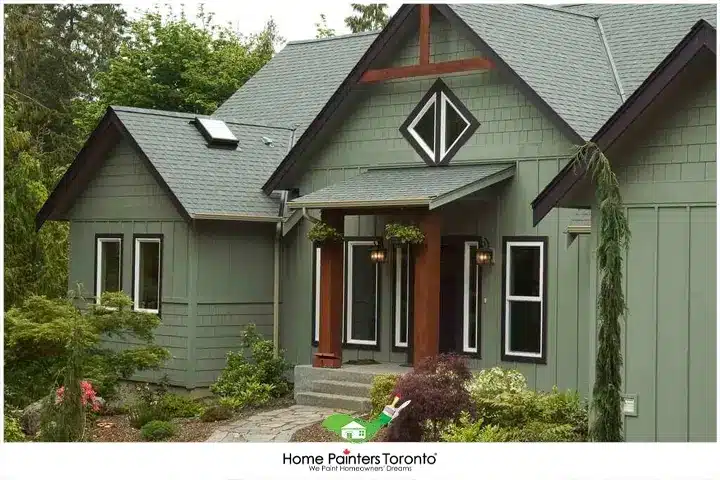
A recent project in the Greenwood Coxwell neighbourhood of East York illustrates how exterior house paint matching works in practice. The client owned a semidetached two storey home clad in LP SmartSide lap siding, originally painted in a muted olive green. The home had not been repainted in eleven years. The owners needed two full exterior elevations repainted after storm debris caused impact damage to the siding. The original paint brand had been discontinued and the colour formula was unknown.
Our project lead used a calibrated spectrophotometer to take five readings across the undamaged north elevation, which had experienced the least UV exposure. The Lab values were entered into the Benjamin Moore colour matching system, and the formula was adjusted for a Low Lustre finish to match the original sheen confirmed by a gloss metre reading of 18 GU. The final colour was produced in Benjamin Moore Aura Exterior in Low Lustre finish. Before application, a pin moisture metre confirmed the siding was at 11% moisture content, well below the 15% threshold. The product was applied at 4.5 mil wet film thickness using a 3/8-inch nap roller, producing a dry film of approximately 1.8 mil per coat.
Ambient temperature at time of application was 12 degrees Celsius with relative humidity at 58%, both within the manufacturer's published application window. The completed match was visually indistinguishable from the untouched south elevation when viewed from the street. The project also included caulking windows and doors on all penetrations and a refinished front door restaining and refinishing as part of the full restoration scope.
Home Painters Toronto is WSIB compliant, fully insured with $5M general liability coverage, and delivers warranty backed results on all exterior work. Our exterior painting projects carry a 3 year warranty. View our painting projects portfolio for before and-after documentation of exterior colour match projects across the GTA.
Common Exterior Paint Matching Failures and How to Prevent Them
The most common colour match failure is applying a new coat over an uncleaned or unchecked surface. Chalking creates a white haze between the old paint film and the new coat, which causes the new colour to appear lighter than intended and produces poor adhesion. The second most common failure is mismatching sheen levels. The third is failing to account for the dry to-cure colour shift on deep base formulas.
| Failure Type | Root Cause | Prevention |
|---|---|---|
| Colour appears too light | Scanning over chalked surface | Clean surface before scan, adjust LRV target |
| Visible match line at repair | Sheen mismatch between old and new | Gloss metre reading before formula pull |
| New paint looks brighter than old | Original formula used without age correction | Scan the existing surface, not the old tin |
| Paint peels within one season | High moisture content at application | Pin moisture metre, confirm below 15% |
| Colour shifts after two weeks | Deep base formula not fully cured before assessment | Allow full 48 hour cure before final colour check |
| Adhesion failure on brick | Wrong primer or no primer on masonry | Use silane siloxane penetrating primer on masonry |
On homes requiring repairs before painting, unresolved substrate issues are the biggest cause of colour match failure. Our drywall repair and installation and exterior carpentry teams handle substrate preparation as part of every exterior painting scope. We also help homeowners understand the full cost of painting a house before any work begins.
How Long a Matched Exterior Paint Job Lasts in Toronto's Climate
A properly matched and applied exterior paint job in Toronto lasts between 7 and 12 years on wood and fibre cement substrates, and between 5 and 8 years on surfaces with higher UV exposure such as south facing wood trim. These ranges apply when the correct primer is used, moisture content was below 15% at application, and a premium acrylic topcoat was applied at minimum 1.5 mil dry film thickness per coat.
| Substrate | Product Tier | Expected Lifespan in Toronto | Warranty |
|---|---|---|---|
| Wood framed siding | Premium acrylic (e.g., Aura Exterior) | 8 to 12 years | 3 year |
| Fibre cement (e.g., HardiePlank) | Premium acrylic | 10 to 15 years | 3 year |
| Aluminum siding | Bonding primer + acrylic topcoat | 7 to 10 years | 3 year |
| Stucco | Elastomeric acrylic | 6 to 9 years | 3 year |
| Brick and masonry | Mineral silicate or elastomeric | 10 to 15 years | 3 year |
For homes with wood decks or fences needing stain matching as part of the same exterior refresh, our deck and fence staining team handles that scope separately with its own colour matching process. Solid deck stains require a UV blocking pigment load to achieve meaningful longevity. Clear stains on south facing Toronto decks typically fail within 18 months. Read our client reviews to see what GTA homeowners say about our exterior colour matching results.
Which Paint Products Support Exterior House Paint Matching in Toronto
Not all paint products support the tinting depth and formula flexibility required for precision exterior house paint matching in Toronto. Two products stand out for their performance in Ontario's climate. Sherwin Williams Emerald Exterior provides a flexible acrylic film suited to freeze and thaw cycles, with a tinting range that covers over 1,500 colours and a published elongation rating of 127% at break. This makes it well suited to wood framed homes in Toronto that experience significant temperature swings across seasons.
Benjamin Moore Aura Exterior operates on a proprietary Colour Lock technology that binds pigment within the acrylic film, which reduces fading and chalking over time. Both products support spectrophotometer based formula input and allow post tint adjustments. At Home Painters Toronto, we select the product based on substrate type and the matched colour formula, not brand default. Deep base colours in dark charcoal or navy tones require products with higher pigment loading capacity to avoid formula drift over multiple batches.
For heritage style homes in Toronto where original colours must be preserved with period accurate precision, we cross reference Benjamin Moore's historical colour library. See our painting projects portfolio for examples of precision colour match work on Toronto heritage properties.
Work With Toronto's Most Trusted Exterior Painting Team
Home Painters Toronto has been handling exterior house paint matching and repainting GTA homes for over 38 years as a family owned business. We are the HomeStars Best of Award 2026 winner, Three Best Rated 2025, and Best of Houzz 2025. Every exterior project comes with our 3 year exterior painting warranty and 100% Satisfaction Guarantee. We are WSIB compliant, carry $5M general liability insurance, and run criminal background checks on all crew members. Our team is available 7 days a week and same day estimates are available across Toronto, Etobicoke, Scarborough, North York, Mississauga, Brampton, and beyond.
Frequently Asked Questions
Yes. Faded exterior paint is matched by scanning the current surface state with a spectrophotometer, not by retrieving the original formula. The scan captures how the colour looks today after UV exposure and weathering, which is the target your repair or repaint needs to hit. Trying to match a faded surface with the original formula produces paint that looks noticeably fresher and brighter than the surrounding area.
Professional painters use a spectrophotometer to match exterior paint colours accurately. The device measures how light reflects off the existing surface across multiple wavelengths and returns Lab colour values (L for lightness, a for red green shift, b for yellow blue shift). These values are fed into a paint manufacturer's tinting system to generate a precise formula. Visual fan deck matching is used only for minor touch ups in low visibility areas.
Yes, and it is the most common cause of visible mismatch failures. Two surfaces painted with the exact same colour formula but different sheen levels will read as different colours under direct sunlight. A flat and a satin of the same formula can appear up to two shades different in tone. Professionals confirm the original sheen using a gloss metre before pulling any formula.
Exterior painting in Toronto ranges from $2,000 to $4,000 for a small home, $4,000 to $8,000 for a medium home, and $8,000 to $10,000 for a large home (all figures in CAD plus HST). Colour matching is included in the project scope at no separate charge when our team completes the full paint job. For partial repaints or single elevation touch ups, pricing is scoped on site. Visit our Get a Free Quote page to request a same day estimate.
Benjamin Moore Aura Exterior and Sherwin Williams Emerald Exterior both support the tinting depth and formula flexibility required for accurate exterior house paint matching in Toronto. Both products perform well in Ontario's freeze and thaw climate and accommodate spectrophotometer based formula input. The correct product for your home depends on substrate type, colour depth, and current paint system. Our team assesses all three before specifying.
Yes, but brick and stucco require specialised primer systems before any topcoat is applied. On brick, standard acrylic topcoats without a breathable primer trap moisture inside the masonry and cause spalling within two to three freeze and thaw cycles. Mineral silicate paint or elastomeric acrylic over a silane siloxane primer is the correct system for brick. On stucco, an elastomeric coating bridges hairline cracks and maintains colour consistency across the textured surface. See our exterior brick staining page for masonry specific colour solutions.

Get Fast Free Quotes for Exterior Paint Matching in Toronto
Contact Home Painters Toronto today for fast free quotes and warranty backed work on your exterior colour match project.
Get a Fast Free Quote for Exterior Paint Matching in Toronto
Contact Home Painters Toronto today for fast free quotes and warranty backed work on your exterior colour match project. Available 7 days a week with same day estimates across the GTA.
Contact Us for a Free Quote