

Toronto homeowners with exterior wood siding face a uniquely demanding maintenance challenge. Ontario's climate swings from humid summers above 30°C to brutal winters that drop below minus 20°C, and wood is one of the few cladding materials that absorbs the full punishment of every season. Without a disciplined maintenance plan, even quality cedar or Douglas fir siding can begin to rot, crack, and delaminate within a decade. Home Painters Toronto has been protecting wood clad homes across the GTA for 38+ years and has earned over 1,200 positive reviews on HomeStars, Google, and Houzz for the quality of that work. This guide covers the full professional approach to keeping your siding structurally sound, moisture resistant, and looking sharp for decades.
Maintaining exterior wood siding in Toronto means annual soft wash cleaning, spring inspections for rot and failed caulk, spot priming of bare substrate, and a full recoat every 5 to 7 years using a breathable acrylic or oil based coating. Skipping any one of these steps allows moisture infiltration and accelerated freeze and thaw damage that can turn minor cracking into structural rot within two seasons.
What Exterior Wood Siding Maintenance Actually Involves
Exterior wood siding maintenance is a structured, multi step programme that keeps the substrate protected against moisture infiltration, UV degradation, and biological growth. It is not simply repainting on a schedule. The programme covers mechanical inspection, cleaning, caulk integrity, spot primer application, and coating renewal. Home Painters Toronto, a HomeStars Best of Award 2026 winner, treats each element as a distinct trade task rather than a combined checklist item, because the failure modes for each are completely different. Skipping the inspection and going straight to painting is one of the most common causes of coating failure we see on Toronto homes.
Wood siding fails from the outside in and from the inside out at the same time. UV radiation breaks down the lignin that holds wood fibres together, causing surface checking. Simultaneously, moisture from rain and condensation enters through cracks, joints, and bare end grain. When that moisture freezes and thaws through a Toronto winter, it expands inside the wood cells and splits them apart. Properly maintained siding interrupts this cycle at multiple points. The table below outlines the core tasks, their frequency, and why each one matters.
| Maintenance Task | Frequency | Why It Matters |
|---|---|---|
| Full visual inspection | Annually (spring) | Catches rot, cracking, and failed caulk before moisture enters |
| Soft wash cleaning | Annually | Removes mould, algae, and dirt that break down coating adhesion |
| Caulk inspection and replacement | Every 2 to 3 years | Seals joints around windows, doors, and trim to block water intrusion |
| Spot priming bare wood | As needed | Bare substrate absorbs moisture and fails within one season |
| Full recoat (stain or paint) | Every 5 to 7 years | Restores UV and moisture protection before catastrophic failure begins |
Full Visual Inspection
Catches rot, cracking, and failed caulk before moisture enters the wall assembly.
Soft Wash Cleaning
Removes mould, algae, and dirt that break down coating adhesion without damaging wood fibres.
Caulk Inspection and Replacement
Seals joints around windows, doors, and trim to block water intrusion at every penetration point.
Spot Priming Bare Wood
Bare substrate absorbs moisture and fails within one season if left unprotected after damage appears.
Full Recoat
Restores UV and moisture protection before catastrophic failure begins. Stain or paint depending on substrate.
Why Toronto's Climate Destroys Neglected Wood Siding Fast
Toronto's climate creates one of the most aggressive environments for exterior wood in North America. The city averages more than 70 freeze and thaw cycles per winter, meaning the surface of your siding may cross the 0°C threshold dozens of times between November and March alone. Every one of those cycles forces liquid water that has penetrated a cracked or permeable coating to expand by roughly 9% as it freezes, applying direct mechanical stress to wood fibres, paint film bonds, and caulk joints.
The summer side of the equation is just as aggressive. Toronto receives an average of 2,066 hours of sunlight annually, and south and west facing walls are exposed to intense UV radiation that degrades acrylic and alkyd binder chains at the molecular level. A coating that has lost its binder integrity becomes chalky and porous, and any subsequent rainfall drives directly into the wood substrate. This is why south facing walls on Toronto homes consistently show coating failure two to three years earlier than north facing walls on the same house.
There is a second climate factor that most homeowners overlook: humidity differentials. Toronto's interior humidity during winter is typically maintained at 35 to 50%, while exterior relative humidity can drop below 20% on cold dry days. This gradient drives moisture from inside the wall assembly outward through the sheathing and siding. If the exterior coating is non breathable, that outward vapour pressure pushes the paint film off the surface from behind, causing blistering even on well protected wood. This is precisely why elastomeric coatings, despite their excellent crack bridging properties, are a risky choice for wood cladding on older Toronto homes without a proper vapour barrier behind the sheathing.
The Professional Maintenance Process Step by Step
Substrate Preparation: The Step Most Toronto Contractors Skip
Proper substrate preparation is the single variable that separates a coating that lasts eight years from one that fails in three. At Home Painters Toronto, our process begins with a moisture meter reading of the wood surface. We target a maximum moisture content of 15% before any primer or coating is applied. Industry guidance from the Painting and Decorating Contractors of America (PDCA) specifies that applying coatings over wood with moisture content above 19% dramatically increases the risk of blistering and adhesion failure.
Once the moisture content is confirmed to be within acceptable range, bare or weathered areas receive mechanical preparation. This means 60 to 80 grit sanding to open the wood grain and remove oxidized fibres that would otherwise prevent proper adhesion. A soft wash solution is then applied to the entire surface at low pressure (under 600 PSI for wood siding) to remove biological contamination including mould, algae, and lichen. After a minimum 24 hour drying period, bare sections receive a spot prime coat. Our crews use an oil based alkyd primer on cedar and Douglas fir substrates specifically because alkyd penetrates deeper into the wood grain than water based latex, providing superior moisture block and a more durable foundation for the finish coat.
Caulk inspection follows substrate preparation. Every joint around window and door frames, at inside and outside corners, and at the junction between siding and trim must be probed for adhesion failure. Failed caulk sections are cut out cleanly with an oscillating tool and replaced with a paintable siliconized acrylic caulk. This step alone prevents the majority of water intrusion events we diagnose on Toronto homes. You can learn more about our approach to caulking windows and doors on the HPT services page.
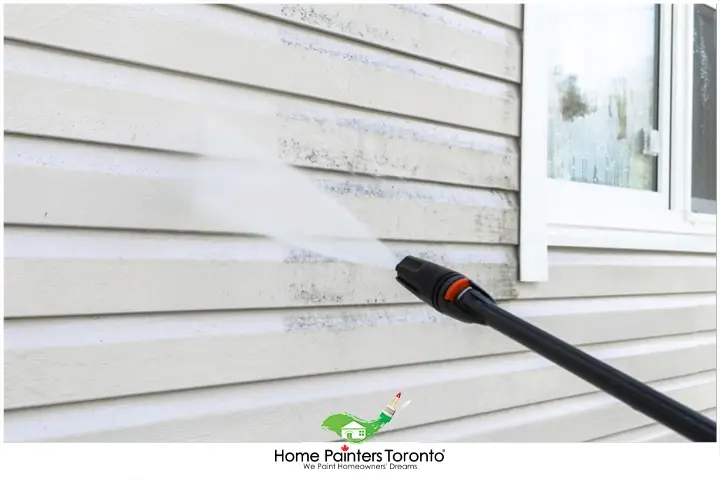
Soft wash at under 600 PSI with diluted sodium hypochlorite kills biological growth without eroding soft summer wood grain — the correct approach before any coating work begins. High pressure washing at 1,500 to 3,000 PSI does the opposite: it saturates the substrate and raises the grain
The Coating Chemistry That Determines How Long Your Siding Lasts
Choosing the Right Finish for Exterior Wood Siding in Toronto
The choice of coating system is not a cosmetic decision. It is an engineering decision. The coating must simultaneously resist UV degradation, repel liquid water, allow water vapour transmission, remain flexible through freeze and thaw cycling, and adhere to a dimensionally unstable substrate that expands and contracts with every moisture and temperature change. No single coating does all of this equally well, which is why product selection must match the specific wood species, the wall orientation, and the existing condition of the substrate.
Alkyd oil based primers followed by a 100% acrylic latex topcoat remain the industry standard for cedar and Douglas fir lap siding across the GTA. The alkyd primer penetrates the wood cell structure and deposits its binder within the grain, while the acrylic topcoat provides the UV resistance and flexibility required to survive Ontario winters without cracking. Penetrating oil based stains offer superior breathability for rough sawn species but require more frequent maintenance cycles of three to five years. The table below compares the four main coating systems used on Toronto wood siding.
| Coating Type | Breathability | Lifespan (Toronto) | Best For |
|---|---|---|---|
| Alkyd oil based primer + acrylic topcoat | Moderate | 6 to 8 years | Cedar and Douglas fir lap siding |
| 100% acrylic latex stain | High | 5 to 7 years | Rough sawn pine and spruce |
| Penetrating oil based stain | Very high | 3 to 5 years (recoat sooner) | Hardwood accents, door frames |
| Elastomeric coating | Low | 8 to 10 years (risk of trapping moisture) | Siding with minor crack bridging needs only |
One important note on low VOC product lines: several municipalities in Ontario are trending toward stricter VOC limits for exterior architectural coatings. Choosing a low VOC acrylic from a reputable manufacturer such as Benjamin Moore or Sherwin Williams is both environmentally responsible and consistent with the direction of Ontario building code evolution. Low VOC formulations have also improved dramatically in the last decade and no longer represent a performance compromise on wood substrates.
Why Annual Power Washing Alone Is Making Your Siding Worse
Annual power washing is widely marketed as a maintenance solution. On wood siding, it is often a maintenance problem. A standard residential pressure washer operating at 1,500 to 3,000 PSI drives water directly into the wood grain, forcibly saturating the substrate in a way that natural rainfall never does. If the wash is performed in early spring before the siding has had time to dry from winter, moisture content can spike to 20 to 25%, well above the threshold at which coatings can be safely applied or reapplied.
The mechanical action of high pressure water also erodes soft summer wood grain from the surface, leaving a raised and fibrous texture that causes coatings to bond unevenly and peel faster. Contractors who power wash and immediately repaint are creating a scenario where the substrate is wet, the grain is raised, and the new coating traps that moisture inside. Peeling within 12 to 18 months is a predictable outcome.
The correct approach for wood siding is a soft wash using a low pressure pump sprayer or garden hose attachment with a cleaning solution containing diluted sodium hypochlorite at 1 to 2% concentration. This kills biological growth without mechanical wood fibre damage and leaves the substrate fully intact for proper adhesion. Our exterior house painting Toronto process uses this soft wash approach on every wood cladding project before any coating work begins.
How Long Properly Maintained Wood Siding Lasts in Toronto
Maintenance Schedule for Toronto Wood Siding by Exposure Zone
Properly maintained exterior wood siding can outlast almost every alternative cladding product available. Western red cedar, the most common species on Toronto homes built between the 1950s and 1990s, has a natural service life of 40 to 60 years when the coating system is renewed on schedule and moisture is kept out of the substrate. The species and exposure zone both heavily influence how aggressive the maintenance schedule needs to be.
| Wood Species | Maintained Lifespan | Neglected Lifespan | Failure Mode |
|---|---|---|---|
| Western red cedar | 40 to 60 years | 10 to 15 years | Surface check cracking, rot at joints |
| Douglas fir | 30 to 50 years | 8 to 12 years | End grain rot, moisture infiltration |
| Spruce pine fir | 25 to 35 years | 6 to 10 years | Rapid delamination, splitting along grain |
| Engineered wood (OSB backed) | 20 to 30 years | 5 to 8 years | Swelling, face paper failure, core exposure |
Exposure zone is the second critical variable. South and west facing walls are exposed to the greatest UV intensity and the most severe afternoon temperature swings, which drive the most rapid coating degradation. North facing walls stay cooler and receive less direct UV, but they also dry more slowly after rain and snow, which makes them more prone to biological growth and condensation related failures. A professional contractor matches the maintenance cycle to each wall orientation independently.
| Exposure Zone | Recoat Cycle | Indicators That Trigger Earlier Action |
|---|---|---|
| South and west facing walls | Every 4 to 5 years | Chalking, fading, and micro cracking signal UV breakdown well before the cycle ends |
| North facing walls | Every 6 to 8 years | Algae and mould growth indicate persistent moisture. Clean and inspect for soft spots |
| Soffit and eave boards | Every 5 to 7 years | Paint peeling from underneath signals trapped condensation from interior air leakage |
| Trim, sills, and corner boards | Every 3 to 5 years | End grain exposure is the fastest failure point. Probe with a screwdriver annually |
For homeowners assessing the cost of a full maintenance and recoat programme, the investment depends heavily on home size and the condition of the existing coating. Standard residential exterior maintenance and repainting at Home Painters Toronto typically ranges from $2,000 to $4,000 for smaller homes up to $8,000 to $10,000 for larger two storey properties, and from $12,000 to $30,000 for very large or complex homes. You can get a detailed breakdown through our cost of painting a house guide.
What Drives the Cost of Wood Siding Maintenance in Toronto
Five factors determine the total cost of a professional wood siding maintenance programme: home size, wood species and condition, storey count, degree of rot or damage found during inspection, and the coating product selected. The table below breaks down each factor and its typical cost impact.
| Factor | Cost Impact | Detail |
|---|---|---|
| Home size (linear footage) | High | Larger homes need more prep time, materials, and crew days |
| Wood species and condition | High | Weathered cedar and pine need extra prep coats and possible board replacement |
| Storey count | Moderate to high | Scaffolding or lifts on two and a half storey homes add labour and equipment costs |
| Degree of rot or damage | Variable | Localized rot repair adds cost but avoids full board replacement later |
| Coating product selected | Moderate | Premium acrylic lines like Benjamin Moore Aura cost more per litre but last significantly longer |
| Number of coats required | Moderate | Bare or heavily weathered wood often needs a full prime coat plus two finish coats |
Why Toronto Homeowners Trust HPT for Wood Siding Work
Incorrectly Diagnosed for Replacement — Moisture Testing Revealed the Real Scope
At a recent exterior painting project in East York, our crew arrived to assess a 1960s detached home with original cedar lap siding. The homeowner had been told by another contractor that the siding needed full replacement. Our lead painter took moisture readings across all four elevations before reaching any conclusions. The south wall readings came in at 19%, borderline for coating application, but the north wall behind the garage showed readings of 26% in two boards near the foundation. Those boards had soft spots we located by probing with a screwdriver, confirming active rot that had been hidden beneath a coat of paint applied without proper preparation.
Our crew completed the necessary wood frame repair on the affected boards, replacing the rotted sections with treated lumber and priming all bare wood with an oil based alkyd primer. Once the substrate was dry and confirmed at or below 15% moisture content, we applied Benjamin Moore Aura Exterior in a Low Lustre finish at a 4 mil wet film thickness across all four elevations. The north wall received an additional prime coat due to the extent of the previous moisture damage. The finished product carried our 3 year exterior warranty and has shown zero adhesion failure or moisture related blistering in the 14 months since completion.
Home Painters Toronto is WSIB compliant, fully insured with $5M in general liability coverage, and carries out criminal background checks on every crew member before they set foot on a client's property. We are open 7 days a week and offer same day estimates. Our warranty backed results speak through 17,000+ satisfied clients served across the GTA since 1987.
Our team handles the full scope of exterior wood work, from deck and fence staining to soffit and fascia repair and painting, wood deck repair, and exterior brick staining for mixed material homes. We also provide drywall repair and installation when interior moisture damage has followed an exterior cladding failure.
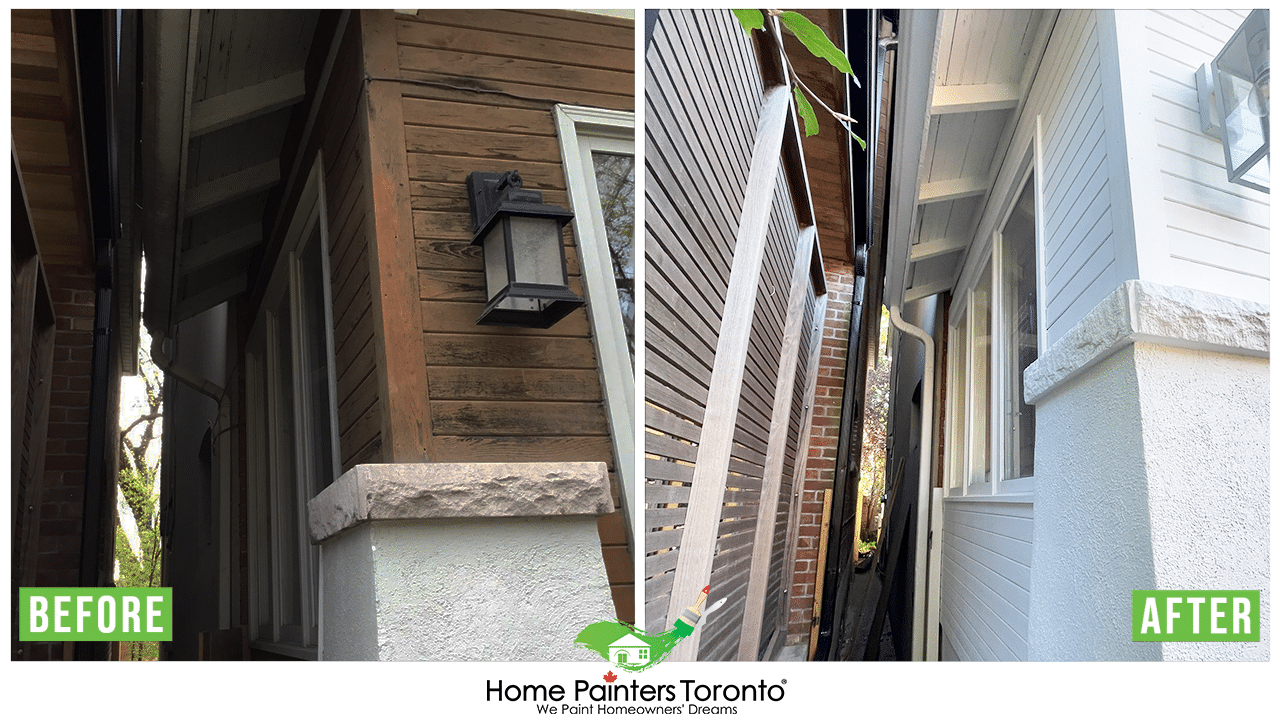
East York project: south wall at 19% moisture, north wall at 26% with active rot behind paint — wood frame repair, alkyd primer on all bare wood, Benjamin Moore Aura Exterior Low Lustre at 4 mil WFT, additional prime coat on north wall — 14 months, zero adhesion failure or moisture blistering
Frequently Asked Questions
Most Toronto homes with cedar or Douglas fir siding need a full recoat every 5 to 7 years on north facing walls and every 4 to 5 years on south and west facing walls due to the higher UV load. Homes in higher humidity areas near ravines or shorelines may need to inspect more frequently, as biological growth accelerates coating breakdown faster than UV alone.
An oil based alkyd primer is the professional standard for bare or heavily weathered cedar and Douglas fir siding in Toronto. Alkyd penetrates deeper into the open wood grain than water based latex, deposits its binder within the cell structure, and provides a superior moisture block. It is applied as the first coat on all bare sections before any acrylic topcoat is used. References from Benjamin Moore and Sherwin Williams technical data sheets both support alkyd as the recommended primer for exterior bare wood in climates with significant freeze and thaw cycling.
Latex and acrylic coatings must not be applied when surface temperatures are below 10°C. In Toronto, this means exterior wood siding painting is typically limited to the period between late April and late October. Applying coatings in cold conditions prevents proper film formation, resulting in a brittle coating that cracks and peels within the first freeze cycle. Early spring applications also carry risk if the wood is still holding residual winter moisture content above 15%.
The most reliable field test is a sharp screwdriver probe at all end grain locations, joints, and areas directly below window sills. Wood that offers firm resistance is structurally sound. Wood that the screwdriver penetrates easily, sinks into, or crumbles is actively rotted and must be replaced before any coating is applied. Paint over rotted wood will last less than one season and traps further moisture, accelerating the structural failure underneath.
Yes, heritage and prewar homes in Toronto present specific challenges. Many homes built before 1950 used old growth Douglas fir or pine siding with a much tighter grain than modern dimensional lumber, which means they are actually more durable when maintained properly. However, they often have no vapour barrier behind the sheathing, which means the coating system must remain breathable. Film forming coatings like elastomeric paint are not appropriate on these homes. A mineral silicate or penetrating oil based stain is the correct product category for heritage siding where breathability is critical.

Protect Your Wood Siding Before the Next Toronto Winter
Exterior wood siding maintenance in Toronto is not something to approach casually or defer season after season. Each year of neglect compounds the cost and complexity of the eventual repair. A coating that could have been renewed for the cost of a standard exterior repaint can become a full board replacement and structural repair job if moisture damage is left to run its course through several freeze and thaw cycles.
Home Painters Toronto brings 38+ years of field experience, Three Best Rated 2025 recognition, and a 3 year exterior warranty to every wood siding project. Our crew performs moisture testing, proper substrate preparation, and coating selection that is matched to your specific wood species and wall orientation. We work 7 days a week and can provide a same day estimate.
View our completed work in the painting projects portfolio, read what clients have said on our client reviews page, or get a fast free quote and warranty backed work today by reaching out to Contact Home Painters Toronto.
Get a Fast Free Quote for Wood Siding Maintenance in Toronto
Contact Home Painters Toronto today for fast free quotes and warranty backed work on your exterior wood siding project. We are open 7 days a week with same day estimates available across the GTA.
Contact Us for a Free Quote