

What Hardboard Siding Painting Really Involves (And How It Differs From Cedar)
Hardboard siding painting is often compared to cedar siding painting, but the two are among the most misunderstood maintenance tasks Toronto homeowners face. It does not. The two materials behave differently under a brush, and they fail in completely different ways when Toronto's climate pushes them hard.
Both hardboard and cedar are common on GTA homes built between the 1950s and the 1990s. Both need regular painting to survive. But the prep work, the timing, and the long-term consequences of skipping a cycle vary considerably between them. Getting this wrong costs far more than getting it right the first time.
This article gives you the honest comparison you need. Here is what we will cover through siding painting fundamentals and beyond:
Hardboard Siding Painting vs. Cedar: Why These Two Materials Are Not the Same Job
An engineered product made from compressed wood fibres and resins, formed into panels or lapped strips. It accepts paint well when dry, primed correctly, and in good condition. The critical weakness: highly sensitive to moisture. Once water gets behind or beneath the paint film, the board swells, softens, and begins to delaminate. At that point, no amount of paint can reverse the damage.
Natural, solid wood. Dimensionally stable in dry conditions and takes paint and stain readily. Unlike hardboard, cedar can sometimes be stripped back and refinished even after significant weathering. However, cedar is also vulnerable to rot, moisture absorption, and insect damage if the paint film breaks down and is left unattended.
For exterior painting Toronto professionals, the key difference is simple. Hardboard punishes neglect faster. Cedar forgives a little longer but still demands consistent attention. Both materials require professional-grade prep and application to achieve results that last.
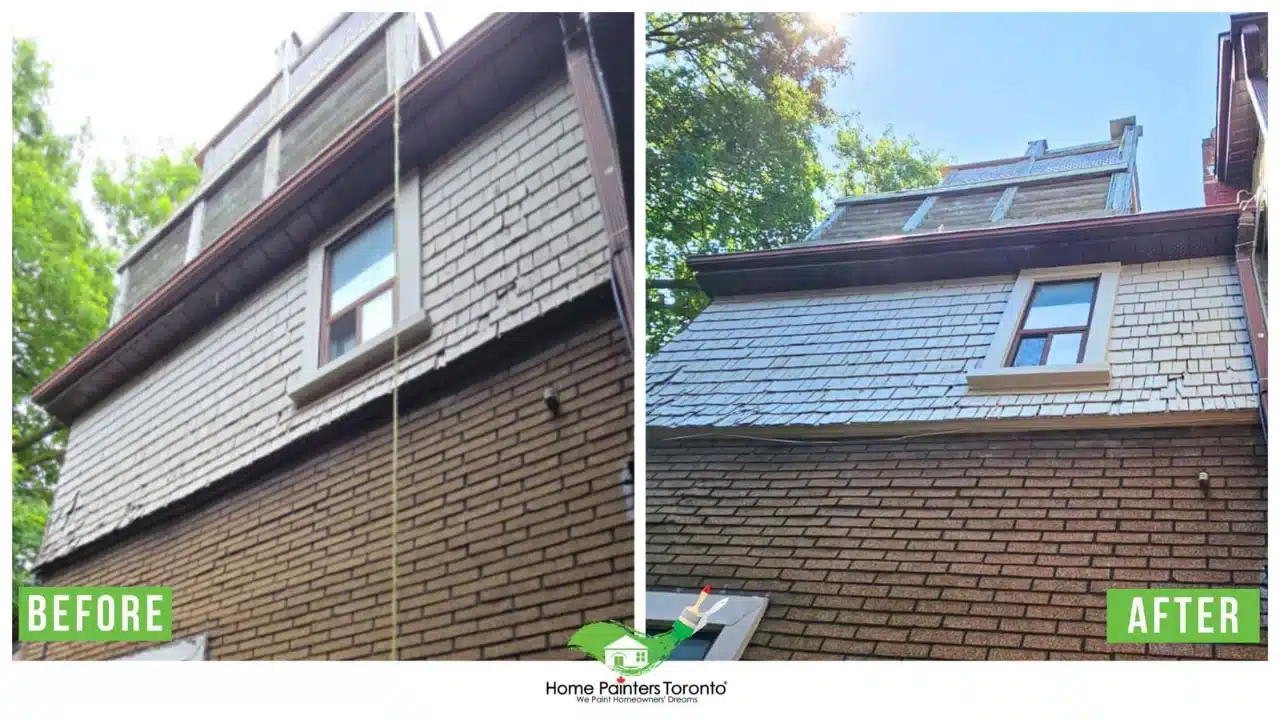
How Toronto's Climate Affects Hardboard and Cedar Siding
Toronto homeowners deal with one of the more demanding climates for exterior wood products in Canada. The GTA sits in a zone with over 40 freeze-thaw cycles per year in a typical winter. Lake Ontario pushes humidity levels higher than most of southern Ontario. Those two factors are particularly hard on painted siding.
Hardboard Siding Lifespan: What to Realistically Expect
Hardboard siding, when installed correctly and maintained diligently, typically lasts 20 to 30 years. That lifespan assumes regular painting, prompt caulking repairs, and no prolonged exposure to standing moisture at the base of panels.
The Ontario Building Code specifies that hardboard cladding must maintain a clearance of at least 200 mm from finished grade. This is not an arbitrary rule. It is a direct acknowledgment that hardboard deteriorates quickly when exposed to ground moisture and splash-back. Many older Toronto homes have had hardboard panels that were installed or later settled too close to the ground, which accelerates base rot significantly.
Repainting cycles for hardboard typically run every 5 to 7 years with professional application. DIY repaints, often done without full primer coats and proper surface preparation, tend to fail earlier. Once hardboard absorbs enough moisture to swell or delaminate, it cannot be painted back to health. It needs to be replaced.
Cedar Siding Lifespan: The Long Game With Real Maintenance Demands
Well-maintained cedar siding can last 30 to 40 years in the GTA, sometimes longer on sheltered elevations. It is a more forgiving material than hardboard because it is solid wood. Even when surface paint begins to fail, cedar can often be scraped, sanded, primed, and repainted without board replacement.
However, cedar does not maintain itself. Paint applied over cedar typically lasts 7 to 10 years with professional application and proper prep. On exposures with high UV loading, such as south-facing walls, that cycle can be closer to 5 to 7 years. Re-staining cycles for cedar are somewhat shorter, at roughly 3 to 5 years, depending on product type and sheen.
The biggest mistake cedar siding owners make is waiting too long between paint cycles. When paint cracks and peels, moisture enters the end grain. End grain is the fastest route for water to reach the core of a cedar board.
Once rot establishes itself in the end grain, the board typically needs replacement. Prompt maintenance is significantly cheaper than board replacement. Cedar siding that is maintained consistently can be beautiful and functional for decades. Neglected cedar typically shows serious deterioration within 15 years, particularly on exposed Toronto elevations.
Cedar siding is also popular on Victorian and Edwardian homes throughout older Toronto neighbourhoods, including the Annex, Rosedale, and High Park. These properties often require careful colour matching and period-appropriate finishes. Getting that right is a job for experienced painters, not a first-time DIY project.
Similarly, cedar is common on decks and fences, where the maintenance logic is identical. Deck and fence staining follows the same preparation discipline as siding work. Consistent cycles protect the investment. Skipped cycles lead to repairs.
Hardboard vs. Cedar Lifespan at a Glance
| Material | Total Lifespan | Repaint Cycle (Pro) | Key Risk Factor |
|---|---|---|---|
| Hardboard siding | 20–30 years | Every 5–7 years | Moisture intrusion, delamination |
| Cedar siding (painted) | 30–40 years | Every 7–10 years | End grain rot, caulk failure |
| Cedar siding (stained) | 30–40 years | Every 3–5 years | UV fading, moisture at joints |
Prep Work: The Biggest Factor in How Long Paint Lasts on Either Siding Type
Whether you have hardboard or cedar, paint longevity is determined more by prep work than by the paint itself. This is the part of the job that separates professional results from DIY disappointment.
Professional Prep for Hardboard Siding
Professional Prep for Cedar Siding
Similar to hardboard, but adds attention to end grain treatment and areas where knots or natural grain variations have caused the existing paint to lift. Cedar also benefits from a shellac-based or oil-based primer on bare wood or areas with significant tannin bleed-through. Tannin bleed is a real issue on cedar and can cause water staining under certain paint systems if the primer does not block it effectively.
For both materials, exterior wood repair and carpentry should happen before any paint is applied. Painting over damaged wood delays the inevitable and often makes repairs more expensive when they cannot be avoided any longer.
When Paint Fails: Recognizing the Warning Signs on Both Materials
Paint failure looks different on hardboard versus cedar, and recognizing the difference matters for deciding what to do next.
Failure typically presents as bubbling, lifting edges at panel seams, or a spongy texture when you press on the board face. These are signs of moisture intrusion. Wood siding replacement and repairs should be assessed before repainting is considered.
Failure usually appears as cracking, alligatoring (a pattern that resembles reptile scales), or peeling in large sheets. These are signs the paint film has lost flexibility. Cedar in this condition can often be stripped, sanded, primed, and repainted successfully.
Siding Types Common in the GTA and How Painting Differs
Toronto's housing stock spans a wide range of eras and construction types. Hardboard siding became popular in post-war bungalows and split-level homes built from the late 1940s through the 1980s. Cedar siding is found on Victorian and Edwardian homes in older Toronto neighbourhoods, and also on 1970s and 1980s contemporary-style homes throughout Etobicoke, North York, and Scarborough.
Some GTA homes have a mix of both materials. A cedar-sided Victorian may have had sections replaced with hardboard over the decades. A post-war bungalow may have had partial cedar additions. Painting these mixed surfaces requires recognizing which material you are dealing with on each elevation before selecting products and prep strategies.
Aluminum siding was also common in the GTA through the same era. If your home has some panels that appear to be metal rather than wood-based, aluminum siding painting follows a different set of rules entirely and requires appropriate primers and paint systems.
Why Professional Painting Outperforms DIY on Both Siding Types
The appeal of DIY exterior painting is understandable. Paint and supplies are available at every hardware store. Videos make it look approachable. The savings seem real on paper.
The reality of hardboard and cedar siding is different. Both materials require careful inspection before any paint is applied. Missing a soft board on hardboard siding and painting over it seals moisture in and accelerates structural failure. Missing tannin bleed-through on cedar and using the wrong primer causes early failure and discolouration that requires a full repaint to fix.
Professional painters bring inspection knowledge, correct product selection for the material, and application methods that achieve proper film thickness and bonding. They also work with warranties. A professional exterior repaint backed by a 3-year warranty provides homeowner protection that no DIY project can match.
The time cost of DIY is also real. A full exterior repaint of a Toronto semi-detached or detached home, including proper prep, takes multiple days for an experienced crew. For one or two people working weekends around weather windows, that timeline stretches across weeks. Toronto's exterior painting season runs reliably from late May through early October, with the best conditions in June, July, and early September. Losing weekends to poor weather or drying delays is a real risk.
Why Home Painters Toronto Is the Right Call for Siding Painting
Home Painters Toronto has been serving Toronto and GTA homeowners for over 38 years. The team includes in-house painters and carpenters who handle prep, repair, and finish work on the same project. You do not need to coordinate a separate contractor for board replacement and then another for painting.
Every exterior project begins with an on-site assessment. The team evaluates the condition of the siding, identifies repairs needed before painting begins, recommends appropriate products for the material, and provides a detailed written estimate. Exterior painting is backed by a 3-year warranty. That is the confidence that comes from doing the job correctly from the first step.
For homeowners managing older GTA homes with hardboard or cedar siding, this is not just a painting job. It is protecting one of the most significant financial assets that most people own.
Frequently Asked Questions About Hardboard Siding Painting
The Right Hardboard Siding Painting Approach Protects Your Home for Years
Hardboard siding painting and cedar siding painting are both investments in your home's protection and value. Done correctly, either material can perform well for decades in Toronto's demanding climate. Done poorly, or left too long between cycles, both become expensive repair problems rather than maintenance tasks.
The honest answer for most GTA homeowners is that professional painting is the smarter choice. The prep work alone, done thoroughly, is what separates a paint job that lasts 8 to 10 years from one that starts failing in three. The materials and application knowledge required to get that right are not things most homeowners develop from a single weekend project.
Home Painters Toronto has over 38 years of experience with exactly these types of projects. The team handles assessment, carpentry repairs, full prep, caulking, priming, and finish painting under a single warranty. You get a clean result, a written scope, and the assurance that the job was done by experienced professionals who know Toronto siding.
Ready to Protect Your Hardboard or Cedar Siding?
Contact Home Painters Toronto today to request a free quote for your hardboard or cedar siding project. The sooner you call, the better the weather window you can secure for your home.
Request a Free Quote Call 416-494-9095