

What Pressure Washing Actually Does — and Does Not Do — Before Deck Staining
Toronto homeowners planning a deck staining project this season often assume a quick pressure wash is all the preparation they need before applying a fresh coat of stain. Across the GTA, from Etobicoke backyards to Markham properties, that assumption leads to stain failure within a single season. Pressure washing is a necessary first step, but it is far from the complete picture. Understanding what professional exterior deck staining prep truly involves will save you time, money, and a full recoat job before the snow arrives.
Yes, pressure washing is required before exterior deck staining, but it is not sufficient on its own. Professional prep also requires oxalic acid wood brightening to restore the wood pH, followed by mechanical sanding to open the grain. Skipping any of these steps causes the stain to sit on the surface instead of penetrating the wood fibres, leading to peeling within one to two seasons.
Pressure washing removes loose dirt, biological growth like mould and algae, and surface debris from the deck boards. Without this step, a stain product has no chance of bonding to the wood because the contamination layer acts as a physical barrier between the coating and the substrate. On Toronto decks exposed to seasonal freeze-thaw cycles, biological growth penetrates the top wood cells, so a thorough wash is the only way to clear the surface before any chemistry can begin.
Pressure washing also raises the wood grain. When water is forced into the wood fibres at high velocity, those fibres swell and stand upright. This raised grain creates a rough surface texture that must be addressed before staining. A stain applied over raised grain dries unevenly, trapping micro-bubbles and creating a patchy finish that weathers poorly. This is why pressure washing begins the prep sequence but cannot end it.
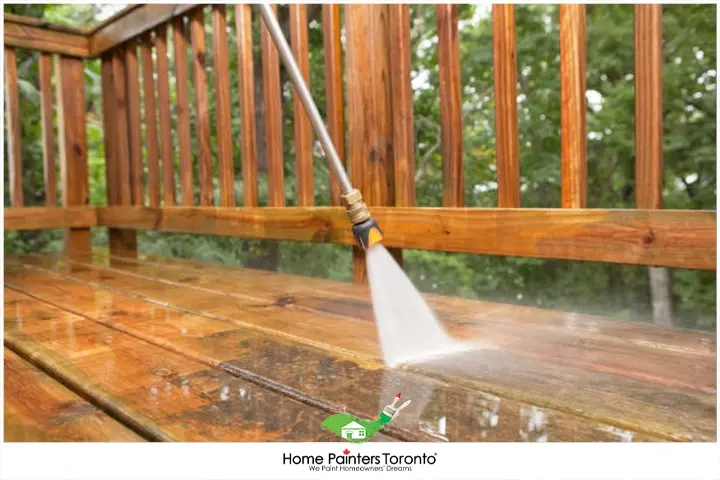
Pressure washing opens the prep sequence but raises the wood grain — without the oxalic acid brightener and 60-grit sanding steps that follow, the stain sits on the surface and fails within one to two seasons
Pressure Washing PSI: What the Wrong Setting Does to Deck Wood
The correct operating pressure for wood deck cleaning is between 500 and 1,200 PSI depending on the wood species. Softer species like cedar and pine damage at pressures above 800 PSI, and the damage is permanent. Pressure washing at 2,500 to 3,000 PSI, which many homeowners use for concrete driveways, tears the soft grain of cedar boards, leaving fuzzy frayed fibres and micro-scoring that traps moisture inside the wood. That trapped moisture then becomes an ideal environment for mould regrowth within weeks.
Softwoods. Fan nozzle at 12–18 inch distance, parallel to grain. Safe for the wood structure.
Ipe, treated pine with tight grain. Higher density tolerates more pressure before damage occurs.
Tears grain, causes fuzzy fibres, drives excess moisture into end grain. Common household washer setting that permanently damages cedar boards.
Contractors fan the pressure nozzle at a consistent 12 to 18 inch distance from the deck surface and always work parallel to the wood grain. Perpendicular pressure washing drives water directly into end grain sections and open knots, which absorbs at a far higher rate than face grain. Boards that absorb excess water during washing may take 72 hours or more to reach a moisture content acceptable for staining.
Why Pressure Washing Alone Is Not Enough to Prepare a Deck for Staining
Pressure washing strips the deck down to a clean surface, but it also strips the wood of its natural pH balance. Cedar and pressure-treated pine both have a slightly acidic to neutral pH when freshly milled. After weathering and after pressure washing, the wood pH shifts toward alkaline. Most penetrating deck stains and oil-based formulas require the wood to be close to a neutral pH, between 5.5 and 7.0, to bond correctly. Applying stain to alkaline wood causes the coating to cure improperly and lift prematurely.
Mechanical preparation is the second reason pressure washing alone fails as a prep method. Pressure washing opens the raised grain but it does not flatten or smooth it. A 60-grit mechanical sand, run parallel to the wood grain after the deck has dried fully, smooths the surface and opens the wood pores in a controlled manner. Open pores absorb penetrating stains evenly, which is the only way to achieve consistent colour and full UV protection across the deck boards. Decks that skip sanding show lap marks and uneven sheen within the first two months of UV exposure.
| Prep Stage | Purpose | What Happens If Skipped | Timing |
|---|---|---|---|
| Pressure Washing (500–1,200 PSI) | Remove dirt, mould, loose coating | Stain cannot bond through contamination layer | Day 1 |
| Oxalic Acid Wood Brightener | Restore wood pH to 5.5–7.0 | Alkaline wood causes stain to lift prematurely | After washing, same day |
| Drying Period | Reduce moisture content below 15% | Trapped moisture causes bubbling and delamination | 48 to 72 hours minimum |
| 60 Grit Mechanical Sanding | Flatten raised grain, open wood pores | Uneven absorption, lap marks, patchy finish | After drying period |
| Tack Cloth Wipe Down | Remove sanding dust before application | Dust particles contaminate the stain coat | Immediately before staining |
The Professional Deck Prep Process: Cleaning, Brightening, and Sanding
Professional deck staining crews in Toronto follow a strict sequence that begins two to three days before the first coat of stain touches the wood. This sequence is not optional and no single step can be compressed to save time. The GTA climate gives decks some of the most punishing weather in North America, and cutting corners on prep produces failures that cost homeowners a full restoration in the following season.
- Purpose-Built Deck Cleaner Application Sodium percarbonate or sodium hypochlorite formulation dwells for 10 to 15 minutes to penetrate and kill biological growth at the root level. This is not a general purpose household cleaner. Wood deck cleaners are formulated to break down the organic compounds left behind by mould, algae, and tannin bleeding from the wood itself.
- Pressure Washing at Correct PSI Full deck surface washed at the species-appropriate pressure, fan nozzle at 12 to 18 inch distance, always parallel to the wood grain. End grain and stair stringers handled with extra care to avoid over-saturating those zones.
- Oxalic Acid Brightener Application Applied at manufacturer-specified dilution immediately after washing. Neutralises the alkaline surface left behind by the wash and removes greyish UV oxidation from the wood fibres, restoring the natural warm tone before staining. Cedar that has gone grey from UV damage responds strongly to oxalic acid treatment and produces a dramatically better finished colour after staining.
- Minimum 48 to 72 Hour Dry Time and Moisture Check Pin-style moisture metre reading taken at multiple points across the deck, including end grain sections near stairs and ledger board connections. End grain retains moisture longer than face grain and represents the highest failure risk. The deck cannot be stained until all measured zones read below the product threshold, without exception.
- 60 Grit Mechanical Sanding Full deck face sanded parallel to the grain. Smooths raised fibres and opens wood pores in a controlled and even manner. Decks with moderately weathered boards may need two sanding passes.
- Tack Cloth Wipe Down and Application Scheduling Sanding dust removed from all surfaces immediately before staining. A 72-hour weather forecast is confirmed with zero precipitation and relative humidity below 70%. Application proceeds only when conditions and moisture readings are in range.
Wood Moisture Content and Why It Determines Your Stain Schedule
Every penetrating deck stain product has a maximum moisture content threshold for the substrate. Most oil-based and alkyd-based stains specify a maximum of 15% moisture content measured by a pin-style moisture metre. Decks in Toronto can hold moisture above 19% for 48 to 72 hours after pressure washing in humid summer conditions. Staining over wet wood means the stain competes with water vapour trying to escape the wood as it dries, which pushes the coating off the surface from the inside.
A professional crew checks moisture content at multiple points across the deck before scheduling the staining date. End grain sections of boards, particularly near stairs and ledger board connections, retain moisture longer than face grain sections. The crew measures those zones specifically because they represent the highest failure risk. A deck cannot be stained until all measured zones read below the product threshold, without exception. We have turned down same-day jobs to make this call, and our clients have never regretted it.
How Toronto's Climate Makes Proper Deck Prep Non-Negotiable
Toronto and the surrounding GTA experience some of the most aggressive seasonal swings in Canada. Decks cycle through temperatures from below minus 20°C in January to above 35°C in July. Wood expands in heat and contracts in cold, and that constant movement creates micro-cracks in the coating film over time. A stain that was not properly penetrated into the wood during application has no flexibility reserve. It sits on the surface as a brittle film and begins to crack and flake within the first freeze-thaw season.
Toronto receives over 800 mm of precipitation annually, and much of it falls during the shoulder seasons when decks are still in active use. A stain film that has not fully penetrated the wood surface becomes a moisture trap rather than a moisture barrier. Water gets under the film through micro-cracks, and the freeze cycle drives that water deeper into the wood. Spalling, checking, and structural softening of the boards follow within two to three seasons.
| Climate Risk Factor | Impact on Deck Stain | How Proper Prep Mitigates It |
|---|---|---|
| Freeze-thaw cycles | Brittle surface film cracks and peels | Deep penetration gives coating flexibility reserve |
| High summer UV index | UV degrades wood fibres if coating is thin | Solid or semi-transparent stain with adequate pigment load |
| 800 mm annual precipitation | Moisture trapped under film causes delamination | Correct moisture content check before application |
| High summer humidity | Slows stain cure, extends open time unpredictably | Schedule application on days below 70% relative humidity |
Stain Selection: Matching the Product to the Wood After Prep
Stain selection happens after the prep sequence is complete because the condition of the wood after prep determines which product will perform best. A deck that has been brightened and sanded down to clean, open wood fibres can accept a penetrating oil-based stain and achieve full penetration in one coat. A deck with moderately weathered boards that required aggressive sanding may need a film-forming product to seal micro-checks in the wood before the penetrating coat goes on.
Solid Stain
Provides full opacity coverage and maximum UV protection. The correct choice for a deck with significant weathering, visible greyness, or boards that show early checking. Semi-transparent stain on a weathered deck produces thin, uneven coverage that fails quickly because the product was not designed to cover substrate imperfections. Solid stain on south and west-facing decks in Toronto is the more durable long-term choice because the pigment load physically blocks UV penetration.
Semi-Transparent Penetrating Oil
Appropriate only for decks with boards that are still structurally sound and within two to three years of their last staining. For cedar decks specifically, a penetrating alkyd or oil-based formula outperforms acrylic formulas in the first two to three years because the oil vehicle penetrates the wood's natural oils and bonds at the cellular level. Acrylic deck stains form a surface film on cedar that can lift as the cedar expands and contracts through freeze-thaw cycles.
For a full overview of exterior staining services and deck staining options available across the GTA, visit our deck and fence staining page. If your deck boards show structural damage, our wood deck repair team can assess and fix the damage before staining begins.
A Recent Deck Staining Project in Etobicoke: What We Found After Washing
Cedar Deck Over-Pressured at 2,400 PSI — Moisture Too High to Stain Same Day
At a recent exterior deck staining project on a detached home in the Mimico neighbourhood of Etobicoke, our crew arrived to find a cedar deck that the homeowner had pressure washed two days earlier using a residential unit set at approximately 2,400 PSI. The surface looked clean to the eye, but our pin moisture metre read 21% at the end grain sections near the stair stringers and 18% at the centre boards.
We could not stain that day. Instead, we applied an oxalic acid brightener at a dilution of one part brightener to three parts water, allowed it to dwell for 12 minutes, then rinsed the surface. We returned 48 hours later and remeasured. The end grain sections had dropped to 14% and the field boards were at 11%, both within the acceptable threshold for the product we had specified.
We applied Cabot Australian Timber Oil in the Natural finish using a brush-and-backroll technique, achieving a wet film thickness of approximately 4 mils per coat. At that thickness, the oil penetrates fully into a clean cedar substrate and cures as part of the wood structure rather than as a separate film layer. The finished deck showed no lap marks, no blotching, and no raised grain texture. The homeowner had attempted to skip the brightening step to save time. Our decision to return a second day is the reason that deck will last three to five seasons before it needs a maintenance coat.
You can see more projects like this in our project portfolio. We have over 1,200 positive reviews on HomeStars, Google, and Houzz, and we are the HomeStars Best of Award 2026 winner.

Mimico project result: end grain down from 21% to 14%, field boards at 11%, Cabot Australian Timber Oil at 4 mil WFT by brush and backroll — three to five seasons before a maintenance coat is needed
Why Toronto Homeowners Trust Home Painters Toronto for Exterior Deck Staining
Home Painters Toronto has been a family-owned and operated painting contractor for over 38 years. Our crew members pass criminal background checks before they are assigned to any residential property. We carry $5 million in general liability insurance and we are fully WSIB-compliant, meaning our workers are covered under Ontario's workers' compensation system on every job site.
Our deck staining work is backed by a 3-year exterior warranty and a 100% Satisfaction Guarantee on all completed projects. When we commit to a prep sequence, we execute it without shortcuts because our warranty means we are accountable for the result. Contractors who skip brightening or sanding to save time are not the ones who have to stand behind the work if it fails after the first winter. We are.
Read what our clients say on our client reviews page, or learn more about our approach on our about page. We are open 7 days a week with same-day estimates available.
We also provide full exterior services that can be coordinated in a single site visit:
- Exterior house painting services across Toronto
- Exterior wood siding assessment and painting
- Front door restaining and refinishing
- Wood trim and wood frame repair
For reference on how project costs are structured for exterior painting and staining work, see our guide to the cost of painting a house.
Frequently Asked Questions About Deck Prep and Staining in Toronto
No. After pressure washing, the wood must dry fully before staining can proceed. In Toronto's summer conditions, cedar and pressure-treated pine decks typically require 48 to 72 hours of drying before they reach a moisture content below 15%, which is the threshold most professional penetrating stains require. Applying stain to wet wood causes the coating to bubble and peel as moisture vapour escapes the wood during curing.
Oxalic acid is a mild organic acid used to neutralise the alkaline pH that results from pressure washing and weathering. Wood that has been left outdoors in Toronto's climate oxidises and develops a grey surface layer caused by UV-degraded lignin. Oxalic acid dissolves that grey layer and restores the wood to a neutral pH close to its original condition. Deck stains bond far more effectively to a properly brightened surface because the wood chemistry is aligned with the stain product's intended substrate.
The correct pressure depends on the wood species. Cedar, pine, and other softwoods should be washed at 500 to 800 PSI with a fan nozzle. Harder woods like ipe or treated pine with a tight grain can tolerate up to 1,200 PSI. Using a residential pressure washer set at 2,500 PSI or higher on a cedar deck causes permanent grain damage, fuzzy wood fibres, and excessive moisture absorption that extends the drying period and increases the risk of mould regrowth before staining.
Yes, in almost every case. Pressure washing raises the wood grain by forcing water into the wood fibres. A 60-grit mechanical sand, run parallel to the grain after the deck has dried fully, smooths the raised fibres and opens the wood pores in a controlled and even manner. Skipping sanding results in uneven stain absorption, lap marks, and a patchy surface appearance that worsens as the coating weathers through its first UV season.
A professionally prepped and stained deck in Toronto typically lasts 3 to 5 years before requiring a maintenance coat, depending on the stain product type, the sun exposure of the deck, and the deck's orientation. South-facing decks in full sun degrade faster due to higher UV load and should be inspected annually. Solid stain products generally outlast semi-transparent products by one to two seasons because their higher pigment load provides stronger UV blocking at the coating level.
Deck staining costs in Toronto depend on the deck size, wood condition, number of prep stages required, and the stain product specified. Costs vary considerably between a small urban townhouse deck and a large two-level suburban deck. For an accurate estimate based on your deck's actual dimensions and condition, contact our team for a free site assessment. Our cost of painting a house guide provides context on how exterior project pricing is structured in the GTA.

Get Fast, Warranty-Backed Deck Staining Quotes Across the GTA
Pressure washing is the required first step in any professional exterior deck staining project, but it is not a complete prep process on its own. Oxalic acid brightening, a full drying period to below 15% moisture content, and 60-grit mechanical sanding are equally mandatory steps that determine whether a deck stain penetrates and performs or sits on the surface and fails. In Toronto's climate, shortcuts in prep are not discovered immediately. They show up in the second winter, when flaking, peeling, and structural board damage force a full restoration at a far higher cost than the original prep would have required.
Home Painters Toronto has delivered exterior staining results across the GTA for over 38 years with a 3-year exterior warranty on all staining work. We are Three Best Rated 2025, Best of Houzz 2025, and a HomeStars Best of Award 2026 winner.
Get a Fast Free Quote on Deck Staining in Toronto
Contact Home Painters Toronto today for fast free quotes and warranty-backed work on your exterior deck staining project. Same-day estimates available 7 days a week across the GTA.
Contact Us for a Free Quote