

How to Match Paint Colour After a Siding Repair
Toronto homeowners who just had a wood or aluminum siding repair often notice one thing right away: the new boards or panels stand out against the old paint. Matching paint colour after a siding repair is rarely as simple as grabbing the same can from three years ago, because weathered paint fades and chalks in ways factory-fresh material never does. A repair on a Leslieville semi or a North York bungalow can leave a bright patch surrounded by sun-faded siding, and that contrast gets more noticeable every week it sits unpainted. The good news is that a professional colour match, done with the right prep and blending technique, can make a repaired section disappear into the wall. This siding repair guide walks through why new siding looks different at first, when a spot repaint works, and when the whole wall needs fresh colour.
New siding rarely matches old paint right away because factory material and weathered paint reflect light differently. Professional matching paint colour after a siding repair combines a colour ID pulled from the existing wall, a feathering technique at the seams, and a dried test patch, and it may call for a spot repaint or a full wall repaint depending on how faded the surrounding siding has become.
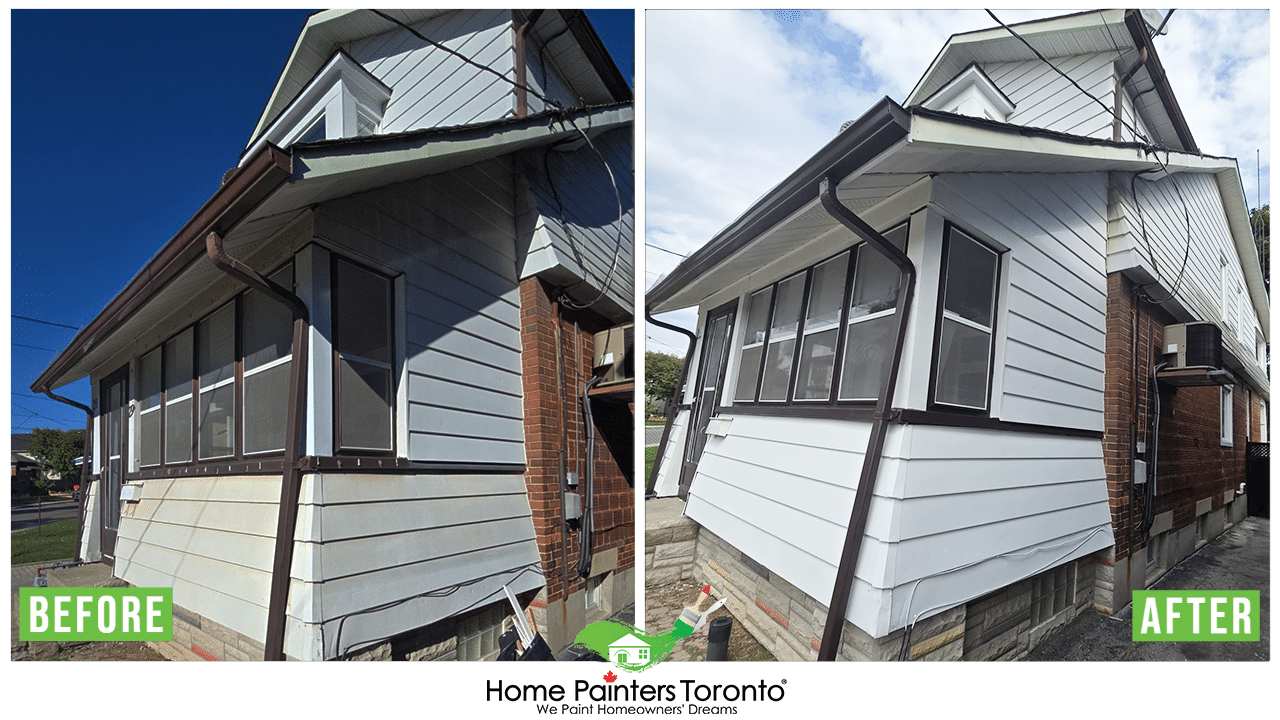
A repair on a Leslieville semi or a North York bungalow can leave a bright patch surrounded by sun-faded siding
Why New Siding Doesn't Match Old Paint Right Away
New siding does not match old paint right away because factory-primed material reflects light differently than a painted surface that has weathered outdoors for years. Sunlight breaks paint film down through UV exposure, a process called chalking, which slightly dulls the surface and shifts how it reads under natural light.
Homeowners who complete a siding repair in Etobicoke, Scarborough, or Leslieville often notice this contrast within days of the crew finishing the patch.
Wood, aluminum, and vinyl each weather differently, which adds another layer to the mismatch. Wood siding absorbs and releases moisture with the seasons and greys unevenly depending on sun exposure, while aluminum siding oxidizes slowly at the seams and vinyl fades more evenly but can still show a visible line where an old panel meets a new one. On a two-storey home in Etobicoke or a semi in Leslieville, a single missing board or dented panel is rarely the real problem on its own. The paint layer around it is. Once a contractor understands how each material ages, matching the new section becomes a controlled process instead of guesswork.
Sheen shifts the mismatch even further. A wall painted years ago in satin or low lustre gradually loses gloss as the resin binder breaks down, so it reads flatter than a fresh coat of the same finish straight from the can. A repaired board painted in the correct colour but the wrong sheen level can look just as out of place as one painted the wrong colour entirely. This is one reason a quick can-matching job at a hardware counter often leaves a visible patch, even when the paint code on the label is technically correct.
Can a Repaired Section Ever Match Perfectly?
A repaired section can get very close to the original colour, but an exact match is unlikely once the surrounding paint has faded unevenly for more than a few years. Paint fades fastest on south- and west-facing walls, so a Richmond Hill home with strong afternoon sun on one elevation often shows more colour drift than a shaded north wall a few metres away.
The Painting Contractors Association's industry standard for a uniform, properly painted surface defines that surface as uniform in colour, texture, and sheen when viewed from a normal distance under standard lighting, and that is the real benchmark a colour match gets judged against, not a swatch held up to a five-year-old wall.
A skilled contractor works toward that standard instead of chasing an impossible pixel-for-pixel match. This usually means blending the new colour slightly toward the faded tone of the surrounding siding, feathering the edges so no hard line forms, and choosing a matching sheen, since a satin patch on a chalky flat wall will always stand out even if the colour itself is close. Homeowners who want ideas for a refreshed exterior palette instead of a strict match can browse HPT's colour inspiration resources before the crew arrives.
Setting the right expectation up front also changes how a homeowner budgets the project. A close, professional-grade match on a wall that has faded evenly is realistic and usually holds up well once cured. A wall with patchy, uneven fading from tree cover, gutter overflow staining, or mixed sun exposure is a much harder target, and it is often the wall where a full repaint ends up costing less frustration than an endless string of spot touch-ups.
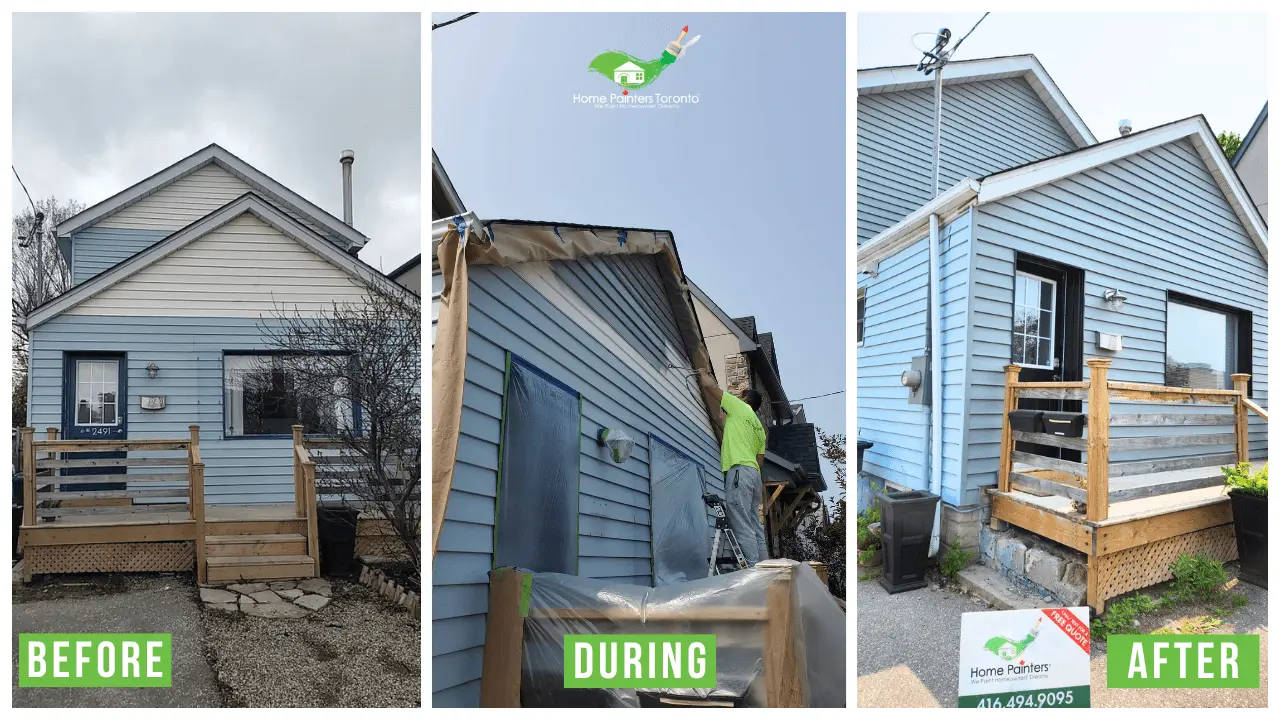
A skilled contractor works toward a uniform standard instead of chasing an impossible pixel-for-pixel match
Spot Painting vs. Full Wall Repaint
Spot painting works when the repaired section is small, recent, and set on a wall with light, even fading, while a full exterior repaint is the better choice once the surrounding paint is more than about eight years old or heavily chalked.
| Situation | Recommended Approach | Why It Works |
|---|---|---|
| Small patch, surrounding paint under 3 years old | Spot painting | Colour hasn't faded much yet, so a blended patch disappears into the wall |
| Storm-damaged panel on an older, faded wall | Full wall repaint | New material next to heavily faded paint creates a visible block or halo |
| Wood board replacement on one sun-exposed elevation | Full repaint of that elevation | Matches fade pattern wall by wall instead of board by board |
| Vinyl or aluminum panel swap | Spot painting or panel replacement | Factory colour match is often close enough without repainting |
| Siding repair with patched stucco texture | Full wall repaint | Texture and colour both need to blend across the entire surface |
For a home with patched stucco siding repairs, texture is often the harder problem to solve, since a trowel pattern that does not match the surrounding wall will show through even a perfect colour match. Our crews walk the wall in daylight and compare the patch against at least three points on the siding before recommending spot work or a full repaint.
How Professionals Colour-Match After a Repair
Professional colour matching after a siding repair follows five core steps: colour identification, primer selection, feathering, test patching, and full application. Skipping any one of these steps is usually why a repaired patch still looks wrong weeks after the crew has left, since the paint may be the right hue but wrong sheen, or applied at a thinner film build than the rest of the wall.
- Pull a colour sample directly from an inconspicuous part of the existing wall, not from an old paint can, since the can colour and the weathered wall colour are rarely identical after a few seasons outdoors.
- Match that sample using a fan deck or in-store spectrophotometer scan to identify the closest current formula and base.
- Select a primer suited to the new substrate, whether that is bare wood, cedar, aluminum, or vinyl, and make sure new exterior caulking around seams and trim has cured before painting begins.
- Feather the new paint into the old coat at the edges so no hard transition line forms.
- Apply a test patch and let it dry fully, since wet paint reads darker than cured paint and can throw off the comparison.
- Apply the full coat once the test patch is approved, keeping film thickness consistent across the old and new sections.
Matching Paint Colour to Weathered Siding
Matching paint colour to weathered siding starts with light, not paint chips. Our crews compare samples in overcast daylight, since both indoor lighting and direct sun distort how a colour actually reads.
- At a recent siding repair in Etobicoke, we replaced four damaged cedar boards on a west-facing wall that had faded unevenly over about seven years.
- We colour-matched the wall in Benjamin Moore Aura Waterborne Exterior in Low Lustre and applied two coats at roughly 1.4 mils of dry film thickness per coat, in line with the product's technical data sheet, to bring the repaired boards and the surrounding wall to one even finish.
The homeowner had been told by another contractor that a full re-side was the only fix. It wasn't.
Feathering Technique for a Seamless Blend
Feathering means fading the new paint's edge gradually into the old coat instead of stopping at a hard line. A painter works the brush or roller lighter and lighter toward the perimeter of the patch, so the eye cannot find exactly where new paint ends and old paint begins. This step matters most on wood and stucco, where texture changes make a sharp edge more obvious than it would be on smooth aluminum or vinyl.
Test Patch Verification Before Full Application
A test patch about the size of a dinner plate goes up first and gets left to dry for a full day before anyone commits to the whole wall. Paint reads several shades darker wet than dry, and colour under a work light is never quite the same as colour under morning sun. This single step catches most colour problems before they become a full-wall mistake.
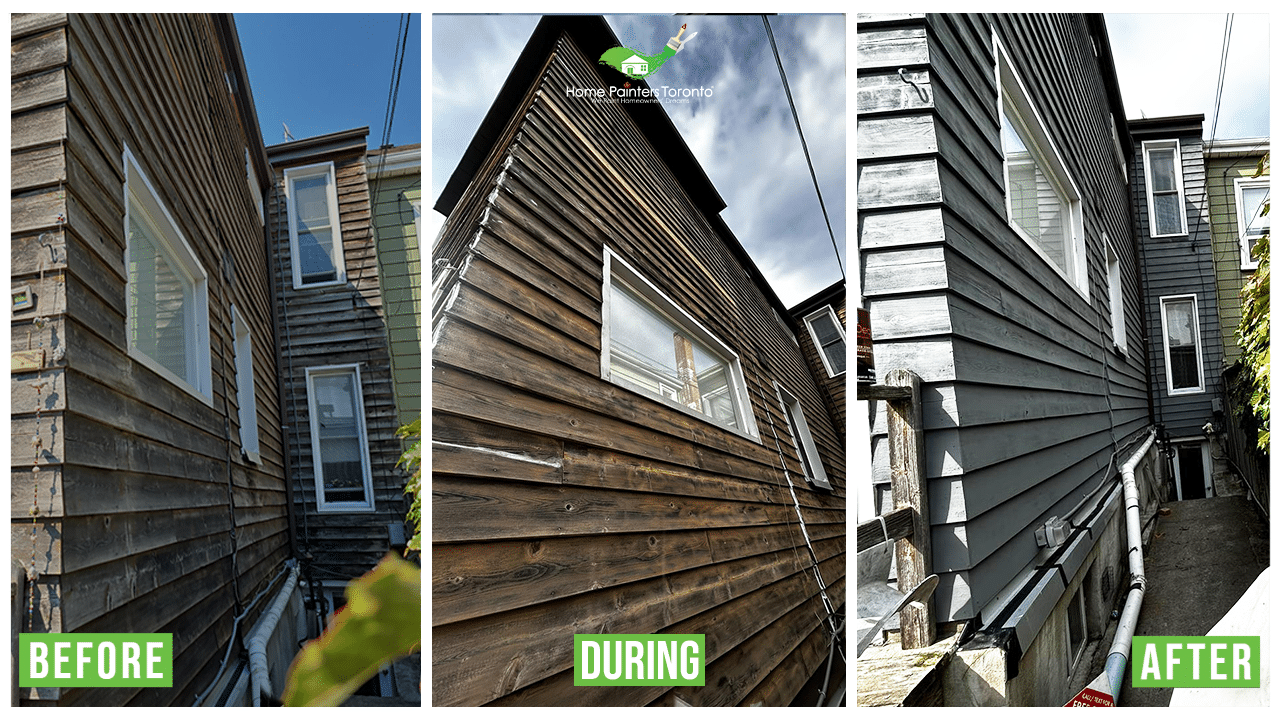
The repaired boards and the surrounding wall came to one even finish once the colour match was applied
Cost to Repaint After a Siding Repair
Repainting after a siding repair in the GTA typically runs $2,000 to $4,000 CAD plus HST for a small spot job or single-elevation touch-up, and $4,000 to $8,000 CAD plus HST once a full-elevation or whole-house repaint is needed.
| Scope | Estimated Cost (CAD + HST) | Typical Scenario |
|---|---|---|
| Spot patch, one or two boards or panels | $2,000 - $4,000 | Small storm or accidental damage on one wall |
| Single elevation repaint | $4,000 - $8,000 | Heavier fade on one sun-exposed wall |
| Full exterior repaint | $8,000 - $10,000 | Repair combined with a whole-house colour refresh |
| Large or multi-storey home | $12,000 - $30,000 | Extensive repair plus full exterior repaint |
These are general project ranges, and a written quote will depend on surface condition, access, and how many elevations need to be blended. A repair that only needs a small spot match costs less than a full repaint, but homeowners should budget toward the higher end of a range whenever the surrounding wall is more than five or six years past its last paint job, since blending gets harder as the base colour keeps fading. For a broader breakdown of exterior pricing across Toronto, see our guide to the cost of painting a house.
Timing: Should Painting Happen Right After Repair?
Painting should wait until repaired wood siding has dried to a stable moisture level and outdoor temperatures sit within the paint manufacturer's application range, which usually means a delay of several dry days after the repair, not same-day painting. Benjamin Moore's technical data sheet for Aura Waterborne Exterior calls for application once surface and air temperatures stay within its listed range, and freshly repaired wood needs that same stable weather window before primer will bond properly. In the GTA, late spring and early fall usually offer the most consistent stretch of dry, moderate days for this kind of work.
Our exterior painting crews check the extended forecast before scheduling a colour-match repaint, since a rushed job in damp or near-freezing conditions can trap moisture under the new coat and cause peeling within a year or two. Waiting an extra week for the right weather window costs far less than repainting a failed patch twice.
Humidity plays a role too, not just temperature. High overnight humidity followed by a hot, direct-sun afternoon, a common pattern in a Toronto summer, can cause paint to skin over on the surface before the layer underneath has fully cured, which traps solvent and shortens the coating's life. Scheduling the repaint for a stretch of moderate, stable days protects both the colour match and the durability of the finish.
Colour Matching FAQ
Not always. A spot repaint works when the patch is small and the surrounding paint is only lightly faded, but a full wall repaint is usually the safer call once fade is heavy or the repair spans more than one or two boards. Our estimators make this call on-site by comparing the patch to several points across the wall in natural light, not by guessing from a photo.
New or repaired wood siding needs to reach a stable moisture content before it will hold paint properly, which typically means several dry days of outdoor exposure after installation, longer during damp or shoulder-season weather common across the GTA. Painting over wood that is still releasing moisture is one of the most common causes of early peeling on a repaired section.
Yes. Aluminum siding painting and vinyl siding painting can both be colour-matched, though aluminum takes paint more predictably than vinyl, which needs a flexible, vinyl-safe formula to avoid warping in direct sun. Vinyl panel swaps are sometimes closer to a factory colour match than a painted repair, so our crews check both options before recommending one.
A discontinued colour can usually be rebuilt from a wall sample using a spectrophotometer scan, even without the original can or formula code on file. The rebuilt formula gets tested on a patch first, the same way any other colour match would be, since a scanned match and a weathered wall are still two different starting points.
Yes, weathered paint fades and chalks at a different rate than new paint, which is exactly why a repaired section painted straight from a new can rarely matches on the first try without a proper colour match process. This gap tends to be widest on older homes in established neighbourhoods like The Annex or Riverdale, where original paint jobs are often eight to ten years old by the time a repair comes up.
See more answers on our full FAQ page.

Get a Free Estimate to Blend Your Siding Repair
A repaired section of siding does not have to stand out for years. Home Painters Toronto is WSIB compliant, fully insured, and every colour-matched repaint comes with warranty-backed work, whether the job covers three boards in Leslieville or a full exterior in Richmond Hill. Homeowners can read client reviews from past siding and exterior projects, or learn more about why homeowners choose Home Painters Toronto, before booking a visit. Our painters bring a portable colour sample kit to every estimate, so the read on your wall happens on-site, not from a photo.
Home Painters Toronto offers fast free quotes and warranty-backed work for every siding repair and repaint project across Toronto and the GTA.
Contact Home Painters Toronto to book a free, on-site colour match estimate.
Get a Free Estimate