

October, 2025
Wood Soffit Repair and Painting
Deer Park
The Situation:
A Small Job Nobody Would Take On
Gillian had been trying to get a small section of rotting wood soffit fixed and repainted on the front of her Deer Park home for some time. The damaged area was modest, roughly two feet by one foot, but it was causing real problems. Water had been getting in, the wood had been quietly rotting, and the front of her home was showing the damage.
The frustrating part was not the repair itself. It was finding someone willing to do it.
Most contractors passed on the job the moment they heard the scope. Too small. Not worth coordinating a crew for a single soffit section and a bit of painting. Gillian was told “no,” or simply never heard back, enough times that she wondered whether she would be stuck with a rotting soffit until the damage spread far enough to become a much bigger and more expensive problem.
Home Painters Toronto said yes. Not because the job was large, but because it was the right thing to do for a homeowner who genuinely needed help and could not get anyone else to show up.
Wood Soffit Repair and Painting
The Challenge: A Small Wood Soffit Repair with a Root Cause
What looked like a simple soffit touch-up turned out to have a cause worth addressing properly.
The eavestrough above the damaged section had not been installed correctly. Over time, it had been leaking – not dramatically, not in a way that was immediately obvious – but persistently enough that the water kept working its way into the wood soffit below. Slow, repeated moisture exposure is one of the most reliable ways to rot exterior wood, and that is exactly what had happened here.
Painting over the damaged area without addressing the rot or the source of the moisture would have been a waste of everyone’s time. The paint would have failed quickly, the wood would have continued to deteriorate, and Gillian would have been back to square one.
The right approach was to fix the problem in the right sequence.
First, the eavestrough issue had to be resolved so the leak was stopped at its source. Second, the rotted wood in the soffit had to come out, painting over compromised wood does not protect it, it just hides the problem temporarily. Third, once the new wood was in place, the area was scraped, sanded, primed, and painted to blend with the surrounding soffit and restore both the appearance and the weather protection of that section of the home’s exterior.
The entire job was small by most standards. But the thinking behind it – fixing the source, replacing what was damaged, then finishing it correctly – is exactly the same approach applied to larger exterior projects.
How We Approached It
Step 1: Site Walkthrough and Assessment
Before any work began, the team walked the front elevation with Gillian to confirm the scope, identify the full extent of the rot, and understand the condition of the surrounding soffit and fascia. The eavestrough situation was identified during this assessment, which changed the order of operations. The leak source had to be resolved before carpentry and painting could begin, otherwise, the repair would simply fail again over time.
Protection was set up around the front porch and garden areas below the work zone before scraping and prep began. Paint chips and debris from deteriorated surfaces fall during prep work, and the front patio and garden beds needed to be covered. All ladders were positioned carefully to avoid contact damage to the siding and eaves, with rubber bumpers in place throughout.
Step 2: Rotted Wood Removal and Replacement
Once the eavestrough had been properly addressed, the exterior carpentry work began.
The rotted portion of the wood soffit, approximately two feet by one foot, was removed. The surrounding wood was assessed to confirm that the rot had not spread beyond the visible damage. Sound wood was sourced and fitted to replace what had been removed, and the repair was integrated cleanly into the existing soffit line.
The goal at this stage was a structurally sound, properly supported section of wood soffit that could be prepped and painted to match the surrounding area. No shortcuts on the repair itself, the new wood needed to be installed correctly so the finished surface would hold up through Toronto’s winters and wet seasons.
Step 3: Surface Preparation – Scrape, Sand, Caulk, Prime
With the new wood in place, the prep work began on the repaired section and the immediately surrounding soffit areas. The sequence was scraping any remaining loose or peeling paint, sanding to create a clean, even surface for adhesion, caulking gaps and edges to seal the repair against moisture, and priming the new wood and any bare or compromised areas before topcoat.
This stage is where a lot of exterior repairs fail when rushed. Skipping or shortcutting prep produces a finish that looks acceptable for a season and then starts peeling from exactly the areas that were not properly addressed. Gillian’s soffit got the full prep sequence, not because the area was large, but because proper prep is what makes the paint last.
Step 4: Two Coats of Benjamin Moore Chantilly Lace
The paint Gillian had on her soffits was Benjamin Moore Chantilly Lace OC-65 – a crisp, clean near-white that is one of the most popular exterior trim and soffit colours in Toronto. She noted that the existing finish had some sheen to it, not flat, so the topcoat was applied in a satin formula to match what was already on the home.
Two full coats were applied across the repaired area and blended into the surrounding soffit. The goal was a finish that read as continuous – not obviously patched, not slightly different in sheen or tone from the sections on either side.
The Result: A Problem Solved the Right Way
The finished job was exactly what Gillian needed and had been unable to find: a contractor who would show up for a small job, do it properly, and not treat a modest-sized project as an afterthought.
The rotted wood was gone. The eavestrough that had caused the problem in the first place was fixed. The replacement soffit section was primed, painted in two coats, and matched to the existing colour and finish. The front of her Deer Park home looked right again, and more importantly, the source of the damage had been addressed, not just covered over.
What Gillian described was a common experience for Toronto homeowners with smaller exterior repair needs: she could not find anyone willing to do the job. Most contractors have minimum project sizes, and a two-foot section of rotting soffit with a paint touch-up falls well below what many will mobilize a crew for.
That gap is exactly why Home Painters Toronto handles this kind of work. Not every exterior job is a full multi-storey repaint. Some of the most important work is the targeted repair that stops a small problem from becoming a large one, and delivers a homeowner peace of mind that they could not find anywhere else.
BEFORE AND AFTER
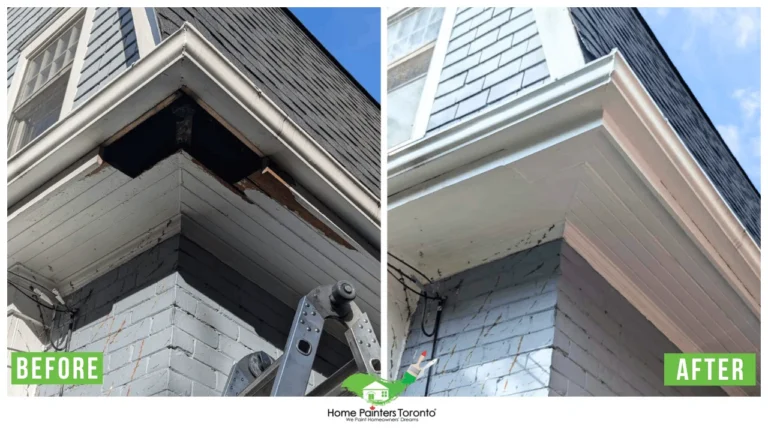
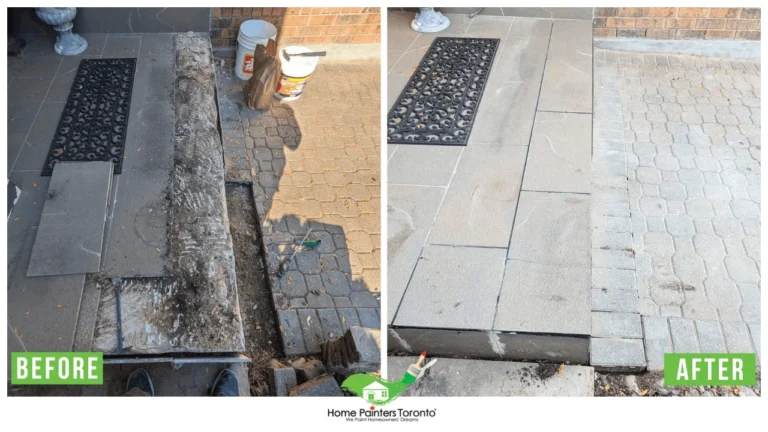
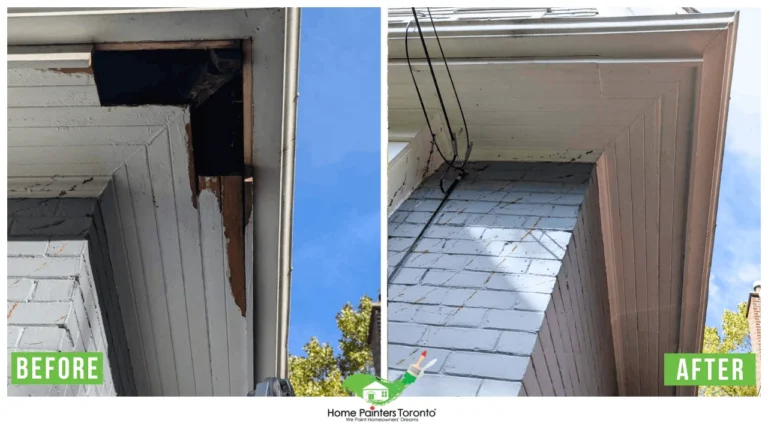
Why This Project Matters for Deer Park and Midtown Toronto Homeowners
Wood soffits and fascia are among the most consistently neglected parts of a Toronto home’s exterior, not because homeowners don’t care about them, but because they’re easy to miss until the damage is already well underway.
Most soffit rot follows the same pattern. A small drainage issue – an improperly seated eavestrough, a gap in caulking, a joint that has shifted – lets water in repeatedly over months or years. The wood doesn’t fail all at once. It softens gradually, darkens, and eventually begins to show visible deterioration. By the time most homeowners notice it, the damage is localized but real, and painting over it without first replacing the compromised wood will not hold.
The compounding problem is that smaller repairs like this are genuinely difficult to get done. Many painting and carpentry contractors won’t take on a job this size. The result is that homeowners either leave the damage to spread, attempt a DIY patch that doesn’t hold up through a Toronto winter, or pay a premium to whoever will eventually say yes.
Home Painters Toronto is set up to handle the full range, from a targeted soffit repair like Gillian’s to a complete exterior house painting project on a multi-storey home. The carpentry team and the painting crew work together under one contract, which means the repair is done before the paint goes on, and the sequence of work is managed correctly without the homeowner having to coordinate between two separate trades.
For homes across Deer Park, where older detached homes with original wood soffits and fascia are common, that kind of integrated approach to exterior repairs makes a real difference.
Related Services Used in This Project
Have a Soffit, Fascia, or Exterior Wood Repair That Needs Attention?
If you have a section of rotting soffit, deteriorating fascia, or any exterior wood repair that other contractors have declined to take on, we can assess the scope and handle both the repair and the painting under one contract.
No job too small. No area is too hard to reach.
Book a free on-site estimate and speak with an exterior carpentry and painting specialist.