

Should You Patch or Replace Rotted Wood Siding on a Toronto Home?
Rotted wood siding is a common problem on older Toronto homes, especially ones with original cedar or pine cladding from before 1980. Homeowners often ask whether patching rotted wood siding will fix the issue for good or if full replacement is the only real solution, and Home Painters Toronto, the HomeStars Best of Award 2026 winner, fields this exact call across the GTA every week. The honest answer depends on how far the rot has spread and what caused it in the first place. A patch on one damaged board can hold up well if the framing behind it stays dry and sound. Once decay has moved through several boards or reached the sheathing underneath, that same patch becomes a short term fix that fails within a season.
Patching rotted wood siding works when decay is limited to one or two boards and the surrounding wood tests under 20 percent moisture content. Once rot spreads past the board face into the sheathing or framing, replacement is the only repair that stops the damage instead of hiding it for a season.
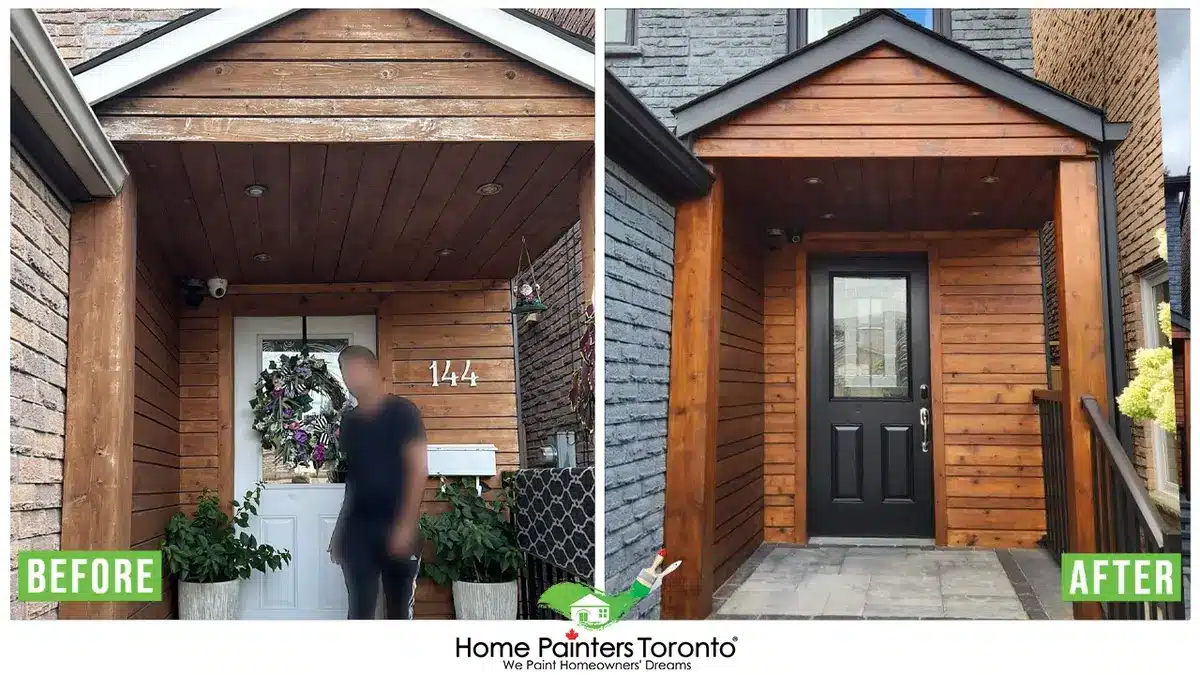
A patch on one damaged board can hold up well if the framing behind it stays dry and sound -- once decay has moved through several boards or reached the sheathing underneath, that same patch becomes a short term fix that fails within a season
Patching vs Replacing Rotted Wood Siding: What Actually Works in Toronto's Climate
Patching rotted wood siding is the right call for isolated, shallow decay caught early, while full replacement is the safer path once rot has spread through multiple boards or into the wall sheathing. Toronto's freezing and thawing winters push moisture deep into any exposed wood grain, so the repair method has to match how far that moisture already travelled. A patch seals the surface, but it does nothing for framing that has already softened underneath. Full wood siding repair removes the damaged material completely, so the crew can confirm the studs and sheathing behind it are dry before new boards go up.
| Factor | Patch Repair | Full Replacement |
|---|---|---|
| Best for | One or two damaged boards | Widespread or repeated rot |
| Typical lifespan | 3 to 5 years with moisture control | 15 to 20 years with a proper coating system |
| Risk of hidden damage | Higher, since sheathing stays covered | Lower, since framing gets inspected |
| Disruption to the wall | Minimal, targeted work | Full wall section removed and rebuilt |
| Warranty fit | Limited scope | Full 3 year exterior warranty applies |
Siding profile also plays a role in this decision. Board and batten walls tend to trap water at the vertical seams, while horizontal lap siding sheds most rain if the overlap is intact and the caulking around windows and doors has not failed. A home with several failure points across the wall usually points toward replacement, even if each individual spot looks small on its own.
Patching Rotted Wood Siding: When Board Repair Makes Sense
Patching rotted wood siding makes sense when the damage sits on the surface of one or two boards, and the framing behind them tests dry with a moisture meter. A skilled crew cuts out the soft wood, fills the cavity with a two part epoxy consolidant, and shapes it to match the original profile. This approach costs less and takes less time than a full section replacement. It works best on siding that gets regular paint maintenance and has not been ignored for several years.
Why Patch Repairs Fail Faster Than Homeowners Expect
Patch repairs often fail within one winter because sealing a rotted board with filler or new wood traps existing moisture instead of removing it. Wood siding absorbs water through the end grain far faster than through the face grain, and a patch rarely reaches every hidden channel where that water travels. Paint and filler create a barrier on top, but moisture already inside the board keeps feeding decay fungi underneath. The result is a board that looks fixed for a season, then bubbles or crumbles again once trapped vapour has nowhere to escape.
This is the same principle that causes sealed coatings to fail on porous masonry: covering the surface without solving the moisture source speeds up failure instead of slowing it down. Gaps in old caulking around windows and doors are one of the most common hidden moisture sources behind patched siding, since water can travel sideways behind the boards long before a homeowner notices a stain on the surface. A patch that ignores the entry point almost always needs to be redone.
Workmanship matters here too. A rushed repair may match filler colour to the existing paint without checking how deep the softwood actually goes. That approach hides the problem for a photo, then fails again within a year once the next rain hits the wall. A proper assessment probes several points around the damaged area, not just the one spot that looks the worst from the ground.
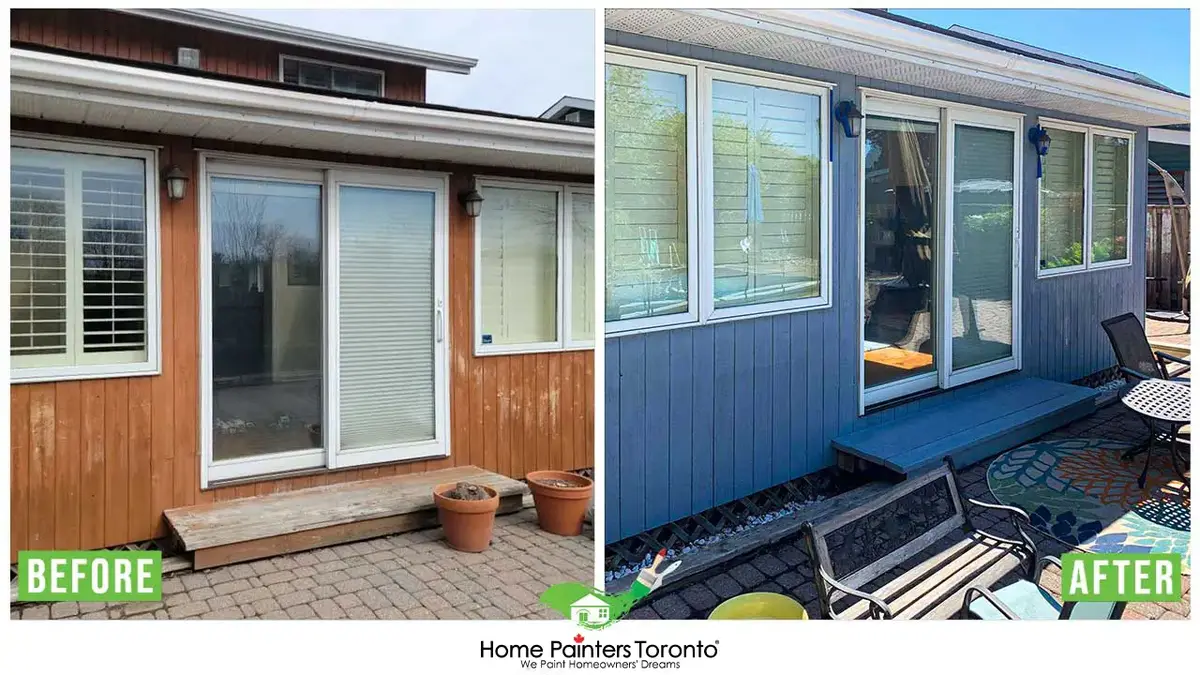
Paint and filler create a barrier on top, but moisture already inside the board keeps feeding decay fungi underneath -- the result is a board that looks fixed for a season, then bubbles or crumbles again once trapped vapour has nowhere to escape
When Full Wood Siding Replacement Is the Smarter Move
Full replacement becomes the smarter move once rot has spread past two boards, reached a corner post, or shown up on the plywood sheathing behind the cladding. At that stage, a patch only covers a fraction of the actual damage. Removing the full section lets the crew check the building paper, flashing, and framing for hidden rot before new siding goes up, and any soft studs get handled through proper wood frame repair instead of a cosmetic fix.
Replacement also resets the clock on the exterior warranty, since Home Painters Toronto backs full replacement work with a 3 year exterior warranty. Homes with damaged soffit and fascia nearby often show the same rot pattern on the wall below, since water running off a failed soffit lands directly on the siding underneath. Homeowners planning to stay in a house for the long term usually save money by replacing a full wall section instead of patching the same spot every few years. You can get a free quote to find out which option fits a specific wall before committing to either approach.
Cost Comparison: Patch Repairs vs Full Siding Replacement
Patch repairs for a small area of rotted wood siding in Toronto typically run between 2,000 and 4,000 dollars CAD plus HST, while full wall replacement can reach 12,000 to 30,000 dollars CAD plus HST for an entire home. The gap between those numbers depends on how much of the wall needs to come off, how many crew hours the access requires, and whether framing repair is part of the scope.
| Scope | Estimated Cost (CAD + HST) |
|---|---|
| Patch repair, 1 to 3 boards | $2,000 – $4,000 |
| Single wall section replacement | $4,000 – $8,000 |
| Large wall or two storey section | $8,000 – $10,000 |
| Full home re siding | $12,000 – $30,000 |
Material choice affects these ranges too. Prefinished cedar costs more than paint grade pine, but it needs fewer maintenance coats over its life. Homeowners weighing this decision against a full exterior repaint can review our cost of painting a house guide for a sense of how siding work compares to a standard repaint budget across a typical GTA home.
A Recent Wood Siding Repair Project in Etobicoke's Alderwood Neighbourhood
Four Boards Removed, Sheathing Replaced, Pressure Treated Furring Sistered, Benjamin Moore Aura Exterior Low Lustre -- 48-Hour Dry, 3-Year Warranty
At a recent project in the Alderwood neighbourhood of Etobicoke, our crew found soft, spongy cedar siding along the north wall of a 1962 bungalow. A moisture meter read 34 percent in the worst boards, well past the level where decay fungi stay active. We removed four full boards and two feet of sheathing, sistered new pressure treated furring strips against the studs, and let the wall dry for 48 hours before closing it back up.
The new cedar boards were primed on all six sides and finished with Benjamin Moore Aura Exterior in Low Lustre finish, applied at the manufacturer's recommended wet film thickness for full coverage. The homeowner's siding call also confirmed something we see often across Etobicoke and Mississauga: north facing walls with heavy tree cover hold moisture the longest and rot first. The same visit turned up a soft section near the front door restaining area, a reminder that rot rarely stays confined to one spot once it starts. All crew members on that job were WSIB compliant and fully insured, and the finished wall carries the same 3 year exterior warranty as the rest of the house. You can see more examples like this one in our recent painting projects gallery.
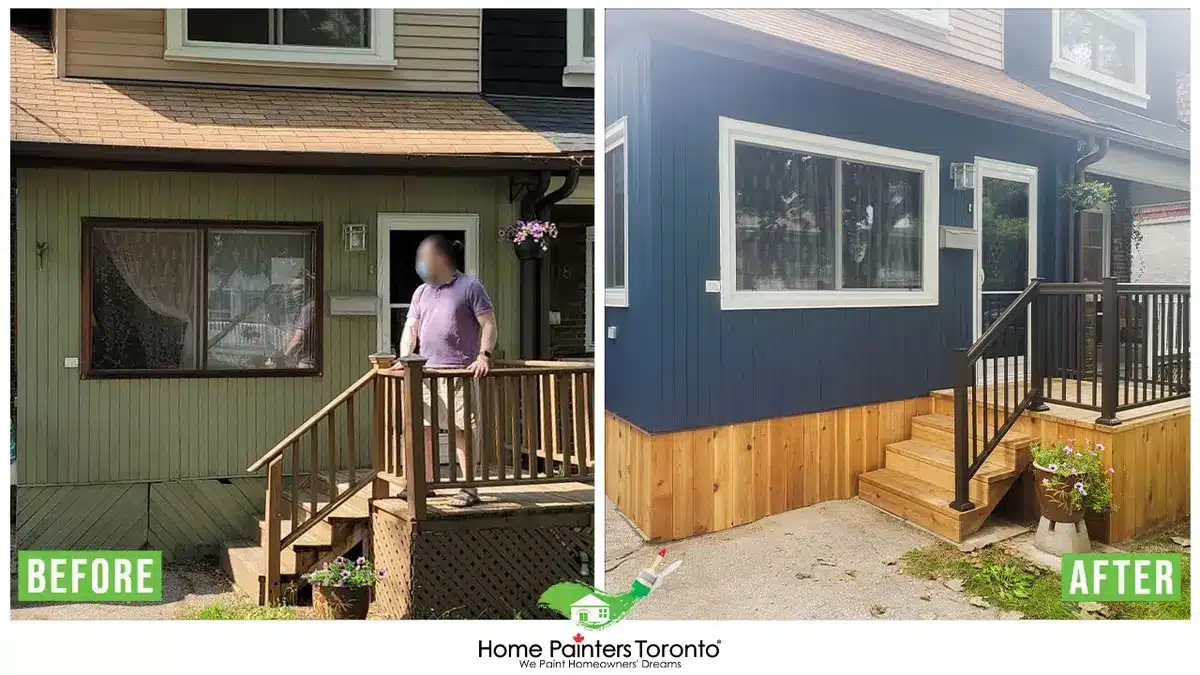
34% moisture in worst boards, four boards and two feet of sheathing removed, pressure treated furring sistered against studs, 48-hour dry, new cedar primed on all six sides, Benjamin Moore Aura Exterior Low Lustre at manufacturer recommended wet film thickness -- 3-year exterior warranty on finished wall
Five Signs Your Siding Has Gone Past the Point of Patching
Five warning signs tell you when rotted wood siding needs full replacement instead of a patch: soft spots larger than a coin, paint that bubbles across several boards, visible gaps at the seams, a screwdriver that sinks into the wood with light pressure, and moisture readings above 20 percent that do not drop after a dry week. Checking for these signs takes less than an hour and saves homeowners from paying for a patch that will not hold.
- Soft spots larger than a coin: a small area of give under light pressure usually means a patch will hold, but anything wider suggests the rot has already spread.
- Paint that bubbles across several boards: this points to moisture spreading behind the surface, not a single weak spot that a patch can fix.
- Visible gaps at the seams: gaps let rain behind the cladding faster than any patch can compensate for, and they usually point to a bigger sealing problem.
- A screwdriver that sinks in easily: this is a sign the wood fibre has already broken down and lost its structural strength.
- Moisture readings above 20 percent after a dry week: this confirms trapped water instead of surface dampness from a recent rain.
Moisture Readings That Signal Replacement, Not Repair
Wood framing normally holds a moisture content between 6 and 14 percent, and stays sound for decades in that range, according to Canada Mortgage and Housing Corporation's building science guide on wood frame envelopes. Once trapped water pushes the reading above 20 percent, decay fungi become active and structural damage begins. A single high reading after a storm is not a reason to panic, but a reading that stays elevated after a dry week points to a leak or trapped moisture source that a patch will not fix on its own.
Structural Sheathing Damage Behind the Boards
Wood reaches what building scientists call the fiber saturation point once its cell walls hold all the water they can, and any moisture beyond that point sits in the open cell cavities where fungi thrive, according to the United States Forest Products Laboratory's Wood Handbook. Sheathing behind rotted siding often crosses this point long before the visible boards show damage, since the plywood sits directly against wet siding with no gap for air movement. This is why a full inspection matters more than a surface look at the paint, and why a patch that only addresses the visible board can leave the real problem untouched.
What Happens During a Professional Patch or Replacement Job
A professional wood siding repair follows five steps: moisture testing, removal of damaged material, framing repair where needed, installation of matched profile boards, and a primer and topcoat system built for Ontario winters. Skipping any one of these steps is the most common reason a repair fails early.
- Moisture testing Crews check every board around the damaged area with a pin type meter, not just the section that looks bad, so hidden problem spots get caught before the wall closes back up.
- Removal of damaged material Soft wood gets cut back to solid, dry material, even if that means taking out more than the original problem board.
- Framing repair Any soft studs or sheathing get sistered or replaced before new siding goes up, since covering damaged framing only delays the next failure.
- Matched profile installation Replacement boards match the reveal, thickness, and profile of the original siding so the wall reads as one continuous surface once painted.
- Primer and topcoat Every new board gets primed on all sides, including the back, before a breathable exterior topcoat goes on as part of a complete exterior house painting finish.
Why Toronto Homeowners Trust Professional Wood Siding Repair
Toronto homeowners trust professional wood siding repair because the work carries real accountability: WSIB compliance, full insurance, and a written warranty instead of a verbal promise. Home Painters Toronto has served more than 17,000 clients across the GTA over 38 years as a family owned business, and the company holds over 1,200 positive reviews across HomeStars, Google, and Houzz, which you can read in full through our client reviews page.
Every crew member passes a criminal background check before stepping onto a property, and the company carries 5 million dollars in general liability insurance on every job. Exterior work, including wood siding repair, carries a 3 year warranty, and all work comes with a 100 percent satisfaction guarantee. Same day estimates are available seven days a week, which matters when a soft board needs an answer before the next rain.
This level of documentation matters most at the estimate stage, before any wood comes off the wall. A written scope that separates patch work from full replacement, with a clear price range for each, gives homeowners a real choice instead of a single number with no context. That clarity is part of why Home Painters Toronto sits as the number one rated painting contractor on HomeStars among GTA homeowners searching for wood siding repair.
Frequently Asked Questions
Yes, in many cases. Patching rotted wood siding works well when the damage is limited to one or two boards and the framing behind them tests dry. Once rot has spread further or reached the sheathing, replacement becomes a more reliable option.
Check for soft spots larger than a coin, paint that bubbles across several boards, and gaps at the seams. A moisture meter reading above 20 percent that does not drop after a dry week is a strong sign that replacement is the better call.
Most home insurance policies in Ontario cover sudden water damage, such as a burst pipe, but they do not cover gradual rot caused by age or lack of maintenance. Homeowners should check their specific policy, since coverage varies between insurers.
A well executed patch on isolated, shallow decay can last 3 to 5 years if the surrounding wood stays dry and the paint film gets maintained on schedule. Patches on wood that was already saturated tend to fail within a single winter.
Patching costs less upfront, usually between 2,000 and 4,000 dollars CAD plus HST for a small area. Full replacement costs more at the time of the job but often costs less over ten years, since it avoids repeat patch visits on the same wall.
Wood siding rots when moisture gets trapped against or inside the board for long periods, usually from failed caulking, damaged flashing, sprinklers hitting the wall, or heavy tree cover that blocks sun and airflow. Paint alone cannot stop rot once one of these moisture sources is active nearby.

Ready to Fix Rotted Wood Siding the Right Way?
Deciding between a patch and a full replacement comes down to how far the rot has actually spread, not just how the siding looks from the driveway. A moisture meter and an experienced eye can tell the difference in minutes, and that difference changes the cost, the timeline, and how long the fix lasts. Toronto's freezing winters and humid summers give rotted wood siding nowhere to hide for long, so an early, accurate diagnosis saves money either way. Home Painters Toronto brings that same diagnosis to every estimate, backed by 38 years of local experience and a crew that shows up WSIB compliant and fully insured on day one. Homeowners who want more background before booking can also check our frequently asked questions page.
Contact Home Painters Toronto for fast, free quotes and warranty backed work on any wood siding repair or replacement project across the GTA.
Get Fast, Free Quotes for Wood Siding Repair in Toronto
Contact Home Painters Toronto for fast, free quotes and warranty backed work on any wood siding repair or replacement project across the GTA. Same day estimates available seven days a week.
Contact Us for a Free Quote