

Peeling Paint on Wood Siding: Why Repainting Alone Won't Fix It
Peeling paint on wood siding is one of the most common exterior calls Home Painters Toronto gets from homeowners in Etobicoke, North York, and across the GTA, and it comes up often enough in our broader siding repair work that our crews follow a standard diagnostic routine for it before any paint gets touched. Many homeowners assume a fresh coat of paint will solve the problem, but peeling paint on wood siding is almost always a sign that moisture is trapped behind the coating, not simply that the old paint wore out. Our track record on exterior work, including more than 1,200 positive reviews from GTA homeowners, comes from catching that distinction before a crew ever picks up a scraper. When a crew scrapes the loose flakes and repaints over that hidden moisture source, the new paint film often starts lifting again within a year or two, sometimes on the exact same boards. Ontario's freeze-thaw winters and humid summers make this failure pattern especially common on south-facing and west-facing walls, where temperature swings and sun exposure are both more extreme. Understanding why the paint failed in the first place, not just where it is peeling, is the only way to get a repaint that actually holds up for years instead of months.
Peeling paint on wood siding usually means moisture is trapped behind the coating, not that the paint simply wore out. Repainting without fixing the moisture source, removing loose material, and priming bare wood typically fails again within one to two years. Lasting results require diagnosing and correcting the substrate problem first.
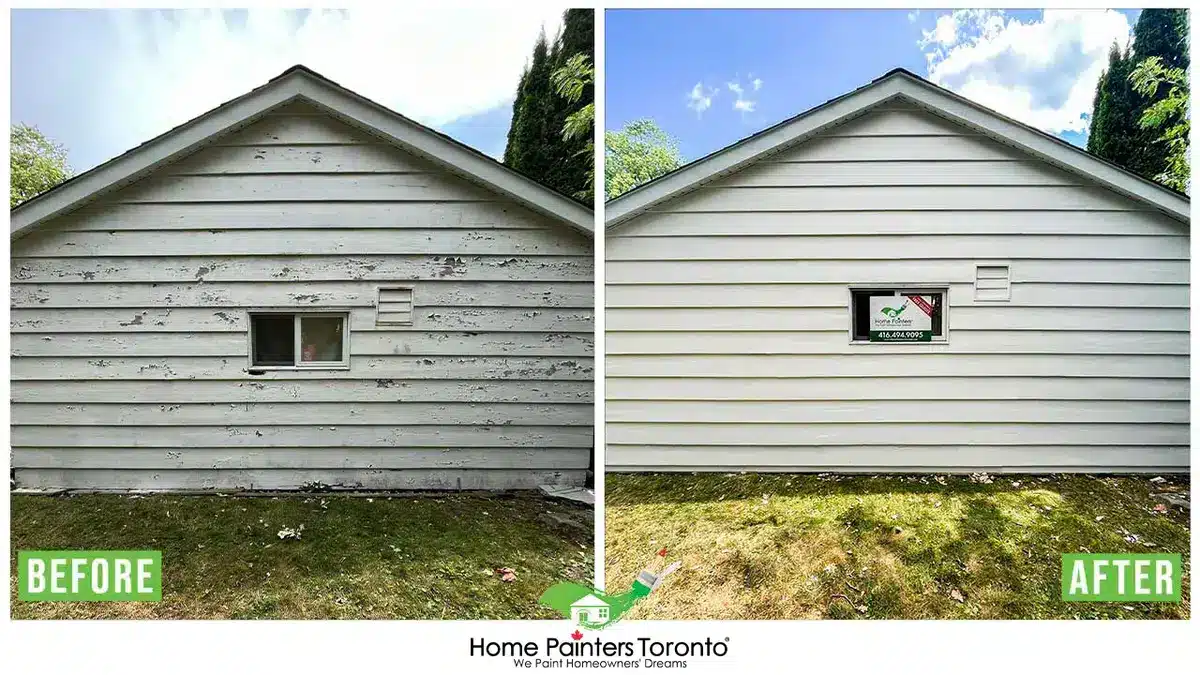
Peeling paint is almost always a sign that moisture is trapped behind the coating, not simply that the old paint wore out
What Causes Peeling Paint on Wood Siding in Toronto
Peeling paint on wood siding is caused by moisture breaking the bond between the paint film and the wood faster than normal weathering ever could. Water gets behind the coating through several common paths: roof runoff or sprinklers hitting the lower courses of siding, poor grading that pushes rainwater back toward the foundation wall, and ice damming near soffits that sends meltwater down behind trim boards. Interior humidity plays a role too, since warm, moist household air can migrate outward through the wall cavity in winter and push against the paint film from the inside, a process painters call vapour drive. Failed or missing caulking at butt joints, window trim, and corner boards is another frequent culprit, since even a hairline gap lets water track behind the siding every time it rains. In most of the homes we assess, it is rarely just one of these paths; it is two or three of them working together over several seasons.
Older Toronto homes built before modern building wraps and rainscreen gaps became standard are especially prone to this pattern, since the original wall assembly has no engineered path for trapped water to escape. Painting over bare wood without a primer coat, or painting before the wood has fully dried after cleaning or a rain event, sets the same failure in motion from day one, no matter how good the topcoat is. Our exterior wood siding crews check grading, caulking, gutters, and interior humidity sources before recommending a repaint, because painting over an active moisture path just delays the next failure instead of preventing it.
Moisture Content and Wood Siding Paint Failure
Paint manufacturers generally recommend keeping exterior wood moisture content under about 15 percent before painting, based on technical guidance published by Benjamin Moore. Wood above that threshold still holds enough water to push vapour through the paint film as it dries, which shows up later as blistering and then peeling, regardless of the paint brand or the number of coats applied. Professional crews use a pin-type moisture meter on suspect boards before starting prep work, instead of judging readiness by how the wood looks or feels on the surface. A board that looks dry on the outside can still read well above 15 percent a few millimetres in, especially on siding facing a sprinkler zone or sitting close to a downspout. On a typical GTA home, a handful of readings across the affected wall is usually enough to confirm whether the whole elevation needs to dry out longer or whether the problem is isolated to one or two boards.
Why Repainting Over Peeling Paint Fails Within a Year or Two
Repainting over peeling paint fails quickly because fresh paint cannot bond to a surface that is still releasing moisture or covered in loose, chalking material underneath. Most quick-turnaround repaints scrape only the flakes that are already lifting and skip the step of tracking down what let water in behind the old coating. If the source, whether a leaking gutter, a gap in the caulking, or high interior humidity, is never addressed, water keeps cycling behind the new paint film through every rain and every freeze cycle. Ontario's winter freeze-thaw cycles then do the rest, since trapped water expands as it freezes and repeatedly stresses a paint film that already has a weak bond to the wood underneath.
Using a thicker coat or a premium paint line does not solve a moisture problem on its own; it only buys the wall another season before the same pattern of blistering and peeling returns. Some contractors skip the diagnosis step because it takes longer and does not show up as visible progress on the first day of a job, but that shortcut is exactly what leads to a callback within a year. On every exterior residential painting project, our crews treat a moisture diagnosis as a required first step, not an optional upgrade, because it is the only way to know whether a wall is actually ready for paint.
The Science Behind Moisture and Paint Adhesion in Ontario Winters
Ontario winters turn a minor moisture problem into a full paint failure because water trapped behind a paint film freezes and expands, physically forcing the coating away from the wood with every cold snap. A home in the GTA goes through dozens of freeze-thaw cycles each winter, not one single freeze, so a wall with hidden moisture gets stressed again and again instead of just once. Each cycle widens the gap between the paint film and the wood a little more, until a section that looked like a small crack in November is a full sheet of peeling paint by March. This is why a peeling problem that seems minor in the fall so often looks much worse by the following spring.
Humid GTA summers add to the problem by keeping wood siding at a higher moisture content for longer stretches before it has a chance to dry out fully. Paint applied at the end of a humid week, without enough dry time built into the schedule, starts its life already fighting a losing battle against trapped water vapour. That combination of a wet summer application and a stressful winter freeze-thaw cycle is why peeling paint on wood siding shows up so consistently on the same walls year after year unless the underlying moisture path gets fixed. Walls that face west or south typically show the fastest failure, since afternoon sun heats the paint film and drives any trapped moisture toward the surface with more force than a shaded, north-facing wall ever sees.
Alligatoring vs. Peeling: What the Failure Pattern Tells You
Alligatoring is a cracked, scaly pattern that usually points to age and UV breakdown across multiple old paint layers, while true peeling is a sign that the paint has lost its bond to the wood entirely, almost always because of moisture. Alligatoring can often be corrected with proper sanding, priming, and a standard repaint, since the wood underneath is typically still sound. Peeling calls for a different response: find the moisture source, correct it, and confirm the substrate is dry before any new paint goes on. Confusing the two failure patterns is one of the most common reasons a repaint that looked fine on move-out day is lifting again within a year, since a crew that treats a moisture-driven peel the same way it treats simple age-related cracking is set up to fail before it starts.
Signs Your Wood Siding Has a Substrate Problem, Not Just a Paint Problem
Wood siding has a substrate problem, not just a paint problem, once the wood underneath the loose paint feels soft, discoloured, or swollen to the touch. A quick inspection after scraping tells a trained crew whether a wall needs a straightforward repaint or carpentry repair first, and the difference changes both the scope and the cost of the job. The table below breaks down what different peeling patterns usually mean and what the wall needs before any paint goes back on.
| Sign | What It Usually Means | What the Wall Needs |
|---|---|---|
| Peeling concentrated near the bottom of the boards | Splash-back moisture from grading or downspouts | Correct drainage, then spot repair and repaint |
| Peeling near window and door trim | Failed or missing caulking letting water behind the trim | Re-caulk exterior joints, then repaint |
| Wood feels soft or spongy once paint is removed | Active rot from prolonged moisture exposure | Carpentry repair or board replacement before painting |
| Dark staining under the lifted paint | Extended water exposure, possible early mould | Investigate the source and replace affected boards |
| Paint blistering but not yet fully separated | Early-stage moisture trapped in the film | Can sometimes be corrected before full peel with a prompt repaint |
Homes with older porch columns or wood trim near grade level often show this same pattern, which is why our porch wood repair crews and exterior painting teams inspect trim details as part of every siding assessment. Front entry areas deserve the same scrutiny, since a failed seal around a wood door frame or an entry door that was never properly restained and resealed can mimic a siding problem when the real source is somewhere else entirely. Failed exterior caulking around trim and joints is one of the most common triggers behind these patterns, which is why crews check it before repainting instead of waiting for a callback the following spring.
Our Process for Fixing Peeling Paint the Right Way
Fixing peeling paint on wood siding correctly takes four stages: diagnosing the moisture source, removing all failed material back to sound wood, priming bare wood, and applying two finish coats rated for exterior use. Skipping any one of these stages shortens the life of the repaint no matter how good the paint itself is, which is why our crews walk through every stage in order on every job, not just the ones with obvious rot.
- Diagnose the moisture source. Crews inspect flashing, caulking, grading, gutters, and downspouts, and check suspect boards with a moisture meter before any scraping begins, so the repair plan matches the actual cause instead of a guess.
- Scrape and sand back to sound, dry wood. Every loose or cracked area comes off, not just the flakes that are already curling, so the new paint has a stable, uniform surface to grip along the whole wall.
- Repair or replace damaged boards. Soft or rotted sections get carpentry repair before any primer goes on, since paint cannot restore structural wood and hides a problem that will keep spreading underneath it.
- Prime bare wood. The right primer for the species and moisture history of the board seals the surface, blocks tannin bleed on cedar, and gives the finish coats something reliable to bond to.
- Apply two coats of exterior paint. Even coverage at the right dry film thickness gives the paint enough body to handle Toronto's temperature swings without failing early, and a second coat corrects any thin spots left by the first.
- At a recent repaint on a 1930s home in Etobicoke's Alderwood neighbourhood, our crew found peeling paint concentrated along the lower courses of cedar board siding.
- A moisture meter reading of 22 percent on the affected boards pointed to splash-back from a downspout draining too close to the foundation, not simple paint wear.
- After correcting the drainage and replacing two rotted boards, the crew primed the bare wood and applied two coats of Benjamin Moore Aura Exterior in Low Lustre at roughly 1.5 mils of dry film thickness per coat.
More than a year later, through a full Toronto winter, the repaint shows no signs of lifting.
The same scrape-to-sound-wood approach carries over to our deck and fence staining work, where the same moisture rules apply to horizontal wood surfaces that see even more direct weather exposure than vertical siding.
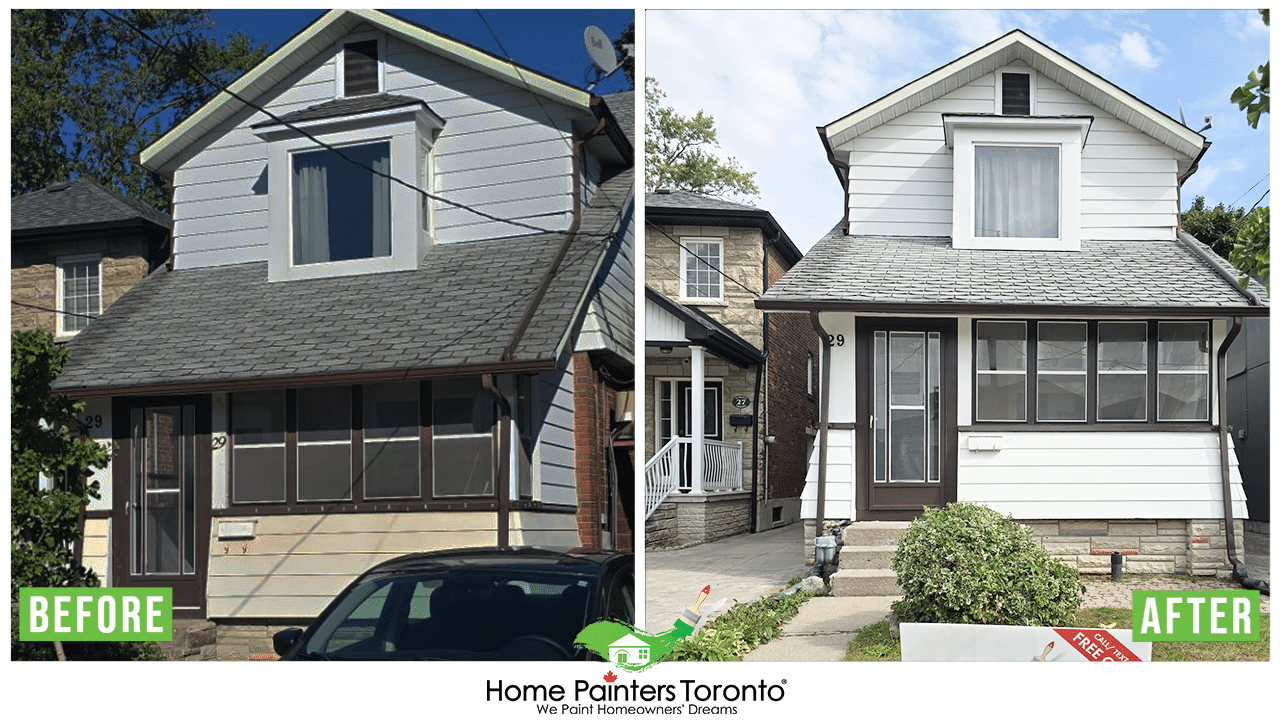
More than a year later, through a full Toronto winter, the repaint shows no signs of lifting
Cost and Longevity: Doing It Right vs. Repainting Over the Problem
Fixing peeling paint correctly costs more upfront than a quick scrape-and-repaint, but repainting over an unresolved moisture problem usually means paying for the same wall twice within two or three years. A straightforward exterior repaint on a small home typically falls in the $2,000 to $4,000 range, while a medium-sized home with some prep and carpentry work runs closer to $4,000 to $8,000. Larger homes needing more substrate repair, board replacement, or full-perimeter caulking can reach $8,000 to $10,000, and extra-large or heavily damaged properties can run from $12,000 up to $30,000, depending on scope. Skipping the diagnosis step to save money on the front end almost always costs more over a five-year span, since the wall gets repainted again sooner and the underlying rot or moisture problem has more time to spread.
| Approach | What It Typically Involves | Expected Longevity |
|---|---|---|
| Scrape and repaint over an unresolved moisture source | Surface prep only, no diagnosis or carpentry repair | 1 to 2 years before peeling returns |
| Diagnose, repair the substrate, then repaint | Moisture source correction, carpentry repair where needed, primer and two finish coats | 3 or more years, matched to HPT's exterior warranty |
| Full exterior repaint with extensive carpentry | Board replacement, re-caulking, and full prep across the home | Longest-lasting result, backed by warranty-backed work |
A full cost of painting a house breakdown covers how these ranges apply across different project types and home sizes, which is useful context once a moisture diagnosis has set the actual scope of the repair.
Every HPT exterior project is WSIB compliant and fully insured, and our exterior painting work carries a 3-year warranty, which only holds up if the moisture source behind a peeling wall gets fixed first. A warranty on a repaint that skipped the diagnosis step is really only a warranty on the paint itself, not on the outcome, since the same moisture problem will reappear regardless of what brand went on the wall.
According to the Canada Mortgage and Housing Corporation, moisture control is the primary defence against material deterioration in a home's building envelope, and that principle applies just as directly to painted wood siding as it does to framing or insulation.
Homeowners can see completed examples of this kind of repair, including before-and-after photos, on our client reviews page.
Peeling Paint Repair FAQ
New paint peels quickly when it goes over a moisture source or unsound wood that was never corrected before the job started. If a downspout, a gap in the caulking, or an interior humidity problem remains, water keeps getting behind the new film during every rain and every freeze cycle. The paint itself is rarely the cause, since the underlying substrate is almost always the real problem, and a repaint that skips diagnosis is simply hiding it for a season.
Yes, peeling paint can be an early sign of rot, especially if the wood feels soft or spongy once the loose paint is scraped away. Rot spreads fastest in areas that stay wet for long stretches, such as low courses near grade or trim around windows and doors. A crew should check for soft wood at every spot where paint has lifted before any repaint work begins, since painting over active rot only buys a season before the problem resurfaces.
Pressure washing alone is not enough to prep peeling wood siding, since it removes surface dirt but not the underlying moisture or loose paint. Proper prep also needs scraping back to sound wood, spot repair of any soft or rotted boards, and enough dry time before primer goes on. Painting too soon after washing traps residual moisture under the new coat and sets up the same failure again within a season or two.
Exterior paint on properly prepared wood siding in Toronto should last three years or more before it needs attention again, which is why HPT backs exterior painting with a 3-year warranty. Paint that peels within a year or two almost always points to a moisture problem that was not addressed during prep. Paint quality matters far less than getting the substrate right before the first coat goes on, and a wall that is properly diagnosed and repaired can often go well beyond the three-year mark.
HPT repairs the wood first when a substrate problem is found, since painting over rotted or unstable boards only hides the problem for a short time. Our crews handle carpentry repair, board replacement, and re-caulking as part of the same project, so the finished repaint has something solid to bond to. This is also why every job starts with a diagnosis, not just a quote for paint and labour.
More general questions about scheduling, pricing, and warranty terms are answered on our FAQ page.

Get a Free Assessment for Peeling Wood Siding
If paint is peeling on your wood siding, Home Painters Toronto offers fast free quotes and warranty-backed work across Toronto and the GTA. Our crews are WSIB compliant and fully insured, and every exterior project starts with a proper diagnosis, not just a quick scrape and repaint.
Contact Home Painters Toronto to book a free, no-obligation assessment and get a repaint that actually holds up through Ontario's winters.
Get a Free Estimate