

Why Your Siding Keeps Failing in the Same Spot (and How Pros Fix It for Good)
If the same corner of your siding in Toronto keeps cracking, staining, or popping loose no matter how many times you patch it, the problem is not bad luck. Recurring siding damage almost always means something behind the panel is still active, usually trapped moisture, a broken flashing detail, or a wall assembly that never drained the way it should. Toronto winters make this worse because water trapped behind a panel expands every time it freezes, widening the same weak point year after year. Most homeowners repaint or replace the visible panel and move on, only to watch the exact same failure return within a season or two. Home Painters Toronto has diagnosed this pattern on homes across the GTA, and the fix starts with finding the hidden cause, not just covering the symptom.
Siding that keeps failing in the same spot usually has trapped moisture, broken flashing, or a missing drainage plane behind the panel, not a random accident. A surface patch fixes the panel but leaves the actual cause active behind the wall. Home Painters Toronto, rated number one on HomeStars with over 1,200 positive reviews, traces the real source before any repair begins.

The pattern almost always points to a hidden moisture path that a surface patch cannot fix
Why Recurring Siding Damage Keeps Coming Back to the Same Spot
Recurring siding damage returns to the same location because the original entry point never got closed off. A flashing gap, a failed caulk joint, or a missing drainage plane keeps feeding water into the same wall cavity. Each freeze-thaw cycle widens the weak spot a little more. By the time a homeowner notices the third or fourth crack in the same panel, the wood or sheathing behind it has usually been wet for months.
Home Painters Toronto has served 17,000+ clients across the GTA and holds the HomeStars Best of Award 2026, so our crews see this exact pattern often. A patched hole rarely lines up with the real path water takes through a wall. Gravity pulls moisture down and sideways along framing members, so the visible damage can sit several inches from the actual gap in the flashing or housewrap.
Vinyl, aluminum, wood, and fibre cement all show the pattern differently. Vinyl cracks or pops at the same seam because the panel below it never fully dried out. Wood swells and splits at the same board because trapped moisture keeps softening the fibres. Homeowners considering vinyl siding painting and refinishing or exterior wood siding work often ask us why a fresh coat of paint or a new panel does not stop the cycle. The honest answer is that finish work cannot fix a drainage problem hiding underneath it.
Older GTA homes are especially prone to this. Many were retrofitted with vinyl or aluminum siding decades ago, directly over the original wall, with no drainage gap ever added. Aluminum soffits that funnel roof water sideways instead of down can also feed the same wall section every time it rains, which explains why the stain always appears in the same place, storm after storm.
Common Entry Points Behind Recurring Siding Damage in the GTA
- Window and door head flashing where the caulking has failed
- Roof to wall transitions with missing or corroded step flashing
- Corner trim and J-channel seams closed up too tightly
- The base of the wall near grade, where splash back keeps one course wet
The Building Science Behind Why the Same Wall Section Keeps Failing
A wall section keeps failing because it never had a working drainage plane behind the cladding. Every type of siding is expected to let some water past the surface, so the wall behind it needs its own path to shed that water back out. When that drainage layer is missing, torn, or blocked, the same low point in the wall stays wet after every rain.
According to drainage plane research from Building Science Corporation, effective drainage can occur in a gap as small as one sixteenth to one eighth of an inch, though fully ventilating and drying a wall may need a space closer to three quarters of an inch to a full inch, depending on the moisture load. Many older Toronto homes were built before this research became standard practice, so the wall behind the siding often has no real gap at all.
This is also why a reservoir cladding like stucco or wood behaves differently than vinyl. A reservoir material can absorb and hold water, then release it slowly into the wall long after the rain has stopped, which is part of why the same section can stay damp for days after a storm has cleared.
| Failure Point | Why It Recurs | What a Professional Correction Requires |
|---|---|---|
| Window head flashing | Water pools above the opening every rain event | New head flashing lapped correctly over the housewrap |
| Roof to wall transition | Step flashing missing or corroded | Reflashing tied into the drainage plane |
| Corner and J channel seams | Expansion gap closed by a previous patch | Reset trim with the correct clearance |
| Base of wall near grade | Splash back keeps the same course wet | Regrading plus a proper drip cap |
Water expands as it freezes, and that pressure works on the same crack, seam, or joint every winter. Instead of healing, the failure point grows a little more with every cold snap, which is why so many recurring problems get worse each year rather than staying the same size.
How Our Crew Traces Recurring Siding Damage Back to Its Source
Our crew traces recurring siding damage using three steps: pattern mapping, moisture probing, and a flashing inspection. We start at the visible damage and work backward to the actual entry point instead of guessing from the surface.
Pattern mapping means photographing every crack, stain, and soft spot on the wall and marking where they line up with windows, rooflines, and grade. Framing runs in a predictable direction, so damage often clusters along one stud bay or one course of siding even when the entry point sits higher up the wall.
Moisture Meter Readings and Probe Testing
A pin-style moisture meter tells us how wet the sheathing and framing really are behind the panel. Wood that tests above 28 percent moisture content has crossed the fiber saturation point, the level at which decay fungi become active, based on published findings from the USDA Forest Products Laboratory. Readings below that line usually mean the wood can still dry out and be saved. Readings above it often mean the sheathing itself needs to come out, not just the siding.
The last step is a visual and physical check of the flashing itself. We look for missing head flashing, reversed laps that funnel water inward instead of out, and caulking that has pulled away from the substrate. This step tells us exactly what has to change so the same spot does not fail again next year.
Why a New Panel Over the Same Spot Almost Always Fails Again
A new panel over the same spot almost always fails again because it only replaces what you can see. The moisture source, the broken flashing, or the missing drainage plane stays exactly where it was. Within a season or two, the same stain or crack reappears in the same place, sometimes faster than before because the new material starts out wetter than the wall around it.
We see this often on homes that already had a quick patch job done by a general handyman before calling us. A patch can look clean for a few months, but paint and caulking are cosmetic layers. Neither one can replace a missing capillary break or a torn housewrap hiding behind the wall.
| Approach | What It Fixes | What It Leaves Behind | Typical Result |
|---|---|---|---|
| Patch-only repair | The visible crack or hole | The moisture source and failed flashing | Same failure returns within one to two seasons |
| Root cause repair | The entry point plus the damaged panel | Nothing active behind the wall | Warranty-backed, lasting result |
This is true across materials. A patched section of aluminum siding painting can look fine from the street while the panel behind it stays damp. A resealed joint on stucco siding repair often hides a crack that reopens the following spring. The material is rarely the real problem. The path water takes to get behind it is.
What a Professional Root Cause Repair Includes
A professional root cause repair includes three parts: removing the damaged material, correcting the flashing and drainage plane, and only then closing the wall back up with matching siding. Skipping the middle step is what causes the failure to return.
Flashing, Housewrap, and Drainage Plane Corrections
We remove enough siding to expose the sheathing around the damaged area, then replace any torn housewrap and reinstall flashing so every lap sheds water downward and outward. Where the original wall never had a drainage gap, we add a proper drainage plane before the new siding goes back on. This single step is usually what stops the cycle for good.
Depending on the material, this work often overlaps with professional caulking around windows and doors, soffit and fascia repair, or wood frame repair, since water rarely respects the boundary between one trade and the next. A window head flashing failure, for example, can show up as siding damage two courses below the window and as soffit staining above it at the same time.
Once the wall tests dry and the drainage path is corrected, we let the sheathing sit for a monitored drying period before closing anything up. Only then do we match the replacement siding to the existing wall for colour and profile ahead of final fastening and sealing.
A Recent Recurring Siding Repair in Etobicoke
- At a recent project on a quiet street near Kingsway in Etobicoke, a homeowner had patched the same section of wood siding three times in four years.
- Our first moisture reading on the sheathing came back at 34 percent, well above the fibre saturation point. We traced the source to a missing piece of step flashing where a small roof section met the main wall, a detail the earlier patchwork had never touched.
- After removing the damaged boards, we corrected the flashing, added a proper drainage gap, and let the wall dry to 14 percent moisture content before closing it back up.
- The homeowner chose Benjamin Moore Aura Exterior in a Low Lustre finish for the new boards, applied at roughly 4 mils dry film thickness per coat to match the rest of the wall.
All of our exterior work on that project came with WSIB-compliant, fully insured crews and warranty-backed results, and the wall has stayed dry through two full winters since.
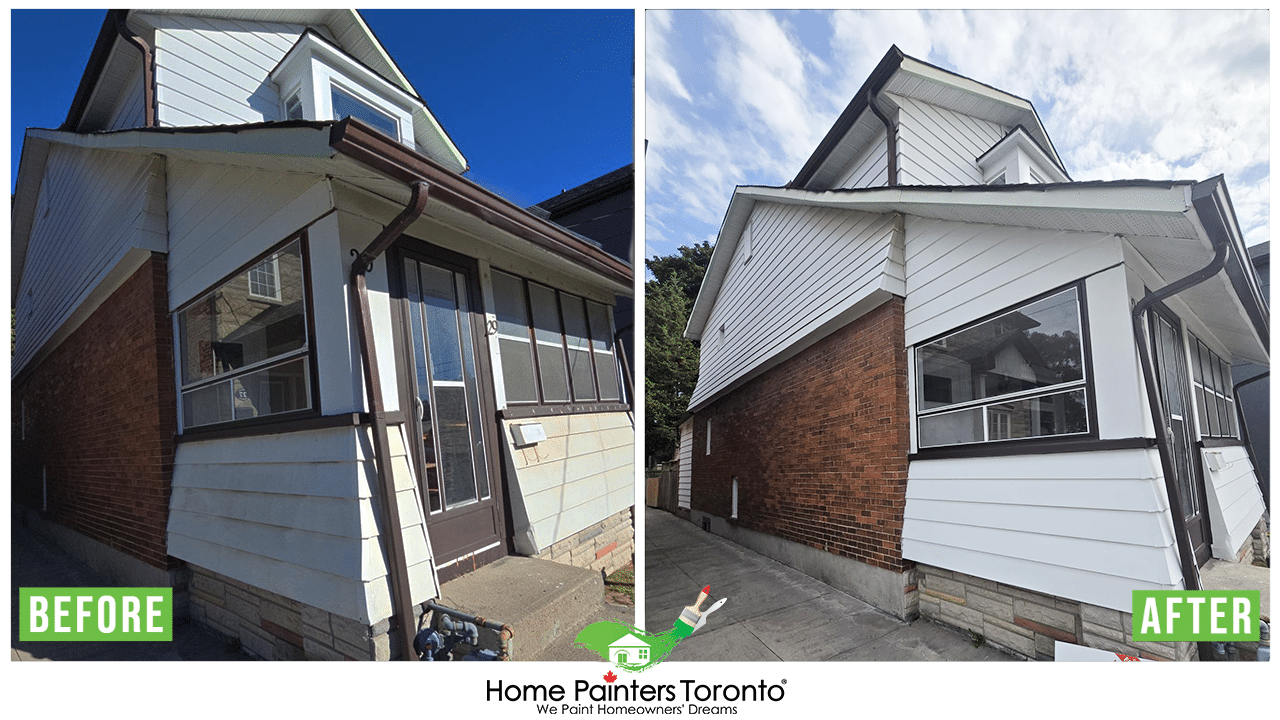
Correcting the flashing and adding a proper drainage gap stopped a failure that three prior patches never touched
Why Toronto Homeowners Trust a Contractor Who Fixes the Cause, Not the Symptom
Toronto homeowners trust a contractor who fixes the cause because a cheap patch almost always costs more the second time around. Home Painters Toronto has been family-owned and operated for 38+ years, and every exterior repair is backed by WSIB compliance and $5M in general liability insurance, with criminal background checks completed on all crew members.
Root cause siding repair is priced by scope, not by the panel. A single wall section with one entry point to correct typically falls in the Exterior Small range, while a project touching multiple flashing details or a larger wall assembly moves into the Exterior Medium range.
| Project Scope | Estimated Range (CAD + HST) |
|---|---|
| Single wall section, one entry point | $2,000 – $4,000 |
| Multiple entry points or wall assembly correction | $4,000 – $8,000 |
Every exterior repair comes with our 3-year exterior warranty and the same 100% Satisfaction Guarantee we apply to every job. You can read client reviews on HomeStars and Google from homeowners who dealt with this exact recurring damage pattern, browse recent siding and exterior projects from across the GTA, or see why homeowners choose Home Painters Toronto before booking a visit.
If you are still deciding whether the damage on your wall is cosmetic or structural, our team can get a free professional estimate scheduled the same week in most cases. Our full frequently asked questions page covers warranty terms, scheduling, and what to expect on inspection day.
Homes with a mix of materials, such as wood siding repair and replacement next to a painted exterior, sometimes need more than one trade on site the same day, which is why our crews are cross-trained across exterior house painting services and carpentry repair rather than sending out a single specialist who can only handle half the wall.
Frequently Asked Questions
It keeps cracking in the same spot because the water source behind it was never closed off. A gap, crack, or failed flashing lets moisture back into the same area after every repair, so the panel fails again in the same place.
Yes, in most cases. A single crack can be cosmetic, but damage that returns to the same spot two or three times usually means the sheathing or framing behind the wall is staying wet, which can lead to rot if it goes uncorrected.
Sometimes, but only after a moisture check confirms the wall behind the panel is dry. If the reading comes back high, replacing just the panel usually means the same damage returns within a year.
Professionals use a pin-style moisture meter on the sheathing and framing, combined with a physical inspection of flashing, caulking, and housewrap. This combination shows both how wet the wall is and where the water is getting in.
Most single wall repairs take one to three days once the assessment is complete, though the timeline depends on how much of the wall needs to open up and how long the sheathing needs to dry before closing it back up.
It depends on the cause. Sudden damage from a storm or impact is often covered, while gradual damage from age, poor maintenance, or an original installation flaw usually is not. A written assessment from a professional helps clarify which category your damage falls into.

Get Your Siding Diagnosed Before the Damage Returns
Recurring siding damage on the same wall is not something a fresh coat of paint or a quick panel swap will solve. The pattern almost always points to a hidden moisture path that needs to be traced, corrected, and closed before the wall goes back together. Home Painters Toronto brings 38+ years of GTA experience, WSIB-compliant crews, and warranty-backed work to every siding repair, with fast free quotes and warranty-backed work available across Toronto and the surrounding GTA.
Contact Home Painters Toronto to get your wall properly diagnosed before the same spot fails a fourth time.
Get a Free Estimate