

What Is Fence Staining and Why Does Richmond Hill's Weather Make It Critical?
Fence staining is the process of applying a protective, pigmented finish that soaks into wood fibres to guard against moisture, UV damage, and temperature-driven movement. Richmond Hill sits in one of the most demanding climate zones for exterior wood in Canada. Winters bring sustained sub-zero temperatures, heavy snowfall, and repeated freeze-thaw cycles. Summers deliver intense UV radiation and humidity that can bleach and crack unprotected wood within a single season.
Without the right stain, a fence that looks solid today can show warping, splitting, and rot within two to three years. Choosing the correct product for this specific climate is not a minor detail. It is the single biggest factor in how long your fence lasts. Our professional deck and fence staining services are built around the realities of GTA weather. Here is what Richmond Hill homeowners need to know before committing to any stain product or approach.
- Why Richmond Hill's climate is uniquely hard on exterior wood
- The three main stain types and which performs best locally
- Oil-based vs. water-based: the honest comparison
- How surface prep determines how long any stain lasts
- When to stain and how often to reapply in Southern Ontario
- Why professional application produces results DIY rarely matches
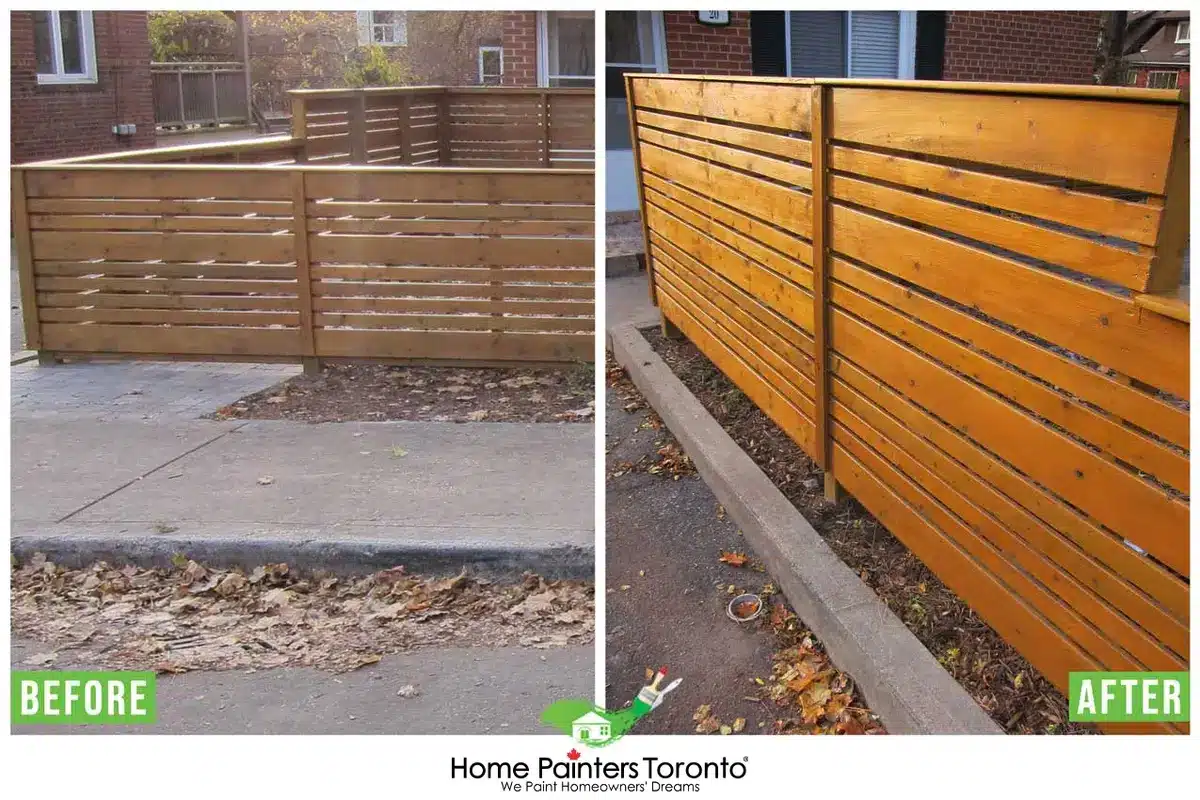
Richmond Hill's freeze-thaw winters and humid summers demand a penetrating stain that moves with the wood — the right product applied to a properly prepared surface can protect a fence for two to three years per application cycle
How Richmond Hill's Freeze-Thaw Cycle Destroys Unprotected Wood Fences
Richmond Hill's freeze-thaw cycle damages unprotected wood fences by forcing moisture into the wood, where it expands by approximately 9% when it freezes, creating internal pressure that widens micro-cracks with every cycle. Over a typical Ontario winter, fence boards can experience dozens of these cycles, each one compounding the last.
Moisture trapped inside wood fibres freezes and expands, widening micro-cracks with every cycle through November to March.
Richmond Hill summers deliver prolonged direct sun. UV rays break down surface lignin, causing graying, softening, and accelerated moisture absorption.
Summer humidity causes wood to swell. Dry fall air causes it to contract. Repeated movement loosens board joints and creates gaps where water enters.
Proximity to Lake Ontario means additional late-season moisture, particularly on north-facing fence runs that stay damp longest after rain.
An unstained fence absorbs this punishment unprotected. A correctly stained fence sheds moisture at the surface, moves with temperature changes without cracking, and maintains structural integrity for years longer. The stain type you choose determines how well it handles each of these threats. Our Richmond Hill painters see the results of both protected and neglected fences every season. The difference is visible within two to three years.
The Three Fence Stain Types: A Direct Comparison for GTA Homeowners
Not all stains are equal. Each type offers a different balance of protection, appearance, and maintenance demand. Here is how the three main categories perform in Richmond Hill's climate.
Semi-Transparent Stain
Penetrates the wood rather than forming a thick surface film. Allows wood grain to show through while adding UV-blocking pigment and moisture resistance. Best for newer fences with good-quality wood in sound condition — cedar, pressure-treated pine, and other common GTA fence woods accept penetrating stains readily.
Strong performance in Richmond Hill. Because penetrating stains move with the wood as it expands and contracts through freeze-thaw cycles, they are far less prone to cracking and peeling than film-forming products.
Solid Colour Stain
Provides near-complete colour coverage, similar in appearance to paint, while still allowing wood to breathe more than a standard exterior paint. Best for older fences with imperfections, mismatched boards, or significant weathering. Solid stains even out visual inconsistencies and provide maximum UV protection.
Very good for colour retention and UV resistance on vertical fence surfaces. Once a fence is coated with solid stain, switching to semi-transparent later requires significant stripping and prep work.
Film-Forming Finishes
Create a continuous surface film on top of the wood. They offer excellent colour hold but handle wood movement poorly in climates with significant temperature swings. Film-forming coatings fail by cracking and peeling when the wood beneath expands and contracts. Refinishing a fence covered in failing paint requires intensive scraping, sanding, and prep before any new product can adhere.
| Stain Type | UV Protection | Freeze-Thaw Performance | Reapplication | Best Wood Condition |
|---|---|---|---|---|
| Semi-Transparent | Moderate | Excellent | 2–3 years | New to fair |
| Solid Colour | High | Good | 3–5 years | Fair to weathered |
| Film-Forming (Paint) | High | Poor | 2–3 years (with stripping) | Not recommended |
For most Richmond Hill fences, semi-transparent or solid stains are the professional recommendation. The choice between them depends on the fence's current condition and the homeowner's aesthetic preference. Our exterior brick staining services follow the same principle: the right product for the substrate and climate, applied correctly, delivers results that last.
Oil-Based vs. Water-Based Fence Stains: Which Is Better for Ontario Winters?
Oil-based fence stains are generally better for Ontario winters because they penetrate deeper into the wood, repel moisture more effectively, and hold up better through repeated freeze-thaw cycles. They create a moisture barrier from the inside out, which gives them a durability edge in climates with significant freeze-thaw activity. Health Canada recommends using an oil- or water-based stain (rather than paint) on treated wood fences for easier long-term maintenance and reduced surface film buildup.
Oil-Based and Alkyd-Hybrid Stains
Penetrate deeper into most wood species, delivering superior moisture resistance through Ontario's shoulder seasons. Require longer dry times and adequate ventilation. Alkyd-hybrid formulations combine penetration depth with lower VOC output and are increasingly the choice for professional exterior applications in the GTA. On a north-facing fence run in a shaded Richmond Hill yard, oil-based formulations typically outperform water-based alternatives in resisting mildew and moisture damage.
Water-Based Acrylic Stains
Have improved substantially in recent years. Modern formulations offer faster dry times, lower VOC content, easier cleanup, and meet Ontario's low-VOC coating standards. Work well on newer wood in sheltered locations. In conditions as demanding as a Richmond Hill winter, oil-based or hybrid formulations still generally outperform water-based products for fence longevity, though this gap is narrowing with newer premium water-based formulas.
The best product choice depends on the specific wood species, the fence's age and condition, and its orientation on the property. A north-facing fence in a shaded yard needs different protection than a south-facing fence with full-day sun exposure. This is exactly the kind of assessment a professional performs before picking up a brush.
In my experience working on Richmond Hill fences, north-facing runs almost always show more mildew and moisture damage than other sides of the same yard. I always recommend a formulation with added mildewcide for those panels specifically. Addressing orientation before product selection is one of the things that separates a two-year result from a five-year result.
Why Surface Preparation Matters More Than the Stain Brand
Surface preparation matters more than the stain brand because even the best stain will fail early if it is applied to wood that is dirty, damp, or not properly prepared. Preparation is where professional fence staining delivers its biggest advantage over DIY.
A proper prep sequence for Richmond Hill fences includes:
- Cleaning Removing dirt, mildew, algae, and old loose finish. Power washing is standard, but pressure must be calibrated to the wood species. Too high, and the surface becomes raised and fibrous.
- Brightening Older, weathered wood benefits from a wood brightener or oxalic acid rinse. This restores the wood's natural pH, improves stain absorption, and removes the grey surface oxidation that blocks penetration.
- Sanding and Repair Raised grain, splinters, and soft or damaged boards should be addressed before any stain is applied. Stain does not repair damaged wood. It protects sound wood. Our wood fence repair and replacement team handles structural issues before staining begins.
- Drying Time Wood must reach an appropriate moisture content before stain is applied. Staining over damp wood traps moisture beneath the finish and causes premature failure, particularly through Richmond Hill's first freeze of the season.
- Application — Including End Grain Consistent, even coat application across all surfaces, including fence posts and end grain, which are the first areas to absorb water and begin rotting. Extra stain passes on cut ends and post tops are standard in a professional application.
If a fence board has moved past staining and into structural failure, our exterior carpentry and handyman services can handle repairs and board replacement as part of the same project.
End grain on fence posts absorbs moisture at a faster rate than any other surface on a fence. I always apply an extra pass of stain to cut ends and post tops before the main coat goes on the boards. Most homeowners doing this themselves do not think about end grain at all, and that is often where rot begins. After 38 years in this industry, I can tell which fences were stained by a professional and which were not just by looking at the post tops.
When Should You Stain a Fence in Richmond Hill?
The best time to stain a fence in Richmond Hill is from late spring through early fall, when temperatures are consistently above 10°C and the wood is dry enough to allow proper absorption and curing. Timing the application correctly matters as much as choosing the right product.
Avoid staining when any of these conditions apply:
- Rain is forecast within 24 to 48 hours of application
- Temperatures will drop below 10 degrees Celsius overnight
- The fence is still wet from recent rain or heavy dew
- Direct, intense sunlight is hitting the surface during application — this causes the stain to dry too quickly and streak
Many Richmond Hill homeowners target late August or early September. Wood is warm and dry from the summer, humidity is dropping, and there is still enough warm weather for proper curing before the first frost. Most quality fence stains applied professionally to properly prepared wood hold well for two to three years in Richmond Hill's climate. A visual inspection each spring can tell you whether the wood is still shedding water or beginning to absorb it.
Why Hiring a Professional Fence Staining Contractor in the GTA Produces Better Results
Hiring a professional fence staining contractor in the GTA produces better results because they combine proper surface preparation, correct product selection, and skilled application techniques that significantly improve durability and finish quality. Fence staining looks simple. The reality is more complicated, and the consequences of getting it wrong are visible every day from your backyard.
- Product selection expertise: A professional knows which formulations adhere best to your specific wood species, whether that is pressure-treated pine, cedar, or hemlock. Choosing the wrong stain for the wood type is one of the most common and costly DIY mistakes.
- Proper prep equipment: Professional crews use calibrated pressure washers, commercial-grade wood brighteners, and sanding equipment that delivers consistent results. Underprepared surfaces reduce stain adhesion and shorten the finish life significantly.
- Even application: Brush, roller, and spray applications each have strengths and weaknesses depending on the fence style. Professionals select the right method for the board profile and spacing to achieve uniform colour and coverage.
- Efficiency: A fence that takes a homeowner a full weekend often takes a professional crew one to two business days, finished before conditions change.
- Warranty: Home Painters Toronto backs its exterior work. That kind of assurance simply does not exist when the job is done yourself.
Beyond fence staining, we handle a full range of exterior painting services across the GTA. If your fence project is part of a broader exterior refresh, we can coordinate everything under one scope of work. If your front door has started to look weathered and dated, our front door restaining and refinishing team can restore its original depth and warmth as part of the same exterior visit.
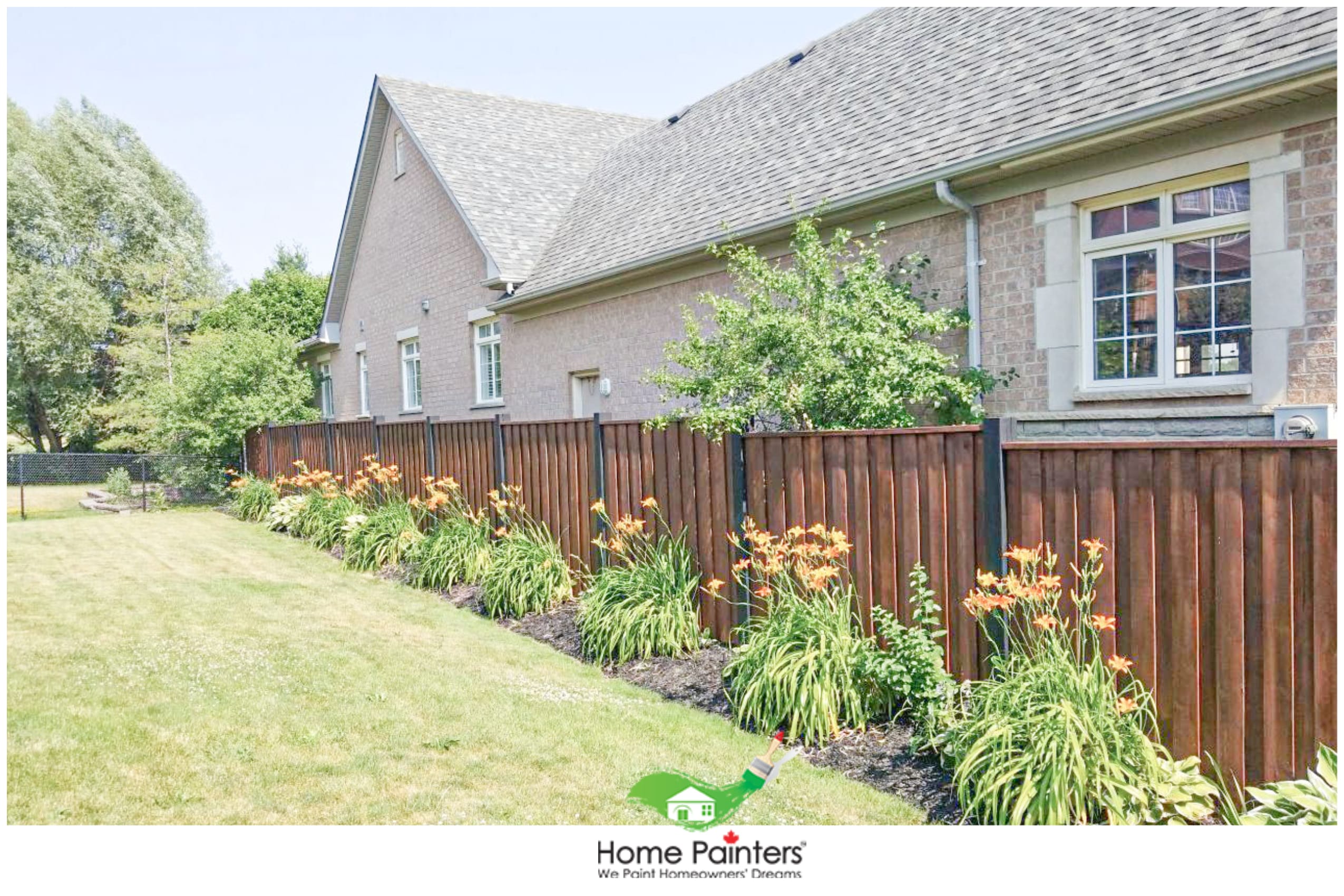
Professional staining includes careful attention to post tops and end grain — the areas most homeowners skip — which is why professional results consistently outlast DIY applications by years
Frequently Asked Questions About Fence Staining in Richmond Hill
Fence staining in Richmond Hill typically requires a fresh coat every two to three years for most stain types on vertical wood surfaces. Fences in exposed locations with heavy direct sun or significant moisture exposure may need attention toward the shorter end of that range. A simple water-bead test each spring tells you whether the current finish is still active — if water soaks in rather than beading on the surface, it is time to restain.
Semi-transparent penetrating stains perform best on newer fences in good condition. They move with wood through freeze-thaw cycles without cracking or peeling. Solid colour stains suit older, more weathered fences. Film-forming products like exterior paint are generally not recommended for Ontario wood fences because they fail by peeling under the stress of seasonal wood movement.
Yes, but timing matters. The application window generally closes when overnight temperatures consistently drop below 10 degrees Celsius. In Richmond Hill, that typically means the end of September or early October. Early fall, when the wood is dry and temperatures are still stable, can be an excellent time for fence staining if spring and summer applications were not possible.
Untreated wood in Richmond Hill's climate deteriorates quickly. UV rays bleach and soften surface fibres. Moisture penetrates and promotes rot and mould. Freeze-thaw cycles crack and split boards from the inside. A fence left unprotected can begin showing significant structural wear within two to three years. Staining is not cosmetic maintenance. It is structural protection.
Damaged, soft, or rotted boards should be replaced before any stain is applied. Staining over compromised wood traps moisture and accelerates decay rather than arresting it. Our wood deck repair services address structural issues before coatings go on, and the same principle applies to fence boards and posts.
Oil-based and alkyd-hybrid formulations generally provide deeper penetration and better moisture resistance in Ontario's demanding climate. Water-based stains have improved significantly and can perform well on newer wood in sheltered conditions. A professional assessment of your specific fence, its wood species, and its orientation will determine which product is the right fit.

Get the Right Fence Staining Results for Richmond Hill's Climate
Fence staining in Richmond Hill is not a one-size-fits-all decision. The right stain type, product formulation, surface preparation, and application timing all determine whether your fence holds up for two seasons or ten. Richmond Hill's freeze-thaw winters, humid summers, and high UV exposure demand a product that penetrates wood rather than sits on top of it, applied to a properly cleaned and repaired surface at the right time of year.
Home Painters Toronto has been serving Richmond Hill and GTA homeowners with professional exterior wood staining for 38 years. Our team selects the right product for your specific fence, preps the surface correctly, and applies it with the kind of consistency that lasts. The result is a finish you can see every day and trust through every season.
Get a Free Fence Staining Quote for Your Richmond Hill Home
Contact us today and let our team assess your fence and recommend the right approach for your home and climate.
Get Your Free Quote Today