

A water stain spreading across a ceiling in Etobicoke or North York almost always gets blamed on the roof first, but the real source is often the soffit and fascia system tucked under the eaves. Homeowners researching roof leak vs soffit failure symptoms usually find the two problems look nearly identical from inside the house. Both send water tracking along rafters and drywall before it ever shows as a visible mark, so guessing wrong means paying a roofer to patch shingles that were never the problem. Home Painters Toronto crews check both systems together on every roofline call, because treating the wrong component wastes a homeowner's budget and leaves the real leak path open. This guide breaks down which signs point to each source and what a proper inspection actually involves.
A roof leak typically stains the centre of a ceiling or follows a roof valley, appearing suddenly during or right after heavy rain. Soffit failure stains the ceiling near an exterior wall line and worsens gradually over several seasons. Checking the mark's position against the roofline pinpoints the source before repairs begin.
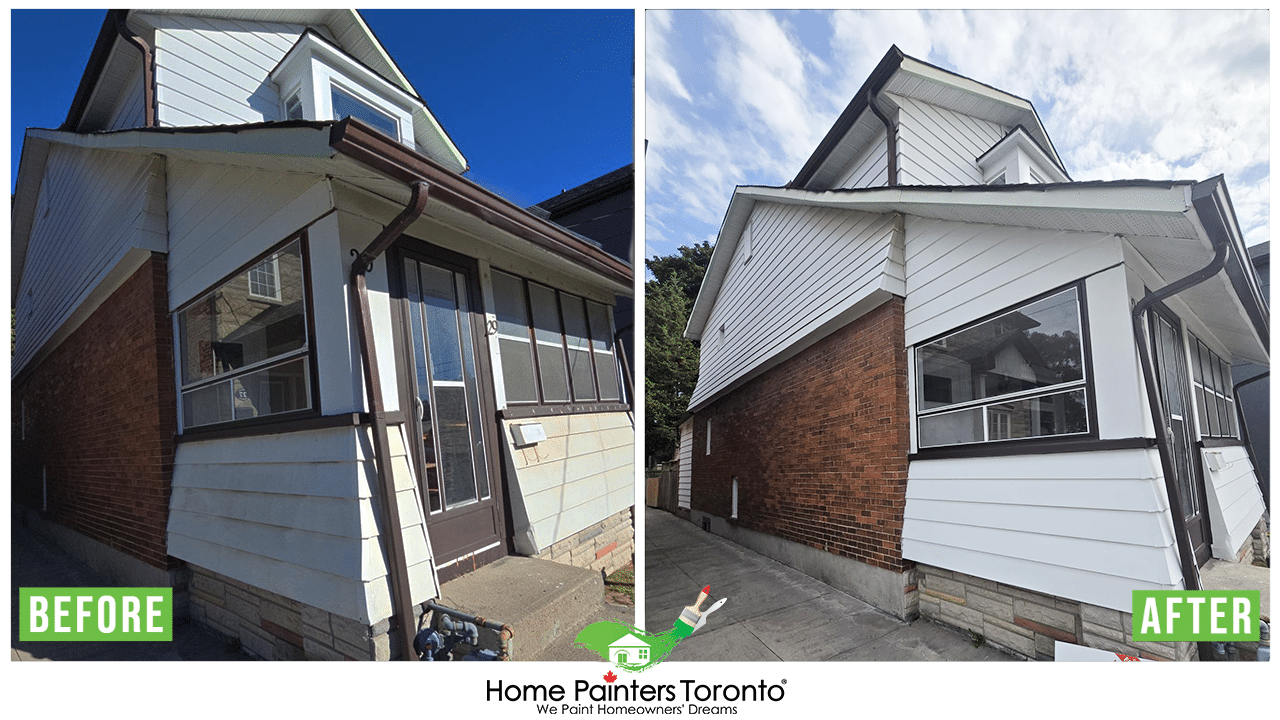
Both problems send water tracking along rafters and drywall before it ever shows as a visible mark
How to Tell a Roof Leak From Soffit Failure
A roof leak and soffit failure are told apart mainly by stain location and timing: a roof leak stains the middle of a ceiling or a valley line right after a storm, while soffit failure stains the outer wall line and spreads slowly across weeks or months.
Both problems share the same attic cavity in most Toronto homes, so a single stain rarely settles the question on its own. Timing matters as much as position. A stain that darkens within hours of a heavy downpour points to an active roof leak, while one that grows slowly through a humid August or a wet spring points toward a soffit or fascia system that has been failing for a while.
Checking the exterior tells the rest of the story. Missing or lifted shingles and damaged flashing point to the roof. Peeling paint, soft panels, or gaps at the fascia point to the soffit. The table below lines up the clues side by side.
Roof Leak vs Soffit Failure: Water Stain Location Comparison
| Clue | Roof Leak | Soffit Failure |
|---|---|---|
| Stain location | Centre of ceiling or along a roof valley | Near an exterior wall, close to the eaves |
| Onset | Sudden, during or right after rain | Gradual, worsens over multiple seasons |
| Shape | Circular ring with a darker centre | Long streak following the wall line |
| Related smell | Rarely present unless the leak is long-term | Musty odour common near the affected wall |
| Exterior evidence | Missing or lifted shingles, damaged flashing | Peeling paint, soft or sagging soffit panels |
Why This Gets Misdiagnosed So Often
This mix-up happens because a roof leak and a soffit failure often share the same attic cavity, so water from either source can travel the same rafter before it drips through drywall in the same spot below.
Contractors who only handle roofing tend to look upward at shingles and flashing and rarely check whether a soffit vent baffle has failed or an intake vent is blocked. Painters called in for peeling fascia paint sometimes refinish the surface without checking whether an active roof leak is feeding the damage from above. Neither trade is wrong to check its own scope first, but neither answers the full question alone.
Older Toronto housing stock adds another layer. Many post-war bungalows and 1960s and 1970s subdivision homes in North York and Scarborough had soffit vents added or upgraded without matching baffles installed in the attic, which blocks airflow and traps moisture right where a roof leak would also show symptoms. A brief look at the exterior wood siding around the same eave line often confirms whether the moisture problem has already spread beyond the roofline.
Insurance adjusters run into the same confusion homeowners do. A claim filed as roof storm damage can get denied once an adjuster finds the actual cause was long-term soffit ventilation failure, since gradual wear from blocked vents is treated differently than sudden storm damage. Getting the diagnosis right before a claim is filed avoids that kind of denial and gives a homeowner a written record of what actually caused the damage.
Signs That Point to the Soffit, Not the Roof
Soffit failure is the likely cause when the stain sits directly under the roofline near an exterior wall and grows worse during humid weather instead of only after rain.
A few field-tested signs consistently point back to the soffit and fascia system instead of the roof covering itself:
- Staining follows the wall line instead of pooling toward the ceiling's centre
- Exterior paint on the fascia board is peeling, bubbling, or flaking near the same spot
- Soffit panels feel soft, sag, or show visible gaps between sections
- Pest holes, droppings, or nesting debris appear in the soffit vents
- A musty smell is strongest near the affected exterior wall, not the middle of the room
- Nail heads or rafter tails near the eave feel damp or show dark staining when checked from the attic side
The same moisture that causes soffit failure often shows up in nearby wood components at the same time. A homeowner dealing with a soffit leak near a rear elevation will sometimes find related rot during a wood deck repair assessment on an attached structure below, since both problems usually trace back to the same seasonal water exposure.
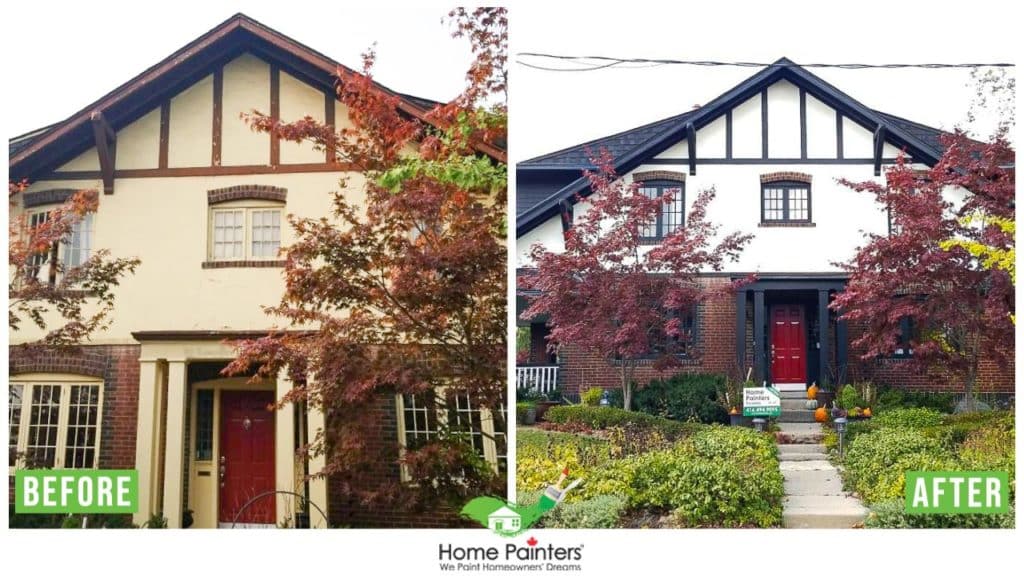
A few field-tested signs consistently point back to the soffit and fascia system instead of the roof covering itself
Signs That Point to the Roof Itself
A stain in the centre of a ceiling, along a roof valley, or around a chimney or plumbing vent almost always traces back to the roof covering or flashing, not the soffit.
These signs tend to confirm the roof deck or shingles as the entry point:
- Missing, curled, or cracked shingles visible from the ground or a ladder
- Damaged or lifted flashing around a chimney, skylight, or plumbing vent
- Heavy granule loss collecting in the gutters below a specific slope
- Water appears indoors within hours of active rainfall, not days later
- The stain forms a circular ring with a darker centre, typical of a direct drip point
- Roof sheathing directly above the stain feels spongy or shows dark staining in the attic
Flashing failures deserve a closer look than most homeowners give them. A chimney, skylight, or plumbing vent penetrating the roof deck needs a properly lapped flashing detail to stay watertight, and a gap as small as a few millimetres at a corner can let enough water through to stain a ceiling within a single storm. A chimney flashing and repair assessment is often the first stop when a stain sits close to a chimney chase and not along an exterior wall.
How Water Travels Along Rafters Before It Shows Up Indoors
Water entering at a roof deck or a soffit vent rarely drips straight down. It typically runs along the underside of a rafter or across the roof sheathing until it reaches a low point, a nail head, or a gap in the insulation, then drips through the ceiling well away from where it first got in.
That distance is often several feet, which is exactly why a ceiling stain over a living room can trace back to a soffit gap above a bedroom window on the other side of the wall. Canada Mortgage and Housing Corporation guidance on tracing attic water leaks confirms that water dripping through a ceiling frequently originates well away from where it entered the roof assembly, since it follows the framing before finding a gap to pass through.
This is also why a homeowner's own description of where the stain appears is a starting point for an inspection, not a final answer. Our crews trace the mark back along the rafters from inside the attic before ever touching a shingle or a soffit panel.
Insulation plays a part in how far water can travel before it becomes visible. Loose-fill or batt insulation near the eaves can absorb a surprising amount of moisture before it saturates fully and starts dripping, which is one reason a small soffit gap can go unnoticed for an entire season before a stain finally appears indoors. By the time the ceiling shows a mark, the insulation underneath it has usually already been wet for weeks.
How Rafter Tail Rot Signals Sustained Soffit Failure
Rafter tail rot signals that a soffit failure has been active long enough for wood moisture content to climb past the point where decay fungi take hold, which building science research on wood decay moisture thresholds puts at around 20 percent moisture content in framing lumber.
A pin-type moisture meter reading above that threshold on a rafter tail or fascia board means the wood has been wet for an extended period, not from one recent storm. When our crews find readings in that range during a rafter tail repair assessment, it usually confirms a soffit or ventilation failure that has been running for at least one full season, sometimes longer.
Why an Accurate Diagnosis Saves Money
An accurate diagnosis saves money because it stops a homeowner from paying twice: once for a roof repair that never addresses the leak, and again for the soffit or fascia repair that was actually needed. Homeowners weighing a broader exterior project at the same time can check our typical exterior painting costs guide for context on how a roofline repair fits into a larger scope of work.
Toronto's climate makes the cost of waiting worse. Freeze-thaw cycles through the winter push moisture deeper into open wood grain each time a misdiagnosed leak goes unresolved, which is the same mechanism that damages exposed brick and mortar when water tracks down an exterior wall for months at a stretch. A single accurate inspection usually costs far less than two separate repair attempts aimed at the wrong system.
Left unresolved long enough, water that starts at a soffit gap can eventually reach the base of an exterior wall and affect foundation parging as well, turning what began as a roofline problem into a repair that spans the full height of the house. Catching the source early at the soffit or the roof, before it has travelled down the wall, keeps the repair scope contained to a single system.
Cost Impact: Misdiagnosis vs Accurate Diagnosis
| Scenario | Approximate Cost (CAD + HST) | Outcome |
|---|---|---|
| Repair aimed at the wrong system | Added cost on top of the correct repair | Leak continues, and damage spreads until the diagnosis is corrected |
| Standard soffit and fascia repair, single elevation | $4,000 - $8,000 | Addresses a typical Toronto home's soffit failure directly |
| Larger or multi-elevation roofline repair | $8,000 - $10,000+ | Needed when rot has spread along several rafter tails |
| Written inspection and quote | Included with the service call | Confirms the source before any repair work begins |
What a Proper Inspection Looks Like
A proper inspection starts inside the attic with a moisture meter and a flashlight, not on the roof with binoculars.
Our process moves in a set order so nothing gets skipped:
- Trace the ceiling stain from inside the attic and measure its distance to the nearest exterior wall
- Check attic insulation near the eaves for compression, staining, or dampness
- Probe the fascia board and rafter tails with a pin-type moisture meter
- Inspect the roof deck, flashing, and shingles from outside at the corresponding slope
- Cross-reference every finding before recommending a repair scope
Every technician on our crew works WSIB-compliant and fully insured, so a roofline assessment never adds liability risk to a homeowner's property.
- At a recent inspection in North York, our crew traced a ceiling stain the homeowner had assumed was a roof leak back to a soffit vent gap above a bay window.
- The fascia board read 34 percent moisture content on a pin-type moisture meter, well past the point where rot sets in, while the roof deck directly above tested dry.
- Once the vent baffle was resealed and the rotted fascia section was replaced, we refinished the trim in Benjamin Moore Aura Exterior in Low Lustre, applying two coats at roughly 5 mils dry film thickness per coat for full UV and moisture protection.
That kind of mismatch between what a homeowner assumes and what the moisture readings actually show is common, and it is exactly why the attic-first approach matters more than a quick look at the shingles.
Photo documentation is part of every inspection we run. Moisture meter readings, the exact spot on the rafter where each reading was taken, and clear photos of the fascia or roof deck condition all get included in the written quote, which gives a homeowner a record they can keep even if the repair happens months later. That same documentation is useful if the damage ever needs to be discussed with an insurer or, for a condominium or townhouse, with a property manager handling shared roofline components.
Once a soffit or fascia repair is finished, the surrounding trim often needs refinishing to match the rest of the home. Our exterior residential painting crews handle that final step as part of the same exterior painting services visit, so a homeowner is not left coordinating two separate contractors for one roofline.

The attic-first approach matters more than a quick look at the shingles
Frequently Asked Questions About Roof Leak vs Soffit Failure Diagnosis
Most roofers can diagnose a soffit-related leak, but only if they check the attic framing and eaves as part of the visit, not just the shingles from above. A roofing-only inspection that skips the attic can miss a soffit or ventilation failure entirely.
Yes, stain location is one of the strongest clues, but it should always be confirmed with a physical inspection instead of a guess from the ceiling alone. Water can travel several feet along a rafter before it drips through, so the stain marks where the water exited, not necessarily where it entered.
A leak can show up in a few hours during heavy rain when the entry point sits close to the drip location, or it can take several months when water travels slowly along framing and insulation before finally reaching drywall. Slow-developing stains are more often tied to soffit failure than to a single storm event.
A second opinion is worth getting whenever only the roof was inspected, and the soffit and attic framing were not checked at the same visit. Confirming the source before committing to a roof-only repair avoids paying for work that will not resolve the stain.
Yes, a single soffit failure can produce more than one ceiling stain when water spreads along multiple rafters or pools at different low points along the attic floor before dripping through in separate spots.

Get the Right Diagnosis Before You Pay for Repairs
Getting the right diagnosis before any repair begins means one inspection covering both the roof and the soffit and fascia system, not two separate contractors each guessing at their own piece of the roofline.
Home Painters Toronto offers fast free quotes and warranty-backed work on every soffit, fascia, and exterior repair project across Toronto and the GTA, including for North York homeowners dealing with an older roofline. Read what past customers say in our client reviews, or check our frequently asked questions page for more on how inspections and quotes work.
Contact Home Painters Toronto to book an inspection that checks the whole system, not just half of it.
Get a Free Estimate