

Siding Repair After a Roof or Gutter Leak: Fixing the Whole Water Path
A roof or gutter leak in Toronto rarely stays where it starts. Water finds the path of least resistance, and that path almost always ends at the siding, where staining, cupping, or soft board sections show up weeks or months after the original leak. Siding damage from a gutter leak is a plumbing problem in disguise: fix only the visible siding and the same rot returns within a season. Home Painters Toronto traces the full water path, from the roof edge to the fascia, soffit, and siding layer, before any repair begins. This article walks through how the damage happens, how to tell a leak from ordinary weathering, and what a proper repair costs in the GTA.
Siding repair after a roof or gutter leak means fixing the entire water path, not just the stained boards. A proper repair addresses the roof or gutter source, checks the fascia and soffit for hidden rot, then replaces or reseals the affected siding. Skipping the source repair almost always causes the damage to return.

Water finds the path of least resistance, and that path almost always ends at the siding
How a Roof or Gutter Leak Damages Siding in Toronto Homes
A roof or gutter leak damages siding by forcing water behind the exterior cladding instead of off the roofline, where it soaks into wood, sheathing, and insulation long before any stain appears on the surface. Overflowing gutters push water down the wall face during heavy rain, and a cracked flashing or clogged downspout sends that same volume behind the siding panels instead of away from the house. Wood siding absorbs this moisture directly, while vinyl and aluminum siding trap it against the sheathing underneath, so the surface can look fine even though the wall assembly rots from the inside. The Canada Mortgage and Housing Corporation's guidance on moisture and wood-frame decay risk notes that wood framing sustains ongoing decay risk once moisture content stays above roughly 20 percent for extended periods, a threshold reached quickly behind a leaking gutter in a wet GTA spring or fall. Our siding repair services start by confirming which of these paths let the water in before any board is replaced.
Toronto's freeze-thaw cycle makes this worse. Water that soaks into siding or sheathing during a warm spell freezes when temperatures drop, and the expanding ice widens cracks, pries seams apart, and loosens fasteners. Each cycle repeats the damage, so a leak left over one winter often causes more harm than the original storm that started it. This is why a same-season repair matters more for leak-related siding damage than for normal weathering.
Material choice changes how quickly the damage shows. Wood siding tends to swell and cup within a single wet season, giving homeowners an early visual warning. Vinyl and aluminum panels hide the same moisture for much longer because the cladding itself does not absorb water, so the sheathing behind it can sit wet for months before a bulge, a musty smell, or a soft spot near a seam finally gives the problem away, which is why our vinyl siding painting and aluminum crews always check the sheathing first. Stucco siding behaves differently again: hairline cracks let water in, but the dense surface slows drying, which extends the time framing lumber stays above a safe moisture range. Homeowners dealing with cracked or leak-affected stucco siding repair should expect a longer drying period before any patch is finished.
Signs Your Siding Is Damaged by a Leak, Not Normal Wear
Leak-related siding damage shows up in specific, localized patterns, while normal wear spreads evenly across a wall. A leak typically produces a vertical staining line below a gutter joint, a soft or spongy patch near a downspout, or bubbling paint confined to one section of wall instead of the whole elevation. Normal wear, by contrast, fades and chalks evenly across sun-exposed walls over many years. The table below separates the two so a homeowner can make a faster call on next steps.
A quick way to test a suspect area without opening the wall is to press firmly on the siding near the stain. Sound wood and intact vinyl flex slightly and spring back, while water-damaged material feels spongy, dented, or gives way under light pressure. Any section that fails this simple check should be treated as a leak indicator and inspected further, even if the surface paint still looks presentable from a distance.
| Sign | Leak-Related Damage | Normal Wear |
|---|---|---|
| Location on wall | Localized under gutters, joints, or downspouts | Even, across full sun-exposed elevations |
| Staining pattern | Vertical streaks or dark blotches | Uniform fading or chalking |
| Board condition | Soft, spongy, or swollen in one area | Dry, brittle, or faded but firm |
| Paint behaviour | Bubbling or peeling in a defined patch | Gradual, even chalking across the surface |
| Smell | Musty odour near the affected section | No odour |
| Timing | Appears weeks to months after a storm or gutter clog | Develops gradually over years |
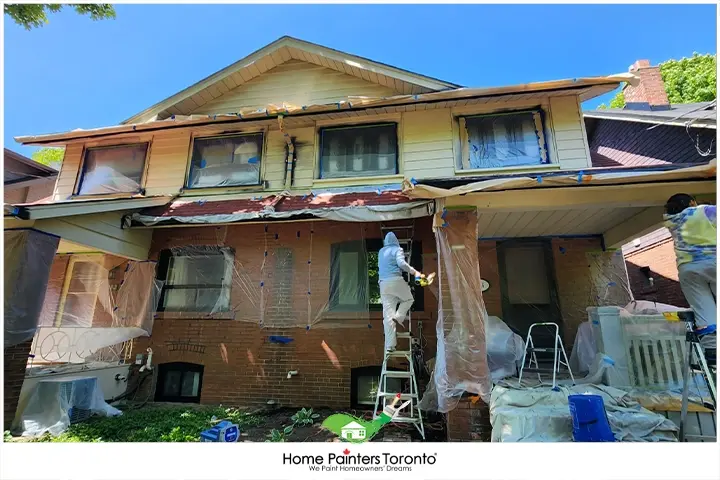
Sound wood and intact vinyl flex slightly and spring back, while water-damaged material feels spongy or gives way
Tracing the Water Path: Roof, Gutter, Fascia, Soffit, Siding
Every leak-related siding repair starts with tracing the water path backward from the stain to its true source, since the visible damage on the siding is often several feet from where water first entered the wall assembly. Most competitor estimates skip this step and simply patch the siding, which is why the same stain often returns within a year.
Roof and Attic Ventilation Failures
Roof leaks reach siding by running down the roof deck, past damaged shingles or flashing, and along the underside of the roof sheathing until they exit at the eave. Poor attic ventilation compounds this, since trapped humid air condenses on the underside of the roof deck and adds moisture to the same path even without an active shingle failure. A blocked or undersized ridge vent is a common contributor the homeowner never sees from the ground.
Gutter and Downspout Overflow
Gutters and downspouts fail in three common ways in the GTA: leaf and debris clogs that cause overflow during heavy rain, loose or pulled-away hangers that tip the gutter's slope, and seam failures at inside corners where two gutter runs meet. Any of these sends water directly down the wall face instead of through the downspout, and the siding immediately below the failure point absorbs the runoff first.
Fascia and Soffit Rot as the Middle Step
Fascia and soffit sit directly behind the gutter and directly above the siding, so they intercept water before it ever reaches the wall below. Rotted fascia board loses its ability to hold the gutter hangers securely, which worsens the slope problem described above, while a rotted soffit allows water to travel behind the top course of siding instead of dripping harmlessly to the ground. A soffit and fascia repair inspection is the single most common step a siding-only repair skips, and it is the single most common reason that the repair fails.
How Water Damage From a Gutter Leak Reaches the Siding Layer
Water damage from a gutter leak reaches the siding layer through capillary action along the top edge of each siding board or panel, where the overlap between boards draws moisture upward and inward instead of letting it run off. Once inside this overlap, water sits against the back of the siding and the face of the sheathing, an area that rarely dries between rain events. This is why staining often appears several courses below the actual leak point, which is exactly why tracing the path backward from the stain matters more than treating the stain itself.
Repairing Siding Damage from a Roof or Gutter Leak: Our Process
Repairing siding damage from a gutter leak requires fixing the source first, then addressing every layer the water passed through on its way to the siding. Home Painters Toronto follows the same five-stage sequence on every leak-related siding call, whether the material is wood, vinyl, aluminum, or stucco. Skipping any single stage in this sequence is the most common reason a homeowner ends up paying for the same repair twice within a few years.
- Trace the leak source. A crew inspects the roof edge, flashing, gutters, and downspouts above the damaged siding to confirm the actual entry point before any siding is touched.
- Test moisture behind the siding. A moisture meter checks the sheathing and framing near the damaged area, since surface staining rarely reflects the true extent of the problem underneath.
- Remove and inspect fascia, soffit, and sheathing. Any rotted wood is cut back to sound material, and the crew confirms the sheathing underneath the siding has dried before closing the wall back up.
- Replace or repair the siding itself. Damaged boards, panels, or sections are replaced to match the existing profile and reveal as part of our wood siding repair process, and remaining sound siding is resecured.
- Seal, prime, and finish. All new wood receives a stain-blocking primer before topcoat, seams are closed with our exterior caulking service using a paintable, weather-resistant sealant, and the finish coat is colour-matched to the surrounding wall.
- At a recent leak repair in Etobicoke's Alderwood neighbourhood, a moisture meter reading behind a section of aluminum siding painting work came back at 34 percent, well above the range the CMHC associates with active decay risk in wood framing.
- Our crew traced the source to a pulled gutter hanger above the affected wall, replaced two rotted sheathing sections, and rebuilt the wood siding beneath with matching cedar board before finishing the wall in Benjamin Moore Aura Exterior in Low Lustre, applied at a 4 mil dry film thickness per coat to match the manufacturer's technical data sheet for full coverage and UV resistance.
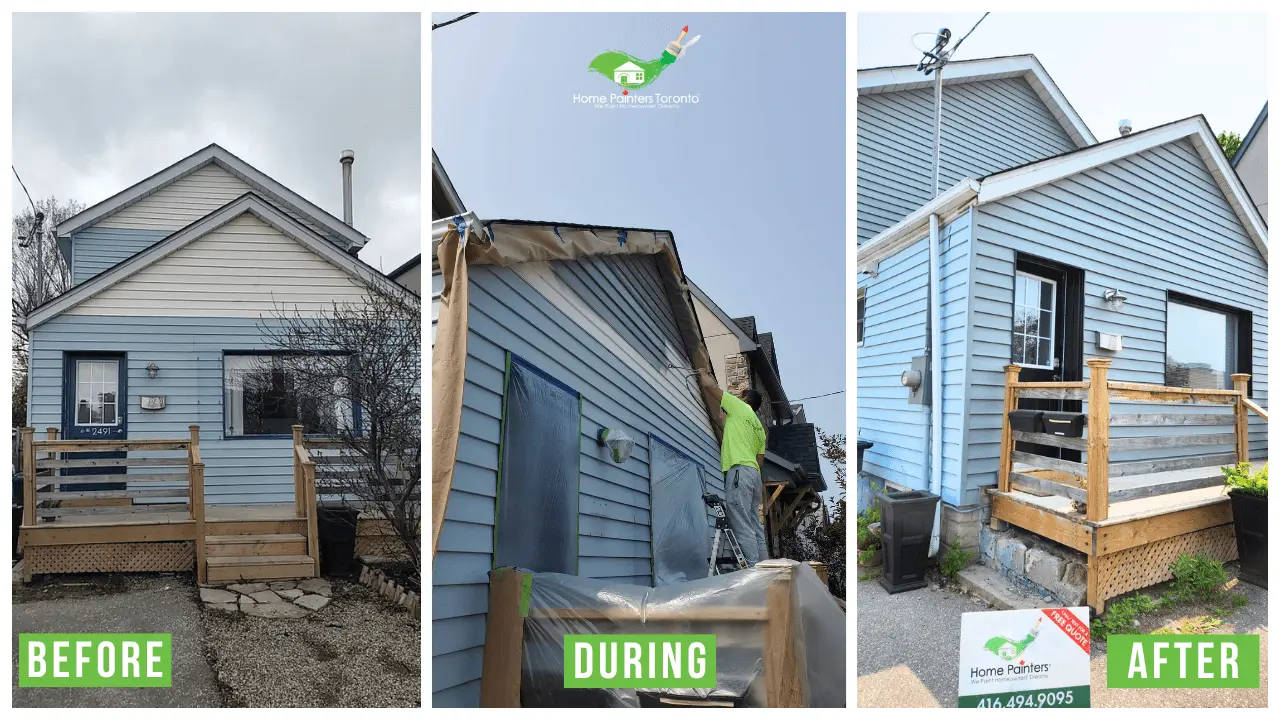
The crew traced the source to a pulled gutter hanger before replacing sheathing and rebuilding the wood siding beneath
Cost to Repair Siding Damaged by a Roof or Gutter Leak in Toronto
Cost to repair siding damaged by a roof or gutter leak in Toronto typically runs from $2,000 to $10,000 CAD plus HST, depending on how far the water travelled before the repair begins. A contained spot repair costs far less than a job that also requires fascia, soffit, and sheathing replacement, so the true cost usually depends more on how long the leak went unnoticed than on the size of the visible stain.
| Repair Scope | What's Included | Estimated Cost (CAD + HST) |
|---|---|---|
| Spot repair | One to two siding boards or panels, localized caulking and paint touch-up | $2,000 – $4,000 |
| Moderate section repair | Multiple siding sections, partial soffit or fascia replacement, resealing | $4,000 – $8,000 |
| Extensive water path repair | Full wall section, sheathing replacement, fascia and soffit rebuild, full repaint | $8,000 – $10,000 |
Larger projects that involve a full elevation or multiple walls can move into the $12,000 to $30,000 range, particularly on older homes where the sheathing has been compromised over more than one season. Requesting a free written estimate from a WSIB-compliant, fully insured contractor is the only reliable way to know which tier applies to a specific leak.
What Happens If You Leave Leak-Damaged Siding Unrepaired
Leaving leak-damaged siding unrepaired allows the moisture cycle to keep repeating behind the wall, which turns a contained repair into a structural one within a year or two. Environment and Climate Change Canada's climate data for the Toronto region shows the area regularly cycles through multiple freeze-thaw events each winter, and every cycle that occurs while sheathing stays wet widens existing cracks and drives moisture deeper into the wall cavity. What starts as a stained board can progress to rotted sheathing, compromised structural framing, and interior drywall repair needs on the other side of the same wall.
Mould growth is the other risk most homeowners underestimate. Once framing lumber sits above the moisture threshold associated with active decay, mould colonies can establish within 24 to 48 hours under the right temperature conditions, and by the time a musty smell reaches the interior of the home, the growth is usually well established inside the wall. Unrepaired leak damage also complicates insurance claims, since insurers distinguish between sudden, accidental water damage and damage that resulted from prolonged neglect of a known leak.
Cost also compounds the longer a leak sits. A repair that would have stayed within the spot-repair range early on can grow into a full wall section once sheathing and framing are involved, since replacing structural material costs more than resealing a surface panel. Waiting through even one additional wet season is often the difference between a two-day repair and a project that takes a full crew the better part of a week.
Preventing Future Leak Damage to Your Siding
Preventing future leak damage to siding starts with keeping water moving off the roof and away from the wall, instead of letting it pool, overflow, or sit against any single point. A short seasonal maintenance routine catches most problems long before they reach the siding layer.
- Clean gutters and downspouts at least twice a year, more often near mature trees
- Check gutter hangers and slope every spring for sagging or pulled fasteners
- Inspect roof flashing around chimneys, vents, and roof-to-wall junctions annually
- Recaulk exterior seams around windows and doors every few years as sealant ages
- Schedule a soffit and fascia check whenever gutters are cleaned, not just when siding looks damaged
- Confirm downspouts direct water at least four to six feet away from the foundation and wall base
Siding Repair After a Gutter Leak FAQ
These are the questions Toronto homeowners ask most often about leak-related siding damage. For general questions about our services, browse our full FAQ page.
Leak damage is usually localized to one section of wall below a gutter joint or downspout, while age-related wear fades evenly across an entire sun-exposed elevation. A soft or spongy patch, a musty smell, or a vertical stain below a specific gutter section points to a leak instead of general weathering.
No, most leak-related siding damage is repairable if it's caught within a season or two, since the affected area is often limited to a few boards or panels plus the sheathing directly behind them. Full replacement usually only becomes necessary when multiple winters of freeze-thaw cycling have compromised a large section of wall.
Coverage depends on the policy and how the damage occurred, since insurers generally cover sudden, accidental water damage but exclude damage from a leak that went unrepaired for an extended period. A written repair estimate that documents the extent of the damage is typically required to support any claim, and homeowners should confirm specifics directly with their insurer.
A contained spot repair on one section of wall usually takes one to two days, while a repair that also involves fascia, soffit, and sheathing replacement typically runs three to five days depending on drying time between stages. Weather and paint cure times can extend either timeline.
Yes, in most cases a repaired section can be matched closely to the surrounding siding using the same paint or stain formula and a feathering technique at the seams. An exact match becomes harder on walls with heavy sun fade, where a full-wall repaint sometimes gives a more even result than a spot match.

Get a Free Estimate for Leak-Damaged Siding Repair
Siding damage from a roof or gutter leak rarely fixes itself, and every rainy season it goes unaddressed adds to the eventual repair scope. Home Painters Toronto has traced and repaired water paths across the GTA for more than 38 years, backed by 1,200+ verified reviews and a record of why Toronto homeowners trust HPT, with WSIB-compliant crews, full insurance coverage, and warranty-backed results on every job.
Contact Home Painters Toronto for fast free quotes and warranty-backed work, and get a full inspection of the roof, gutter, fascia, soffit, and siding, not just a patch on the visible stain.
Get a Free Estimate