

A window replacement in Toronto often leaves more than a fresh pane behind. Crews cut into the J-channel, pull trim, and sometimes leave the wall around the new frame looking rougher than before they started. Siding repair after window replacement is one of the most common calls Home Painters Toronto receives in the weeks after an installation, usually from a homeowner staring at a gap, a mismatched patch, or bare sheathing where the old trim used to sit. The window itself may be perfect. The siding around it is frequently left as someone else's problem. This guide covers what to check once the window crew leaves, who typically finishes the exterior, and what a proper repair costs across Toronto and the GTA.
Siding repair after window replacement is usually needed to close gaps, correct cut J-channel, replace a missing drip cap and trim, and colour-match the patch to the surrounding wall. Window installers typically handle only the opening itself, so a siding contractor should finish the surrounding wall within days, not months, once the new frame is in.
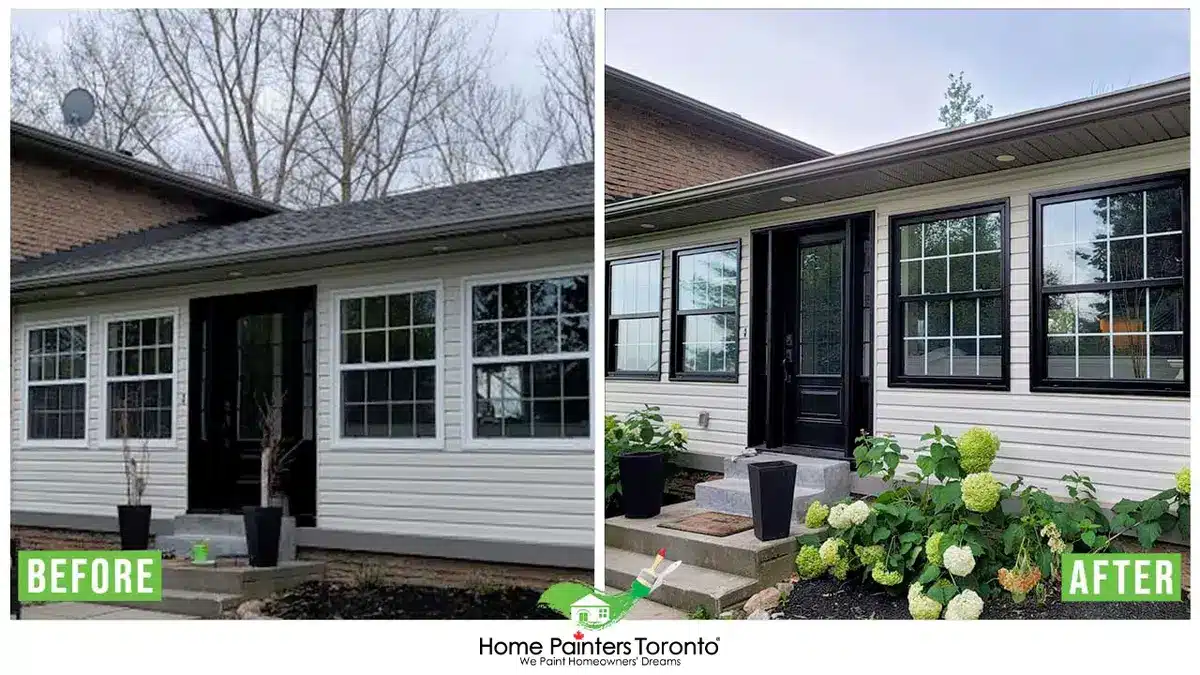
The window itself may be perfect. The siding around it is frequently left as someone else's problem
Why Siding Is Often Left Unfinished After a Window Install
Siding is often left unfinished after a window install because most window companies are contracted to handle the opening itself, not the wall around it. A typical window replacement contract covers removing the old unit, setting the new frame, and sealing the immediate rough opening. Trim, J-channel, and cladding that tie into the surrounding wall usually sit outside that scope of work.
Crews working on a tight schedule will cut siding and trim to fit the new frame, then move on to the next house before finishing the return properly. This is standard practice across the window industry in the GTA, and it is not automatically a sign of a careless crew. The gap between a window being installed and the exterior being properly closed up is where most post-installation siding calls to Home Painters Toronto start.
Homeowners are often surprised to learn a second trade needs to be brought in at all. Exterior finishing after a window or door swap is its own scope of work, with its own materials, flashing details, and matching requirements. It is covered in more depth in our complete guide to siding repair, which walks through how repair decisions get made across every siding material we work with in Toronto and the GTA.
A written window contract will usually name the scope in a single line, something like "installation of unit and interior/exterior trim return," without ever mentioning the wider siding field. That single line is often the difference between a free callback and a separate invoice. Reading it before the crew starts, not after, is the best way to avoid a surprise once the work is done.
What to Look For Once the Window Crew Leaves
Six signs point to unfinished siding work around a new window or door, and most of them are visible from the ground within a few minutes of looking. Catching them early keeps the eventual repair small.
- Gaps at the head or sill where the frame meets the surrounding siding
- J-channel cut short or not reinstalled along the frame edge
- Sheathing or building paper visible at an exposed cut edge
- Trim that doesn't match the surrounding siding profile
- Caulk bridging a gap that should have been flashed instead
- No drip cap installed above the new window or door
A wall with visible gaps between siding panels near a new opening rarely closes itself over time. Left alone, these gaps tend to widen with every freeze-thaw cycle instead of settling down on their own.
None of these six signs require special tools to spot. A slow walk around the affected wall on a clear day, looking at eye level and again from a few steps back, catches most of them. Photographing each issue with a tape measure or a coin for scale gives a contractor useful reference points before the first visit, and it also creates a dated record if a dispute with the installer ever comes up.
Is This the Window Company's Responsibility?
Whether the window company owes you a repair depends on what the original contract actually states. Most window replacement agreements in Ontario cover the unit itself, the rough opening seal, and basic trim immediately touching the frame. Exterior siding, cladding, and wall-level trim beyond that narrow band are commonly excluded, even when a crew has visibly disturbed them while working.
Under the Consumer Protection Act, home renovation and repair contracts worth more than fifty dollars must be in writing, so the written scope of work is what actually governs the dispute, not what a homeowner assumed was included. Ontario's guidance on renovation and repair contracts sets out what a written agreement should specify before work begins, and it is worth the ten minutes it takes to review against the original window contract.
Raising the gap early, ideally while the crew is still on site or within the first few days, gives the clearest chance of a fast resolution at no cost. Once the crew has moved on to the next job, most window companies treat exterior siding finishing as a separate, billable scope that falls to a siding contractor.
The Risk of Leaving It Through One Toronto Winter
Leaving an unfinished window opening through a single Toronto winter is often enough to turn a cosmetic gap into a structural repair. Freeze-thaw cycling is one of the more aggressive weathering patterns in the region, with temperatures in the Toronto area crossing the freezing point on dozens of separate days between November and March, based on climate normals published by Environment and Climate Change Canada.
Water that gets behind an unsealed trim edge in October has months to work into the sheathing before spring, expanding a little further with every freeze cycle and pushing joints apart along the way. A gap that starts at an eighth of an inch can widen enough by April to let in wind-driven rain on its own, without any help from ice.
Mould and soft sheathing are the most common findings when we open a wall that sat exposed over a single winter. A repair that would have taken half a day in October, covering trim and flashing only, often becomes a multi-day sheathing replacement by spring, at several times the original cost.
How We Finish and Repair Siding Around New Openings
Repairing siding around a new window or door follows five steps, starting with an assessment and ending with a sealed, colour-matched finish.
- Assess the opening. We check the frame-to-wall gap, the condition of the existing J-channel and trim, and whether the sheathing behind the cut edge was left exposed to weather.
- Install or correct the drip cap and flashing. A drip cap above the opening and correctly lapped flashing are treated as minimum requirements under Ontario's Building Code for keeping water out of a wall assembly at an opening, and they are also the two details most often missing after a window crew leaves.
- Reinstall or replace J-channel and trim. A cut or missing channel is replaced to match the surrounding profile, not patched over with sealant alone.
- Patch and match the siding. Panels or boards are cut, colour-matched to the weathered surrounding wall, and fastened using the same reveal and fastening pattern as the rest of the elevation.
- Seal and finish. Every seam gets a paintable, low-VOC sealant rated for the temperature swings the GTA sees each year, and any painted trim is primed and finished to match the existing wall.
- At a recent siding repair in Etobicoke's Alderwood neighbourhood, a bay window replacement had left the J-channel cut nearly three-eighths of an inch short on two sides, with no head flashing installed above the frame.
- We reinstalled colour-matched vinyl J-channel, corrected the head flashing to a two-inch minimum overlap, and sealed the trim return with a paintable elastomeric sealant rated to negative thirty-four degrees Celsius.
- The surrounding wood trim was primed and finished in Benjamin Moore Aura Exterior, Low Lustre, applied at roughly five mils wet film thickness to match the existing fascia.
The homeowner had noticed a draft near the window for two months before calling, which traced directly back to the missing flashing.
Older window frames sometimes need structural attention beyond the siding itself. Where the frame or surrounding sill has softened, that work is handled through our window wood frame repair service before any siding or trim goes back on.

A draft near the window traced directly back to the missing flashing that had gone unaddressed for two months
Matching Siding Around a New Window
Matching siding around a new window starts with identifying whether the existing profile is still manufactured, and the approach adjusts from there. Vinyl, aluminum, and engineered wood panels are frequently discontinued or updated within a few product cycles, so a wall installed even eight to ten years ago may no longer have an exact match available. When an exact match exists, the repair is straightforward. Cut panels are colour-matched against a weathered section of the wall, not a brand-new sample, since sun exposure fades most siding noticeably within the first few years.
Matching Siding After a Window Replacement on Discontinued Profiles
Discontinued profiles change the approach to siding repair after window replacement from a simple swap to a judgment call. When the exact panel is no longer made, options include sourcing reclaimed stock of the same style, blending a close manufacturer match onto a less visible elevation, or capping the affected trim area instead of chasing an exact colour. None of these is automatically the right answer. The choice depends on how visible the wall section is, how close a substitute profile comes, and how much of the wall would need to come apart to blend a clean transition seam.
When Capping Beats a Visible Patch
Capping beats a visible patch when the surrounding siding has faded enough that any new material, matched or not, will stand out as a bright rectangle against the rest of the wall. Aluminum or PVC capping over the trim area gives a clean, factory-finished look that reads as intentional instead of patched. It also sidesteps the risk of a colour-matched panel weathering at a different rate than the original material around it over the following seasons. We reserve capping for cases where a patch would be more noticeable than the problem it fixes, not as a default shortcut to save a step.
Two homes on the same street, with the same window installer, can end up in different tiers of this table. The deciding factor is usually how long the opening sat unfinished, not the size of the window itself. A trim and flashing correction caught within a few weeks stays a low-end repair. The same opening, left through a wet fall and a full winter, can spread moisture into adjoining panels and push the job into the middle or upper tier.
Cost to Repair Siding After a Window Replacement
Siding repair after a window or door replacement typically costs between $2,000 and $8,000 in the Toronto area, depending on how many openings are affected and how much of the surrounding wall needs to come apart to fix them properly. A single opening with a straightforward trim and flashing correction sits at the low end. Multiple openings on one elevation, or damage that has spread into the sheathing after a season of exposure, push the price toward the higher end.
| Scope of Repair | Estimated Cost (CAD + HST) |
|---|---|
| Single window or door opening: trim and flashing correction | $2,000 – $4,000 |
| Multiple openings on one elevation | $4,000 – $8,000 |
| Whole-wall repair after extended moisture exposure | $8,000 – $10,000 |
These ranges reflect labour, matched material, and standard flashing and sealant work. For a fuller breakdown of pricing across siding materials, see our siding replacement cost guide for the GTA. A written estimate after an on-site assessment is the only way to get an exact number for a specific home.
Post-Installation Siding FAQ
Sometimes, but not always. Window installers are typically contracted to seal and trim the immediate rough opening, not the surrounding wall cladding. Check the original contract for what exterior work was included before assuming it should have been done. If the scope is unclear, raising it directly with the window company first is worth doing before booking a separate repair.
Yes, in most cases a single opening can be repaired without touching the rest of the wall. The panel or board closest to the opening is cut and colour-matched against the surrounding, weathered material, then tied in with correctly reinstalled J-channel and trim. Matching gets harder on older or discontinued profiles, where a close substitute or a capped trim solution may work better than chasing an exact colour.
No, caulking alone is not a permanent fix for a gap left after a window replacement. Sealant blocks a small opening temporarily but does nothing to redirect water the way flashing does, and it breaks down faster than a properly lapped drip cap. A gap held closed only with caulk usually needs flashing and trim work added, not more sealant.
As soon as possible, ideally within a few weeks of the window installation and before the next season of heavy rain or snow. An unfinished opening left through even one Toronto winter can let enough moisture into the wall to turn a trim repair into a sheathing replacement. Booking an assessment while the damage is still cosmetic keeps the eventual repair smaller and faster.
Older siding can usually still be repaired, even without an exact factory match available. Reclaimed stock, a close manufacturer substitute blended onto a less visible wall section, or aluminum capping over the affected trim are all standard options. An on-site assessment is the fastest way to find out which approach fits a specific wall and budget.
Home Painters Toronto has repaired siding around new window and door openings across Toronto and the GTA for years, and that track record is part of why homeowners call us after another trade leaves a wall unfinished. See our background and approach and read client reviews from homeowners who have had similar post-installation repairs done.

Get a Free Estimate to Finish the Work Around Your New Windows
An unfinished window opening will not close itself, and the longer it sits, the more it costs to fix. Home Painters Toronto is WSIB compliant and fully insured, and every repair is backed by warranty-backed work across Toronto and the GTA.
Home Painters Toronto offers fast free quotes and warranty-backed work on siding repair after window and door replacement. Get a full look at our siding repair services, then contact us to book a free, on-site assessment.
Contact Home Painters Toronto to book a free, on-site assessment and get the wall around your new windows properly closed before the next season of GTA weather.
Get a Free Estimate