

How Do Professionals Diagnose and Fix Siding Rot Damage in Toronto?
Siding rot repair is one of the most common calls Home Painters Toronto receives once fall rains soak into wood siding across the city. Toronto homes face freezing winters and humid summers, and that mix pushes moisture into wood fibres faster than most owners expect. A soft spot near a window sill or a dark stain under the eaves often signals decay that started months earlier. Professionals do not guess at the damage. They test moisture levels, probe the wood with an awl, and map how far the rot has spread before they choose a repair method.
Professionals diagnose siding rot damage using moisture meters, visual inspection, and probe tests to find soft or spongy wood, then fix it through spot repair with epoxy consolidant, full board replacement, or panel removal, followed by primer and two coats of exterior paint that seal the wood against Toronto's freeze and thaw cycles.

Professionals do not guess at the damage -- they test moisture levels, probe the wood with an awl, and map how far the rot has spread before they choose a repair method
What Causes Siding Rot Damage in Toronto Homes?
Siding rot damage in Toronto homes starts when water gets trapped behind or inside wood siding and the wood cannot dry fast enough between rainfalls. Home Painters Toronto has diagnosed and repaired this type of damage across the GTA for 38+ years, backed by 1,200+ positive reviews on HomeStars, Google, and Houzz. Clogged gutters and missing flashing above wood trim boards are two of the most common entry points our crews find. Once water sits inside the wood, fungi begin breaking down the cell structure, and the board loses strength from the inside out. Homes in older neighbourhoods such as Leaside, the Beaches, and High Park often show rot around wood trim and fascia boards first because those areas use more original wood siding than newer builds.
Moisture also enters through cracked paint film, since paint failure exposes bare wood directly to rain and snowmelt. Wood siding without a working moisture barrier behind it holds water against the back face, where nobody sees the damage until siding rot repair becomes urgent. Homes with vinyl siding painting rarely see this exact problem, but the wood trim hidden behind vinyl panels still needs the same inspection. Improper site grading near a foundation pushes splash back onto the lowest siding boards, and that splash zone rots first on nearly every job our crews inspect across the GTA.
The Science Behind Wood Siding Rot in Ontario Winters
Wood siding rot accelerates in Ontario winters because water inside the wood fibres freezes, expands, and forces cell walls apart, creating tiny fractures that let in even more moisture the next time it rains. According to the USDA Forest Products Laboratory, wood moisture content above 20 percent creates conditions where decay fungi can establish and spread. Toronto sees dozens of freeze and thaw cycles each winter, and every cycle repeats that fracture process on wood that stays wet. Siding on the north side of a house dries more slowly because it gets less direct sun, so rot often shows up there years before the south wall shows any sign of trouble.
Aluminum siding resists this kind of decay entirely, but the wood trim and fascia boards behind aluminum panels can still rot unnoticed for years.
Rot and surface mildew look similar at first glance, but they behave differently and need different fixes. Mildew sits on top of the paint film as a grey or black film and washes off with a mild cleaner, while rot lives inside the wood fibres and cannot be cleaned away. Crews check both conditions on every inspection, since a homeowner who scrubs mildew off a rotting board may believe the problem is solved when the wood underneath keeps decaying. The Ontario Building Code requires exterior wood cladding to shed water away from the wall assembly, and gaps in that water management system are usually the real root cause behind repeat rot calls in the same spot.
How Professionals Diagnose Siding Rot Damage
Professionals diagnose siding rot damage by combining a visual walk around the house with a moisture meter test, a probe test, and a check of the flashing and caulking at every joint. Home Painters Toronto crews start at the roof line and work down, since water almost always travels from a high point before it reaches the siding. Each board gets tapped with a screwdriver handle, and any board that sounds hollow or feels soft gets flagged for a moisture reading. Homeowners can book a free quote once the inspection points to a repair scope. Some inspections call for extra tools beyond a moisture meter and a screwdriver. A thermal camera can reveal temperature differences that point to trapped moisture behind an intact painted surface, which helps confirm rot before any wood gets cut open. Home Painters Toronto uses these tools on larger commercial painting properties and older homes where the extent of hidden damage is not obvious from the outside.
Diagnosing Siding Rot Repair Needs with a Moisture Meter Test
A pin type moisture meter measures resistance between two small probes pushed into the wood, and readings above 20 percent confirm active decay risk. Crews mark every reading on a diagram of the wall so the homeowner sees exactly where the damage is. On a recent inspection, one board near a downspout in Scarborough read 34 percent moisture, while a board two feet away read a healthy 12 percent. That gap shows how localized rot can be and why guessing at repair boundaries wastes money.
The probe test uses an awl or a small screwdriver pushed gently into the wood grain. Sound wood resists the point and holds its shape, while rotten wood gives way with almost no pressure and often crumbles into soft fibres. Crews also check the caulking around windows and doors, the soffit and fascia boards, and any spot where two materials meet, since these joints fail first.
The Hidden Signs Homeowners Miss Until Structural Damage Sets In
Homeowners usually miss three early signs of siding rot: a slightly wavy board surface, paint that keeps bubbling in the same spot after repainting, and a faint musty smell near an exterior wall on humid days. Repainting over rot without fixing the wood underneath hides the problem for a season, but the paint film cracks again within a year because the substrate keeps moving as it decays. A wavy board usually means the wood has already absorbed enough water to swell and lose its shape, which is a later stage sign, not an early one. By the time a homeowner notices a soft spot with a finger press, the damage usually reaches the sheathing behind the siding, not just the board itself.
- A slightly wavy board surface that did not exist at installation
- Paint that keeps bubbling in the same spot after repainting
- A faint musty smell near an exterior wall on humid days
- A soft spot detectable with a finger press along the board face
- Dark staining or streaks below a window sill or under the eaves
A trained eye catches these signs faster than an untrained one because technicians know which spots fail first on a given house style. A century home in Cabbagetown with original wood trim behaves differently from a 1960s bungalow in Scarborough with newer cladding, so the inspection checklist shifts based on construction era and siding material. Homeowners who schedule a yearly exterior check tend to catch rot while it still qualifies for a small spot repair instead of a full board swap.
Soft Spots Behind Downspouts and Corner Trim
Corner trim boards and any siding directly behind a downspout take on water faster than open wall sections. Home Painters Toronto crews check these two spots on every estimate because they account for a large share of the wood frame repair calls we receive each spring. A downspout that empties too close to the foundation or a loose corner joint lets water run behind the siding for months before anyone notices a stain.
Repair Options: Spot Repair vs Full Panel Replacement
Spot repair fixes an isolated area of rot with an epoxy wood consolidant or a cut out patch, while full panel replacement removes and replaces an entire board or section when the damage spreads beyond a small area. The choice depends on how deep the rot travels through the board and whether the sheathing underneath is tested dry.
| Repair Method | Best For | Typical Lifespan |
|---|---|---|
| Epoxy consolidant | Small, shallow soft spots | 10 to 15 years with proper paint maintenance |
| Cut out patch repair | Localized rot under 30 cm | 10 to 15 years |
| Full board replacement | Rot through the board thickness | 20+ years with cedar or engineered wood |
| Full panel or section replacement | Rot spreading across multiple boards | 20+ years |
Product choice matters as much as the repair method. A two part epoxy consolidant bonds into the surrounding sound wood fibres and cures to a density close to the original material, which lets it hold paint and screws the same way healthy wood does. Cheaper wood fillers sold at hardware stores lack this bonding strength and often crack loose within a single season once the wood beneath continues to move with temperature swings. Home Painters Toronto crews only use exterior grade consolidants and fillers rated for the temperature swings common across the GTA.
When Spot Repair Works
Spot repair makes sense when the rot affects less than a third of a board's thickness and the surrounding wood tests dry. Home Painters Toronto crews dig out the soft material down to solid wood, let the area dry, then fill it with a two part epoxy consolidant rated for exterior use. Once cured, the patch gets sanded smooth and primed with a low VOC exterior primer before painting.
When Full Replacement is Necessary
Full replacement becomes necessary once rot passes through more than a third of the board or spreads into the sheathing behind the siding. Trying to patch damage that deep leaves a weak board that fails again within a season or two. Crews remove the damaged section, check the sheathing and moisture barrier underneath, and install new wood siding or exterior wood siding matched to the existing profile before priming and painting.
Expected Longevity of Repaired Siding in the GTA Climate
Properly repaired and repainted wood siding in the GTA typically lasts 15 to 20 years before the next full exterior house painting service, provided the repair addressed the moisture source and not just the visible symptom. The same freeze and thaw stress that damages wood siding also affects mortar joints, which is why many of our siding calls turn into brick and mortar repair estimates on the same visit.
| Factor | Impact on Longevity |
|---|---|
| Paint quality and coats | High opacity acrylic paint with two coats extends service life |
| Sun exposure | South and west walls fade and dry faster, so they often need an earlier recoat |
| Grading and drainage | Poor grading shortens lifespan by pushing splash back onto low boards |
| Gutter maintenance | Clogged gutters overflow onto siding and cut years off the repair |
Homeowners can extend that lifespan further with a simple maintenance routine. Clearing gutters twice a year, trimming back shrubs that trap moisture against the wall, and touching up small paint chips before winter all reduce the odds of new rot forming. A quick walk around the exterior each spring catches most problems while they still qualify for spot repair.
Recent Siding Rot Repair Project in Etobicoke
32% Moisture at Worst Board, Kiln Dried Cedar Matched to Existing Profile, Benjamin Moore Aura Exterior Low Lustre -- 48-Hour Acclimation, 6-Week Follow Up
At a recent siding rot repair project in the Alderwood neighbourhood of Etobicoke, our crew found rot spreading along the bottom three courses of cedar siding on the north wall. Moisture meter readings hit 32 percent near the worst board, well above the 20 percent threshold where decay fungi stay active. We cut out the damaged sections, replaced them with kiln dried cedar matched to the existing profile, and let the new wood acclimate for 48 hours before priming.
The full wall received two coats of Benjamin Moore Aura Exterior in Low Lustre finish, applied at a surface temperature within the product's recommended range for proper film formation. See more recent painting projects like this one from across the GTA. The homeowner's siding rot repair finished within four days, and every technician on site was WSIB compliant and background checked, since the job involved ladder work above two storeys. The crew returned six weeks later for a follow up check, confirming the epoxy consolidant patches on two smaller trim sections had cured properly and the paint film showed no early cracking.
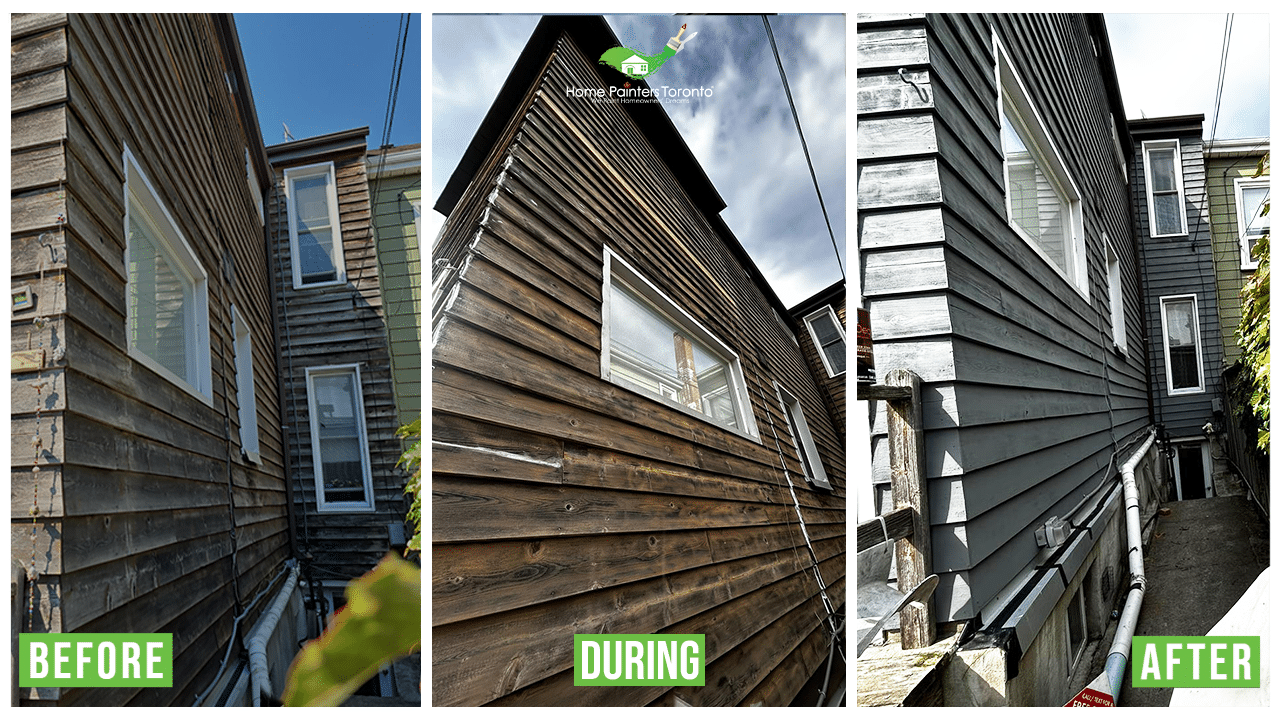
32% moisture at worst board, damaged sections cut out and replaced with kiln dried cedar matched to existing profile, 48-hour acclimation before priming, two coats Benjamin Moore Aura Exterior Low Lustre within recommended surface temperature range -- four day project, WSIB compliant crew, six week follow up confirmed epoxy patches cured properly and no early cracking
Why Toronto Homeowners Trust Professional Siding Repair
Toronto homeowners trust Home Painters Toronto for siding rot repair because the company is WSIB compliant, fully insured with 5 million dollars in general liability coverage, and backs exterior work with a 3 year warranty. Read verified client reviews from homeowners across the GTA before booking an estimate.
That track record shows up in how the company handles a project from the first call to the final coat. An estimator visits the home, documents every rot location with photos and moisture readings, and provides a written scope before any work begins. Crews then follow that scope on site, so the homeowner knows exactly which boards get replaced, which get spot repaired, and why. This kind of documentation also helps homeowners who plan to sell within a few years, since a clear repair record shows a buyer's inspector that the damage was addressed at the source and not simply painted over.
- 38+ years in business, family owned and operated
- WSIB compliant with full workers' compensation coverage
- $5M general liability insurance on every project
- Criminal background checks on all crew members
- 3 year warranty on exterior painting and repair work
- HomeStars Best of Award 2026 winner, 1,200+ positive reviews on HomeStars, Google, and Houzz
Frequently Asked Questions
Rotten siding often feels soft or spongy when pressed, and the paint film cracks or bubbles in the same spot repeatedly. A hollow sound when tapped, a musty smell near the wall, and dark staining under the eaves are other common signs. A moisture meter reading above 20 percent confirms active decay.
Yes, when the damage is shallow and localized, technicians can remove the soft wood and rebuild the area with an epoxy consolidant or a cut out patch. Deeper rot that passes through the board or reaches the sheathing usually needs full board or panel replacement instead.
Costs vary with the extent of the damage and the size of the affected wall section. Small repairs to a single board or corner trim area typically fall within the $2,000 to $4,000 exterior repair range, while larger sections with spreading rot can reach $4,000 to $8,000 or more once repainting is included. For a broader breakdown, see our full cost of painting a house guide.
Most standard home insurance policies do not cover gradual wood rot because insurers classify it as a maintenance issue and not sudden accidental damage. Coverage sometimes applies if the rot resulted from a specific covered event, such as a burst pipe or storm damage, so homeowners should check their policy details with their insurer directly.
Most single board or corner repairs finish within one to two days, including priming and painting. Larger sections with multiple damaged boards or full panel replacement can take three to five days, depending on wall size and weather conditions.
A high opacity 100% acrylic exterior paint with a low lustre or satin finish gives repaired wood siding strong moisture resistance and even colour coverage. Two coats over a quality primer give the best long lasting protection against Toronto's freeze and thaw cycles.

Get Your Siding Rot Repair Started
Siding rot repair works best when a professional catches the damage early and fixes the moisture source, not just the visible board. Home Painters Toronto has diagnosed and repaired wood siding across the GTA for 38+ years, and every project comes with fast, free quotes and warranty backed work. Contact Home Painters Toronto today to book a same day estimate and protect your home's wood siding before small damage turns into a costly rebuild.
Get a Fast, Free Quote for Siding Rot Repair in Toronto
Contact Home Painters Toronto today to book a same day estimate and protect your home's wood siding before small damage turns into a costly rebuild.
Contact Us for a Free Quote