

Toronto homeowners often assume a chalky, peeling soffit panel just needs a fresh coat of paint. In many cases, the paint is failing because the wood or aluminum underneath it is already compromised, not because the coating itself wore out. Learning the signs your soffit and fascia repair needs, not just paint, can save you from a much larger bill once winter sets in. A soffit or fascia board that looks rough from the ground may already be softened by rot, pried loose by squirrels, or holding water against your roofline every time it rains. This guide covers the seven warning signs Home Painters Toronto crews see most often across the GTA, and how to tell a simple touch-up from a repair that needs attention now.
Soffit and fascia need repair, not just paint, when you see peeling paint over soft wood, sagging panels, water stains, pest entry holes, gaps at the roofline, a musty attic smell, or paint that keeps failing in the same spot. Any of these signs means the substrate underneath is compromised, and repainting alone will not stop the damage.
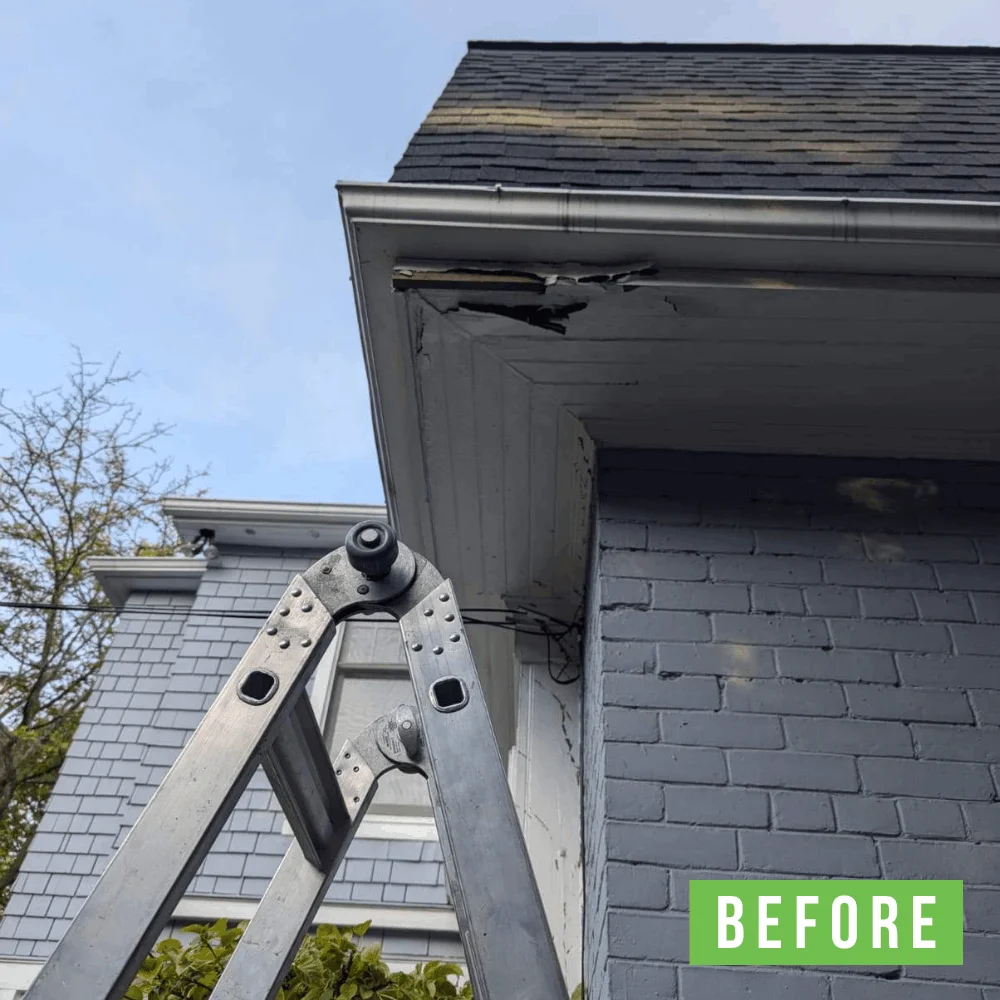
A soffit or fascia board that looks rough from the ground may already be softened by rot or holding water against your roofline
Signs Your Soffit and Fascia Need Repair
Seven signs reliably separate a cosmetic soffit or fascia problem from one that needs repair: peeling paint over soft wood, sagging or soft panels, water stains, visible pest entry holes, gaps at the roofline, a musty smell near the ceiling, and paint that fails repeatedly in the same spot. These are the same signs our crews check for during a free on-site assessment, and homeowners often check our client reviews before booking one to see how past repairs held up over time.
| Sign | What It Usually Means | Repair or Repaint? |
|---|---|---|
| Peeling or bubbling paint over soft wood | Moisture has already entered the substrate | Repair |
| Sagging or soft panels | Wood is rotted or waterlogged | Repair |
| Water stains or streaking | Water is bypassing the gutter or a seal | Repair |
| Visible pest entry holes | Wildlife has chewed or pried an opening | Repair |
| Gaps at the roofline | Fasteners or trim have pulled away | Repair |
| Musty smell near the ceiling | Moisture is trapped in the attic | Repair |
| Repeated paint failure, same spot | Underlying rot keeps breaking the paint film | Repair |
| Faded colour, surface intact | UV wear only, substrate is sound | Repaint |
If your soffit or fascia only shows the last row, faded colour with a firm, dry surface underneath, a standard repaint will hold for its expected service life. Every other row on this list means the paint film is a symptom, not the actual problem, and repainting over it usually fails again within a season or two. The sections below walk through each sign in detail, along with the field tests our crews use to confirm what is really happening underneath.
We have painted and repaired more than 20,000 homes across Toronto and the GTA since 1991, and soffit and fascia calls follow the same pattern almost every time: a homeowner notices the paint first and only learns about the rot underneath once a crew probes the board. Catching the pattern early, before an entire run needs replacing, is the difference between a half-day repair and a multi-day project.
1. Peeling or Bubbling Paint
Peeling or bubbling paint on a soffit or fascia board almost always means moisture is trapped underneath the paint film, not that the coating failed on its own. Exterior coatings need a dry, stable substrate to bond properly, and manufacturers such as Benjamin Moore note in their technical data sheets that wood moisture content above roughly 15 to 19 percent will prevent proper adhesion. Painting and Decorating Contractors Association application standards call for a similar moisture ceiling before primer or topcoat goes on, which is one reason our crews check moisture levels with a meter before quoting a job.
Once moisture gets behind the paint film, vapor pressure pushes the coating off the surface from the inside, which is why bubbling often appears before any visible cracking. Painting over a board in this condition, even with a premium coating used elsewhere for exterior residential painting, will not solve the underlying problem. The board needs to dry out and, in many cases, be partially replaced before any new coating is applied.
2. Soft Spots or Sagging Panels
Soft spots or sagging fascia panels mean the wood has already lost enough structural integrity to flex under light pressure, which no amount of paint can restore. Sagging usually starts at the seams or where fasteners have pulled through weakened wood, and it tends to spread along the board once moisture has a clear path inside. A panel that bows or dips visibly from the ground has typically been compromised for a season or more before anyone noticed it. Older housing stock across neighbourhoods like North York and Scarborough tends to show this sign first, since original fascia boards installed decades ago have had more freeze-thaw cycles to work against them than a newer build.
The Screwdriver-Probe Test for Soft Fascia
A flathead screwdriver pressed at a low angle into a suspect board is the same field test contractors use to confirm rot before recoating. Healthy wood resists the screwdriver tip with a firm, solid feel and barely marks the surface. Rotted or waterlogged wood lets the tip sink in with little resistance, sometimes more than a centimetre, which confirms the board needs repair instead of a surface coating. You can see examples of this kind of repair work in our recent project photos from similar GTA homes.

Rotted or waterlogged wood lets the tip sink in with little resistance, confirming the board needs repair instead of a surface coating
3. Water Stains or Streaking
Water stains or streaking on a soffit panel mean water is bypassing the gutter system or slipping past a failed seal, and it has already been collecting inside the material for some time. Streaking usually runs in a vertical or diagonal line from a specific point, such as a gutter joint, a downspout, or a spot where flashing has separated from the wall. Gutters that overflow even a few times each fall are a common trigger, and clearing them at least twice a year keeps most of that water off the fascia altogether.
Left unaddressed, the same water path that stains the soffit eventually reaches the fascia board behind it and the siding below it, so the damage rarely stays contained to one panel. A full roofline inspection often uncovers early siding repair services needs at the same time, since the water travels along the same wall assembly instead of stopping neatly at the soffit line.
4. Visible Pest Entry Points
Visible pest entry points, chewed holes, pried seams, or scratched openings, mean wildlife has already breached the soffit and widened the opening enough to get inside. Squirrels and raccoons are the most common culprits on Toronto rooflines, and they typically target a soft or already-damaged section because it is easier to chew through than sound wood. A squirrel-sized entry hole usually starts under two inches across and grows quickly once the animal returns to the same spot night after night.
Once an animal establishes an entry point, the surrounding wood usually softens further from nesting material, droppings, and repeated scratching trapped against it. Entry points near a chimney or masonry chase sometimes overlap with brick and mortar repair needs, since a gap in the mortar joint can give pests an additional route into the roofline alongside the soffit itself.
Pest activity around soffits tends to spike in early spring, when females look for a warm, dry spot to nest, and again in fall, as animals prepare for winter. A hole that seems minor in September can widen substantially by the time cold weather forces more activity into the attic space, so an entry point spotted in fall is worth addressing before winter sets in, not once spring arrives.

5. Gaps Between Fascia and Roofline
Gaps between the fascia and the roofline mean fasteners have pulled loose or the board has shrunk, warped, or begun separating from the structure behind it. A small gap allows wind-driven rain behind the fascia, and a larger one is often a sign that the framing underneath has already started to deteriorate. Elastomeric sealants used for minor gaps typically need at least 25 percent joint elongation capacity to handle Toronto's seasonal wood movement, which is a spec worth confirming if a contractor proposes caulking as the fix.
Reading Gap Width: 1/8 Inch vs. 1/2 Inch
A gap under about 1/8 inch is usually just normal seasonal wood movement and can often be resealed during a routine maintenance visit. A gap wider than roughly 1/2 inch typically signals a fastening or structural problem that caulking will not solve, and it often means the rafter tail and wood frame repair behind the fascia needs attention before the board is reset and refastened.
Gaps also show up more often on homes with aluminum fascia capping installed over the original wood, since the capping can hide a growing gap from view at ground level. A visual check from a ladder, or a close look with binoculars during an assessment, usually catches these gaps well before they become a bigger structural issue.
6. Musty Smell or Interior Ceiling Stains Near the Roofline
A musty smell or ceiling stains near the roofline often trace back to the soffit, not the roof itself, because blocked or damaged soffit vents trap humid air against the attic sheathing. Warm, moist indoor air rises into the attic year-round, and if the intake vents in the soffit are painted shut, clogged with debris, or physically damaged, that moisture has nowhere to escape. Over time, condensation forms on the underside of the roof deck and drips back down, which can show up indoors as a ceiling stain nowhere near an actual roof leak.
Why a Musty Attic Smell Isn't Always a Roof Leak
Homeowners, and even some roofers, default to assuming a ceiling stain means a roof leak, but a blocked soffit vent produces a similar stain pattern from condensation instead of an active water intrusion. The two causes need different fixes, so confirming which one you actually have before paying for roof repairs is worth the extra step, and it is one of the first things our crews check during a roofline assessment.
7. Repeated Paint Failure in the Same Spot
Paint that fails in the same spot year after year, even after proper preparation and a fresh coat, means the substrate underneath is still wet or actively rotting, and no coating will hold until that is fixed. Coatings are designed to protect sound wood from moisture, not to seal in moisture that is already trapped inside the board.
The Greater Toronto Area sees dozens of freeze-thaw cycles most winters, and Climate Atlas of Canada freeze-thaw cycle data shows how often trapped moisture inside a board freezes, expands, and thaws again across a single season. That repeated expansion is what physically pries paint and wood fibre apart faster than typical southern Ontario weather alone would explain.
- At a recent inspection in Etobicoke's Islington-City Centre West neighbourhood, a homeowner had recoated a fascia run twice in three years with Benjamin Moore Aura Exterior in Low Lustre, and the paint kept blistering along the same six-foot section.
- A moisture meter read 34 percent inside the board, well above the roughly 15 to 19 percent threshold most exterior coatings need for proper adhesion.
Repainting a third time would have failed the same way within a year, so the section was cut back to sound, dry wood and replaced as part of a broader exterior wood siding repair visit before any new coating went on.
Repair vs. Replace: Quick Checklist
Deciding between a repair and a full replacement comes down to how much of the board is affected and whether the damage has already reached the framing behind it. Use the checklist below as a starting point before your assessment.
Repair is usually enough when damage is limited to one or two boards, the wood probes firm just past the affected area, and fasteners still hold securely.
Replacement is usually needed when rot or softness spans several boards in a row, the screwdriver probe sinks deeply across a wide section, or water has already reached the rafter tails.
A repaint alone is appropriate only when the surface is faded but firm, there are no gaps, stains, or pest damage, and the last coating held for its full expected service life.
Book an inspection before winter when you notice any combination of the signs above, since GTA freeze-thaw cycles turn small gaps into larger ones quickly once cold weather sets in.
According to CMHC's home maintenance guidance, a regular walk-around inspection of exterior components like soffit and fascia is one of the most effective ways to catch deterioration early, since early repairs are consistently cheaper than a full replacement later.
Homeowners across our GTA service areas can request a free, no-obligation assessment, and our crews will tell you honestly whether a section needs repair, replacement, or nothing at all.
Frequently Asked Questions About Soffit and Fascia Damage
Here are the frequently asked questions homeowners ask us most often during on-site soffit and fascia assessments.
Sagging soffit repair is urgent within weeks, not months, because a sagging panel means the wood underneath is already failing and rain or snowmelt is likely getting behind it. Left through even one more Toronto winter, freeze-thaw cycling and pest activity often turn a single panel repair into a multi-board replacement, which costs considerably more than catching it early.
No, painting over peeling soffit paint without repairing the substrate first almost never holds, because the new coating is applied to compromised wood or already-failing paint underneath. Most exterior coatings need a sound, properly prepared surface to bond, so skipping the repair step typically means the same peeling returns within a season, and the second failure is usually worse than the first.
Rotted fascia feels soft or spongy when probed and often sounds dull or hollow when tapped, instead of the sharp, solid sound healthy wood makes. A flathead screwdriver pressed at a low angle sinks into rotted wood with little resistance, which is the same probe test used during a professional assessment to confirm the extent of the damage before a quote is written.
No, a musty attic smell is not always soffit-related, though blocked or damaged soffit vents are one of the most common causes in Toronto homes. Roof leaks, poor exhaust ventilation, and high indoor humidity reaching the attic can all produce a similar smell, so a proper inspection is the only reliable way to confirm the actual source before any repair work begins.

Get a Free Soffit and Fascia Assessment
If you are seeing any of these seven signs on your Toronto or GTA home, a short on-site assessment will tell you quickly whether you need a simple repaint or a full soffit and fascia repair. Home Painters Toronto has been working on rooflines across Toronto and the GTA since 1991, and founder Brian Young brings four decades of painting industry experience to every crew we send out.
Our teams are WSIB compliant and fully insured, and every completed repair comes with warranty-backed work so you know the fix will hold through GTA winters. We offer fast free quotes and warranty-backed work on every project, and why homeowners choose HPT usually comes down to that combination of speed, honesty, and follow-through.
Contact Home Painters Toronto to book your free soffit and fascia assessment today.
Get a Free Estimate