

Stucco Cracks: Telling Hairline From Structural, and Who to Call
A hairline crack on a Toronto stucco wall rarely means the same thing as a crack that keeps growing every season. Homeowners across the GTA send us photos every fall asking whether they need stucco crack repair right away or if it can wait. The honest answer depends on the crack width, its direction, and what sits behind it. Some cracks are cosmetic surface stress from curing and thermal movement. Others point to moisture trapped inside the wall assembly or movement in the framing underneath. This guide breaks down how to read a stucco crack the way a contractor does, why our freeze-thaw climate causes them, and exactly who to call before a small crack turns into an expensive repair.
Hairline stucco cracks are thin, usually under 1/16 inch, and spread in random spider patterns from curing shrinkage. Structural cracks run wider, often diagonal near corners and openings, and keep growing season after season. If a crack exceeds about 1/8 inch or keeps spreading, call a stucco crack repair specialist for an on-site assessment.
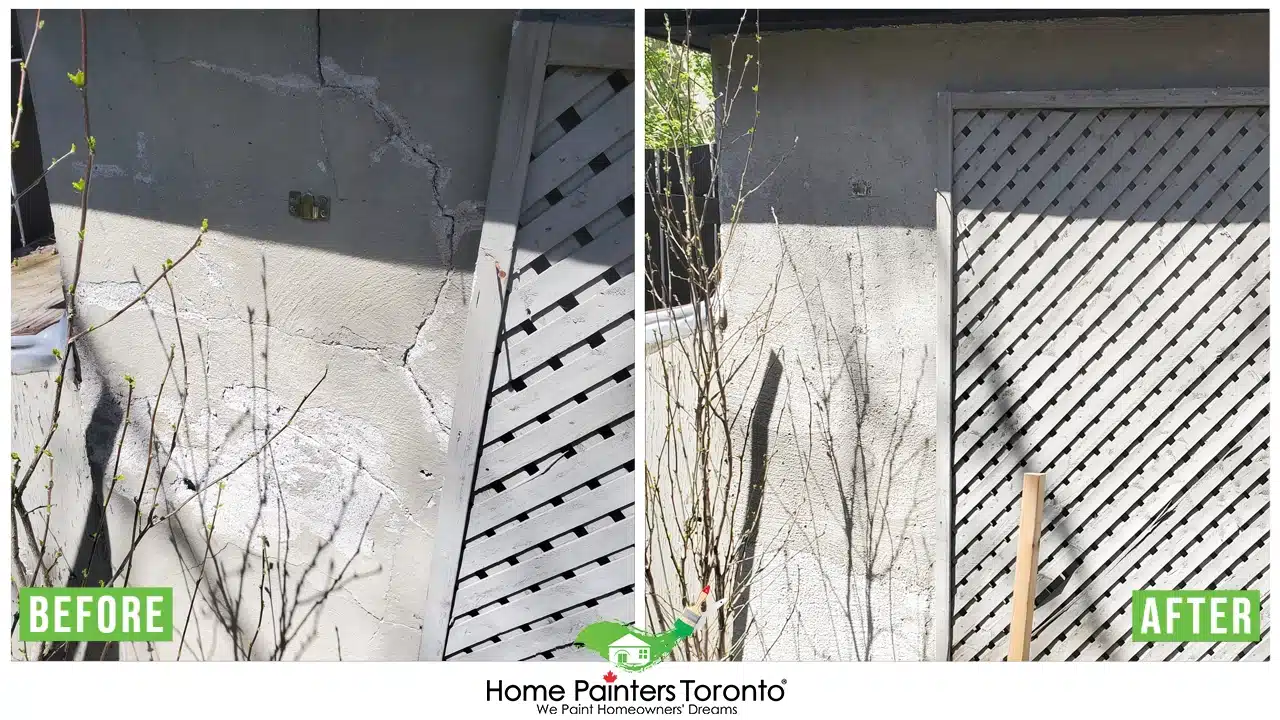
Some cracks are cosmetic surface stress, while others point to moisture or movement in the framing underneath
Hairline vs Structural Stucco Cracks: The Width and Pattern That Matter
Hairline cracks measure less than about 1/16 inch with random, spidery patterns, while structural cracks run wider, straighter, and often diagonal. As a HomeStars Best of Award 2026 winner with more than 1,200 positive reviews across the GTA, our crew inspects stucco cracks like these year-round. Width alone rarely tells the full story. Pattern, location, and whether a crack keeps growing over a season matter just as much as the number on a tape measure.
| Feature | Hairline Crack | Structural Crack |
|---|---|---|
| Width | Under 1/16 inch | 1/8 inch or wider |
| Pattern | Random, spider-like | Straight or diagonal |
| Common Cause | Curing shrinkage, minor thermal movement | Framing movement, settling, moisture damage |
| Typical Location | Open wall field | Corners, window and door openings |
| Urgency | Monitor, cosmetic repair | Needs a professional structural assessment |
A crack that stays the same width from spring to spring is usually cosmetic. A crack that widens, especially after a winter freeze-thaw cycle, points to ongoing movement. Building envelope research on stucco crack acceptability classifies cracks up to about 60 mils, close to 1/16 inch, as hairline and lower risk, while cracks nearing 1/8 inch generally warrant repair. For a broader look at how exterior stucco siding performs across material types in our climate, see our service breakdown.
Why Stucco Cracks Form in Toronto's Freeze-Thaw Climate
Toronto stucco cracks mostly form because water gets behind the finish coat and then freezes. Water expands as it turns to ice, and that expansion pushes against the stucco from the inside. Over a typical Ontario winter, a wall assembly can cycle through dozens of freeze-thaw events. Each cycle stresses the bond between the stucco and the substrate underneath a little more.
Moisture gets in through failed caulking around windows and doors, cracked flashing, or hairline cracks that were never sealed. Canada Mortgage and Housing Corporation guidance on moisture and air problems in homes identifies wind-driven rain and missing flashing as leading causes of cladding damage. Once water sits behind stucco, it does not just cause cracking. It can also feed rot in the sheathing and framing below, which turns into a wood frame repair issue if it goes unchecked.
Thermal movement adds a second layer of stress. Stucco and the wood or steel framing behind it expand and contract at different rates as temperatures swing. Toronto summers push wall surface temperatures well above typical room temperature, while winter nights can drop far below freezing. That swing puts real strain on a rigid, cement-based material.
Crack Patterns and What Each One Reveals
Every crack pattern points to a different cause. A spider web of thin lines almost always means normal curing shrinkage. A single straight vertical crack often follows a control joint or a seam in the lath underneath. A diagonal crack running from the corner of a window or door usually means the framing around that opening has shifted.
Diagonal Stair Step Cracks at Corners and Openings
Diagonal cracks that step across a corner, or radiate from a window corner in stucco, usually signal movement in the structure behind the finish. This pattern shows up most often on additions, over garage doors, and near foundation corners where settling is more likely. The same movement that causes stair step cracking in a masonry veneer corner can show up in stucco near the same structural point, which is why our brick and mortar repair crew and stucco crew often inspect older homes together. A stucco crack repair specialist checks framing and moisture levels before patching a crack like this, because sealing the surface without fixing the movement guarantees the crack returns.
- Horizontal cracks at floor lines: often linked to shrinkage in the framing or a shift where two storeys meet.
- Cracks around vents and light fixtures: usually caused by movement where different materials meet the stucco.
- Map cracking across a whole wall: typically a sign the base coat cured too fast or too thin.
Timing matters when you read a crack pattern, too. A crack that appears right after a heavy rain, or right after the first hard frost of the season, usually points to moisture or thermal movement rather than a slow structural shift. A crack that shows up gradually over several years, with no clear seasonal trigger, more often points to settling in the foundation or framing. Keeping a simple photo log each fall helps homeowners and our crew compare the same crack year over year instead of guessing from memory.

Diagonal cracks that step across a corner usually signal movement in the structure behind the finish
How Our Crew Diagnoses a Stucco Crack On Site
A proper stucco crack diagnosis starts with a moisture reading, not a caulking gun. Our crew uses a pin-type moisture meter to test the wall assembly at several points around the crack. We also tap the surrounding stucco to listen for hollow spots that signal delamination behind the finish coat.
Moisture Meter Readings Behind the Finish Coat
A moisture reading under about 16 percent in the substrate generally means the wall is dry enough for a standard patch. Readings above that level usually mean water is still active behind the stucco, and patching before the wall dries out traps moisture inside. We document every reading with photos so homeowners can see exactly what we found.
After the moisture check, we measure crack width with a crack comparator card and note the direction and location on the wall. That combination, width, pattern, and moisture, tells us whether the repair is a surface patch, a deeper resurface, or a referral to a structural engineer for anything tied to the foundation. Whether the fix is a spot patch or ties into a broader exterior house painting project, we document everything before quoting.
- Visual inspection of the full elevation, not just the cracked area.
- Moisture meter readings at the crack and at least two nearby points.
- Tap testing for hollow or delaminated sections.
- Written assessment with photos before any repair quote.
When a Crack Signals a Structural Problem, Not a Cosmetic One
A stucco crack points to a structural problem when it keeps widening, runs diagonally from an opening, or lines up with a crack in the foundation below it. Cracks wider than about 1/8 inch fall outside what most building envelope guidance treats as normal, cosmetic movement.
Doors and windows near a structural crack often start sticking or no longer close flush. Stair step cracking in a masonry corner, paired with a stucco crack right above the foundation line, often means the footing has settled unevenly. None of these signs are something to diagnose from the ground with binoculars. They call for a hands-on inspection by someone trained to read a wall assembly.
Efflorescence, that white chalky residue near a crack, is another red flag. It means water has been moving through the stucco and depositing dissolved minerals as it evaporates. Combined with a crack wider than 1/8 inch, efflorescence usually means the repair needs to address moisture intrusion first. If similar cracking shows up on an interior stucco ceiling, that is a separate scope; see our stucco ceiling repair and painting page for that kind of work.
Stucco Crack Repair Costs in Toronto
Stucco crack repair in Toronto typically runs between $2,000 and $8,000 CAD plus HST, depending on the crack pattern, wall area, and whether moisture damage sits underneath the finish.
| Repair Scope | Estimated Cost (CAD + HST) |
|---|---|
| Minor hairline patch, single wall section | $2,000 – $4,000 |
| Multiple cracks or moisture-affected area | $4,000 – $8,000 |
| Full elevation resurface or lath replacement | $8,000 – $10,000 |
Price moves with access, too. A crack three storeys up needs staging or a lift, and that adds labour hours before anyone touches the wall. Colour matching an older, tinted, or textured stucco finish can also add cost because sourcing or blending the right finish takes extra time. For comparison, see our full breakdown of the cost of painting a house in Toronto.
Repair scope also shifts with the wall assembly behind the finish. A home with a traditional three-coat stucco system over wood lath often needs more careful matching than a newer, one-coat synthetic system. Older homes in established neighbourhoods sometimes carry a tinted base coat that is no longer sold, which pushes the job toward a broader resurface instead of a single spot repair.
Why a Sealant Only Patch Fails on Stucco
A sealant-only patch fails because it seals the surface without addressing the moisture or movement causing the crack in the first place. Caulk flexes for a season or two, then the underlying stress reopens the crack, often wider than before.
Painting over a crack without patching it first hides the problem instead of fixing it. New paint film stretches with the wall, then splits again once the crack moves. Homeowners often end up paying for the same repair twice within a few years because the root cause, whether it is trapped moisture or a shifting substrate, was never treated.
A proper siding repair keys new stucco material or an elastomeric patching compound into a widened, cleaned-out channel, then ties the finish coat and texture back into the surrounding wall. That process takes longer than a bead of exterior caulk, and it is the difference between a repair that lasts and one that reopens by next winter.
Who to Call: Choosing a Stucco Crack Repair Contractor in the GTA
Choosing the right contractor for a stucco crack repair means checking for WSIB compliance, insurance, and material-specific experience before anything else. A generalist who is comfortable with drywall or siding is not automatically comfortable diagnosing a cement-based cladding system. Home Painters Toronto is WSIB compliant, fully insured with $5M in general liability coverage, and every repair is backed by warranty-backed results. Criminal background checks on every crew member give homeowners one less thing to worry about when a crew is working around windows, ladders, and family space.
- At a recent stucco crack assessment in Leaside, our crew found a network of diagonal cracks radiating from a second-storey window corner on a 1958 two-storey home.
- A moisture meter reading behind the finish coat showed 22 percent moisture content in the underlying lath, well above the 16 percent threshold we treat as a warning sign.
- We keyed out the cracked section, let the substrate dry, then rebuilt the area with a fibre-reinforced base coat before finishing with Benjamin Moore Aura Exterior in Low Lustre to blend the patch into the surrounding wall.
The assessment, repair, and finish work took three days, and the repair is covered under our warranty-backed exterior painting terms. You can see more examples like this one in our project portfolio.
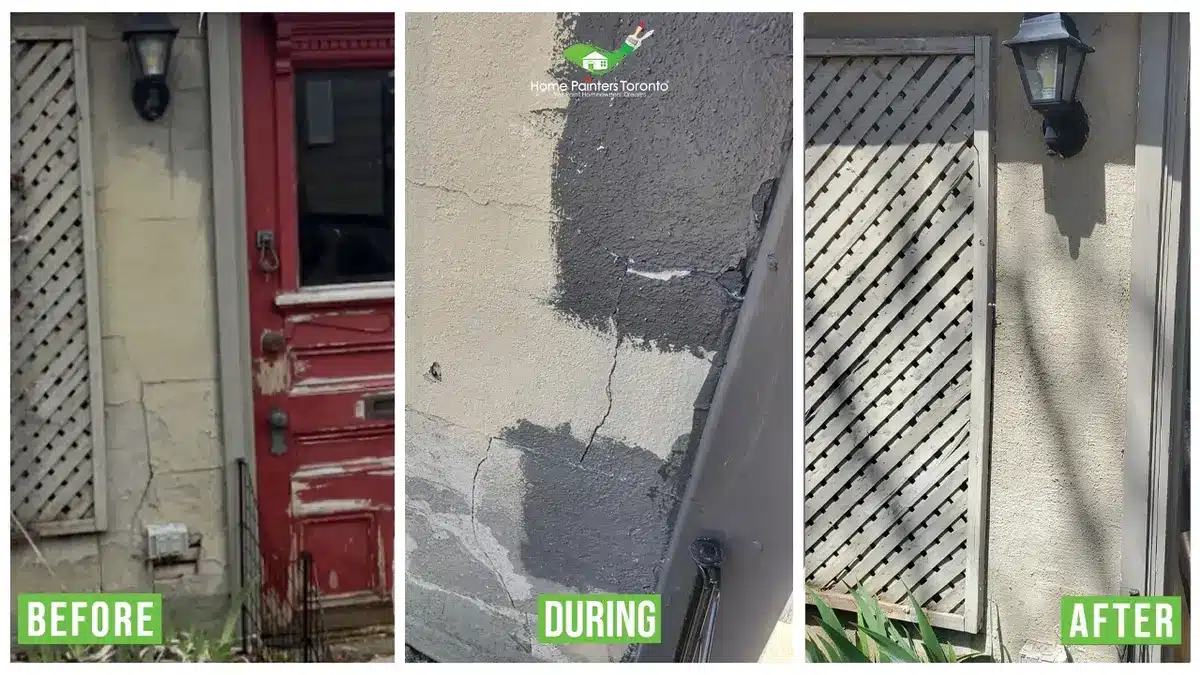
Keying out the cracked section and rebuilding with a fibre-reinforced base coat let the patch blend into the wall
When to Book a Stucco Crack Repair Assessment
Book an assessment as soon as a crack widens, a second crack appears near the first, or you notice staining or efflorescence around the edges. Waiting through another freeze-thaw season usually means a bigger repair bill, not a smaller one. Home Painters Toronto offers same-day estimates seven days a week across the GTA. Read more homeowner experiences in our client reviews before you book, and see why homeowners choose us for stucco and exterior repairs across the region.
- Ask for WSIB clearance and proof of $5M general liability insurance.
- Ask how a contractor tests for moisture before quoting a repair.
- Ask what the finish coat warranty actually covers.
- Ask for examples of stucco crack repairs in your neighbourhood.
Frequently Asked Questions about Stucco Repair
Painting over a stucco crack hides it temporarily but does not stop it from reopening. The crack still moves underneath the paint film, so the paint splits again within a season or two. A proper repair patches and keys the crack before any finish coat goes on.
A structural stucco crack is usually wider than about 1/8 inch, runs diagonally from a corner or opening, and keeps growing season over season. Doors or windows nearby may also start sticking. A hands on inspection with a moisture meter and crack comparator gives a clear answer.
Not every stucco crack means active water damage, but every crack is a potential entry point. Thin, stable hairline cracks are often just cosmetic curing marks. Wider or growing cracks, especially with staining or efflorescence nearby, usually mean moisture has already reached the substrate.
Stucco crack repair in Toronto generally runs from $2,000 to $8,000 CAD plus HST for most homes, depending on the number of cracks, wall area, and whether moisture damage is present. Full elevation resurfacing runs higher, closer to $8,000 to $10,000.
Hairline cracks under about 1/16 inch are usually cosmetic and low risk, but they still deserve a yearly check. Watch for any hairline crack that widens, multiplies, or shows staining, because that shift usually means conditions behind the wall have changed.
Most single wall stucco crack repairs take one to three days, including time for the substrate to dry and the patch to cure before the finish coat goes on. Larger jobs with moisture damage or multiple wall sections can take longer.

Get a Professional Stucco Crack Assessment
A hairline crack and a structural crack can look similar from the driveway, but they call for very different repairs. Checking width, pattern, and moisture behind the wall is the only way to know which one you are dealing with. Home Painters Toronto brings 38+ years of experience as a trusted painting contractor, WSIB-compliant crews, and warranty-backed results to every stucco crack assessment across the GTA. For more answers, visit our full FAQ page.
Contact Home Painters Toronto for fast, free quotes and warranty-backed work on your stucco crack repair.
Get a Free Estimate