

Exterior Caulking Fails Early on Mississauga Homes More Often Than You Might Expect
Exterior caulking fails early on Mississauga homes, and the reasons go well beyond simple age or wear. Most homeowners notice cracking, peeling, or gaps around their windows and doors and assume the sealant just reached the end of its lifespan. The real story is more complicated. Our climate, housing stock, and the quality of previous applications all play a significant role.
Mississauga sits in a weather zone where temperatures can swing 30 degrees within a single week during spring and fall. That constant expansion and contraction is hard on any sealant. Older homes, which make up a large share of the GTA housing stock, face an even greater challenge because settling foundations and aging building materials create movement that fresh caulk cannot always handle. When exterior caulking is applied with the wrong product or over an unprepared surface, failure can arrive within a single season.
Understanding what drives early failure helps you protect your home before small cracks become costly water damage. Our professional window and door caulking services cover every gap with the right product, applied the right way, to surfaces that are properly prepared from the start. Here is what this article covers:
- The top reasons exterior caulking fails ahead of schedule
- How Mississauga's climate accelerates deterioration
- The real consequences of failed caulking beyond cosmetics
- What makes professional sealing last significantly longer
- When to call in a professional and what to expect from the process

Caulk that looks intact from across the street often reveals cracking, shrinkage, and separation on close inspection — early failure driven by Mississauga's freeze-thaw cycles and incorrect product selection
The Mississauga Climate Is the Biggest Culprit
Mississauga's weather is genuinely hard on exterior building materials. Freeze-thaw cycles are the primary driver of premature caulk failure in the GTA. During shoulder seasons like October through December and March through May, temperatures regularly fluctuate around zero degrees Celsius. Water seeps into hairline gaps during the day, then freezes and expands overnight. That expansion forces the sealant apart from the surface it is bonded to, breaking the seal before the product's rated lifespan is up.
According to Environment and Climate Change Canada, Southern Ontario receives significant precipitation across all four seasons. That year-round moisture exposure means exterior sealants face constant stress, not just seasonal challenges. Our exterior residential house painting team sees the results of this stress on nearly every project. Caulk applied five or six years ago often looks like it has been in place for fifteen.
Water enters gaps, freezes overnight, expands, and forces sealant away from the substrate repeatedly through fall and spring.
UV radiation dries out caulk material and reduces elasticity. High summer heat accelerates the degradation of less flexible formulations.
Elevated humidity in summer can prevent fresh caulk from curing properly if conditions are wrong at application time.
Pushes moisture directly at joints and gaps, magnifying any weakness in the seal throughout fall and shoulder seasons.
Wrong Product for the Job
Not all caulking products perform equally outdoors. This is one of the most common causes of early failure that professionals see in Mississauga homes. Basic acrylic caulks, often used in budget applications or purchased at hardware stores, are designed for interior trim work. They lack the flexibility and UV resistance required for exterior joints exposed to full seasonal swings.
Exterior applications need a high-performance siliconized acrylic or elastomeric caulk with the flexibility to move with the building. Products like Dymeric, Mono, and Dow Corning-grade sealants handle expansion and contraction without cracking. Applying an interior-grade product on an exterior surface might look fine for a season, but it will typically start cracking within 12 to 18 months.
Beyond product type, compatibility with the substrate also matters. Some formulations do not bond well to aluminum, vinyl, or painted brick. Using a product without checking compatibility is a common error that leads to peeling within the first year. Our exterior carpentry and handyman services team always matches the right product to each substrate before any sealing work begins.
In my 38 years of working on GTA homes, I have seen interior-grade caulk applied to exterior window frames more times than I can count. It looks identical to proper exterior caulk when it goes on, but it turns chalky and brittle by the following spring. The product you choose matters as much as the application itself. Always verify that the sealant is rated for exterior use and compatible with the specific substrate you are sealing.
Poor Surface Preparation Before Application
Surface preparation is where most caulking jobs either succeed or fail. Clean, dry, and properly primed surfaces are essential for caulk to bond correctly. Skipping any part of that preparation leads to adhesion failure, sometimes within weeks.
Common preparation mistakes that cause early failure on Mississauga homes:
- Applying over old caulk. Layering new caulk over cracked or shrinking old caulk is a temporary patch at best. The new bead bonds to the old sealant rather than to the substrate. When the old caulk continues to deteriorate, the new layer fails with it.
- Applying to a damp surface. Moisture trapped behind a fresh bead prevents proper curing. This is especially common on spring and fall applications when morning dew or recent rain leaves surfaces slightly wet.
- Skipping primer on porous substrates. Brick and concrete are highly porous. Without a primer coat, they absorb moisture from the caulk before it cures, weakening the bond and causing premature separation.
- Applying in cold temperatures. Caulk applied below 5 degrees Celsius does not cure properly. The product remains soft and tacky, then cracks as temperatures continue to drop.
A professional team takes the time to strip old caulk completely, clean the substrate, allow full drying time, and apply primer where the surface requires it. That preparation is what distinguishes a seal that lasts five to eight years from one that fails within eighteen months.
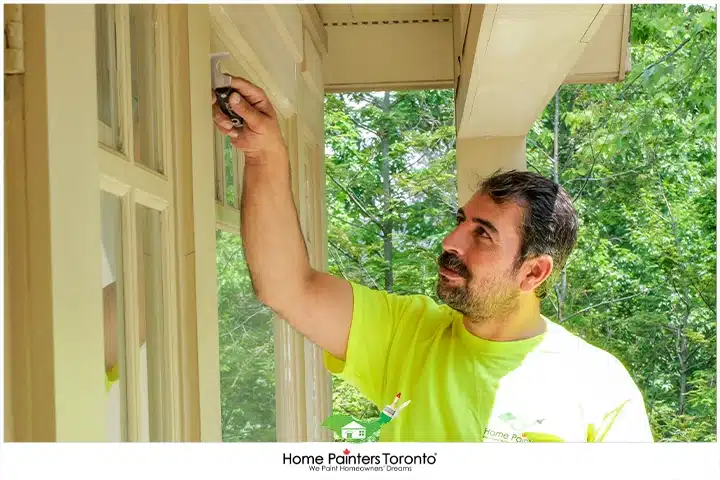
Complete removal of old caulk, surface cleaning, and priming before new application — the preparation sequence that separates a seal lasting two years from one lasting seven
What Happens When Exterior Caulking Fails
When exterior caulking fails, it creates openings that allow water to seep behind siding, windows, and trim, where it can cause hidden moisture damage to the structure of your home. In Mississauga's climate, that water can freeze in winter, expand, and widen the gap further. Over one or two seasons, a hairline crack becomes a channel for moisture intrusion that reaches insulation, framing, and drywall.
The downstream consequences of ignored caulk failure include:
- Mould and mildew growth inside wall cavities
- Rotting wood framing around windows and door jambs
- Paint peeling from moisture building up behind the surface
- Higher heating and cooling bills from air infiltration through failed seals
- Interior water staining and damage to walls and ceilings
Water damage repairs cost significantly more than proactive caulking maintenance. Our exterior painting services team regularly encounters rot and mould during prep work on homes where caulk failure went unaddressed for multiple seasons. The Canada Mortgage and Housing Corporation recognizes that properly sealing a home's building envelope, including joints around windows and doors, directly supports energy efficiency and moisture control — both key to long-term structural health in Canadian climates.
How Mississauga's Older Housing Stock Creates Additional Risk
Mississauga's older housing stock creates additional risk because many homes were built before modern sealing standards, making them more vulnerable to air and moisture intrusion around exterior joints. Many Mississauga neighbourhoods include post-war bungalows, 1970s and 1980s two-storeys, and semi-detached homes built before current sealing standards were adopted. These properties have specific vulnerabilities that make exterior caulking even more critical than on newer builds.
Older homes settle over time. Foundation movement creates slight shifts in the framing around window and door openings. That movement stresses the caulk bead continuously, even when the structure appears solid and stable. The older the building materials, the more movement has already accumulated, and the harder the joint works against the sealant.
Surface-specific challenges common in Mississauga housing:
- Brick homes: Mortar joints absorb and release moisture, creating constant movement around window frames. Breathable, masonry-compatible sealants are required.
- Stucco exteriors: Micro-cracks in the stucco surface become water entry points when the caulk at the perimeter fails. Our stucco siding repair service often runs alongside caulking work to address the full scope of moisture vulnerability at once.
- Aluminum siding: Expansion and contraction rates differ significantly from the wall structure beneath, pulling caulk beads apart over time. Flexible elastomeric products are essential on aluminum substrates.
The Real Lifespan of Exterior Caulking and Why It Often Falls Short
Quality exterior caulking, properly applied to a prepared surface, should last five to ten years in a typical GTA climate, which aligns with the expected lifespan of exterior caulking in residential applications. In practice, many applications fail in two to four years. The gap between expected and actual lifespan comes down to compounding factors that each shorten performance.
| Failure Factor | Effect on Lifespan |
|---|---|
| Low-grade product | Reduces lifespan by 50% or more |
| Poor surface preparation | Causes adhesion failure within 1 to 2 seasons |
| Incorrect product for substrate | Leads to peeling within 12 to 18 months |
| Application in cold or damp conditions | Prevents proper cure; creates immediate vulnerability |
| Layering over old caulk | New bead fails as old bead continues to deteriorate |
Any single factor from that table can cut the lifespan significantly. Combine two or three of them, and failure arrives within the first year.
When we inspect a home before an exterior painting or caulking project, one of the first things we check is whether the existing caulk was tooled properly after application. A well-tooled bead is pressed firmly into the joint, creating contact with both sides of the gap. A poorly tooled bead sits on top of the substrate rather than bonding to it, and it fails much faster. That is a detail you can only assess in person, which is why a proper on-site inspection before any caulking work is non-negotiable.
Why Professional Caulking Lasts Longer Than DIY Attempts
Professional caulking lasts longer than DIY attempts because it relies on proper surface preparation, commercial-grade materials, and application techniques designed for long-term performance. Homeowners who tackle caulking themselves often find themselves repeating the job every one or two seasons. The problem is rarely effort. It is knowledge, materials access, and process discipline that make the difference.
Tradespeople have access to commercial-grade sealants not readily available at retail stores. Brands like Dymeric 240 and Mono 150 are formulated for high-movement exterior joints and extreme Canadian temperature ranges.
A professional crew strips old caulk completely, dries and primes the substrate, and applies the correct bead thickness for the joint width. Each step protects the bond from the day of application forward.
Home Painters Toronto backs its exterior work with a 3-year warranty. When caulking is completed as part of a full exterior painting project, it falls within that warranty framework.
The cost of professional caulking pays for itself quickly when you consider avoided water damage repairs and lower heating costs through properly sealed joints.
What to Expect from a Professional Caulking Project
A professional caulking project typically includes a full exterior inspection, removal of failed sealant, surface preparation, and precise application of new caulking to create a durable weather-resistant seal. A professional exterior caulking project at Home Painters Toronto typically follows this sequence:
- On-site assessment A project manager inspects all windows, doors, and other exterior joints. They identify failed caulk, assess substrate condition, and note any water damage that may need carpentry attention before sealing begins.
- Old caulk removal Every trace of the existing sealant is stripped completely. This step takes time but is non-negotiable for a lasting result.
- Surface cleaning and priming Joints are cleaned of dust, chalky paint, and debris. Porous substrates receive a primer coat to improve adhesion before any new product is applied.
- Product selection and application The right product is matched to each substrate and joint type. The bead is applied in one continuous motion and tooled firmly into the joint to create contact with both surfaces.
- Cure time The project timeline accounts for proper cure, which varies by product and temperature. Cold or humid conditions extend the required cure window.
- Final walkthrough Every sealed joint is reviewed with the homeowner before the project is signed off and final payment is processed.
For Mississauga homeowners planning an exterior repaint, caulking is built into the scope from the start. You can learn more about pricing variables through our cost of painting a house guide.
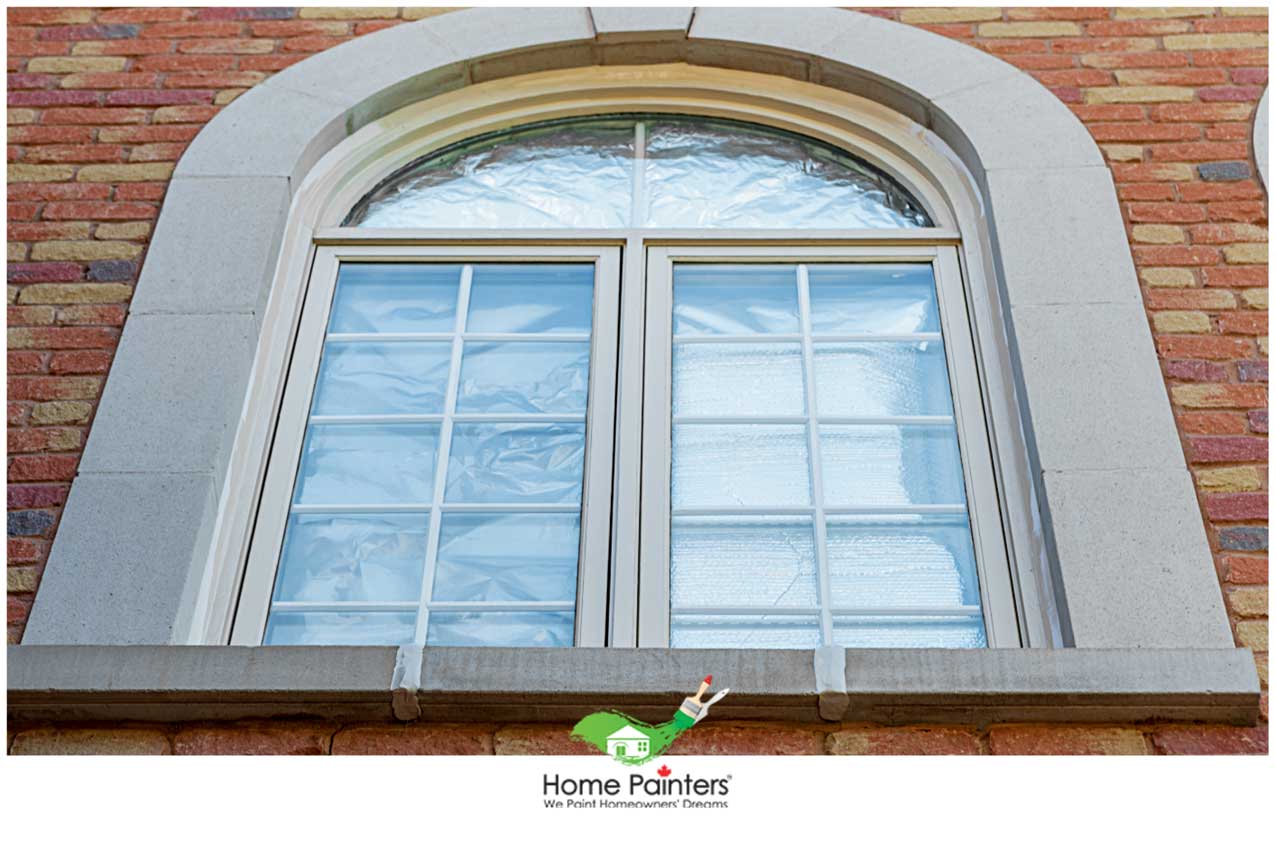
A properly tooled caulk bead bonds to both sides of the joint — distinguishable from a bead that simply sits on the surface and fails within the first freeze-thaw season
Why Home Painters Toronto Is the Right Call for Mississauga Homeowners
Home Painters Toronto has been serving GTA homeowners, including Mississauga, for over 38 years. Our team understands the climate demands, the housing stock, and the substrates common to this region. We do not apply generic solutions. Every caulking scope is assessed on-site, matched to the specific home, and completed with commercial-grade materials.
Our exterior brick painting and sealing work, carpentry repairs, and full exterior repaints all include a careful caulking assessment as a standard part of the process. We also offer standalone caulking scopes for homeowners who want their windows and doors properly sealed without a full repaint.
Frequently Asked Questions About Exterior Caulking in Mississauga
Quality exterior caulking, properly applied to a clean and prepared surface, should last five to ten years. In practice, many applications in Mississauga fail in two to four years due to freeze-thaw cycles, wrong product selection, or poor surface preparation. Annual inspection in spring, after the freeze season ends, helps catch early signs of failure before moisture intrusion begins.
The most common warning signs are visible cracks, gaps, or shrinkage in the bead around windows and doors. Peeling or separation from the frame is also a clear indicator. Inside the home, increased drafts near windows, moisture staining on interior walls, or rising heating and cooling costs can all point to failed exterior caulking that needs immediate attention.
Application below approximately 5 degrees Celsius is not recommended. Cold temperatures prevent the sealant from curing correctly, leaving it soft and vulnerable to cracking as temperatures drop further. The ideal application window in Mississauga is late spring through early fall, when temperatures are consistently above 10 degrees Celsius. A professional team will assess conditions before proceeding and reschedule if conditions could compromise the result.
Repeated cracking after recent replacement almost always points to one of three causes. The product used lacks sufficient flexibility for exterior use in Ontario's climate. The new caulk was applied over old sealant rather than to a bare, cleaned substrate. Or the application occurred on a damp or cold surface, preventing proper adhesion. Each of these errors creates a seal that appears intact initially but fails quickly once the home goes through seasonal temperature cycles.
Yes, and the impact is meaningful. Gaps around windows and doors allow conditioned air to escape and outdoor air to infiltrate, forcing heating and cooling systems to work harder. Properly sealed joints reduce that air exchange. The Canada Mortgage and Housing Corporation notes that sealing a home's building envelope, including around window and door openings, is one of the most cost-effective energy efficiency improvements a homeowner can make.
Professionally applied exterior caulking for a residential home in Mississauga typically starts at $1,495 plus HST for a small scope. Medium and larger projects range higher based on the number of windows and doors, the extent of old caulk removal needed, and the substrate conditions. All labour and materials are included. For exact pricing specific to your home, a free on-site estimate from Home Painters Toronto gives you the most accurate number.

Exterior Caulking That Actually Holds: The Bottom Line for Mississauga Homeowners
Exterior caulking fails early on Mississauga homes because of a combination of forces that no single product can overcome on its own. Freeze-thaw cycles, UV exposure, high humidity, and the movement of aging building materials all work against a poorly selected or poorly applied sealant. The fix is not simply applying more caulk. It is applying the right product to a properly prepared surface, at the right time of year, by someone who understands the difference.
Homeowners who invest in professional caulking see longer-lasting seals, lower energy costs, and real protection against moisture intrusion that can reach structural components. When exterior caulking is done right, it quietly does its job for years without demanding attention. When it is done wrong, it becomes an annual expense and a gateway for damage that costs far more to repair.
Home Painters Toronto has served Mississauga and the broader GTA for over 38 years. Our exterior caulking assessments are built into every project scope, and we back our exterior work with a 3-year warranty. If you have noticed cracks around your windows or doors, or if it has been more than three years since your last seal was applied, now is the right time to act before Mississauga's next freeze-thaw season does the damage for you.
Get a Free Exterior Caulking Estimate in Mississauga
Contact Home Painters Toronto today for a free, no-obligation estimate. Same-day response, seven days a week.
Get Your Free Estimate Today