

How Exterior Painting in Toronto Gets Damaged by Freeze-Thaw Cycles Every Winter
Why freeze-thaw cycles crack exterior painting in Toronto is a question every homeowner asks after their first peeling spring. These cycles are the single biggest threat to exterior coatings in the GTA, and most homeowners do not realize the damage has started until it is already visible. If your home is showing hairline cracks, blistering, or lifted paint each spring, Toronto's climate is the cause, but inadequate preparation is almost always what makes it worse.
This article explains the mechanism behind freeze-thaw paint failure, which surfaces take the worst damage, and why professional prep work is the only reliable line of defence. You can explore Home Painters Toronto's full exterior painting Toronto services to understand what a properly protected exterior looks like from start to finish.
- Why water is the root cause of nearly all freeze-thaw paint failures
- Which surfaces and home types are most vulnerable in the GTA
- What happens inside your wall when temperatures cross zero
- Why prep work determines how long paint actually lasts
- When professional intervention is the only lasting solution
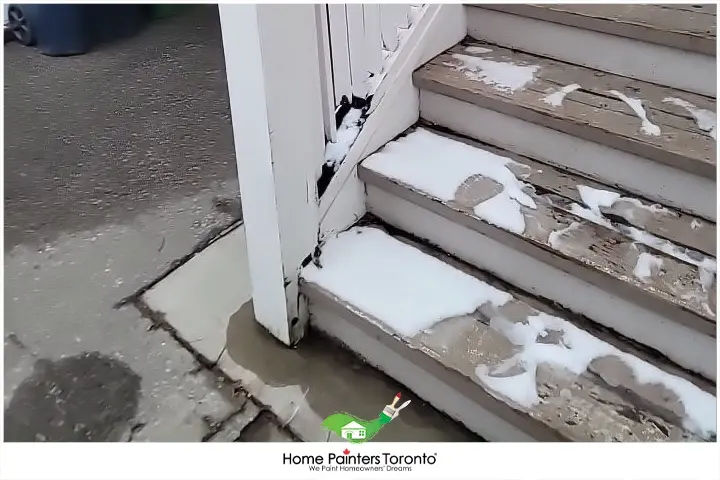
What looks like sudden spring paint failure almost always started the previous October or November — at a caulk line, unsealed end grain, or a spot where old paint was left on before repainting
Why Water Is the Real Enemy of Exterior Paint in Toronto
Water causes exterior paint to fail, and Toronto's freeze-thaw cycles make that process dramatically faster. Every exterior surface has tiny pores, cracks, and gaps. During Toronto's wet fall and winter months, water works its way into those openings.
When temperatures drop below zero, that trapped moisture expands as it turns to ice. Water expands by roughly nine percent when it freezes, generating outward pressure against every adjacent surface, including your paint film. When the temperature rises again, the ice melts and the surface contracts. This repeated expansion-and-contraction cycle breaks the bond between the paint and the substrate underneath.
Toronto experiences a high concentration of freeze-thaw events each season, with the most active periods occurring in December and March, according to research published in Theoretical and Applied Climatology. Each cycle applies cumulative stress to your exterior coating. After enough cycles, even a paint job applied correctly on a healthy surface will begin to show hairline cracks. Once those cracks appear, more water enters and the damage accelerates. The Climate Atlas of Canada tracks freeze-thaw cycle projections for Southern Ontario and confirms that the Toronto region experiences a high concentration of temperature crossings, particularly in shoulder seasons when temperatures swing above and below freezing repeatedly within a single day.
Rain, dew, or snowmelt seeps into hairline cracks, caulk gaps, and porous surfaces
Overnight temperatures drop below zero. Trapped moisture expands 9%, pushing the paint film away
Ice melts, paint settles back, but does not re-adhere. A microscopic gap now exists beneath the film
Dozens of cycles widen each gap until visible blistering, cracking, and peeling appear by spring
Which Surfaces Suffer the Most Freeze-Thaw Paint Damage
Wood surfaces suffer the most freeze-thaw paint damage because they absorb moisture easily and expand and contract more aggressively than other exterior materials. When wood siding swells with moisture and then contracts as temperatures drop, rigid paint film cannot move with it. The bond cracks, water enters, and the cycle continues beneath the surface where you cannot see it.
Older Toronto homes are at particular risk. Victorian-era and post-war bungalows common in neighbourhoods like the Annex, Roncesvalles, and Scarborough often have multiple layers of paint built up over decades. Each layer adds rigidity and reduces flexibility. These stacked coatings are significantly more prone to failure under freeze-thaw stress than a properly stripped and recoated surface.
Wood Siding and Trim
Absorbs moisture directly. Expands and contracts dramatically with temperature swings. Multiple paint layers from previous coats increase rigidity and reduce the film's ability to flex.
Caulked Seams Around Windows and Doors
Hardened caulk that can no longer compress and expand gaps open in cold weather, creating direct water entry points. Failed caulk is the most common entry point for freeze-thaw damage.
Brick Mortar Joints and Stucco
Porous surfaces absorb moisture at joints and micro-cracks. Freeze-thaw expansion within the masonry itself can cause spalling when moisture is trapped and allowed to freeze repeatedly.
Aluminum and Vinyl Siding
These materials contract more sharply in cold temperatures. If the paint was not formulated to flex with the substrate, it will crack along seams and edges first. Proper product selection for aluminum siding is critical in Toronto's climate.
What Actually Happens Inside the Paint Film When Temperatures Drop
When temperatures drop, trapped moisture inside small cracks and gaps freezes, expands, and pushes the paint film away from the surface beneath it. Picture this scenario: your exterior wall has a hairline crack in the caulking around a window frame. During a November rainfall, water seeps in. Overnight, temperatures drop to minus eight. That trapped water turns to ice and expands, pushing the paint film slightly away from the substrate.
The temperature rises the next afternoon, the ice melts, and the paint settles back, but does not re-bond. A microscopic gap now exists between the paint and the surface. This process repeats dozens of times through the winter.
By early spring, those microscopic gaps have grown into visible blisters, bubbles, or peeling sections. What looks like sudden paint failure in April actually started in October or November, often at a caulk line, an unsealed wood end grain, or a spot where old paint was not properly removed before repainting.
The damage is not always immediate or obvious. Often, homeowners see the surface look fine through December and assume the paint is holding. One sustained cold snap, combined with moisture that entered earlier, can cause a large section of paint to lift off in sheets within days.
Over 38 years of working on Toronto homes, we have found that the first places to look for freeze-thaw damage are the north-facing walls, window frames, and any area where caulk has visibly cracked or separated. These are the entry points where water gets in before the real damage begins. We always address those spots first, before any new coating goes on.
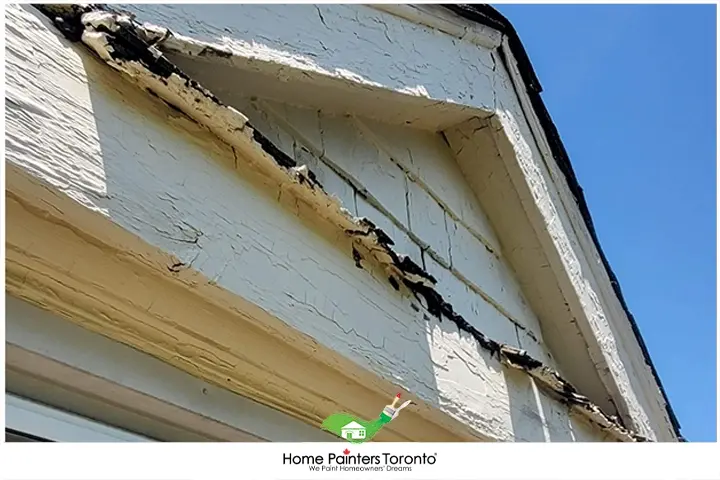
Visible spring damage began inside the wall assembly the previous autumn — at caulk gaps, unsealed wood grain, and spots where old paint was not fully removed before recoating
Why Poor Prep Work Makes Freeze-Thaw Paint Damage Worse
Poor prep work makes freeze-thaw paint damage worse by allowing moisture to become trapped beneath the paint, where repeated freezing and thawing gradually break the bond between the coating and the surface. Inadequate preparation is the number one reason exterior paint fails prematurely on Toronto homes.
If failing or peeling paint was not fully removed before repainting, moisture sits trapped between the old and new layers. If bare wood was not primed properly, it absorbs water directly. If gaps in caulking were not sealed before painting, water follows those paths every time it rains.
A professional exterior residential house painting project starts with a thorough inspection of every surface. A proper prep sequence includes:
- Scraping all loose and failing paint back to a stable, firm edge
- Sanding to smooth transitions and improve adhesion
- Replacing all cracked or failed exterior caulking around windows, doors, and trim
- Priming all bare wood before any topcoat goes on
- Addressing any wood rot and carpentry repairs before painting begins
- Applying a quality 100% acrylic topcoat in conditions above the manufacturer's minimum temperature
The paint product itself also matters significantly. High-quality 100% acrylic exterior formulations have elongation properties that allow the cured film to expand and contract without cracking. Lower-cost products lack those flexibility characteristics and fail faster when temperatures swing repeatedly across the freezing point.
In my experience, homeowners who repainted their own exterior or hired a low-bid contractor often see failure within one or two seasons. The paint itself is rarely to blame. The real cause is almost always skipped prep: old paint left on, gaps not caulked, wood not primed, or paint applied in weather that was too cold for proper curing. Skipping prep to save time or money costs far more in the long run.
How Freeze-Thaw Damage Compounds Over Multiple Toronto Winters
Freeze-thaw damage compounds over multiple Toronto winters because small cracks allow more moisture into the surface each season, causing progressively larger paint failures and deeper structural deterioration over time. A single winter of freeze-thaw activity might leave your paint looking slightly chalky or showing a few hairline cracks. Two or three winters of that same stress, without proper repairs, leads to exponential deterioration.
- Minor chalking and hairline cracks along panel edges and caulk lines. Paint still mostly intact. Cost to address: a standard repaint with proper prep.
- Blistering, bubbling, and sections lifting in sheets. Water has been behind the paint film for at least one full season. Cost to address: repaint plus caulking replacement, additional prep time.
- Soft wood, rot at trim and sills, mould in wall cavities. No longer a paint project alone. Carpentry and structural repairs must precede any new coating. Costs multiply significantly.
Water that enters through a crack does not just damage paint. It penetrates wood siding, promotes rot, and can work into the wall assembly behind the cladding. At that point, the issue involves exterior wood repair and carpentry to address rotted boards, split fascia, or failing soffits before any new paint can even be considered. Decks and fences face a related version of this problem. Proper deck and fence staining with the right preparation process dramatically reduces this type of seasonal damage.
What Determines How Long Exterior Paint Lasts on a Toronto Home
The lifespan of exterior paint on a Toronto home depends on factors like surface preparation, paint quality, moisture control, sun exposure, and how well the coating handles repeated freeze-thaw cycles. Understanding these helps homeowners evaluate quotes and project proposals more critically.
| Factor | Impact on Paint Longevity |
|---|---|
| Surface preparation quality | Highest impact. Proper scraping, priming, and caulking is the single biggest determinant of lifespan. |
| Paint product flexibility | High-quality 100% acrylic products resist cracking under thermal stress far better than budget alternatives. |
| Application temperature | Paint applied below the manufacturer's minimum temperature cures improperly and fails sooner. |
| Surface type | Wood is highest risk. Vinyl and aluminum require substrate-specific products. Brick and stucco need breathable formulations. |
| Moisture entry points | Unsealed caulk, failed flashing, or cracked siding allow water in before freeze-thaw damage begins. |
| Timing of application | Late spring to early fall provides the temperature stability needed for proper curing before winter. |
A contractor who skips prep or rushes application timing is not saving you money. They are shifting the cost to a future repaint. For homeowners weighing total project costs, the cost of painting a house resource from Home Painters Toronto breaks down the key pricing variables in detail.
Warning Signs That Freeze-Thaw Damage Has Already Started
Most freeze-thaw damage on exterior painting is well underway before it becomes visible to the eye. These warning signs indicate the process has started and that professional assessment is worth scheduling before another winter cycle.
- Hairline cracks following the wood grain or panel edges, particularly on north-facing walls
- Blistering or bubbling paint sections, especially around window and door frames
- Peeling that starts at corners, edges, or areas near gutters and downspouts
- Caulk pulling away from window frames or showing visible gaps along the joint
- A chalky or powdery residue when touching the painted surface
- Soft or spongy wood when pressing firmly on trim, sills, or fascia boards
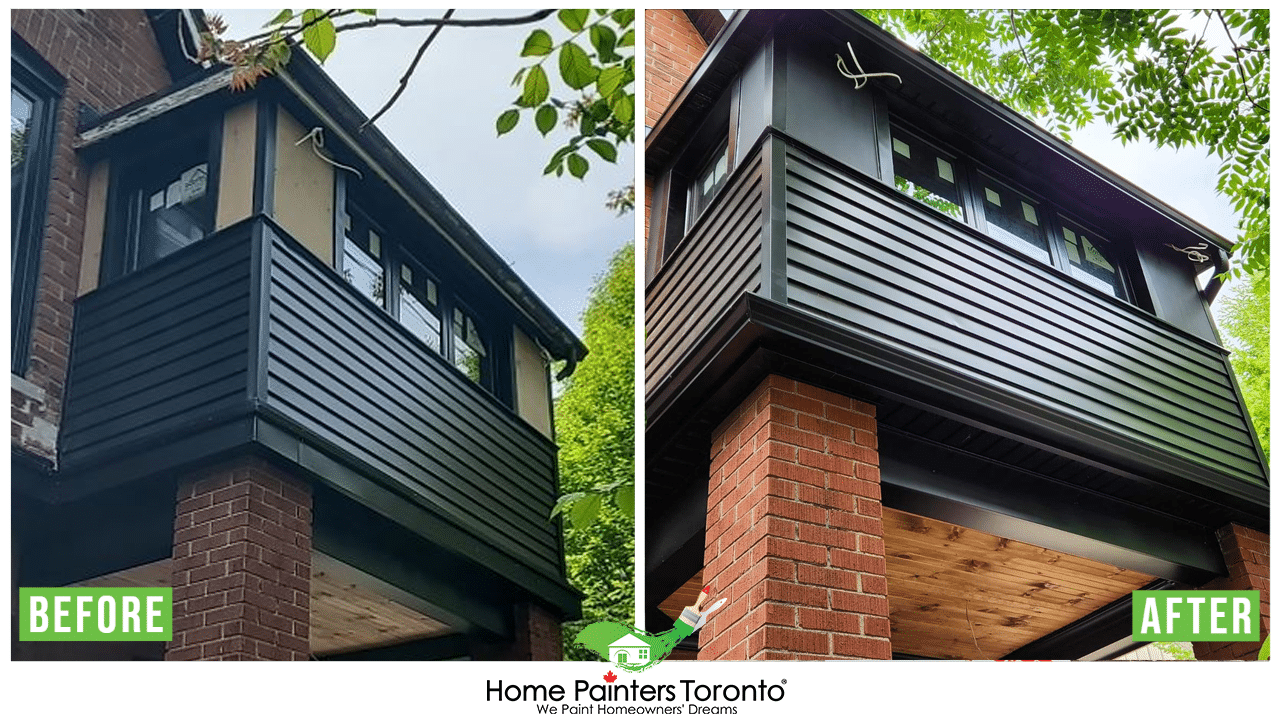
Done properly with thorough prep, quality products, and correct timing, a professional exterior repaint in Toronto protects surfaces for 7 to 12 years through every freeze-thaw season
Why Freeze-Thaw Paint Repair Is Not a DIY Weekend Project
Freeze-thaw paint repair is not a simple DIY project because long-term results depend on properly diagnosing moisture problems, repairing damaged substrates, and using products designed for Toronto's climate conditions. It requires assessing whether the underlying wood is sound, identifying all moisture entry points, selecting the right primer and topcoat for each surface material, applying caulk that remains flexible in cold temperatures, and timing the project correctly within Toronto's narrow exterior painting window.
Done properly, a professional exterior repaint with full prep can protect a home's surfaces for seven to twelve years. Done without the right prep or with the wrong products, results often fail in one to two seasons. North-facing walls and areas near downspouts and grade-level siding are typically the first to show it.
Home Painters Toronto has been completing exterior painting projects across Toronto and the GTA since 1987. Their team provides written estimates with clear scope, performs all prep and carpentry in-house, and backs exterior work with a 3-year warranty.
Frequently Asked Questions About Exterior Painting in Toronto
Peeling exterior paint in Toronto after a single winter is almost always a prep problem. If old, failing paint was not fully removed before repainting, moisture trapped between layers expands during freeze-thaw cycles and lifts the new coat. Skipped priming, uncaulked gaps, and paint applied in temperatures below the manufacturer's minimum all produce the same result. The paint fails not because of the product, but because the surface was not properly prepared.
Toronto experiences a significant number of freeze-thaw events each winter season, concentrated in November through March, with peaks typically in December and March. Research in Theoretical and Applied Climatology documents the bimodal seasonal pattern of freeze-thaw activity across multiple Toronto weather stations. Each event stresses exterior paint by forcing the substrate and coating to expand and contract repeatedly.
High-quality 100% acrylic latex exterior paint with high elongation properties performs best in Toronto's climate. These formulas flex with thermal movement rather than cracking under it. However, even the best paint will fail prematurely if prep work is inadequate. Product selection and surface preparation always work together. No premium product compensates for a surface that was not properly cleaned, scraped, primed, and sealed before application.
Late spring through early fall, typically from late May through September, provides the most reliable conditions for exterior painting in Toronto. Temperatures need to stay consistently above 10 degrees Celsius during application and for several days afterward while the paint cures. Painting too close to the frost season risks applying paint that never fully hardens, leaving it vulnerable to the first hard freeze.
The most common signs of freeze-thaw paint damage include peeling or flaking sections, visible hairline cracks following the wood grain or panel edges, and blistering along north-facing walls. Caulk that has pulled away from window frames or door frames is a strong indicator that water has been entering. A professional surface assessment can identify damage that is not yet visible to the eye.
Full-service exterior painting contractors in Toronto address rotted wood as part of the project scope when needed. At Home Painters Toronto, all necessary carpentry and wood repair work is completed before any new paint goes on. Painting over rotted or structurally compromised wood produces results that fail quickly and masks ongoing damage. Surface repair is not optional when it is present.

Exterior Painting in Toronto That Holds Up Through Every Winter
Exterior painting in Toronto is not just a colour decision. It is a structural investment that determines how well your home withstands freeze-thaw cycles, moisture infiltration, and the year-on-year wear that Southern Ontario winters deliver to every exposed surface. Paint that was properly prepped, applied in the right conditions, and backed with a warranty protects siding, trim, and wood for years.
Paint that skipped the prep fails by spring and leaves your siding exposed to the next season of freeze-thaw damage. If your exterior is showing cracks, peeling, or blistering after this past winter, the right time to act is before the next season of moisture exposure arrives. The longer the failing exterior painting sits untreated, the further water penetrates and the more expensive the repair becomes.
Get a Free Assessment Before the Next Freeze-Thaw Season
Contact Home Painters Toronto for a free quote and have a professional assess your exterior before the damage goes deeper. The team has protected Toronto homes since 1987 and backs every exterior project with a written 3-year warranty.
Get Your Free Quote Today