

Woodpecker Holes in Wood Siding: Professional Repair and Prevention
Woodpecker holes in wood siding are one of the most misread problems on a Toronto home. What looks like random bird damage on a cedar or pine wall usually indicates something happening beneath the surface, whether that is an old carpenter bee tunnel, a nesting cavity, or a section of wood softened by moisture. Homeowners across the GTA, from North York to Oakville, often spot a cluster of round holes near a roofline or a corner board and assume a quick patch will solve it. In most cases, the holes are a symptom, not the whole problem. This guide covers what causes woodpecker holes in wood siding, why filler alone rarely holds, and how our crew repairs the wood, treats the real cause, and reseals the wall so the damage does not return.
Woodpecker holes in wood siding need more than a filled cavity. A proper repair treats any insect activity behind the hole, consolidates or replaces the damaged wood, matches the profile, and reseals the surface with primer and paint rated for exterior wood. Left alone, holes let in moisture and invite more pecking.
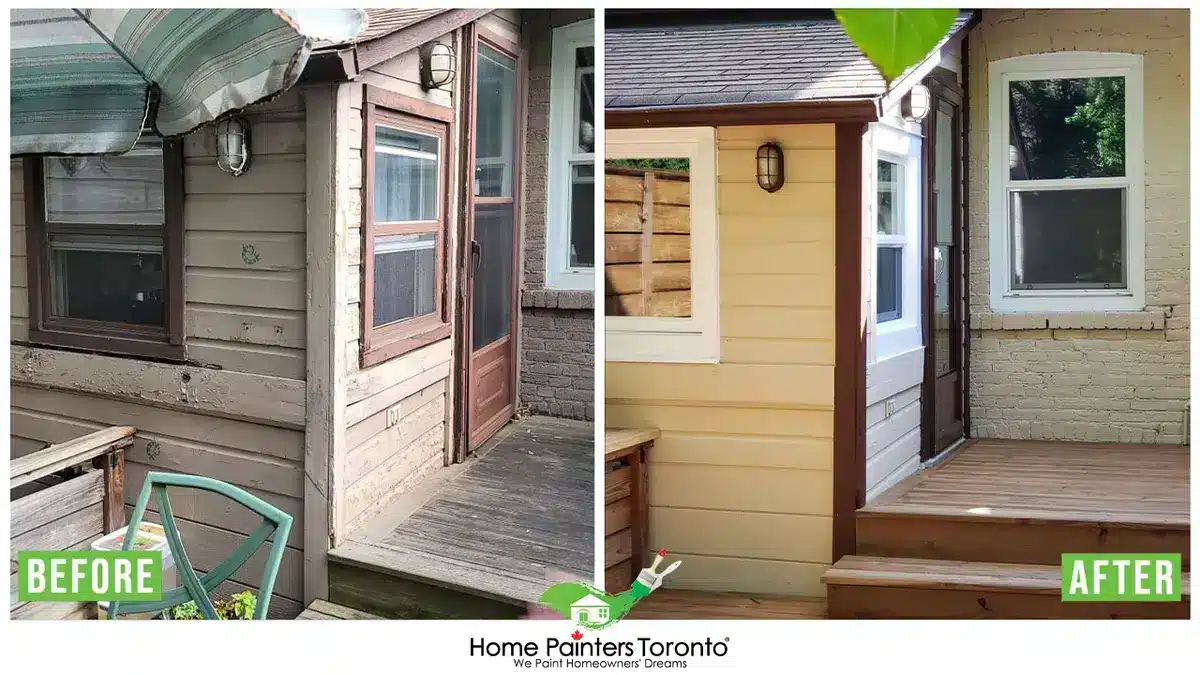
In most cases, the holes are a symptom, not the whole problem
What Woodpecker Holes Look Like on Wood Siding
Woodpecker holes in wood siding are round or oval, usually a quarter inch to two inches wide, and they often appear in a tight vertical row or a small cluster near a corner, soffit, or gable. Home Painters Toronto has documented this exact pattern across 17,000-plus completed GTA projects, backed by 1,200-plus reviews on HomeStars, Google, and Houzz, and a HomeStars Best of Award for 2026. Two distinct patterns matter for diagnosis. Territorial drumming leaves shallow, scattered marks on the loudest, most hollow-sounding part of the wall, often near flashing, gutters, or a resonant corner board. Foraging holes look different. They cluster tightly in a short section of one board, sometimes tunnelling sideways under the surface, because the bird is chasing insect larvae it can hear moving inside the wood. Cornell Lab of Ornithology's research on woodpecker behaviour breaks down both behaviours and how homeowners can tell them apart before calling in a repair crew.
Signs of Woodpecker Holes in Wood Siding
- Round or oval entrance holes with clean or splintered edges
- Fresh wood chips or sawdust collected at the base of the wall
- A hollow or papery sound when you tap the board near the holes
- Holes clustered near a corner, gable, or resonant flashing joint
- Old holes that reopen or spread wider each season
| Damage Type | Typical Appearance | Likely Cause |
|---|---|---|
| Woodpecker foraging holes | Tight cluster, round, may tunnel sideways | Insect larvae inside the wood |
| Woodpecker drumming marks | Shallow, scattered, on hollow or metal trim | Territory or mating display |
| Insect exit holes | Small, perfectly round, pinhead-sized | Wood boring beetles or carpenter ants |
| Wood rot cavity | Soft, spongy, crumbles under light pressure | Trapped moisture, fungal decay |
Why Woodpeckers Target Wood Siding in the GTA
Woodpeckers target wood siding for two reasons only: a resonant surface to drum on, or insects living inside the wood. Cedar and pine boards resonate well when there is an air gap behind them, which is common near roof lines, soffit returns, and older furring strips. That hollow sound carries further than solid brick or fibre cement, so a bird looking to announce territory in spring gravitates toward it. Drumming activity peaks in March and April across Southern Ontario, then tapers once breeding starts. Foraging is a separate driver. Carpenter bees bore round tunnels into unpainted or thinly painted wood to lay eggs, and carpenter ants move into wood that has already softened from moisture. A woodpecker can hear or sense that movement through the wall and starts digging toward it. Toronto's freeze-thaw cycle adds to the problem. Repeated expansion and contraction cracks old paint film, exposing raw wood grain that absorbs water each spring melt. That softened, unprotected wood is exactly what draws insects, and in turn, the birds that hunt them. If your exterior wood siding or wood trim has not been repainted in several years, it is more likely to attract both.

Softened, unprotected wood is exactly what draws insects, and in turn, the birds that hunt them
The Hidden Damage Behind Every Woodpecker Hole
A woodpecker hole rarely causes damage on its own. The real damage is whatever drew the bird there in the first place. Carpenter bee galleries often run three to six inches deeper into the board than the visible entrance hole, and a surface patch does nothing to reach them. Moisture pockets behave the same way. The wood around a hole can already be softened well beyond what you can see from the ground. Filling the opening without checking what is behind it just seals the problem inside the wall. That trapped moisture and any surviving insects keep working at the wood through the next winter, so the same section usually fails again within a year or two, sometimes with a wider hole in nearly the same spot once the bird or a new one returns to the same food source. This is why we treat every woodpecker hole in wood siding as a diagnostic clue first and a cosmetic fix second.
The species matter too. Downy and hairy woodpeckers cause most of the residential damage seen across Toronto and its ravine-adjacent neighbourhoods, since both forage on smaller branches and siding-sized surfaces. The much larger pileated woodpecker occasionally shows up near mature tree cover in areas like the Don Valley or High Park, and it leaves bigger, more ragged holes when it does. Regardless of species, the wood under an active hole is rarely as sound as the board around it, which is why an inspection always looks past the opening itself before any repair plan gets written up. Knowing the likely species also helps us judge whether the activity is a short seasonal spike or a pattern that will keep coming back to the same wall.
Our Professional Wood Siding Repair Process for Woodpecker Holes
Our repair process for woodpecker holes in wood siding follows five steps: inspection, insect treatment where needed, wood consolidation or replacement, profile matching, and a full primer and paint system. We start with a moisture reading and a close inspection of each hole, including a check for active larvae or fresh frass. If insects are present, we treat the section before closing anything up. Softened wood gets consolidated or cut out entirely, depending on how far the damage runs. The repaired area is then shaped to match the board profile, primed, and finished to blend with the surrounding wall.
Epoxy Consolidation and Cavity Repair
Small to moderate cavities get filled with a two-part epoxy wood consolidant, not standard carpenter's filler. The epoxy soaks into the surrounding grain first, then cures into a dense, paintable surface that will not shrink or crack the way lightweight fillers do. For more serious damage, we cut a clean patch, known as a Dutchman repair, and splice in new wood matched to the existing board thickness and profile. Once cured or installed, the area is sanded flush before priming. We also check and reseal nearby soffit and fascia returns and recaulk trim joints with professional caulking services so water cannot find a new path in through the repaired section.
| Repair Scope | What It Typically Involves | Estimated Cost (CAD + HST) |
|---|---|---|
| Isolated holes, single wall section | A few holes on one board or corner, spot consolidation and repaint | $2,000 – $4,000 |
| Extensive or repeat damage | Multiple boards, insect treatment, and a full wall repaint | $4,000 – $8,000 |
- At a recent wood siding repair project in Leaside, our crew found seven separate woodpecker holes across two courses of cedar clapboard on the south wall.
- A moisture reading at the deepest cavity came back at 19 percent, above the range most paint manufacturers consider safe for coating.
- We let the wall dry under a temporary cover for four days, treated an active carpenter bee gallery, then consolidated the softened wood with a two-part epoxy filler.
- Once cured and sanded flush, the wall was primed and finished with Benjamin Moore Aura Exterior in Low Lustre finish, applied at 6 to 10 mils wet film thickness per Benjamin Moore's Aura Exterior technical data sheet.
Every job like this is completed WSIB compliant and fully insured, with warranty-backed results on the finished wall.
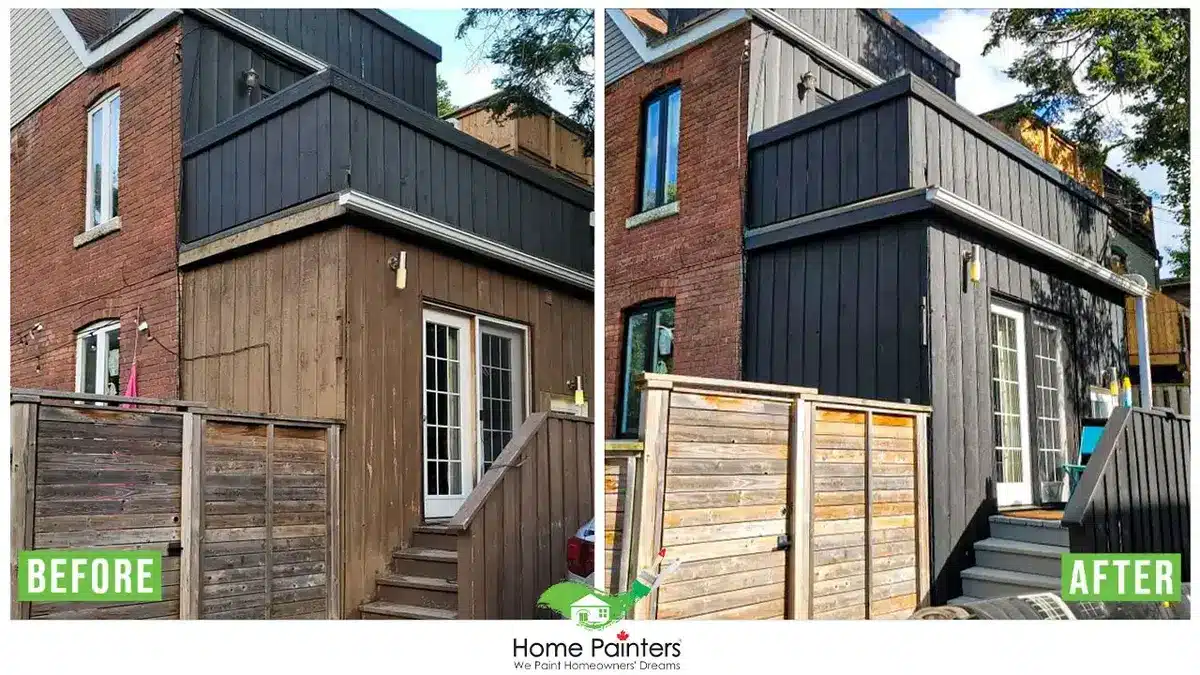
Once cured and sanded flush, the wall was primed and finished to blend with the rest of the elevation
Why Off the Shelf Wood Filler Repairs Fail Within a Year
Off-the-shelf wood filler fails on woodpecker holes for three technical reasons: poor bond to end grain, no flexibility for wood movement, and no answer for insects still living behind it. Most retail fillers are polyester or lightweight acrylic blends built for small nail holes, not open end grain cavities exposed to weather. They shrink slightly as they cure, which opens a hairline gap at the edge. Toronto's freeze-thaw cycle works that gap wider every winter until the patch pops loose. A filled hole also traps whatever insects or moisture were already inside, so the wood keeps failing from within even while the surface looks fixed. None of this shows up until the next paint job, when the patch cracks or the surrounding wood turns soft again.
Expected Longevity of a Professional Repair in Toronto's Climate
A professional woodpecker hole repair on wood siding, done with epoxy consolidation and a full paint system, typically lasts as long as the surrounding painted wall, which is why we back the work with our 3-year exterior warranty. Coating performance depends on getting the wood dry before painting. Most paint manufacturers, including Benjamin Moore, recommend the substrate sit at or below the moisture threshold outlined in Benjamin Moore's product data before the first coat goes on, and our crews confirm that with a meter on every job instead of judging it by eye. Repairs finished this way typically need only routine maintenance painting on the same cycle as the rest of the exterior. South and west facing walls in direct sun tend to need attention sooner than shaded north walls. We recommend a quick visual check each spring, right when drumming activity picks up, so a new hole gets treated while it is still small instead of turning into a larger consolidation or replacement job by fall.
Preventing Future Woodpecker Damage the Right Way
Preventing future woodpecker damage on wood siding comes down to two things: removing whatever attracted the bird, and making the spot a poor target while that happens. Woodpeckers are a protected species in Canada, so removal, trapping, or nest disturbance without authorization is not an option. The lawful approach is deterrence paired with repair. If insects are active, treat them first. If the wood is bare or thinly painted, get it primed and coated so it stops resonating and stops feeding anything living inside it.
Deterrents That Actually Work on Wood Siding
Reflective, moving deterrents outperform static ones. Cornell Lab of Ornithology's testing on woodpecker deterrents found that reflective mylar streamers eliminated damage completely at half of sixteen test homes, while plastic owls and distress call systems lost effectiveness once the birds got used to them. Bird netting also works when it is hung taut and kept at least three inches away from the wall so the bird cannot reach through it. Sticky repellent products should be avoided entirely, since they can trap and injure the bird instead of just discouraging it.
| Method | How It Works | Effectiveness |
|---|---|---|
| Reflective mylar streamers | Movement and glare startle the bird away from the surface | Serious, eliminated damage at half of tested sites |
| Taut bird netting | Physical barrier set off the wall | High if installed correctly |
| Plastic owl or hawk decoy | Visual predator deterrent | Low, birds adapt quickly |
| Distress call audio | Mimics alarm calls | Low, effect fades over weeks |
Frequently Asked Questions
Coverage depends on your policy and how the damage happened. Sudden, one-time damage is sometimes covered, while ongoing pecking or insect-related decay is usually treated as a maintenance issue and excluded. A documented, professional repair estimate gives you the paperwork an insurer will ask for either way.
Usually not. If insects or trapped moisture are behind the hole, sealing it without treating that cause typically means the same spot fails again within a season. A professional inspection identifies what is actually happening inside the wall before any hole gets closed.
The bird keeps returning because the reason it started has not changed. That is usually an insect food source still active inside the wood, or a resonant, hollow section of the wall that makes an ideal drumming spot for territory or mating calls.
Not always. Territorial drumming leaves shallow marks without any insects involved, especially in early spring. Repeated foraging holes concentrated in one small area, though, are a strong sign that carpenter bees, carpenter ants, or another wood-boring insect is active in that section.
Isolated damage on a single wall section generally falls in the $2,000 to $4,000 range, while extensive or repeat damage across multiple boards with insect treatment and a full repaint runs $4,000 to $8,000. A free, no-obligation quote gives you an exact number for your home, based on how many boards are affected and whether insect treatment is needed.
No. Woodpeckers are a protected species in Canada, and disturbing an active nest without authorization is not permitted. The right approach is to wait until the nest is inactive, then seal and repair the section properly so it does not attract another bird.

Get Your Wood Siding Repaired the Right Way
Woodpecker holes in wood siding are rarely just a bird problem. They usually point to insects, trapped moisture, or a wall that needs attention. Home Painters Toronto has repaired this exact issue across the GTA, from Leaside to Oakville, using consolidation, insect treatment, and a paint system built for our climate. Our estimators walk the affected wall in person, note every hole and any softened board, and put the full scope in writing before any work starts.
Contact Home Painters Toronto for a fast, free quote and warranty-backed work on your next wood siding repair.
Get a Free Estimate