

Crown Moulding or Trim?
Crown moulding is one of the most searched home improvement topics among Toronto homeowners, and for good reason. The right moulding profile transforms an ordinary room into something that feels finished, considered, and valuable. But the difference between crown moulding and general trim, which materials hold up best in Toronto homes, what installation and painting actually cost, and whether to DIY or hire a professional are questions that most guides skip over. This one covers all of it.
Here is what you need to know before you start:
- Crown moulding and trim serve different purposes and are not interchangeable
- Material choice matters more in Toronto than in milder climates due to seasonal expansion and contraction
- Installation and painting are separate jobs that require different skill sets
- The right profile size depends entirely on ceiling height, which varies widely across Toronto housing types
- Cost ranges from under $500 to over $5,000 depending on room size, profile complexity, and whether painting is included

Crown moulding transforms the wall-ceiling junction into an architectural feature; trim frames openings, covers edges, and ties a room together. Both require the right profile, material, and painted finish to last in Toronto's climate.
What is Crown Moulding?
Crown moulding is decorative trim installed where walls meet the ceiling to create a cleaner, more elegant transition between both surfaces. It softens sharp room edges, adds architectural detail, and gives the space a more finished, polished appearance.
Crown moulding comes in various materials, including wood, plaster, PVC, and polyurethane. Each of these materials adds a unique character to the room. Moreover, they offer several styles, ranging from traditional and ornate to craftsman and contemporary, allowing homeowners to choose the one that best suits their interior design.
What is Trim?
Unlike crown moulding which is specific to the wall-ceiling intersection, trim refers to the more general application of decorative moulding. Wall trim moulding can be used in numerous places. Including doorways, windows, along the baseboard, around fireplaces, and even chair rails. It serves both a functional and an aesthetic purpose, protecting the edges of these areas from damage while also adding an embellishing touch to a home.
Trim, like crown moulding, comes in a range of materials and styles, although wood and MDF (medium density fiberboard) are the most common materials.
What is the Difference Between Crown Moulding and Trim?
When it comes to home renovation projects, you will have most likely heard the terms moulding and trim quite interchangeably.
Now, you may be wondering, what is the difference between the two? Trim is a type of material used around openings like doors and windows or used in corners between walls and ceilings.
You can also apply trim in the middle of walls, like a chair rail or wainscoting. Molding, on the other hand, is a type of trim and is recognized through its enhanced profile. This is because molding is much more decorative than trim and enhanced in detail.
An example of molding is crown molding which is used at the intersection between walls and the ceiling to add visual appeal to your home. Overall, crown molding softens the transition between the wall and ceiling.
Here are some other key differences between the two:
- Application: As already discussed, crown moulding is used where the ceiling meets the wall, while the moulding trim is more universally applied around doors, windows, and baseboards.
- Detail and Complexity: Modern crown moulding typically has more detail and complexity than other types of trim and is often more ornate, reflecting a higher level of craftsmanship.
- Impact on the Room: While both elements enhance a room, crown moulding, being at a higher level, tends to draw the eye upwards, giving a sense of height and grandeur to a room. Trim around windows, doors, and baseboards, however, often goes unnoticed until inspected closely.
- Cost: Given its complexity and detailed design, crown moulding can be more expensive than other types of trim.
Crown Moulding vs Trim - Full Side-by-Side Comparison
Most homeowners know the two terms but are unclear on which one suits their project. Here is a complete head-to-head breakdown across every factor that matters for Toronto homes.
| Feature | Crown Moulding | General Trim |
|---|---|---|
| Where it goes | Wall-ceiling junction only | Doors, windows, baseboards, chair rails, wainscoting |
| Primary purpose | Decorative transition between wall and ceiling | Functional and decorative; covers gaps and edges |
| Profile complexity | High; curved, layered, detailed profiles | Ranges from simple flat casing to detailed ogee |
| Visual impact | Draws the eye upward; adds perceived height and grandeur | Subtle framing effect; noticed mostly when absent |
| Common materials | Wood, plaster, PVC, polyurethane, MDF | Wood, MDF, PVC, finger-jointed pine |
| Best ceiling height | Works best at 2.7m (9 ft) and higher | Suitable for any ceiling height |
| Difficulty to install | High; compound angle cuts required | Moderate; simple mitre cuts for most trim types |
| Paint sheen | Semi-gloss or gloss for crisp definition | Semi-gloss or gloss; same finish as doors and baseboards |
| Cost range (Toronto, per linear ft installed) | $8 to $20+ CAD | $4 to $12 CAD |
| DIY suitability | Moderate to difficult; compound mitre saw required | Beginner to moderate; basic mitre saw sufficient |
Trim Molding Types
Trim molding is in four main categories, depending on the installation. It could be openings, the floor, ceiling, or directly on the wall. Casing trim is placed around openings, such as doors and windows.
Baseboards are along the bottom of walls, while crown molding is installed at the top near the ceiling. All trim that is directly on walls and not at openings or corners are called wall trim. Whether it be crown trim or other types of trim, they will visually make your home appealing.
| Areas | Measuring Considerations |
|---|---|
| Window and Door Casing | Casing is used around openings like doors and windows mostly. It serves as a frame around openings to help cover gaps between walls, doors, and windows. For door openings, a casing is installed at the top and both sides of the opening. For window openings, casing is installed on all around the window. Typically speaking, the bottom of the opening has a stool and apron. |
| Baseboard Trim (Wall Base Molding) | Installed on the bottom of walls. Not only is it an accent to the wall, but can help hide imperfections between the flooring and the walls. In addition, it is usually installed at outside corners and coped at inside corners. |
| Ceiling Trim Molding (Crown Molding) | This is placed at the top of walls and provides helpful separation between wall and ceiling. Also, it will give your space elegance because it is such a detailed material. Crown molding comes in many profiles from simple to fancy. From a home renovation perspective, crown molding works best on rooms with high ceilings. If your room has a lower ceiling, you should install a simple profile with a narrow dimension, as it would be more effective. |
| Wall Trim Molding | This type of trim can be installed anywhere on walls, other than openings or at the corners of floors or ceilings. It is placed directly on walls, making it more aesthetically pleasing than functional. |
Crown Moulding Materials - Which is Best for Toronto Homes?
Toronto's climate creates a specific challenge for crown moulding that most guides written for milder regions do not address. The city experiences over 100 freeze-thaw cycles per year, and that thermal movement affects every material in the house, including moulding. A material that performs perfectly in a climate-controlled showroom may develop gaps, crack at joints, or lose adhesion in a Toronto home that goes from minus 20 in January to plus 30 in July. Here is how the main materials compare.
| Material | Appearance | Toronto Climate Performance | Best For | Cost (per linear ft, uninstalled) |
|---|---|---|---|---|
| Solid wood (pine, maple, oak) | Warm, natural grain; paintable or stainable | Good if properly primed and sealed; susceptible to humidity movement at joints | Heritage homes, high-end finishes, stainable applications | $3 to $8 CAD |
| MDF (medium density fiberboard) | Smooth, paint-ready surface; no grain | Good indoors in climate-controlled spaces; not suitable for high-humidity areas like bathrooms | Most interior rooms in Toronto homes; best value for painted finishes | $1.50 to $4 CAD |
| Polyurethane / PVC | Crisp profiles; looks like plaster | Excellent; does not expand, contract, crack, or rot; highly stable year-round | Bathrooms, kitchens, high-humidity areas; low-maintenance applications | $2 to $6 CAD |
| Plaster | Rich, heavy, historical profiles | Good if existing; difficult and expensive to repair or replicate | Heritage restoration in older Toronto homes (The Annex, Rosedale, Cabbagetown) | $10 to $25+ CAD (custom) |
| Finger-jointed pine | Paintable; lower cost | Similar to solid pine; joint lines may show under certain lighting without proper priming | Budget installs where a painted finish is planned | $1.50 to $3.50 CAD |
For Toronto homes built before the 1960s, particularly in neighbourhoods like Forest Hill, Moore Park, and Riverdale, plaster crown moulding is often original to the house. Matching or repairing original plaster profiles requires a specialist. Our interior carpentry and handyman service includes assessment and repair of existing moulding as part of any renovation project.
Profile width must be matched to ceiling height — the single most common sizing mistake is using wide, ornate crown on a low ceiling, which closes the room in rather than making it feel grander.
Choosing the Right Crown Moulding Profile for Your Toronto Home
Profile size should be matched to ceiling height. Getting this wrong is the single most common mistake homeowners make when selecting crown moulding in Toronto. Here is a practical guide by ceiling height and room type.
| Ceiling Height | Recommended Profile Width | Notes |
|---|---|---|
| 2.4m (8 ft) standard | 50 to 75mm (2 to 3 in) | Narrow profile only; wide crown on a low ceiling looks heavy and closes the room in |
| 2.7m (9 ft) | 75 to 100mm (3 to 4 in) | Most common in newer Toronto construction; medium profiles work well |
| 3.0m (10 ft) | 100 to 150mm (4 to 6 in) | Allows for more ornate or layered profiles; typical in Victorian semi-detached homes |
| 3.3m (11 ft) and above | 150mm+ (6 in+); layered build-up acceptable | High ceilings in Edwardian and heritage homes; multi-piece assemblies appropriate |
| Open-plan living areas | Match to the tallest ceiling height in the space | Consistent profile throughout the open space; transitions at doorways only |
Trim Paint
When it comes to interior trim paint, you should go for modern and sleek. For many homeowners, they opted to use a white trim paint. For example, this could be Decorator's White from Benjamin Moore or Oxford White CC-30. These white tones scream modern and sophistication. They are also the top choices for trims that are white, but not too stark. For a warmer tone of white, you can purchase the Cloud White CC-40. If you are more of a bright and bold person, you should go for Simply White OC-117 or Chantilly Lace OC-65. These paints could take up to 3 to 4 coats to really hone in on their brightness.
How to Paint Crown Moulding - What Toronto Homeowners Need to Know
Painting crown moulding is a different job from painting walls, and it requires a different approach to primer, sheen, and technique. Getting it wrong leaves visible brush marks, missed edges, and a finish that looks amateur even on a perfectly installed profile.
What Sheen Should You Use on Crown Moulding?
Semi-gloss is the standard recommendation for crown moulding and all interior trim in Toronto homes. It provides enough sheen to create visible definition at the ceiling line, is easy to wipe clean, and holds up to the scrubbing that trim inevitably receives near doorways and high-traffic areas. High-gloss is also acceptable on crown moulding and gives a crisper, more formal look, but highlights any imperfections in the profile or wall surface. Flat or eggshell sheens on trim and crown moulding are not recommended, as they scuff easily and lose definition at the wall-ceiling junction.
Do You Paint Crown Moulding the Same Colour as the Ceiling or the Walls?
The most common approach in Toronto homes is to paint crown moulding the same colour as the ceiling, typically white or off-white, which creates a clean transition and makes the ceiling feel higher. Painting the moulding the same colour as the walls is a bolder choice that makes the moulding recede rather than stand out, which can work well in rooms with lower ceilings. A third option is to paint the moulding a contrasting colour to both the wall and ceiling, which makes the profile itself a feature, most effective with wide, ornate profiles in rooms with high ceilings.
Primer and Paint Product Recommendations for Crown Moulding
For MDF and finger-jointed pine crown moulding, always prime with an oil-based or shellac primer before topcoating. MDF is highly absorbent and will raise the surface fibres with a water-based primer, leaving a rough finish even after sanding. For polyurethane and PVC profiles, use a bonding primer to ensure adhesion. For solid wood, a high-quality acrylic primer such as Benjamin Moore Fresh Start is appropriate. For the topcoat, Benjamin Moore Advance in a semi-gloss sheen is the product our team uses most frequently on trim and crown moulding in Toronto homes. It levels exceptionally well and leaves a hard, smooth finish. See our blog on top colours for interior trim and doors for more colour guidance.
Crown Moulding Installation and Painting Cost in Toronto - 2026 Guide
Cost is the most searched question about crown moulding in Toronto and the one most guides avoid answering directly. Here is an honest breakdown for 2026.
Crown Moulding Installation Cost (Toronto, 2026)
| Job Type | Typical Range (CAD) | Notes |
|---|---|---|
| Single room, standard MDF profile (avg 12x14 ft room) | $400 to $800 | Includes material and labour; painting not included |
| Single room, wide or ornate wood profile | $700 to $1,400 | Higher material cost; more complex mitre and coping cuts |
| Full home (5 to 7 rooms), standard profile | $2,500 to $5,000 | Volume pricing applies; consistent profile throughout |
| Heritage plaster restoration (per room) | $800 to $2,500+ | Matching original profiles; specialist skill required |
| Crown moulding plus baseboard package (per room) | $600 to $1,200 | Common combination; more efficient labour when done together |
Crown Moulding Painting Cost (Toronto, 2026)
| Job Type | Typical Range (CAD) | Notes |
|---|---|---|
| Crown moulding painting, single room (new install) | $150 to $350 | Includes priming and two coats; done after installation |
| Crown moulding painting, full home (5 to 7 rooms) | $600 to $1,400 | Best combined with full interior repaint for efficiency |
| Crown moulding plus all trim painting (per room) | $250 to $550 | Baseboards, casings, and crown painted together |
| Touch-up painting on existing moulding | $100 to $250 per room | Cleaning, light sanding, and one coat |
For a precise quote on crown moulding installation and painting for your Toronto home, see our crown moulding installation and repair service or contact us directly for a free in-person estimate. Also see our interior painting cost guide for broader pricing context.
Real Project - Crown Moulding Installation and Interior Repaint in Toronto
Leslieville Victorian Semi-Detached: Crown Moulding Installation and Full Interior Repaint
One of the best ways to understand what a professional crown moulding job actually involves is to look at a completed project. Here is a summary of a job our team completed in Toronto.
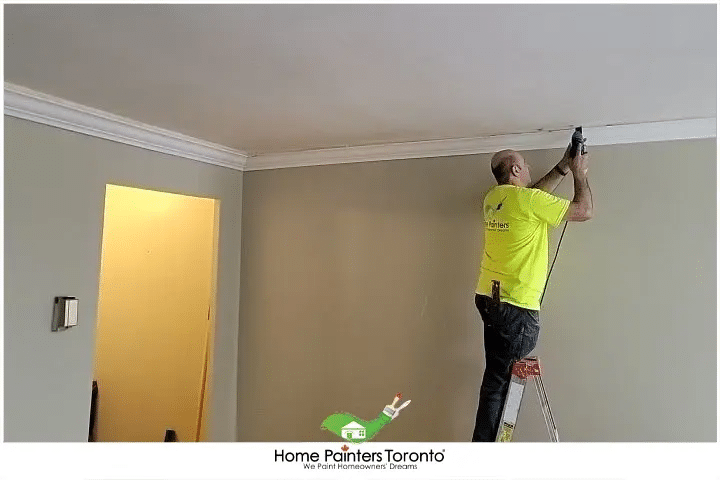
The situation: A homeowner in a Victorian semi-detached home in Leslieville contacted Home Painters Toronto to install crown moulding in the living room and dining room, and to repaint both spaces. The rooms had 3.0m (10 ft) ceilings, original plaster walls, and no existing crown moulding. The homeowner wanted a period-appropriate profile that would complement the existing Victorian character of the home without appearing modern or out of place.
What the job involved: Our team recommended a 120mm (4.75 in) colonial-style MDF crown moulding profile, which provided the proportional scale appropriate for 10 ft ceilings without the cost of custom plaster. All joints were coped rather than mitered at inside corners to allow for seasonal wood movement and provide a tighter long-term fit. The moulding was primed with an oil-based primer before installation, then caulked and painted with two coats of Benjamin Moore Advance in a semi-gloss finish, matched to the existing baseboard colour. The walls received two coats of Benjamin Moore Aura in a client-selected warm white.
The result: A finished living and dining room that the homeowner described as looking like it had always had crown moulding. For more completed projects like this one, visit our Toronto painting projects page.
Painting Your Stairs
Now that you have worked on your trims, you can possibly start working on your stairs. Stairway painting is not only important for the overall appeal of your home, but it maintains its value in your home. It is always good to get a jumpstart on painting your stairs when you know it is slowly getting worn out because it is a mode of transportation in your home. To add value to your home, you should consider stairway painting, as it will keep your home well maintained with a stunning decor. Quality stairs are important.
Final Thoughts
Picking between crown moulding and trim largely depends on the unique style you want for your space and the statement each piece makes in your room. Both features, each boasting distinctive functionality and aesthetic impacts, can enhance the beauty of your place in their own ways.
Knowing the difference, however, just gets you started. Implementing these enhancements requires expertise to ensure that your walls and corners not only look great but also stand the test of time, displaying the craftsmanship that went into your home's design.
That is where Home Painters Toronto comes in. With extensive experience, this professional team can take on any interior detailing project, saving you the time, energy, and potential missteps of a DIY project.
Frequently Asked Questions About Crown Moulding
Crown moulding sits at an angle between the wall and ceiling and usually features a curved or S-shaped profile with flat sections that rest against both surfaces. Cove moulding is a simpler concave curve that transitions straight from wall to ceiling. Crown moulding is more complex and ornate; cove moulding is a minimal, contemporary alternative suited to rooms with lower ceilings or modern interiors.
Match the profile width to your ceiling height. For standard 2.4m (8 ft) ceilings, use a profile no wider than 75mm (3 in). For 2.7m (9 ft) ceilings, 75 to 100mm works well. For 3.0m (10 ft) ceilings and above, 100 to 150mm or wider profiles are appropriate. Using wide, ornate crown on a low ceiling is the most common sizing mistake and makes rooms feel smaller rather than grander.
Yes, but it requires more care than in drywall construction. Plaster walls are harder than drywall and require pilot holes before nailing to avoid cracking. The plaster surface is also typically irregular, which means the moulding may need more caulking and filling at the wall line to produce a clean finish. For heritage homes with original plaster crown moulding that needs repair, a specialist who can match the original profile is essential.
In most Toronto homes, painting crown moulding the same colour as the ceiling (typically white or off-white) is the most widely used approach. It unifies the ceiling plane and creates visual height. Matching crown moulding to the walls makes it recede, which suits lower-ceilinged rooms. Contrasting crown moulding in a bold colour or dark tone is a design-forward choice that works well in rooms with high ceilings and ornate profiles.
Yes, particularly in the detached and semi-detached home market. Crown moulding is consistently listed among the finishing details that buyers notice and associate with quality construction and careful ownership. In Toronto's competitive resale market, professionally installed and painted crown moulding in key rooms such as the living room, dining room, and master bedroom contributes to a strong first impression. It is unlikely to add a specific dollar amount to a listing price, but it does contribute to the overall presentation quality that supports strong offers.
A single room typically takes four to eight hours for a professional installer, depending on room complexity, number of corners, and ceiling height. A full home installation across five to seven rooms typically takes two to three days. Painting the moulding adds one to two days depending on the number of coats required and whether the full interior is being repainted at the same time.
Yes, but preparation is the critical step. The moulding needs to be primed correctly for the material type (oil-based primer for MDF, bonding primer for PVC, acrylic primer for solid wood), caulked at both the wall and ceiling lines, and lightly sanded before any topcoat is applied. Skipping primer or caulking will result in a finish that looks unfinished and ages poorly. If you want the full walkthrough, see our guide on how to prepare walls for an interior painting job.
Yes. We offer crown moulding installation and repair as part of our interior carpentry and handyman service, and we regularly combine installation with interior painting on the same job. This is more cost-efficient than hiring two separate trades and ensures the moulding and walls are painted with a consistent product and finish. See our crown moulding installation and repair service for more details, or contact us at 416.494.9095 for a free quote.
More Interesting Blogs Related to Crown Moulding or Trim
Ready to Install or Paint Crown Moulding in Your Toronto Home?
Home Painters Toronto handles installation, repair, and painting of crown moulding and trim in the same project. Call 416-494-9095 or email [email protected] for a FREE quote.