

Toronto homeowners who compare painting quotes often get three different answers to one simple question about their home. How many coats of paint does a house need? One company promises a single coat, another lists two, and a third never mentions coats at all, so the quotes are impossible to line up. At Home Painters Toronto, our team of Toronto house painters has painted 20,000+ homes across Toronto and the GTA since 1991, and our 1,200+ positive reviews on HomeStars, Google, and Houzz come from homeowners who wanted that answer in writing. This guide covers what paint manufacturers specify, when primer counts as a coat, how to check film thickness, and what a professional quote should say before you sign anything.
Most houses need two coats of finish paint, plus a primer coat on bare wood, new drywall, stains, or dramatic colour changes. Benjamin Moore says one coat is sometimes achievable on sound, previously painted surfaces, but it recommends two for full colour and performance. A professional quote should state the coat count and primer for every surface.
How Many Coats of Paint Does a House Need? The Short Answer
A house needs two coats of finish paint in most cases, with a separate primer added wherever the surface is bare, stained, patched, or changing colour in a big way. That two-coat standard applies to interior walls, ceilings, trim, and most exterior siding. One coat can work on a sound surface repainted in the same colour, but it leaves very little margin for wear. A third coat shows up on deep colours and major colour shifts.
| Situation | Typical Coats | Why It Matters |
|---|---|---|
| Same colour, sound previously painted surface | 1 to 2 finish coats | Benjamin Moore allows one or two coats on previously painted surfaces |
| New colour of similar depth | 2 finish coats | Full colour development and even sheen |
| Bare substrate (new drywall, bare wood, patches) | 2 coats minimum, often primer plus 2 | Benjamin Moore calls for two coats on bare substrates |
| Dark to light colour change | Primer plus 2 finish coats | The old colour shadows through a thin film |
| Deep or bright custom colour | Tinted primer plus 2 to 3 coats | Some colours need a deep-base primer to reach true shade |
| Exterior siding and trim | 2 finish coats | Film thickness carries the weather protection |
Coat count also drives the price and the schedule. Each extra coat adds labour hours and paint volume, which is one reason two quotes for the same home can sit thousands of dollars apart. Our guide to the cost of painting a house covers full-home price ranges. The rest of this article explains what each coat actually does for the surface, so you can judge whether a quote has priced enough of them.
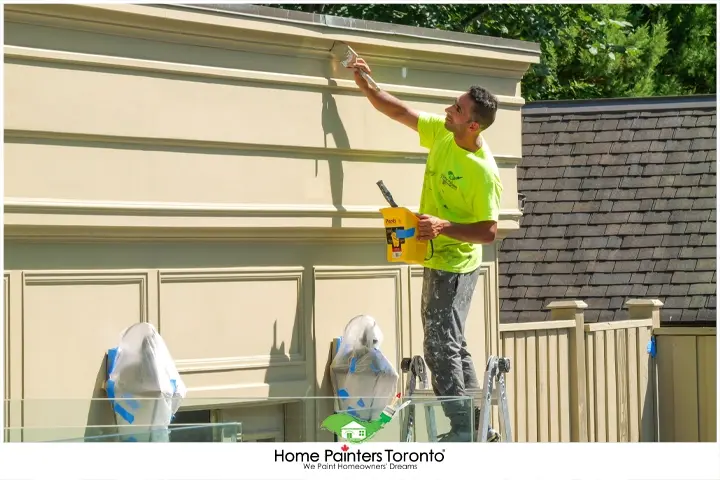
A second coat crosses and fills the thin spots a single pass leaves behind
One Coat vs Two Coats: What Paint Makers Actually Say
Paint makers say one coat is sometimes possible, but two coats are the recommended standard. Benjamin Moore recommends two coats for full colour development and performance, even on its paint and primer products. Its guidance calls for two coats on bare substrates and allows one or two on previously painted surfaces. A one-coat result under ideal conditions is not the same thing as a one-coat promise.
| Factor | One Coat | Two Coats |
|---|---|---|
| Colour depth | Can look thin or blotchy, especially on colour changes | Full, even colour |
| Dry film per job (Aura Exterior Low Lustre) | 2.1–2.9 mils | 4.2–5.8 mils |
| Hides the old colour | Only the same or a very similar colour | Most colour changes over a sound base |
| Roller gaps and pinholes | Often stay visible | Second pass crosses and fills them |
| Sheen over patched spots | Patches can flash shiny or dull | Uniform sheen across the wall |
| Best fit | Sound surface, same colour, low wear | Most repaints and every bare surface |
The film figures in that table come from Benjamin Moore's Aura Exterior Low Lustre data sheet, which lists 2.1 to 2.9 dry mils per coat. Two coats simply double that build. More film means more material between the siding and the weather. That is the practical case for two coats, and it has nothing to do with looks alone.
Rollers and brushes never lay paint perfectly even. Painters call the missed or thin spots holidays, and they are hard to see while the paint is wet. A second coat goes on in a crossing pattern, so it covers the holidays left by the first. On interior walls, it also evens out the sheen where patching compound soaked up more paint than the wall around it.
Does Primer Count as a Coat of Paint?
Primer does not count as a finish coat, because it seals and bonds the surface but does not provide the final colour, sheen, or weather resistance. A quote that says two coats should make clear whether that means primer plus one finish coat, or two finish coats over primer. Those are very different jobs. The first leaves a single layer of finish paint carrying all the wear.
Self-Priming Paint vs a Dedicated Primer Coat
Self-priming paint, often sold as paint and primer in one, replaces a separate primer only on properly prepared surfaces. Benjamin Moore's Aura Exterior data sheet says the product self-primes on most properly prepared wood, fibre cement, and cured masonry, yet it still requires two coats on bare substrates. In practice, the first coat does the priming job and the second coat is the true finish. Calling that a one-coat product misreads the label.
Some surfaces still need a dedicated primer no matter what the can says. The same data sheet calls for a specialty primer, such as Fresh Start Exterior Deck and Siding Primer, on bleeding woods like cedar and redwood. Tannins in those species can stain straight through a finish coat. We see this often on exterior wood siding, where cedar knots bleed brown spots through paint that skipped the primer step.
New drywall is the most common interior case. Fresh joint compound and paper facing absorb paint at different rates, so a single coat shows shiny and dull patches called flashing. A primer-sealer evens out that absorption before two finish coats go on. If your project includes drywall repair and installation, ask the painter to list primer on every patched area.
Benjamin Moore also lists water stains, smoke damage, grease stains, and very slick surfaces as cases for a special-purpose primer. Paint and primer in one will not lock those problems in. A finish coat over an untreated water stain often shows the stain again within weeks. The quote should name the stain-blocking primer and the areas it covers.
Dark-to-Light and Other Dramatic Colour Changes
A dramatic colour change usually needs a primer coat plus two finish coats, and deep or bright colours sometimes need a third. Light paint over a dark wall lets the old colour shadow through a thin film. Benjamin Moore notes that certain custom colours need a deep-base primer tinted to a special formula to reach the true shade. In our experience, saturated reds, yellows, and bold blues fall into that group most often.
On a dark-to-light interior job, the quote should name the primer and its tint. A grey-tinted primer under a mid-tone colour often removes the need for a third finish coat, which is a fair trade a good painter will explain up front. Skipping primer and hoping two coats will cover usually ends with a patchy wall. That third coat then shows up as an unplanned change order.
Going darker on the exterior raises a separate risk on vinyl. Benjamin Moore's Aura Exterior data sheet warns against painting vinyl siding darker than its original colour, or any colour with a light reflectance value (LRV) under 55, unless the colour is on the approved vinyl palette. Darker colours absorb more heat and can warp the panels. That rule limits colour choice before coat count even enters the conversation, and our vinyl siding painting crews check the LRV of every chosen colour before quoting.
Interior vs Exterior Coats: Why Exteriors Need More Film Build
Exterior paint depends on two full coats more than interior paint, because the dry film itself is what shields siding and trim from UV, rain, and Toronto's freeze-thaw cycles. An interior wall faces scuffs and cleaning. An exterior wall faces summer sun on the south side, wind-driven rain, and winter moisture. Thin spots are where peeling and chalking start.
Interior rooms usually get two coats as well, but the main reason is colour and sheen uniformity. A bedroom repainted in the same shade over sound paint can sometimes finish in one coat. Kitchens, bathrooms, and hallways take more cleaning, so a second coat adds scrub resistance where it counts. Our interior painting estimates list the coat count room by room for this reason.
How Many Coats of Exterior Paint a Toronto House Needs
A Toronto house exterior typically needs two coats of a premium acrylic, which builds about 4.2 to 5.8 dry mils with a product like Aura Exterior Low Lustre. That figure comes from doubling the 2.1 to 2.9 dry mils per coat listed on Benjamin Moore's Aura Exterior Low Lustre technical data sheet. One coat leaves about half that protection on the wall. South- and west-facing elevations take the most sun, so they wear through a thin film first.
The same data sheet allows a high-build, one-coat spray application at 6 to 10 wet mils, but only over substrates already in good condition. Coverage at that thickness drops to 160 to 265 square feet per gallon, compared with 250 to 350 square feet for a standard coat. In plain terms, a true one-coat exterior uses nearly as much paint as two normal coats. A quote that promises one coat at normal paint volume is really promising a thin film.
Wet Mils vs Dry Mils: How a Coat Is Measured
Wet mils measure paint thickness the moment it goes on, while dry mils measure what stays after the water evaporates. Aura Exterior Low Lustre lists 4.6 to 6.4 wet mils per coat, which dries down to 2.1 to 2.9 mils, according to Benjamin Moore. Professional crews check wet film with a notched gauge as they work. A reading below that range means the coat is too thin, even if the colour already looks covered.
Paint volume is the easiest way for a homeowner to check a coat count. At the data sheet's 250 to 350 square feet per gallon, 2,000 square feet of siding needs about 6 to 8 gallons per coat. Two coats call for roughly 12 to 16 gallons. If a quote budgets half that amount, it has priced one coat, whatever the wording says.
One-Coat Quotes: The Hidden Risk in a Low Bid
A one-coat quote is risky because it cuts labour on painting day but leaves a thinner film that wears out sooner. Labour is the biggest part of most painting jobs, so dropping a coat is the fastest way to lower a bid. The trouble is that a single coat often looks fine on the day the crew leaves. The difference shows up after a few winters, when the thin areas fade, chalk, or peel first.
| Quote Wording | What It Often Means | What to Ask |
|---|---|---|
| One-coat coverage | A single finish coat at standard spread rate | What wet mil target and how many gallons? |
| Paint and primer in one | Primer step skipped on bare or stained areas | Which surfaces get a dedicated primer? |
| Two coats, no detail | Primer may be counted as a coat | Is that primer plus two finish coats? |
| Touch-ups as needed | Spot work, not full coats | Which surfaces get full coats? |
| No product named | Contractor-grade paint with lower solids | Which brand, product line, and sheen? |
Volume solids explain why product names matter. This number shows how much of each gallon stays on the wall as dry film. Aura Exterior Low Lustre lists 45.5% volume solids on its data sheet, and a lower-solids paint leaves less film per coat at the same wet thickness. A cheap two-coat job and a premium two-coat job are not the same thing.
More coats are not always better, either. Stacking fresh paint on a weathered exterior without prep only adds weight to a film that is already losing grip. Benjamin Moore's surface preparation instructions require surfaces free of chalk and loose or scaling paint before application. New coats bond only as well as the layer underneath, so scraping, sanding, and spot priming come first.
What a Professional Painting Quote Should Say About Coats
A professional painting quote should state the number of finish coats, the primer, the product line and sheen, and the surfaces each one covers, all in writing. Vague wording is where most coat disputes begin. The table below shows each line a solid quote includes and the warning sign to watch for. Use it side by side with every estimate you collect.
| Quote Line | What It Should Say | Red Flag |
|---|---|---|
| Finish coats | Two coats for each surface listed | No coat count anywhere |
| Primer | Primer name, plus full or spot coverage by area | Paint and primer in one as the only primer |
| Product and sheen | For example, Benjamin Moore Aura Exterior, Low Lustre | Premium paint, with no brand |
| Surfaces | Walls, ceilings, trim, doors, siding, soffits listed | One lump-sum line |
| Prep | Scraping, sanding, caulking, spot priming | Light prep |
| Colour change | Tinted primer or extra coat noted | Silent on the colour change |
| Warranty | Written term for each service | Verbal promise only |
Ask these questions at the estimate visit, before any deposit changes hands:
- How many finish coats will each surface get?
- Is primer a separate coat, and on which areas?
- What wet mil thickness do your crews target per coat?
- How many gallons have you budgeted for the job?
- Who checks coverage before the final walkthrough?
Written detail protects you after signing, too. Consumer Protection Ontario states that a final renovation price cannot exceed a written estimate in your contract by more than 10% unless you agree to added work. A coat count written into that estimate makes it clear what the price covers. Our breakdown of home painting pricing methods shows how coats fit into per-room, per-square-foot, and flat-rate quotes.
House Painting Coats FAQs
One coat is enough only on a sound, previously painted surface getting the same or a very similar colour. Benjamin Moore allows one or two coats in that case but still recommends two for full colour and performance. On bare wood, new drywall, patches, or any real colour change, one coat falls short.
You may get away with one coat in the same colour if the old paint is clean, intact, and not faded. Most Toronto exteriors have faded or chalked by the time they need repainting, which makes two coats the safer choice. Indoors, a second coat evens out the sheen over touched-up spots.
New drywall needs a primer-sealer plus two finish coats in most cases. The primer evens out absorption between joint compound and paper facing, so the finish does not flash. Benjamin Moore calls for two coats on bare substrates even when the paint is self-priming.
A dark house going lighter usually needs one primer coat plus two finish coats. A tinted primer blocks the old colour so the finish coats show their true shade. Without that primer, a third finish coat is often needed to stop the dark colour from shadowing through.
Better paint covers more evenly per coat, but it does not change the two-coat standard on most surfaces. Higher volume solids leave more dry film per coat, which improves protection. Benjamin Moore still recommends two coats for its premium paint and primer products.
A third coat is sometimes needed for deep or bright colours, big colour changes, or very porous surfaces like rough stucco. Benjamin Moore notes that some custom colours need a tinted deep-base primer to reach the right shade. A good quote flags this risk before the job starts, not after the second coat goes on.
How Many Coats Should Your House Painting Quote Include?
Your house painting quote should include two finish coats on most surfaces, plus a named primer wherever the surface is bare, stained, patched, or changing colour. One coat fits only sound, same-colour repaints, and a third coat belongs in the quote if the colour change calls for it. The product, sheen, and surfaces should sit on the page beside the coat count. If any of those are missing, ask before you sign.
Home Painters Toronto is a family-run company that has served Toronto and the GTA since 1991, and we have been rated the #1 painting contractor on HomeStars nine times. We are WSIB-compliant and fully insured with $5 million in general liability coverage, and every crew member passes a criminal background check. Our work is warranty-backed, with a lifetime warranty on interior painting and a 3-year warranty on exterior painting. Read what past clients say in our client reviews, or learn why homeowners choose Home Painters Toronto.

Ready to compare quotes on equal terms? We offer fast, free quotes and warranty-backed work, with every coat, primer, and product written down before we start.
Get A Free Quote Today!