

Most Toronto homeowners who search house painting vs siding have faded, chalky or peeling cladding and a replacement quote that feels too high. The right choice depends on what sits under the surface, not on which option looks newer or which contractor called back first. Sound panels and solid boards can be cleaned, repaired, primed and coated in days through our house painting in Toronto service. Rot, warped panels and wet sheathing point to replacement, because no coating can fix a wall assembly that already holds water. Home Painters Toronto has painted 20,000+ homes across Toronto and the GTA since 1991, and our crews bring that field experience, plus 1,200+ positive reviews on HomeStars, Google and Houzz, to every exterior assessment.
Repaint when your siding is structurally sound: panels sit flat, boards are solid and the wall behind is dry. Replace when rot, warping or moisture has reached the sheathing. In Toronto, a vinyl or aluminum repaint typically runs $1,500 to $12,000 plus HST, while full siding replacement usually runs $12,000 to $30,000 plus HST.
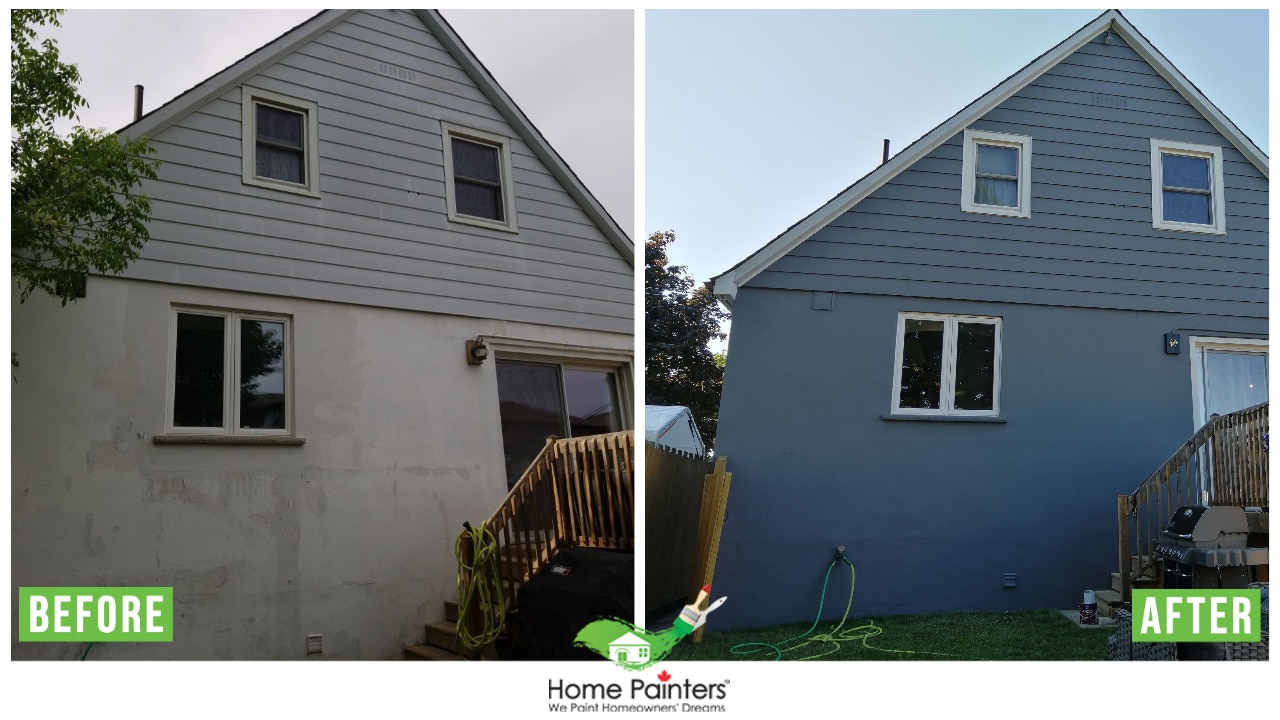
Sound siding with a failed finish is usually a repaint, not a replacement
House Painting vs Siding: The Short Answer
House painting is the right choice when the siding is sound, and siding replacement is the right choice when the cladding or the wall behind it has failed. Condition decides the answer, not preference and not age alone. An older aluminum wall with a chalky finish is often a strong repaint candidate. A much newer wood wall with soft lower boards may not be.
Key Takeaways for Toronto and GTA Homes
- Sound siding with a failed finish calls for a repaint. Chalking, fading and light peeling are coating problems.
- Failed siding or a wet wall calls for replacement. Rot, warped panels and soft sheathing are substrate problems.
- Our field rule of thumb: localized damage on less than about 20 percent of one wall is usually a repair, followed by paint.
- Our exterior house painting carries a 3-year warranty, and every quote starts with an on-site look at the wall.
| Condition you see | Paint | Replace |
|---|---|---|
| Faded or chalky finish, panels flat and tight | Yes | No |
| Peeling paint on solid, dry wood | Yes, after scraping, sanding and priming | No |
| One or two dented or cracked panels | Yes, after a panel swap | No |
| Soft or rotted boards across a wall | No | Yes, the boards or the full wall |
| Warped or buckled vinyl panels | No | Yes, the affected panels at minimum |
| Stains, bulging or damp sheathing behind the cladding | No | Yes, once the moisture source is fixed |
The two paths also differ in disruption. A repaint keeps the existing cladding on the wall, and the building envelope closed. Replacement means tear-off, disposal and an open wall assembly for part of the job. That difference matters most in the shoulder seasons, when rain can arrive mid-project.
Cost Comparison: Repainting vs Replacing Siding in Toronto
Repainting vinyl or aluminum siding in Toronto typically costs $1,500 to $12,000 CAD plus HST, while full siding replacement typically costs $12,000 to $30,000 CAD plus HST. Both ranges come from Home Painters Toronto's published pricing. They shift with home size, storey count, access and surface condition. Treat them as typical ranges, not as a fixed quote for your home.
| Job size | Vinyl siding repaint (CAD + HST) | Aluminum siding repaint (CAD + HST) |
|---|---|---|
| Small | $1,500–$3,000 | $1,500–$3,000 |
| Medium | $3,000–$6,000 | $3,000–$6,000 |
| Large | $5,000–$8,000 | $5,000–$8,000 |
| XL | $8,000–$12,000 | $8,000–$12,000 |
Wood and stucco exteriors follow our standard exterior ranges, because they need more scraping, sanding, patching and priming. Small homes sit near the low end, and large two-storey homes sit near the top. The second table sets each option side by side.
| Option | Typical range (CAD + HST) | What the price covers |
|---|---|---|
| Vinyl or aluminum siding repaint | $1,500–$12,000 | Washing, substrate preparation and finish coats |
| Wood or stucco exterior repaint, small to large home | $2,000–$10,000 | Scraping, sanding, spot priming and finish coats |
| Board or panel section repair before paint | $150–$1,500 | One board swap or one wall section |
| Full siding replacement | $12,000–$30,000 | Tear-off, disposal and new cladding |
Our guide to siding replacement cost in Toronto breaks the replacement range down by material and job size. For paint-only budgets, our cost of painting a house page covers full exterior pricing. The gap between the two options is widest on sound vinyl and aluminum. It narrows on wood, where hidden rot can add carpentry to either path.
Substrate condition is the line a replacement quote cannot price in advance. Once old panels come off, a crew may find soft sheathing or a torn moisture barrier. That work gets added after the contract is signed. A repaint quote carries a similar risk only where rot is already visible.
Disruption and Demolition Waste: Costs Not Shown on a Quote
A repaint keeps the existing cladding in service, so there is no tear-off and very little to haul away. Replacement fills a bin with old panels, trim, fasteners and underlayment that someone must sort and dispose of. It also leaves the sheathing exposed until new cladding goes on. Ask any replacement contractor how the open wall will be protected overnight.
Timelines differ as well. Home Painters Toronto's published schedules put a small to medium siding repaint at 1 to 2 business days. Medium to large jobs take 2 to 4 business days, and large to XL jobs take 5 to 7. Replacement adds demolition, inspection and installation stages on top of any finishing work.
Lifespan: How Long Paint and New Siding Each Last
A siding repaint is a maintenance cycle measured in years, while new siding is a capital replacement measured in decades. Home Painters Toronto backs exterior painting with a 3-year warranty. Our siding care guidance calls for recoating painted or stained wood every 3 to 5 years. Painted aluminum and vinyl usually go longer between coats, because those substrates do not absorb water the way wood does.
| Option | Documented term | Source |
|---|---|---|
| Exterior repaint by Home Painters Toronto | 3-year warranty | Home Painters Toronto warranty terms |
| Painted or stained wood siding | Recoat every 3 to 5 years | Home Painters Toronto siding care guidance |
| Existing vinyl and aluminum panels | About 20 to 40 years of service life | Home Painters Toronto siding cost guide |
| New vinyl siding | Lifetime limited, non-prorated, transferable warranty with fade and hail coverage | Gentek Canada product warranty |
A long siding warranty is not a promise about the wall behind it. Gentek's warranty literature excludes damage caused by faulty or improper installation. Flashing, housewrap laps and fastening still decide how long a new wall performs. A lifetime label on the panel does not cover a leak at the window head.
The same logic applies to paint. Benjamin Moore describes Aura Exterior as a vapour-permeable coating, which helps limit blistering and peeling. Film build matters too. The technical data sheet for Aura Exterior Low Lustre lists a recommended wet film of 4.6 to 6.4 mils. A coat applied below that mil thickness wears through early, whatever the label says.
Lifespan numbers also hide the cost of timing. Paint that is renewed while the old film is still intact needs light preparation. Paint that is left until it peels needs scraping, sanding and full priming of bare areas. Staying on the recoat cycle is the cheapest way to keep siding off the replacement list.
Material by Material: Vinyl, Aluminum, Wood and Stucco
Aluminum and stucco are usually the strongest repaint candidates, vinyl can be repainted within colour limits, and wood depends almost entirely on moisture and rot. Each cladding fails in its own way, so each has its own test for paint versus replacement. The table summarizes how we sort them on site.
| Material | Repaint when | Replace when | Coating note |
|---|---|---|---|
| Vinyl | Panels are flat, locked and not brittle | Panels are warped, cracked or popping loose | Stay no darker than the original colour unless a vinyl-safe colour is used (Sherwin-Williams) |
| Aluminum | Finish is chalky or faded but panels are intact | Seams are corroded or dents are widespread | Remove all chalk before any coating goes on |
| Wood | Boards are solid and read 15% moisture or less (Master Painters Institute) | Rot spans several boards or reaches the sheathing | Prime every bare face before finish coats |
| Stucco or parging | Cracks are hairline and the surface is still bonded | Sections are bulging, hollow or crumbling | Repair and cure first, then coat at 12% moisture or less (Master Painters Institute) |
Vinyl Siding Painting and the Dark Colour Heat Limit
Vinyl siding painting works only when the new colour does not overheat the panel. Sherwin-Williams warns that repainting vinyl darker than its original colour can cause warping or buckling. A darker coating soaks up more solar heat and passes it into the panel. The vinyl then swells past the point where it can shrink back, and it stays distorted.
Sherwin-Williams lists 100 VinylSafe colour options formulated to resist that failure on sound, stable vinyl. Outside a vinyl-safe palette, the working rule is a shade no darker than the factory colour. The same guidance advises against oil-based coatings on vinyl, because they lack flexibility. Our vinyl siding painting crews confirm the colour limit before any quote is finalized.
Aluminum Siding Repaint and Chalk Removal
An aluminum siding repaint succeeds or fails on chalk removal. Older aluminum develops a chalky, faded surface as the factory coating breaks down under UV exposure. Paint applied over that powder bonds to the chalk, not to the metal. It then releases in sheets.
We wash the wall, rinse it and run a wipe test before any primer or finish coat goes on. Dented panels get straightened, filled or swapped first. Aluminum panels interlock, so a single damaged section can usually come out without disturbing the wall. Our aluminum siding painting page shows finished examples and colour options.
Wood Siding and Stucco: Repair First, Then Coat
Wood siding and stucco both need repair before paint, because a coating cannot restore a damaged substrate. On exterior wood siding, we probe the bottom edges and joints, where trapped moisture softens boards first. Soft boards come out through our wood siding replacement and repair service. New wood gets primed on every bare face before it goes back on the wall.
On exterior stucco siding, hairline cracks are routine, and an elastomeric coating can bridge them. Bulging or crumbling patches are different, because they signal water trapped behind the surface. Those areas need stucco repair and parging and full cure time before any finish goes on. Coating over a hollow patch only hides the failure for a season.
Why Paint Fails When Moisture Sits Behind the Cladding
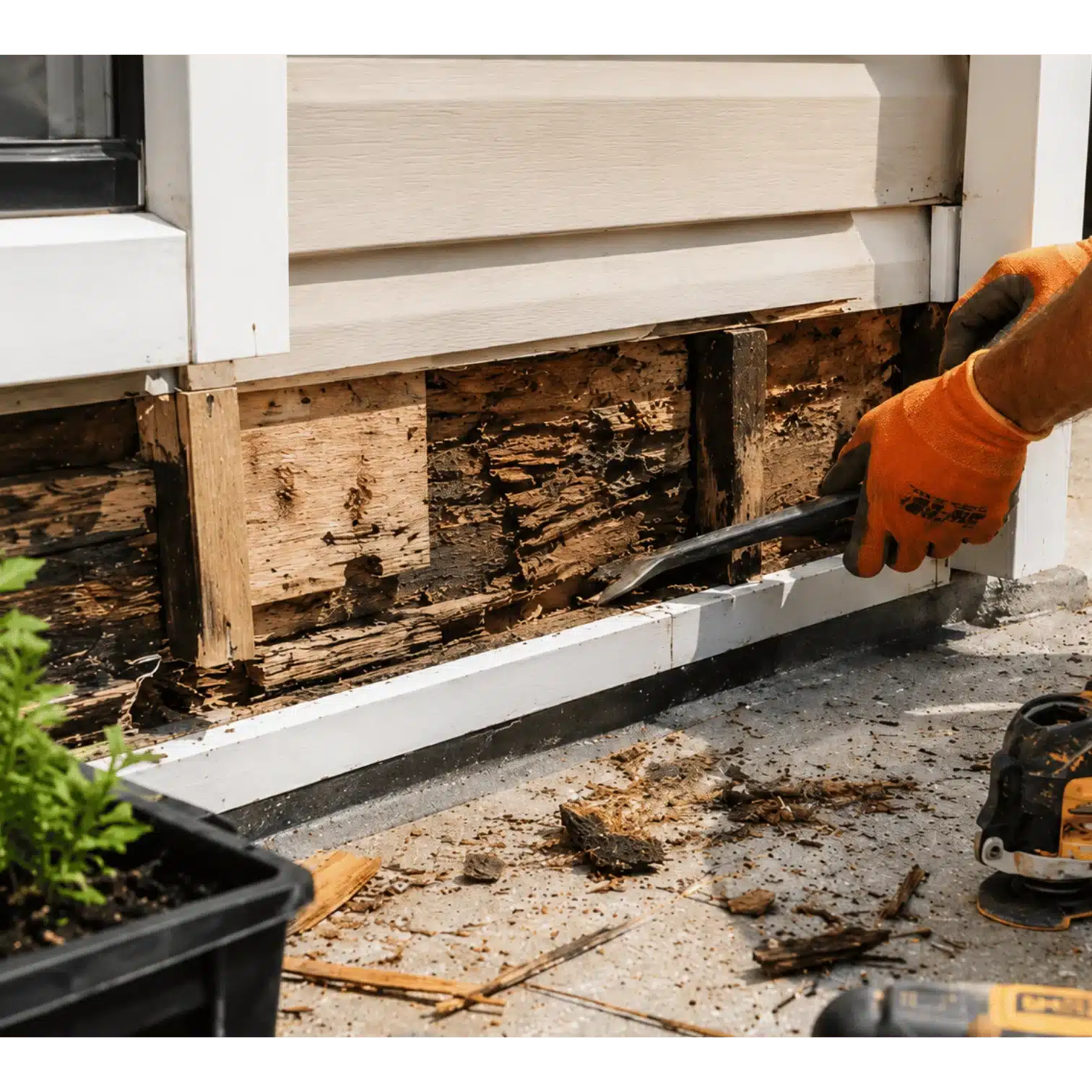
Paint fails on wet siding because moisture pushing out from behind the film breaks the bond between the coating and the substrate. Peeling that returns to the same spot every year is a symptom, not the disease. Many owners blame the paint brand and pay for a third coat. The real cause is usually water entering the wall from above or beside the failed area.
| Moisture source | What happens to the finish | Fix before coating |
|---|---|---|
| Failed caulking at windows and doors | Peeling starts at trim joints and spreads outward | Remove old sealant and recaulk |
| Missing or damaged flashing | Staining and blistering below the opening | Repair the flashing before any coating |
| Overflowing eavestroughs | Paint fails along the top courses and soffit line | Clear and re-slope the eavestrough |
| Cracked or lifted panels | Water enters behind the cladding with every storm | Replace the panels and check the sheathing |
The Master Painters Institute sets clear limits for substrate moisture. Exterior wood should hold no more than 15% moisture before painting, and stucco should read 12% or less. We check suspect areas with a pin-type moisture meter before we quote a repaint. Readings above those limits mean the wall dries first, or the job changes scope.
Toronto's climate raises the stakes. The Climate Atlas of Canada tracks freeze-thaw cycles as a standard climate variable, and the GTA sees them through the shoulder seasons. Water that enters a gap in autumn freezes, expands and widens that gap by spring. A coating applied over that cycle fails from behind, however good the product is.
This is where repainting and replacing overlap. A wall with one wet corner can often be opened, dried, repaired and repainted. A wall that reads wet across several sections usually needs the cladding off, so the sheathing and moisture barrier can be inspected. Fresh exterior caulking around windows and doors then closes the most common entry points.
Signs It's Time to Replace Instead of Repaint
Replace siding instead of repainting when rot spans several boards, panels are warped or brittle, the same spot keeps failing, or the sheathing underneath is soft. Each of those signs points to a substrate problem that a coating cannot solve. The table matches what you can see from the ground to its likely cause.
| Sign | What it usually means | Best next step |
|---|---|---|
| Soft boards when pressed or probed | Rot has moved past the surface | Replace the boards, then check the sheathing |
| Warped or buckled vinyl panels | Heat distortion or failed fastening | Replace the panels, since paint will not flatten them |
| Panels that crack under light pressure | Vinyl has gone brittle with age and UV | Plan replacement of that elevation |
| Peeling that returns in the same spot | An unresolved moisture source | Find the leak before any coating |
| Bulging or hollow stucco | Trapped water has broken the bond | Remove and rebuild the section |
| Damage across more than about 20 percent of one wall | Past our usual repair threshold | Price a full-wall replacement |
Our field rule of thumb sets the line at about 20 percent of one wall. Localized damage below that mark is usually a job for siding repair in Toronto, followed by primer and paint. Widespread rot, several failed panels or repeat failure in one spot point toward replacement. Our article on when siding replacement makes more sense than repair walks through the borderline cases.
Photos often understate how far damage runs under the surface. An in-person check with a probe and a moisture meter is the only reliable test. We will tell you plainly if a repaint will not hold up. A coating sold over a failing wall helps nobody, including the painter who has to warranty it.
A Lesson From a Recent Aluminum Siding Repaint in East York
A recent aluminum siding repaint in East York taught a simple lesson: test the wall before pricing its replacement. The owners of a two-storey semi expected to replace cladding that proved sound enough to coat. Their original factory-finished aluminum had gone pale and powdery on the south elevation. We found two dented panels near the driveway and no corrosion at the seams.
A wipe test left heavy chalk on the cloth, which told us the factory coating had weathered while the metal stayed intact. We checked the wood fascia next, since it was the only substrate on that wall able to hold water. Our pin-type moisture meter read 11%, under the 15% ceiling the Master Painters Institute sets for exterior wood. We swapped the two dented panels, washed and rinsed the wall, and let it dry fu lly.
We sprayed Benjamin Moore Aura Exterior in Low Lustre and checked the film with a wet film gauge as we worked. It read 5 mils, inside the 4.6 to 6.4 mil range on the product's technical data sheet. The shaded north wall measured 9 °C that morning, and Benjamin Moore lists an application range of 1.7 to 37.7 °C for this paint. We still waited for the surface to climb clear of the dew point, since a damp panel matters as much as a cold one.
The job closed in three working days with the cladding left in place. Our crew was WSIB compliant and fully insured, and the owners received the 3-year exterior warranty in writing. That mix of measurement and paperwork is what we mean by warranty-backed results. You can read similar accounts in our verified client reviews.
How the CRA Treats Painting vs New Siding for Landlords
The Canada Revenue Agency generally treats exterior repainting of a rental property as a current expense and new siding as a capital expense. CRA Guide T4036, Rental Income, uses this exact pairing as its example. It explains that repainting a wooden house's exterior counts as a current expense. Putting vinyl siding on that same house counts as a capital expense, because it gives a lasting benefit.
| Work on a rental property | CRA category | How it is deducted |
|---|---|---|
| Repainting the existing exterior | Current expense | In full, in the year it is incurred |
| Repairing boards or panels back to original condition | Usually a current expense | In full, in the year it is incurred |
| Installing new vinyl siding on a wooden house | Capital expense | Over several years through capital cost allowance |
The timing changes the after-tax cost of each quote. A landlord deducts a current expense from rental income in the year it is incurred. A capital expense is claimed gradually through capital cost allowance. Two quotes with similar totals can therefore land very differently on a tax return.
This treatment applies to rental properties, not to a principal residence. The guide also notes that repairs made to ready a property for sale can count as capital. Treat this section as general information and not as tax advice. An accountant should confirm how the rules apply to your building.
House Painting vs Siding FAQs
Painting is cheaper whenever the existing siding is sound. Home Painters Toronto's published ranges put a vinyl or aluminum repaint at $1,500 to $12,000 plus HST and full replacement at $12,000 to $30,000 plus HST. The comparison only holds when the wall is dry and the panels are intact. Paint over rot is money spent twice.
Yes, vinyl siding can be painted when the panels are flat, locked and not brittle. Sherwin-Williams advises staying no darker than the original colour unless a vinyl-safe colour is used, because darker coatings can overheat and warp the panel. An acrylic topcoat is the standard choice, and oil-based coatings are not recommended on vinyl. Warped panels must be replaced first, since paint will not flatten them.
Painted siding runs on a recoat cycle of years, while new siding is expected to serve for decades. Our siding care guidance calls for recoating wood every 3 to 5 years, and our exterior painting carries a 3-year warranty. Our siding cost guide puts vinyl and aluminum panel service life at about 20 to 40 years. Preparation, film build and moisture control decide where a given wall lands.
No fixed figure favours either option, because buyers and home inspectors respond to the condition of the wall. A dry, intact and evenly coated exterior reads as maintained. New cladding installed over an unresolved leak can still be flagged in an inspection report. Spend on whichever option leaves the wall assembly sound, then keep the warranty paperwork for the buyer.
Yes, aluminum siding is one of the best repaint candidates when the panels are intact. The usual complaint is a chalky, faded finish, which is a coating problem and not a metal problem. Full chalk removal and a quality acrylic system matter more than the colour chosen. Replacement makes sense only where seams have corroded or dents cover much of a wall.
Storm-damaged siding usually needs panel replacement first and paint second. Cracked or lifted panels let wind-driven rain reach the sheathing, so the opening should be closed quickly. Insurers often cover sudden wind, hail or impact damage but rarely cover age-related wear, so confirm coverage with your provider. We supply a written estimate that you can pass to an adjuster.
Choosing Between House Painting and Siding Replacement
Choose house painting when the cladding is sound and only the finish has failed, and choose siding replacement when the substrate or the wall behind it has failed. A short on-site assessment settles most cases. We check panel flatness, probe wood, read moisture and look at flashing and caulking. Then we tell you plainly which path will hold up.
Many GTA homes land in the middle. A few boards or panels get replaced, the moisture source gets fixed, and the rest of the wall gets a full coating system. That hybrid often delivers the service life owners wanted from replacement at a fraction of the scope. It also keeps sound material out of the waste bin.

Home Painters Toronto offers fast, free quotes and warranty-backed work on every exterior, from a single wall to a full repaint. Tell us what you see on your siding, and we will bring the moisture meter.
Get Your Free Estimate