


Painting ladders are among the most critical and most misused pieces of equipment in any professional painting crew's toolkit, and the ladder decision made before any exterior painting project begins determines both the safety of the crew working at height and the quality of the finish they produce on the surface being painted. Home Painters Toronto, the HomeStars Best of Award 2026 winner with over 1,200 positive reviews and 37 years serving the GTA, uses ladders on interior and exterior residential and commercial painting projects every day. A ladder is a simple tool, but it can be a powerful one. At Home Painters Toronto, work is performed on everything from baseboards to ceilings, both interior and exterior, on commercial and residential properties throughout Toronto. Thousands of people end up in emergency rooms due to ladder related injuries each year, which is why understanding ladders properly matters whether one is a professional painter or a homeowner overseeing a project.

A correctly sized ladder positioned at the proper 4:1 angle gives a painter a stable working position that produces consistent brush pressure across the full stroke, a direct link between ladder choice and finish quality.
Painting Ladders for Professional Painters: Why the Right Ladder Is a Safety and Quality Decision, Not Just Equipment
The connection between ladder selection and paint finish quality is one that most homeowners do not expect. A painter working from an undersized extension ladder who cannot reach the full soffits and fascia of a two storey Toronto home without overreaching will produce an inconsistent finish at the top of their reach, where the brush or roller is extended beyond the stable working position. The same painter on a correctly sized ladder with a stable working position at the correct height applies paint with consistent pressure across the full stroke, producing a uniform finish. According to Ontario's Occupational Health and Safety Act, employers are required to ensure that workers use appropriate equipment for working at height, and that the equipment is maintained in good condition. This is not only a legal requirement but a direct determinant of work quality on every elevation that requires ladder access.
The safety and quality decisions around ladders are inseparable on any Toronto exterior painting project. A ladder that is too short forces overreaching. A ladder that is set at the wrong angle is unstable and moves during application. A ladder that is placed on uneven ground on one of Toronto's Victorian residential lots creates lateral flex that a painter can feel through the rungs and that affects the smoothness of every brush stroke made from it.
How do you paint high places on a ladder?
At Home Painters Toronto, work covers everything from baseboards to ceilings, both interior and exterior, and commercial and residential properties.
Oftentimes, our work calls for using a ladder, which many people can find daunting.
In fact, thousands of people end up in the ER due to ladder related injuries each year.
Some of this advice may seem like common sense, but you'd be surprised at how many people forget or overlook these simple guidelines.
Whether it's a 4, 6, or 8' ladder, the safety parameters remain the same. Follow these top ladder safety tips on every painting project.
Top Ladder Safety Tips
- When opening a ladder, ensure that the two hinged metal braces (called spreaders) are fully locked down and straight.
- Never set up a ladder on uneven ground. All four feet of the ladder must be firmly planted.
- Use the 4:1 rule: for every 4 feet of the ladder, it should be 1 foot away from the wall. This prevents the ladder from tipping over.
- Never climb up the backside of the ladder: only and always the front. Always face the ladder when ascending and descending.
- Pay attention to load capacity. The ladder holds the weight of the person and whatever they are carrying.
- Regardless of the ladder height, stay off of the top two rungs.
- Never sit on a rung of the ladder.
- Avoid overreaching. A good general rule of thumb is to keep hips within the vertical rails of the ladder.
- Keep hands free with a tool belt. Much better than hanging tools from the ladder.
Types of Ladders Professional Painters Use in Toronto
Painting Ladders Professional Painters Use: Why Extension Ladder Length and Duty Rating Both Matter
Extension ladders are the most commonly used ladder on Toronto residential exterior painting projects. A Type IA extension ladder with a 300 pound duty rating is the professional standard for exterior residential painting because it safely supports the painter, a full paint bucket, and a roller tray simultaneously without flexing at the rails. A lighter duty Type II or Type III extension ladder at the same height will feel stable until a load is added, at which point the rail flex becomes perceptible and affects brush control.
Ladder length selection for a Toronto exterior project follows the rule that the working height should be no higher than 4 rungs from the top of the ladder. A standard two storey Toronto Victorian home with 9 foot ceilings and an exterior wall height of approximately 20 feet requires a 24 foot extension ladder positioned at the correct 4:1 angle. A 20 foot extension ladder on that same home forces the painter to work from the top rungs, which is both unsafe and produces an unstable working position for fine work at soffits and fascia.
| Ladder Type | Typical Use in Painting | Height Range | Notes |
|---|---|---|---|
| Extension ladder (Type IA, 300 lb rating) | Exterior walls, soffits, fascia, eaves on two and three storey Toronto homes | Up to 40 feet extended | Must follow 4:1 placement rule; do not work from top 4 rungs |
| Step ladder (Type I or IA) | Interior high wall access, ceilings in confined rooms, stairwell cutting in | 4 to 12 feet | Use fully opened with spreaders locked; never lean against a wall in A frame use |
| Platform ladder | Stable working platform for sustained interior or exterior painting at fixed height | 4 to 8 feet | Wide standing area improves brush control on flat section trim and fascia; preferred over step ladder for sustained finish work |
| Articulating (multi position) ladder | Stairwells, angled ceilings, uneven ground on Toronto Victorian lots | Configurable to multiple heights | Converts between step, extension, and scaffold configurations; invaluable on uneven terrain |
| Pump jack scaffold system | Two and three storey exterior repaints on large Toronto heritage homes | Up to 30 plus feet working height | Requires fall protection per Ontario OHSA; two workers to set up and dismantle safely |
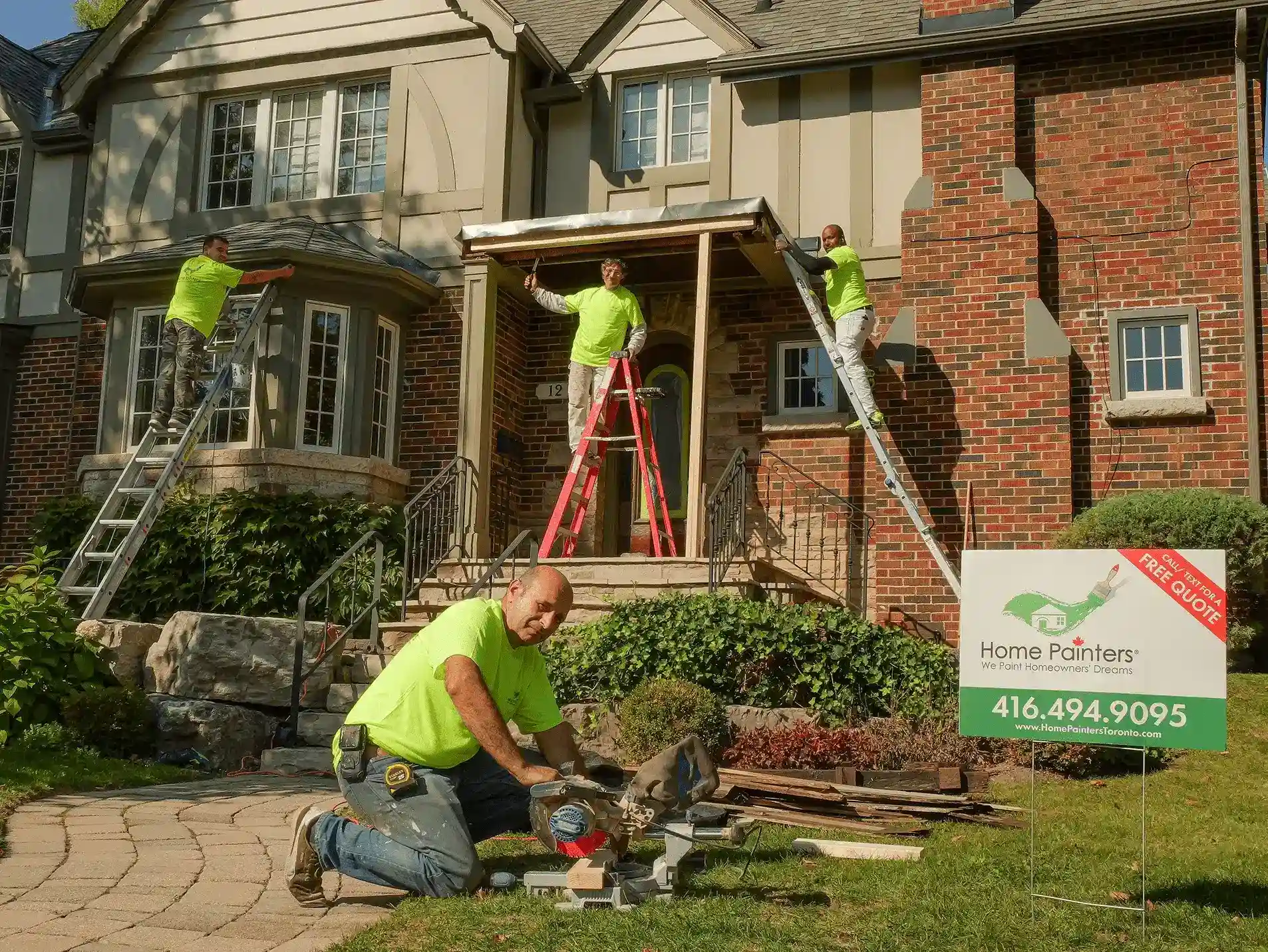
Types of ladders for painting
There are three main types of ladders for painting: extension, step, and scaffold
- Extension Ladders — are the most common and are used for reaching high places. They extend from 4 to 20 feet long depending on the type of job. Extension ladders are the best ladder for exterior painting because they are lightweight and portable and can be extended to the appropriate height for the work required. Extension ladders are also great for painting high walls inside a home because they do not take up much space and allow access to hard to-reach spots.
- Step Ladders — have steps instead of rungs and are best for working in confined spaces like under a sink or between cabinets. Step ladders are designed to get painters up very high and are a good choice for reaching the eaves of a house or roof.
- Scaffold Ladders — are made of lightweight tubing and are used to access hard to-reach places. They are also the best choice for working with power tools or large pieces of equipment that require more than one person to move them. Scaffold ladders are used in construction sites where multiple people will be working at once.
Bonus Tip:
Extension ladders: with great heights comes great responsibility and a greater chance of injury.
Ladder Safety Requirements for Painting Contractors in Toronto: What the Law Requires
Ontario OHSA Ladder Safety Requirements for Painting Contractors
Ontario's Occupational Health and Safety Act requires that workers performing tasks at a height of 3 metres (approximately 10 feet) or more above the ground or a working level must be protected by fall protection equipment. For painting contractors working on exterior Toronto homes, this threshold is reached at approximately the second floor sill height on a standard two storey Victorian semidetached. At this height, Ontario regulations require either guardrails, personal fall protection (harness and anchor), or scaffolding. A painting contractor who does not carry working at-heights certification and fall protection equipment for all crew working above 3 metres is in violation of the OHSA and places both the workers and the homeowner at legal risk.
Every Home Painters Toronto crew member working at height carries working at-heights certification per Ontario OHSA requirements. Our company is WSIB compliant and carries $5 million in general liability insurance. The WSIB clearance certificate confirming current compliance is provided to all residential and commercial clients before work begins.
Why Ladder Choice Affects Paint Quality on Toronto Homes
When a Platform Ladder Produces a Better Finish Than an Extension Ladder
Extension ladders are the correct tool for reaching height on exterior Toronto homes. Platform ladders are the correct tool for sustained finish work at a fixed height on flat surfaces like fascia boards, soffit sections, window trim bands, and interior high wall sections. The distinction matters because platform ladders have a wide, flat standing surface that allows the painter to maintain a stable two footed stance while making horizontal brush strokes across the full width of a fascia board without repositioning. On an extension ladder, the same section requires the painter to move the ladder laterally two or three times to complete the same run, introducing slight variation in the working position and pressure at each repositioning.
For sustained interior work at ceiling height, a platform ladder or scaffold plank bridging two step ladders provides the stable, level working position that produces consistent rolling on ceiling sections. A painter applying ceiling paint from an extension ladder in an interior room is working at an awkward angle that makes consistent roller pressure across a full 12 inch roller difficult to maintain throughout the stroke.
These equipment choices are part of what justifies the professional cost of exterior residential painting and interior residential painting services. The right ladder for the specific surface and height produces a more consistent finish than an improvised setup, and the difference is visible in the cured paint film.
When Scaffolding Is Required Instead of Ladders for Toronto Painting Projects
Scaffolding is required on Toronto painting projects in two situations: when the working height exceeds 3 metres and continuous working at-heights fall protection cannot be achieved with a ladder, and when the scope of work requires sustained access to a large surface area that would require the ladder to be repositioned every few minutes on an extension ladder.
The most common scaffolding scope on Toronto residential painting projects is the full exterior repaint of a two and a half or three storey heritage home, where the peak of the gable or the soffit at the roofline is beyond safe extension ladder access. Pump jack scaffolding systems, which use vertical poles and adjustable brackets to create a continuous working platform at a fixed height, are the professional solution for these projects. The pump jack system allows the painter to move along the full elevation at a consistent height without repositioning a ladder for every metre of progress, producing more consistent lap marks and uniform coverage on large uninterrupted wall sections.
For Toronto homeowners, the presence of scaffolding on a professional exterior painting project is a positive indicator of correct equipment selection, not a cost inflating addition. A contractor who proposes to paint a three storey Toronto home without scaffolding is working at unsafe heights with inadequate equipment. For our full exterior painting service including all equipment and safety protocols, see our exterior residential painting service.
What to Ask a Painting Contractor About Their Ladder and Height Safety Equipment in Toronto
Before signing a contract for any Toronto exterior painting project involving work above the first floor window line, the following questions establish whether the contractor has the correct equipment and credentials for safe work at height.
- Do all crew members working above 3 metres carry working at-heights certification per Ontario OHSA requirements?
- Does the company carry a current WSIB clearance certificate, available on request before work begins?
- What is the duty rating of the extension ladders being used, and is it sufficient for the painter, equipment, and paint load?
- Does the scope include scaffolding or pump jack systems for any elevation where the working height exceeds safe extension ladder access?
- Is the company's general liability insurance current and at a minimum of $2 million for residential projects?
Home Painters Toronto meets all five of these requirements on every project. For information about Home Painters Toronto including credentials and warranty terms, see our About page. For completed project examples, see our Toronto painting projects page.
Frequently Asked Questions About Ladders and Professional Painting in Toronto
Professional painters use Type IA extension ladders with a 300 pound duty rating for exterior work on Toronto homes. The heavy duty rating accommodates the painter, a full bucket, and a roller tray simultaneously without rail flex. For two and a half and three storey Toronto heritage homes, pump jack scaffolding systems are used in addition to extension ladders to maintain safe working at-heights fall protection per Ontario OHSA requirements.
The 4:1 rule states that for every 4 feet of height the ladder reaches, the base should be placed 1 foot away from the wall. A 20 foot extension ladder placed against a wall should have its base approximately 5 feet from the wall. This angle prevents the ladder from tipping backward and distributes the load correctly across the ladder's structure.
Ontario's Occupational Health and Safety Act requires fall protection for workers at heights of 3 metres (approximately 10 feet) or more. For exterior painting on Toronto homes, this threshold is reached at approximately the second floor sill height on a standard two storey home. At this height, the contractor must provide guardrails, personal fall protection harness and anchor, or scaffolding. Painting contractors who do not have working at-heights certified crew for work above 3 metres are not compliant with the Ontario OHSA.
Yes, on projects where the working height exceeds safe extension ladder access. Full exterior repaints of two and a half and three storey Toronto heritage homes typically require pump jack scaffolding systems for the upper elevation work. All scaffolding work is performed by working at-heights certified crew under Ontario OHSA requirements.
Confirm working at-heights certification for all crew working above 3 metres, a current WSIB clearance certificate, minimum $2 million in general liability insurance, and that the equipment plan includes appropriate ladders or scaffolding for the specific height of the project. Home Painters Toronto provides all of these credentials in writing before work begins.
More Interesting Blogs Related to "How Do I Get That High? A Beginner's Guide to Ladders"
Ready for a Safe, High Quality Exterior Repaint?
Home Painters Toronto is the HomeStars Best of Award 2026 winner with working at-heights certified crew and 37 years serving the GTA. Call 416-494-9095 or email [email protected] for a FREE same-day estimate.