

Partial house painting is one of the most common requests we hear from Toronto homeowners who need only one area refreshed. The south-facing front may have faded, the trim may be peeling, or two bedrooms may need new colour before a baby arrives. As a house painting company in Toronto, we have painted 20,000+ homes across the GTA since 1991 and earned the HomeStars Best of Award 2026. Our 1,200+ positive reviews on HomeStars, Google and Houzz include plenty of small, targeted jobs, from single bedrooms to trim-only exteriors. Some partial jobs blend in perfectly, while others leave a visible line between new and old paint, so this guide shows which is which, what drives the price, and how to phase a repaint properly.
Yes, you can paint just part of a house. Interior rooms, ceilings and trim paint well on their own. Partial exterior painting is trickier because unpainted walls have faded, so fresh paint can stand out at corners. Partial jobs also cost more per square foot, so many homeowners bundle several small areas into one visit.
Partial House Painting: What's Possible and What Isn't
Partial house painting is possible on almost any surface, but the result depends on the existing paint's age and the stopping point. Interior rooms are the safest partial job because each room has natural edges at its corners and ceiling. Exteriors carry more risk, since sun and weather age each side of a house at a different rate. Trim, doors and porch details fall in between and usually blend well.
| Partial Option | Works Well? | Watch-Out |
|---|---|---|
| One or two interior rooms | Yes | Match the sheen and paint each wall corner to corner |
| Ceilings only | Yes | Old ceilings may look yellow beside fresh white |
| Interior trim and doors only | Yes | Oil-based trim needs sanding and a bonding primer |
| Single accent wall | Yes | Nearby walls may look dull beside the new colour |
| Exterior trim only | Usually | The new trim colour must still suit the siding |
| Front door or garage door only | Yes | Pick a colour that works with faded siding |
| Front elevation only | Sometimes | Side walls may look faded where they meet the front |
| One side of the house | Risky | Outside corners often show a fade line |
The table shows a clear pattern. Partial work succeeds when it ends at a natural break. It struggles when new and old paint meet on one flat surface. Our exterior painting and interior painting crews plan every stopping point before the first coat goes on. That one planning step decides whether a small job looks intentional or unfinished.
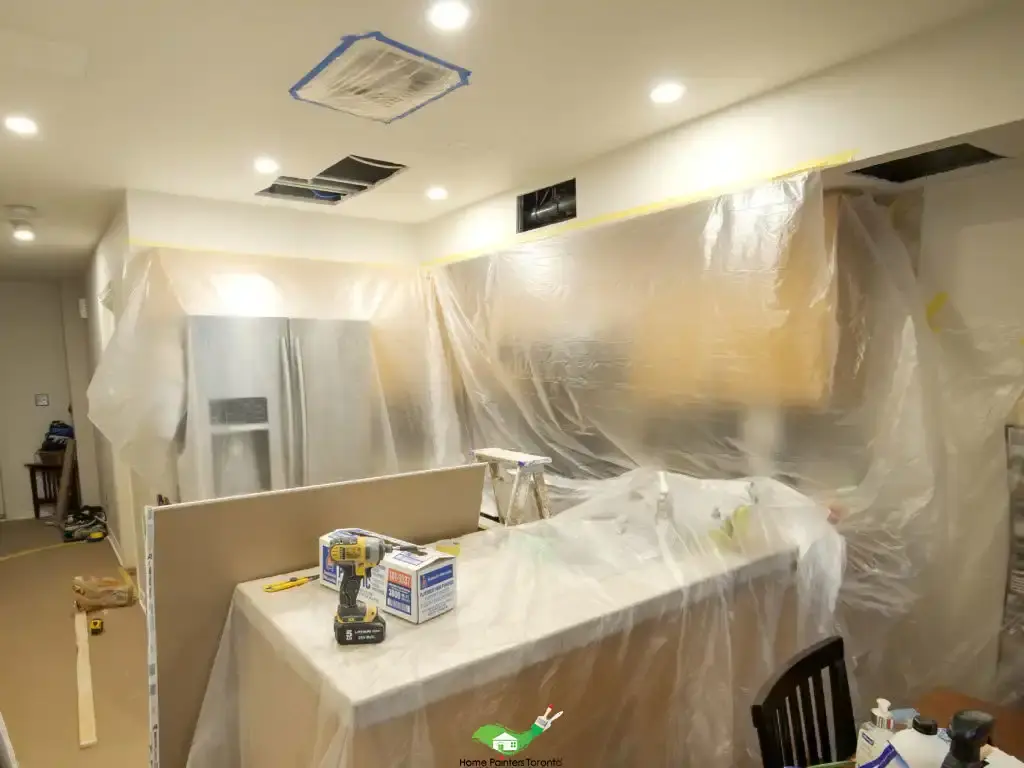
Interior Partial Painting: Rooms, Ceilings, Trim and Accent Walls
Interior partial painting works well for single rooms, ceilings, trim and accent walls, as long as each area ends at a corner or trim line. Indoor walls get far less sunlight than siding does. The colour gap between old and new paint indoors is usually small. The bigger risk inside is sheen. A fresh eggshell wall can catch light differently from an older eggshell wall next to it.
Ceilings are one of the most popular stand-alone jobs. Older white ceilings often yellow from cooking, smoke or age. A fresh coat makes the whole room look cleaner without touching the walls at all. Kitchens and basements in older Toronto homes show this yellowing most clearly.
Trim and doors are another common choice. Many older Toronto homes still have oil-based paint on baseboards, casings and doors. A waterborne finish will not bond to glossy oil paint without scuff sanding and a bonding primer. A painter who skips that step leaves trim that chips the first time a vacuum bumps it.
Accent walls are the easiest partial job of all. A new colour on one wall is supposed to look different, so nobody expects it to blend. The other walls in the room still matter, though. If they are scuffed or dull, the fresh accent wall can make them look tired by comparison.
Small wall damage often surfaces during partial work. Nail holes and minor dents fill easily. Settlement cracks and water stains need proper drywall repair first, or the patch will telegraph through the new finish. For a quick ballpark on one or two rooms, our interior painting calculator uses the same room-based logic as our estimates.
Why Painters Finish Corner to Corner on Partial Interior Work
Professional crews paint a full wall from corner to corner, because a patch in the middle of a wall almost always shows. Touched-up areas reflect light differently from the film around them, an effect painters call flashing. Benjamin Moore's touch-up guidance notes that flatter finishes touch up more easily than glossy ones. It also suggests repainting the whole wall when a touch-up may not blend. That is why a partial interior quote should list whole walls, not spots.
Exterior Partial Painting: Front Only, One Side or Trim Only
Exterior partial painting works best on trim, doors and clearly edged features, and worst on one side where new siding paint meets old. The reason is weathering. Every exterior coating fades over time, and it fades faster on walls that face the sun. In Toronto, a south-facing front can look noticeably lighter than the shaded north wall of the same house.
Sherwin-Williams explains that sunny exposures fade faster while sheltered spots like eaves usually keep their colour. A fresh coat on the front may match the paint chip perfectly but still clash with the side walls beside it. Homeowners notice the gap most at outside corners, where both colours sit in the same view. Street-facing corners on a corner lot make the problem even more visible.
| Exterior Scope | How It Usually Looks | Our Recommendation |
|---|---|---|
| Trim, fascia and soffits only | Clean and intentional | Good partial job; pair it with new caulking |
| Front door and porch | Blends well | Good partial job |
| Garage door only | Blends well if the colour suits the siding | Good partial job |
| Front elevation only | Can show at side corners | Check fade on the side walls first |
| One sun-damaged side only | Often shows a colour line | Paint the full body or stop at a natural break |
| Siding body only, trim untouched | Old trim can look tired | Usually worth adding the trim |
Trim-only work is the most forgiving exterior option because trim is a separate colour by design. It is also the right time to renew exterior caulking around windows and doors. Failed caulk lets water get behind the paint. A front door restaining and refinishing job is another stand-alone project that rarely clashes with the rest of the house. Garage doors behave the same way, as long as the new colour suits the faded siding.
How Sun Fade Affects Partial Exterior House Painting
Sun fade shows up on partial exterior house painting as a visible step in colour where new and weathered paint meet. Aged paint also chalks, leaving a powdery layer that dulls the colour even more. Benjamin Moore's Aura Exterior technical data sheet requires chalk-free surfaces before painting. Chalky walls need washing, even on a small job. Even after washing, the new coat will look richer than the aged coat beside it for the first few seasons.
The Natural-Break Rule for Exterior Stopping Points
The natural-break rule means a partial exterior job should stop where the eye already expects a change. Good stopping points include an inside corner, a porch roof, a band board or a change in siding material. A colour shift at those lines reads as design. The same shift halfway along a flat wall reads as a job someone forgot to finish.
Many post-war homes in North York and Scarborough have a built-in break. Brick covers the first storey and aluminum or wood siding covers the second. Painting only the siding level can look completely intentional, because the material change already separates the two zones. On a Toronto semi, the porch roof line is often the cleanest place to end a front-only job.

Why Partial Jobs Cost More per Square Foot
Partial jobs cost more per square foot because the fixed costs of any painting project are spread over a smaller area. Every job needs an estimate visit, travel, ladders or staging, masking, drop sheets, colour mixing and cleanup. Those steps take close to the same time whether the crew paints one wall or four. On a small scope, they make up a larger share of the final bill.
Home Painters Toronto's published price ranges show how this plays out. The table below lists typical ranges for common partial scopes, in CAD plus HST.
| Partial Scope | Typical Range (CAD + HST) | What Moves the Price |
|---|---|---|
| Bathroom | $250–$500 | Moisture damage and fixture masking |
| Bedroom | $400–$800 | Colour change, ceiling height and wall repairs |
| Living or dining room | $400–$900 | Open layouts, tall walls and number of openings |
| Interior trims, doors and baseboards | $700–$1,200 | Oil-based trim, door count and detail work |
| Interior ceilings | $1,000–$1,300 | Stains, texture and ceiling height |
| Small exterior scope | $2,000–$4,000 | Storeys, access, prep and caulking |
| Medium exterior scope | $4,000–$8,000 | Surface condition, trim detail and repairs |
A room booked on its own often lands near the top of its range. The same room inside a whole-floor job usually lands lower. Bundling changes that math. Adding a hallway, a ceiling or the trim to the same visit spreads the set-up time across more surface. For a closer look at quote formats, read our guide on how painters price a job.
Exterior partial work follows the same logic with one extra cost: access. A front-only job on a two-storey home still needs tall ladders or staging at the gable. That equipment costs the same to set up for one elevation as it does for four. A crew that is already on site with staging can add a side wall for far less than a separate visit later.
When Partial Painting Is a Bad Idea
Partial painting is a bad idea when the paint problem is a symptom of something bigger, because new paint over a failing system fails too. A fresh coat on one side cannot fix rot, widespread peeling or moisture moving through the wall. In those cases, a small job turns into a repeat call within a season or two. The homeowner ends up paying twice for the same wall.
| Warning Sign | What It Usually Means | Better Approach |
|---|---|---|
| Peeling on more than one side | The paint system has reached the end of its life | Full exterior repaint with proper prep |
| Soft or spongy wood trim | Rot has started behind the paint film | Carpentry repair first, then paint |
| Peeling right under the eaves | Eavestrough overflow or poor attic ventilation | Fix the water source, then repaint |
| Heavy chalking on every wall | UV has broken down the binder | Wash, spot-prime and repaint the full body |
| Blistering on one interior wall | Moisture is moving behind the drywall | Find the moisture source before painting |
| Plans to list within a few months | Buyers notice mismatched walls and sides | Paint whole rooms or full elevations |
Soffit and fascia trouble is the most common hidden problem we find on Toronto exteriors. When we see peeling right under the eaves, we test the wood with a probe before quoting any paint. Soft boards call for wood soffit and fascia repairs first. Our guide to the signs your house needs painting covers the full list of warning signs.
The contrarian truth is that a partial job can cost more over five years than a full repaint. If three of four walls are near the end of their life, painting one now means paying for three more set-ups later. A full repaint resets every wall to the same age and colour at once. We tell homeowners that openly at the estimate, even when it means a larger quote.
How to Phase a Whole-House Repaint Over Time
Phasing a whole-house repaint means splitting the work into planned stages across several seasons, using one product line and colour record. Phasing is the smart version of partial painting. It accepts that budget or timing limits the work, but it plans every stopping point in advance. Done well, the finished house looks like one job, not four.
- Fix anything letting water in first, such as failed caulk, rotted wood and peeling trim.
- Paint the most exposed elevations next, which are usually the south and west faces.
- Keep one product line, one sheen and one colour formula for every phase.
- End each phase at a natural break, such as a corner, a porch line or a material change.
- Keep the estimate, colour codes and product names on file for the next visit.
- Book exterior phases inside the best time of year to paint the exterior, when temperatures and humidity are stable.
Interior phasing follows the same logic. Many families paint the bedrooms one winter and the main living areas the next. Keeping one trim colour throughout ties the stages together. Homeowners getting ready to list should usually skip phasing, since buyers compare rooms side by side. Our page on preparing your home for sale covers that timing.
What to Ask Your Painter About a Partial Job
Ask your painter where each section will stop, how they will match the existing paint, and what the written quote covers. Clear answers to those questions prevent most partial-job disappointments.
- Where will the new paint stop, and why there?
- Will you match the faded paint or the original colour formula?
- Which product, sheen and number of coats are included?
- Is prep listed, including washing, scraping, caulking and priming?
- Will you record the colour formula for future phases?
- Is the work warranty-backed, and for how long?
Vinyl trim and siding need one extra question. Benjamin Moore's Aura Exterior data sheet warns against painting vinyl darker than its original colour. It also rules out colours below a Light Reflective Value of 55, unless they are on its approved vinyl palette. Darker colours absorb more heat and can warp the vinyl. Our page on painting vinyl windows and trim explains the other limits.
Painting Only Part of a House FAQs
Yes, you can paint just the front of a house, but check the side walls first. If the sides have faded, new paint on the front will look brighter at the corners. Many homeowners add the side returns up to the first corner. That way, the colour change lands at a natural break.
Yes, painting one wall works well as an accent wall in a new colour. Repainting one wall in the same colour is harder. The fresh coat can look cleaner or shinier than the walls beside it. In that case, painting the whole room usually gives a better result.
New paint rarely matches old exterior paint exactly, even with the same colour formula. Sun, rain and chalking change how a coating looks over time. A paint store can scan a faded sample to get closer. The safest plan is still to stop at a corner or trim line.
Painting part of a house costs less in total but more per square foot. Set-up, masking, ladders and cleanup take similar time on a small job. Bundling a few small areas into one visit is the best way to get more value from a partial scope.
Yes, trim-only painting is one of the most popular partial jobs in Toronto. Trim is meant to contrast with the siding, so a fresh coat rarely looks out of place. It is also a good time to replace failed caulk and check the wood for soft spots.
Paint the areas buyers notice first, such as the front door, entry trim and main living rooms, but avoid patches that show. Mismatched walls can raise questions during showings. A whole room or a full elevation reads as cared for, while a half-finished look does not.
Is Partial House Painting Right for Your Home?
Partial house painting is right for your home when the work ends at a natural break and the other paint is sound. Rooms, ceilings, trim, doors and porches are reliable partial jobs. Single sides of an exterior and spot touch-ups are where mismatches show up. When the surrounding paint is near the end of its life, a phased plan or full repaint works better.
Home Painters Toronto is WSIB compliant and fully insured, with $5M in general liability coverage. Every crew member passes a criminal background check. Interior painting carries a lifetime warranty and exterior painting carries a 3-year warranty. Even a small partial job comes with warranty-backed results. You can read what past clients say in our client reviews.

Not sure where your project should start and stop? Tell us your budget and which areas bother you most, and we will suggest a scope that looks finished.
Contact Home Painters Toronto