

Homeowners across Toronto and the GTA often ask whether a fresh repaint or a full tear-off is the greener choice for tired siding. The honest answer on repainting vs replacing siding sustainability is that a repaint wins on waste and carbon whenever the siding itself is sound. Replacement sends a whole wall of old cladding to disposal and triggers new manufacturing, while a repaint keeps that cladding in service. Home Painters Toronto is a family-run residential painting company serving Toronto and the GTA since 1991, and we back our advice with 1,200+ positive reviews on HomeStars, Google and Houzz. This guide compares waste, carbon and lifespan, and it names the specific cases where replacing your siding is the better call.
Repainting is usually more sustainable than replacing siding. It keeps the existing cladding in service and avoids the emissions of making new cladding. Replacement wins only when siding has rotted, cracked or failed structurally, or when hazardous material must come off the wall.
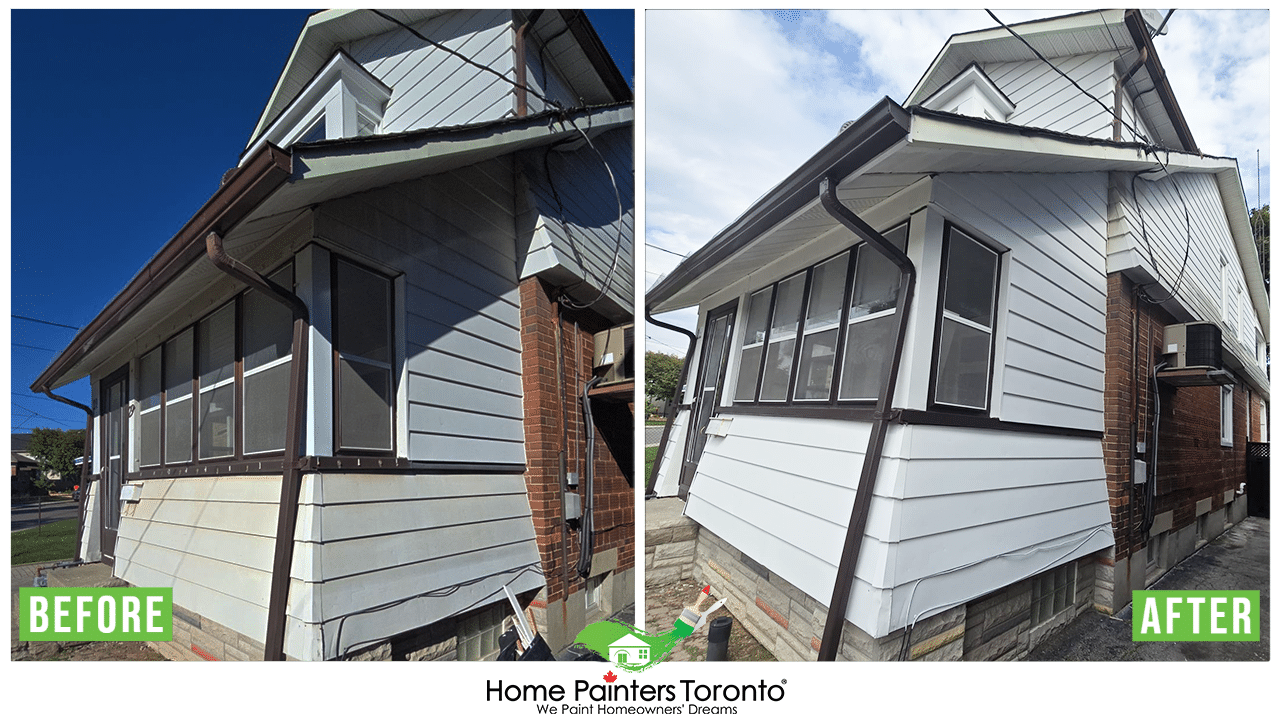
A repaint keeps existing cladding in service and avoids the emissions of making new cladding
Repainting vs Replacing Siding Sustainability: The Environmental Trade-Offs
Repainting is the more sustainable option for sound siding. It adds a thin coating to material that already exists. Replacement adds a full cladding system and sends the old one to disposal. The table compares the two across the factors that matter most.
| Factor | Repainting | Full Siding Replacement |
|---|---|---|
| Material waste | Scraped paint, masking and packaging | Every old panel or board, plus trim, flashing, fasteners and damaged sheathing |
| Manufacturing footprint | One coating system applied to existing material | New cladding, underlayment, fasteners and trim, all freshly manufactured |
| Landfill impact | Small volume, and leftover paint goes to a household hazardous waste depot | Large volume that joins the construction waste stream |
| Embodied carbon | Keeps the carbon already spent on the existing siding | Adds a new load of embodied carbon and discards the old one |
| Lifespan effect | Extends the service life of sound siding by protecting the substrate | Restarts the service life, which only pays off when the old material has failed |
| Best fit | Intact panels or boards with an aging finish | Rotted, cracked, delaminated or hazardous material |
Repainting is not free of impact. Paint is a manufactured product, and prep work produces scrapings, masking and packaging. The difference is scale, since a coating film is a small fraction of a cladding system's mass. That gap in volume drives every other line in the table.
Embodied Carbon in Siding Replacement vs a Repaint
Siding replacement adds a fresh load of embodied carbon, while a repaint adds only a coating. Embodied carbon is the greenhouse gas released to extract, make, ship and install a material. A recent University of Toronto study looked at five renovation and adaptive reuse projects in Canada and the U.S. It found that 60 to 98% of the original structural mass was preserved.
Every finished building still carried more embodied emissions than before. New insulation, windows and concrete carry a lot of carbon. The study covered whole buildings, not siding. The logic still carries over. What you keep has already paid its carbon cost, and anything new adds more.
How Much Material Waste Does a Full Siding Replacement Generate?
A full siding replacement generates waste equal to the entire exterior cladding, plus trim, flashing, fasteners and any sheathing damaged during removal. Every panel or board on every wall comes off the house. That debris is bulky and fills bins fast.
Construction, renovation and demolition (CRD) waste is a big part of what Canada throws away. Environment and Climate Change Canada reports that CRD waste totals about 4 million tonnes, or 12% of the solid waste stream. The Canadian Council of Ministers of the Environment adds two figures, based on Statistics Canada estimates. Renovation work produces about 47% of CRD waste. About 84% of all CRD waste goes to disposal, mostly in landfills.
Removing old siding is renovation work, so it feeds that stream directly. Painted wood counts as CRD waste too. A repaint creates far less debris. Crews scrape loose paint, wash the surface and use masking, drop sheets and rollers. Leftover paint belongs at a City of Toronto household hazardous waste depot, not in the garbage.
Where Old Siding Goes After Removal
Old siding goes to a scrap yard, a specialty recycler or a waste bin, depending on its material. Those routes differ widely between aluminum, vinyl, wood and fibre cement. The table shows what to expect and what to ask a contractor before removal starts.
| Siding Material | Typical End-of-Life Route | What to Ask Your Contractor |
|---|---|---|
| Aluminum | Scrap yards and metal recyclers commonly accept it | Confirm the crew delivers it to a metal recycler |
| Vinyl (PVC) | Specialty recyclers take clean, sorted panels, and some municipal guides list it as garbage | Ask for a recycler drop-off instead of a general bin |
| Painted or treated wood | Usually joins the construction waste stream, since painted wood counts as CRD waste | Ask whether the bin goes to a sorting facility |
| Fibre cement | Recycling options are limited, so disposal is common | Ask for the disposal route in writing |
York Region's waste guide, for example, lists vinyl siding as garbage with disposal fees. The Revinylize Recycling Collaborative lists specialty collection sites, including one in Toronto. Rules change from city to city. Ask the contractor where removed material lands before you sign.
What Does Repainting Actually Preserve in Existing Siding?
Repainting preserves the existing siding, its trim and fasteners, and the carbon already spent making them. A coating shields the substrate from moisture and ultraviolet light, the two forces that end the life of most siding. Renewing that film before it fails keeps water out of boards, seams and joints. The same Environment and Climate Change Canada page ranks reuse and repair above recycling, with landfill last. Each common cladding takes a repaint well with the right prep:
- Aluminum: aluminum siding painting fixes a chalky, faded finish and keeps every panel on the wall.
- Wood: exterior wood siding projects swap only the failed boards and recoat the rest.
- Vinyl: a repaint works on sound panels when the colour is vinyl-safe, as covered below.
- Stucco: a flexible elastomeric coating can bridge hairline cracks and seal the surface.
Exterior repaints on standard Toronto homes typically cost $2,000 to $10,000 CAD + HST. Size, storey count and surface condition set the final number. Our cost of painting a house guide breaks down those ranges. For the cost comparison against new cladding, see our siding repair in Toronto page. You can also browse our full range of exterior painting in Toronto services.
Repainting also leaves the wall assembly closed and dry. A tear-off exposes the weather barrier and sheathing, and any damage found there adds new materials to the job. That is sometimes the right call, but it is never free of cost.
When Is Replacement the More Sustainable Choice?
Replacement is the more sustainable choice when siding has rotted, cracked or lost its ability to shed water. A coating cannot restore failed material. A repaint over failing siding only delays the tear-off. The coating then joins the waste stream anyway. The table shows how we sort common conditions.
| Condition | Better Choice | Why |
|---|---|---|
| Sound siding with chalking, fading or scuffs | Repaint | The material is intact and only the coating has aged |
| Rot on a few boards or panels | Repair the failed pieces, then repaint | Targeted replacement keeps the rest of the wall in service |
| Rot or damage across several walls | Replace | Widespread failure means a coating cannot restore the material |
| Cracked, brittle or warped vinyl panels | Replace the affected panels | Paint cannot fix distorted or split PVC |
| Wet, soft or mouldy sheathing behind the siding | Open the wall and replace | Hidden moisture damage returns under any coating |
| Suspected asbestos-cement cladding | Test before any work | A lab result decides the safe next step under Ontario rules |
Three questions settle most repaint-or-replace decisions. The first two check the siding and the wall behind it, and the third checks the finish. Answer them in order:
- Does the material still feel solid when probed and tapped?
- Is the sheathing behind it dry?
- Has only the finish failed, and not the siding itself?
Three yes answers point to a repaint. Home Painters Toronto's working rule on site adds a simple threshold. Damage limited to less than about 20 percent of one wall is usually a repair, and widespread rot points to replacement. Our guide on when siding replacement makes more sense than repair covers that decision in more depth.
Repeat failure in the same spot is a warning sign. It usually means water keeps getting in behind the siding. Fix that source first, or any new coating will fail again.
A hybrid job often has the lowest impact of all. Crews replace the failed boards, panels or trim and then repaint the whole wall. The repairs blend in, and every sound piece stays on the house.
Older homes can have asbestos-cement siding. Ontario Regulation 278/05 sets the rules for handling asbestos on construction projects. A lab test comes before any sanding or removal.
Not sure which side of the line your siding falls on? Request a free exterior assessment. We will give an honest recommendation, even when that means pointing you toward replacement.
Why Does Prep Quality Decide Whether a Repaint Is Sustainable?
Prep quality decides sustainability because a repaint only pays off if the coating lasts. A failed coat forces a second round of scraping, primer, paint and disposal within a few years. Skipping primer on bare wood all but guarantees peeling. Power washing alone does not open the wood grain, so mechanical sanding comes first. Five prep steps give a repaint its longest life:
- Wash the walls to remove dirt, mildew and chalk.
- Scrape loose paint and sand bare wood mechanically.
- Replace rotted boards and re-caulk open joints.
- Prime every bare or repaired spot with a good exterior primer.
- Apply two coats within the maker's stated temperature and drying limits.
Loose caulking lets water in behind fresh paint. Fresh exterior caulking around windows and doors belongs in every prep scope. Rotted boards need replacement before painting starts. Our page on wood siding replacement and repairs explains how we swap failed boards so the repaint has sound wood to bond to.
A moisture meter reading and a probe test come before any paint goes on. Wood that reads wetter than the coating manufacturer allows needs time to dry. Painting damp wood traps water and shortens coating life.
Coating specifications matter as much as prep. Benjamin Moore and Sherwin-Williams publish technical data sheets for each exterior product. Those sheets set application temperatures, drying times and spread rates. Crews that ignore those limits trade service life for a faster schedule.
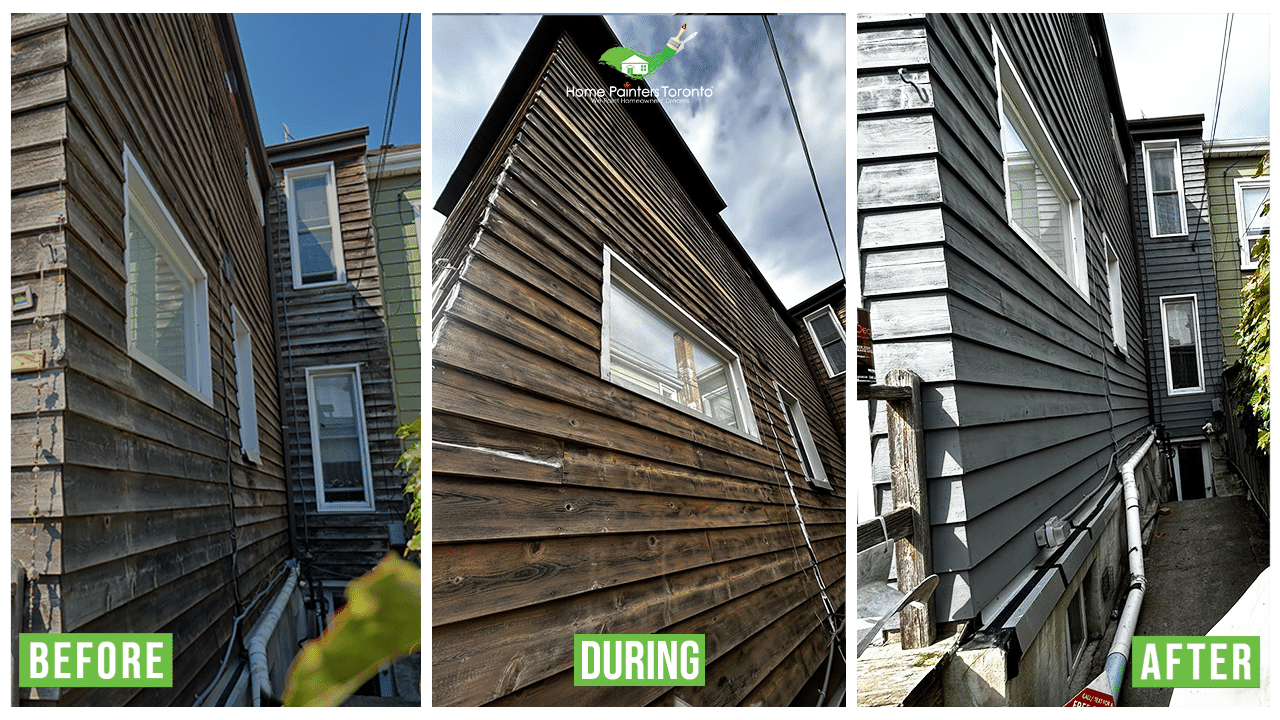
Field Example: Repainting Etobicoke Cedar Siding Instead of Replacing It
- At a recent exterior repaint on a two-storey home in Etobicoke, the owners already held a full replacement quote. A pin meter read 11% to 13% moisture content in the cedar, and only six boards were soft enough to replace.
- We washed the walls at about 1,200 PSI, sanded the bare wood and spot-primed it.
- Two coats of Benjamin Moore Aura Exterior in Low Lustre followed, each at roughly 4 mils wet on a 14°C surface. About 1,400 square feet of original cedar stayed on the house, under our 3-year exterior warranty.
Which Paint Choices Have the Lowest Impact on a Siding Repaint?
The lowest-impact siding repaint uses a durable 100% acrylic exterior coating with low VOC content. It goes on within the manufacturer's stated conditions, so it does not need redoing early. A long-lasting coat drives most of the benefit. Every repaint cycle you avoid also avoids more product, prep waste and truck trips.
VOC content matters too, and Environment and Climate Change Canada limits it in paints and coatings sold in Canada because VOCs contribute to smog. Low-VOC and zero-VOC labels mean different things, and tint colourants can add VOCs back into a base. Our guide on low-VOC or zero-VOC paint explains the difference. For exteriors, choose a low-VOC acrylic from a major paint line and follow its data sheet. Ask any contractor these four questions before signing:
- Which exact product and finish will go on each surface?
- What is the VOC content listed on the product data sheet?
- Which primer goes on bare or repaired areas?
- How many coats are included, and what does the written warranty cover?
Vinyl-Safe Colours: The Sustainability Detail Most Guides Skip
Vinyl siding needs a vinyl-safe colour, because dark paint absorbs heat and can warp panels that a repaint was meant to save. The Vinyl Siding Institute states that temperatures beginning at 160 to 165°F (about 71 to 74°C) can soften normal grades of vinyl siding. A Massachusetts state advisory that cites the institute adds that darker colours absorb more heat and soften first.
Paint makers respond with restricted palettes, such as Sherwin-Williams VinylSafe. A warped panel becomes a replacement, so the wrong colour turns a low-waste repaint into a tear-off. Our page on painting vinyl siding covers colour selection and prep for vinyl.
Repainting vs Replacing Siding Sustainability FAQs
Repainting is the more sustainable choice for sound siding. Replacement is the better choice only when the material has failed. The answers below cover the questions homeowners ask most.
Repainting is more sustainable when the siding is structurally sound, because it keeps the old cladding in use and avoids new production and disposal. Replacement is the better choice when boards are rotted, panels are cracked or the wall behind them is wet. Repairing failed sections and repainting the rest often has the lowest impact of all.
Yes, a well-prepared repaint extends the life of sound siding by renewing the film that keeps moisture and ultraviolet light out. It cannot reverse rot or cracking that has already started. That is why prep and a moisture check come first, and why Home Painters Toronto stands behind exterior painting with a 3-year warranty.
Most old siding goes to disposal, and only some materials have practical recycling routes. Aluminum has strong scrap markets, clean vinyl can reach specialty recyclers, and painted wood usually joins the construction waste stream. Ask your contractor in writing where removed material goes.
Scrap yards take aluminum siding. Vinyl siding needs a specialty recycling program. Some municipal waste guides list vinyl siding as garbage. The Revinylize Recycling Collaborative lists collection sites, including one in Toronto, so confirm current acceptance before delivery.
Low-VOC paint cuts solvent fumes during painting and curing. Durability also shapes the total footprint, since a low-VOC coat that fails early forces a second repaint. That second repaint cancels the benefit. Pair a low-VOC exterior acrylic with proper prep and the maker's stated conditions.
Siding is too far gone when boards are soft or crumbling, panels are cracked or warped, or moisture has reached the sheathing behind it. A screwdriver that sinks easily into wood signals rot, and a moisture meter confirms it. If only a few pieces have failed, replace those pieces and repaint the rest.
Making the Sustainable Choice for Your Home's Exterior
The sustainable choice for your home's exterior is a repaint when the siding is sound. A targeted replacement is the better call when parts of it have failed. Repainting keeps the old cladding in service, avoids new production and cuts waste volume. A hybrid of board replacement plus a repaint often gives the lowest impact of all.
Home Painters Toronto is a family-run residential painting company serving Toronto and the GTA since 1991. Brian Young founded the company and has worked in the painting industry since 1987. Home Painters Toronto has painted 20,000+ homes across Toronto and the GTA. We are WSIB compliant and fully insured, and we stand behind our advice with warranty-backed results.

Ready to find out whether your siding needs a repaint or a replacement? Home Painters Toronto delivers fast, free quotes and warranty-backed work across Toronto and the GTA.
Get a Free Estimate