School and Daycare Painting During the March Break

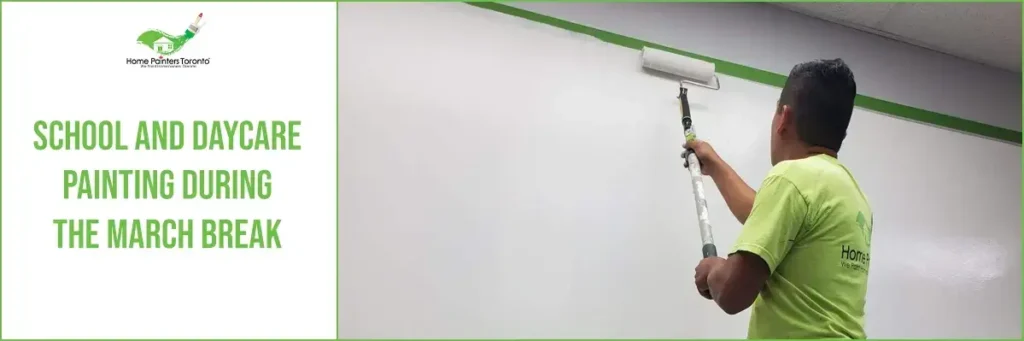
School and daycare painting during March Break is the most strategic use of Toronto's annual one week student and teacher hiatus, giving professional painters unobstructed access to every classroom, hallway, and common area without scheduling conflicts or child safety restrictions. Home Painters Toronto, the HomeStars Best of Award 2026 winner with over 1,200 positive reviews and 37 years serving the GTA, has completed school and daycare painting projects across Toronto and North York every March Break since 1987. March Break: a time synonymous with family getaways and a brief pause from the academic rigours for students and teachers alike. However, for the forward thinking administrator or facility manager, this interlude is a golden opportunity to refresh and revitalize educational spaces without disrupting learning.

Quick Answer: March Break is the ideal window for Toronto school and daycare painting because students and staff are off premises, eliminating scheduling restrictions and child safety concerns. Zero VOC products are mandatory in all educational environments. A standard 6 to 8 classroom daycare or school can typically be repainted across a 5 to 7 day March Break window. All painting crews working in schools or daycares must carry WSIB compliance and general liability insurance, and criminal background checks on all crew are required by most Toronto school boards and licensed daycares.

School and Daycare Painting in Toronto: Why March Break and Summer Schedules Are the Only Windows That Work

Painting a Toronto school or daycare during active occupancy is not a logistical challenge: it is a regulatory and safety impossibility. Ontario's Health and Safety Act and the licensing requirements governing Toronto daycares and licensed childcare centres both prohibit painting with occupied children present, regardless of the VOC content of the paint being used. The physical act of painting, including surface preparation with sanding equipment, generates dust, requires ladders in hallways, and creates conditions incompatible with children in the same building. According to Health Canada's guidance on VOCs in indoor environments, even low and zero VOC paint products release some off gassing during and immediately after application, and enclosed spaces with children present warrant the precautionary approach of zero occupancy during painting and a minimum 12 to 24 hour ventilation period before reoccupancy.

Scheduling Toronto School Painting Projects: March Break vs Summer vs PA Days

Window Duration Advantages Limitations
March Break (Ontario) 5 to 7 days Full building access; no student or staff present; ideal for interior repaints of all classrooms and hallways Shorter window than summer; exterior painting limited by March temperature (must stay above 10 degrees C)
Summer break 6 to 8 weeks Longest access window; exterior painting possible; larger scope projects feasible Staff may be present for admin days; some facilities remain partially occupied for summer programs
PA days (Professional Activity Days) 1 day Suitable for single room touch ups or corridor accent walls only Too short for multi room scopes; scheduling must align with the PA day calendar
After hours weekday painting Available year round Suitable for small common areas and corridors in secondary schools Cannot access classrooms during term; limited to non instructional spaces

Understanding the Importance

Before diving into the specifics, let's acknowledge why March Break is an ideal time for such projects. With students and teachers away, professional painters can move freely and safely, without the constraints of daily school or daycare schedules. This not only speeds up the process but also ensures that the environment is safe and ready for its occupants upon their return. Moreover, a fresh coat of paint doesn't just cover up scuffs and marks. Painting daycare walls can invigorate a space, foster a better learning environment, and positively affect moods and energy levels.

Planning and Preparation: The Blueprint of Success

1
Defining the Scope: Start with a clear understanding of what you aim to achieve. Are you looking to update a single room, or are you considering a complete makeover? Knowing the extent of your project will help in effective planning and budgeting.
2
Choosing the Right Colours: Colours significantly influence mood and concentration. Opt for hues that complement the age group and purpose of the room. For instance, vibrant colours can stimulate younger children, while older students may benefit from more subdued shades that help maintain focus.
3
Selecting the Right Paint: When it comes to schools and daycares, not just any paint will do. Look for durable, washable, and low VOC (Volatile Organic Compounds) options that ensure the health and safety of children are not compromised.
4
Timing and Logistics: Coordinate with painting professionals who understand the time sensitive nature of the task at hand. Ensure they are briefed about the school calendar and any specific requirements regarding access and security.

What Professional School and Daycare Painting Actually Involves in Toronto

A professional school or daycare painting project in Toronto begins with a scope walk with the facility director or school administrator before the March Break window opens. The walk establishes which rooms are being painted, which surfaces (walls only, walls and ceilings, trim, doors), whether any drywall repair is needed, and whether any accent walls or murals are included in the scope. That walk determines the product quantity order, the crew size, and the daily schedule needed to complete the project before reopening.

Surface preparation in a school or daycare environment covers cleaning all wall surfaces of crayon, felt marker, adhesive residue from displayed artwork, and dirt that has accumulated through the school year. These contaminants are common in educational environments and are not present in standard residential painting projects. Standard prep protocols that work on adult residential walls do not remove crayon wax effectively; a TSP substitute cleaning solution is required on any surface with crayon or grease contamination before primer is applied.

School and Daycare Painting in Toronto: Why Zero VOC Products Are Mandatory, Not Optional

Zero VOC paint products are the only products appropriate for Toronto schools and licensed daycares. The distinction between low VOC and zero VOC matters in this specific environment: low VOC products release fewer than 50 grams per litre of volatile organic compounds during and after application. Zero VOC products release fewer than 5 grams per litre. For an enclosed classroom with limited ventilation that will be reoccupied by children within 24 to 48 hours of painting, that difference is meaningful. Benjamin Moore Natura Interior Zero VOC is the product our team specifies for all school and daycare painting: it meets the zero VOC threshold, is available in the full Benjamin Moore colour range, and provides excellent washability for surfaces that receive daily contact from children. For a full comparison of low and zero VOC products, see our guide on low VOC vs zero VOC paint.

The Palette of Productivity and Positivity

An educational environment should inspire productivity and positivity. Colour psychology is a tool that can greatly impact mood and cognitive function. Soft blues and greens can elicit calm and focus, while warm yellows stimulate energy and creativity. Employ these insights to create an environment that not only looks fresh but feels conducive to the educational aims of your space.

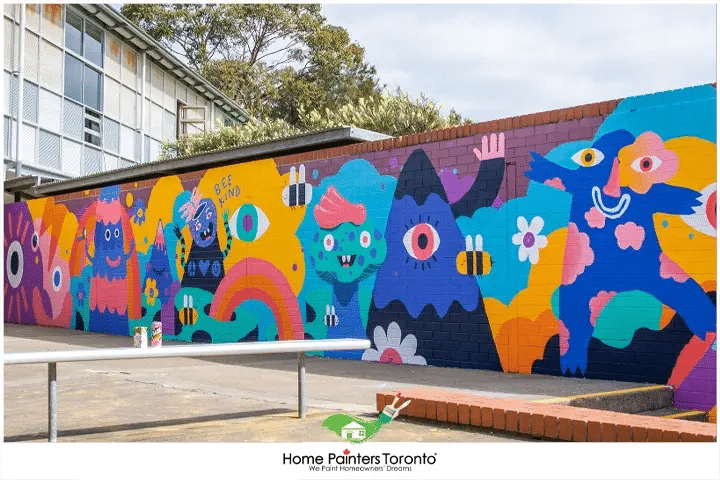
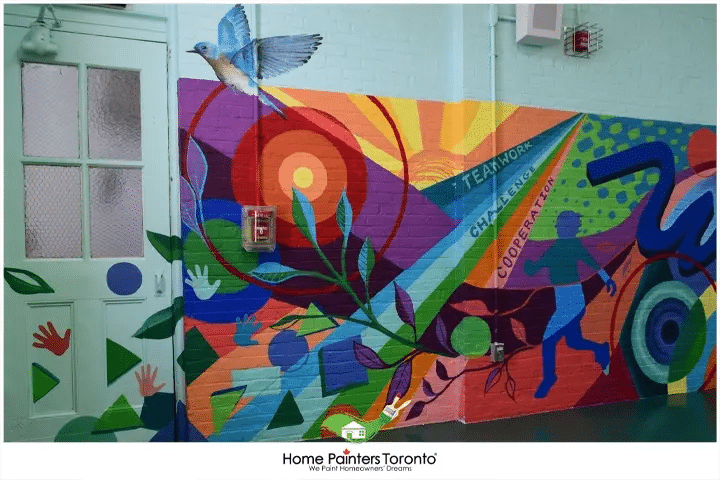
Looking for a fun and easy project to brighten up your school or daycare during March Break? Try painting murals for walls!

A great way to infuse creativity and inspiration into your school or daycare environment is by incorporating mural paintings. Delving beyond mere aesthetics, mural painting carries deep symbolism and transformative power. Murals can stimulate learning, engage community participation, and turn monotonous walls into storybook accounts of the collective imagination.

Colour Selection for Toronto Schools and Daycares: What the Research Says and What Actually Works

Colour Psychology in Toronto School and Daycare Environments

Colour psychology in educational environments is a well established field, and the practical guidance it produces is straightforward to apply. Younger children (ages 2 to 5) in daycare and pre kindergarten settings respond positively to warm primary colours in accent walls: yellow, orange, and warm green. These colours stimulate visual engagement and energy in spaces designed for active play. Neutral warm whites on the majority of the wall area prevent sensory overload, with the accent colour limited to one wall per room.

Children aged 6 to 12 in primary school classrooms benefit from calmer colour environments. Medium blue, soft green, and warm neutral tones on walls create a lower stimulation visual environment that supports concentration and focus. Secondary school corridors and common areas can accommodate bolder accent colours, including deep teal, warm terracotta, and charcoal, which feel age appropriate and respect older students' aesthetic preferences.

The most consistently successful approach in Toronto schools and daycares is a warm white or warm off white on all ceilings and the majority of wall area, with a single confident accent colour on one feature wall per room. This approach makes spaces feel bright and clean on reopening while giving each room a distinct colour identity that children and staff can identify with their specific classroom.

School and Daycare Center Mural Design

Murals are a great choice for schools, daycares, and even kids' bedrooms. We worked with the charity The Sunshine Foundation to transform a room with a custom mural. Murals can add vibrancy and much needed colour to the day to-day activities of educational institutions. Murals can tell a story, show school pride, or celebrate diversity. Turning a blank preschool or school wall into a work of art needs planning and preparation.

Pre-School and Daycare Painting Ideas

  • A sketch of the design with different variations is created. School communities can brainstorm together or have everyone contribute to the concept.
  • Murals do not have to obey the laws of depth perception or scale. A composition can start big and finish small.
  • Mural painting gives a different experience than traditional paintings. A narrative scene or a wide landscape reads well at the scale of a school wall.
  • Artworks are referenced for examples when inspiration is needed.
  • School officials or parents receive an explanation of the images and ideas being used before painting begins.

Preparing the School Wall for Murals

1
The wall material is identified first. Cinderblock, drywall, and plaster all require different primer types.
2
A tarp or dropcloth is placed under the work surface to protect the floor.
3
All surfaces are cleaned with a TSP substitute solution to remove dust, crayon, dirt, adhesive residue, and any other contamination. Mould and dampness are addressed before any paint is applied.
4
Wallpaper is fully removed before any primer is applied.
5
White primer is applied evenly over the entire wall and allowed to dry completely. Two coats of primer may be needed where the existing wall colour is particularly dark.

Draw the Mural on Daycare Walls

1
The mural design is drawn directly on the wall to scale using chalk or pencil as a guide. An overhead projector can be used to project the image onto the wall for tracing.
2
The sketch is used as a guide throughout. What looks good up close may not look great from across the room.
3
Stepping back from the wall to view the full composition at regular intervals reveals any areas that need adjustment.
4
Once the outline is confirmed, painting of the mural can begin.

Painting Daycare and School Walls

1
Paint quantities are calculated for each colour before ordering, to avoid waste and prevent running short mid project.
2
Paint is poured into appropriate containers for brush and roller application.
3
Paint consistency is confirmed before application: too thick and it will not dry correctly; too thin and it will run.
4
The correct brush or roller size is selected for each element of the design. Rollers cover large background areas efficiently; smaller angled brushes provide detail on faces and intricate elements.
5
Each area is allowed to dry completely before any adjacent area or second coat is applied.
6
All unused paint is stored in sealed, labelled containers for touch up use.

Safety and Certification Requirements for Painting in Toronto Schools and Daycares

Toronto school boards and licensed daycares operating under Ontario's Child Care and Early Years Act have specific contractor certification requirements that go beyond standard commercial painting contracting. Any painting contractor working in a facility with child occupants must carry active WSIB compliance, minimum $2 million in general liability insurance, and criminal background checks on all crew members who will access the facility. Many Toronto District School Board and Toronto Catholic District School Board contracts additionally require the contractor to provide proof of compliance with the board's own contractor safety orientation program before access is granted. The WSIB clearance certificate confirming current compliance must be provided in writing before any work begins.

Home Painters Toronto carries $5 million in general liability insurance, conducts criminal background checks on every crew member, and is fully WSIB compliant. These credentials are documented and provided to facility managers and school administrators as part of our standard project onboarding for every school and daycare painting contract.

Cost of Professional School and Daycare Painting in Toronto in 2026

All school and daycare painting is quoted by scope after a site walk. Prices below are indicative ranges based on typical Toronto daycare and school facility sizes. For a general painting cost reference, see our painting cost guide. All prices are in CAD and exclude HST.

Scope Estimated Cost (CAD) Notes
Small daycare (4 to 6 classrooms, walls and ceilings) $3,000 – $6,000 Benjamin Moore Natura Zero VOC throughout; includes prep, prime, two topcoats
Medium school facility (8 to 12 classrooms plus corridor) $6,000 – $14,000 March Break scope; all rooms and common areas; completed before reopening
Large school facility (15 plus rooms, gymnasium, corridor) $14,000 – $30,000 Multi crew scope; may extend into summer for completion
Mural design and painting (per wall) $800 – $3,000 Depends on size and complexity of design; includes sketch, prep, and full execution
Single room refresh (walls and ceiling only) $600 – $1,200 Suitable for PA day or after hours single room scope
Drywall repair before painting (impact damage, wall anchors) Quoted after inspection Common in school and daycare environments; addressed before primer in the painting scope

Bottom Line

Painting during March Break is a strategic decision that can bring about a marked improvement in the learning environment. With the right planning, colours, techniques, and professional assistance, the project can lead to a multitude of benefits without interfering with the educational process. Utilize this time wisely, and watch as the refreshed walls breathe new life into the daily grind of school and daycare life.

Your painting project may start during March Break, but the benefits will be felt long after. Consider these tips as a compass that guides you to a successful painting endeavour, one that echoes the vibrancy and vitality of the learning that takes place within those colourful walls.

Frequently Asked Questions About School and Daycare Painting in Toronto

Why is March Break the best time to paint a Toronto school or daycare?

March Break provides 5 to 7 days of full building access with no students or staff present, which is the minimum required to complete a standard multi room daycare or school interior repaint. Ontario's Health and Safety Act and daycare licensing requirements prohibit painting during active occupancy with children present. March Break eliminates those restrictions and provides a complete, unobstructed access window that allows painting to be completed and surfaces to be fully ventilated before students return.

What paint products are required for school and daycare painting in Toronto?

Zero VOC products are the only products appropriate for Toronto school and daycare painting. Benjamin Moore Natura Interior Zero VOC is the standard specification for these environments: it meets the zero VOC threshold (fewer than 5 grams per litre), is available in the full Benjamin Moore colour range, and provides excellent washability for daily contact surfaces. Standard low VOC products are not appropriate for spaces that will be reoccupied by children within 24 to 48 hours of painting. For background on the difference between low and zero VOC products, see our guide on low VOC vs zero VOC paint.

What credentials does a painting contractor need to work in a Toronto school or daycare?

A contractor working in a Toronto school or licensed daycare must carry active WSIB compliance, minimum $2 million in general liability insurance, and criminal background checks on all crew members who access the facility. Toronto District School Board and Toronto Catholic District School Board contracts additionally require contractor safety orientation compliance before access is granted. Home Painters Toronto carries $5 million in general liability insurance, conducts criminal background checks on all crew, and is fully WSIB compliant.

How much does it cost to paint a Toronto daycare or school?

A small daycare of 4 to 6 classrooms runs $3,000 to $6,000 for a full interior repaint with zero VOC products. A medium school facility of 8 to 12 classrooms plus corridor runs $6,000 to $14,000. A mural on a single wall runs $800 to $3,000 depending on the size and complexity of the design. All quotes are free and provided after a site walk to confirm the scope.

How long does it take to paint a daycare during March Break?

A standard 6 to 8 classroom daycare can be repainted across a 5 to 7 day March Break window with a crew of 3 to 4 professional painters. The project timeline depends on the number of rooms, the scope of surface preparation needed, and whether any drywall repair is included. Our team conducts a scope walk in advance of March Break to confirm the crew size and daily schedule needed to complete the project before reopening.

More Interesting Blogs Related to "School and Daycare Painting During the March Break"

Ready to Plan Your March Break Painting Project?

Home Painters Toronto is the HomeStars Best of Award 2026 winner with 37 years serving the GTA, WSIB compliance, and $5 million in general liability insurance. Call 416-494-9095 or email [email protected] for a FREE same-day estimate.