

The best exterior paint for wood in Toronto is a 100% acrylic latex or water-based alkyd product that is specifically formulated to flex through freeze-thaw cycles, resist moisture penetration, and hold colour under prolonged UV exposure. If you skip the right product or cut corners on prep, the paint will peel within two seasons, no matter how much it cost.
- Why Toronto's climate makes exterior wood painting harder than most homeowners expect
- The difference between painting and staining, and when each one is the right call
- How oil-based and water-based paints compare for exterior wood surfaces
- Which brands and specific products our team actually uses on Toronto jobs
- A surface-by-surface breakdown so you pick the right product for each part of your home
- What a professional exterior wood painting job costs in Toronto in 2026
- A real project example from a Toronto neighbourhood
- Answers to the most common questions homeowners ask before starting
Want this done right the first time? Get a free quote for exterior painting in Toronto.
When it comes to the best exterior paint for wood, each project has different needs. Some exterior siding that looks like wood, may not require as much care and attention. But with the real stuff, whether you are painting wooden doors, the deck, frames for the roof, or the entire house, so many factors may be bouncing around in your head that it can get confusing! Here are some things to consider.

Choosing the right exterior paint for wood in Toronto means matching the product to the surface, the species, and the climate.
Why Toronto's Climate Makes Exterior Wood Painting More Demanding
Toronto is one of the harder cities in Canada to paint exterior wood well, and the reason is the climate. The city experiences more than 100 freeze-thaw cycles per year, with temperatures swinging from above 30 degrees Celsius in summer to minus 15 or colder in winter. Every time wood absorbs moisture and then freezes, it expands slightly. Every time it thaws, it contracts. Paint that cannot flex with that movement will crack, lift, and peel, often within a single season if the wrong product was used.
Homes in older Toronto neighbourhoods like The Annex, Roncesvalles, Riverdale, and Leslieville typically have original wood siding, fascia boards, window frames, and trim that have been painted and repainted over several decades. Older wood is often more porous and has more existing layers of paint to contend with, which means surface prep is not just a formality. It is the step that determines whether your paint job lasts two years or ten.
According to the Canada Mortgage and Housing Corporation's guidance on moisture control in housing, exterior wood surfaces in Canadian climates require paints that allow some degree of moisture vapour transmission. Products that trap moisture behind a sealed film cause the wood to rot from within, which is a more expensive problem than a paint job that needs redoing.
The products recommended in this guide, particularly 100% acrylic exterior paints and water-based alkyds for trim and doors, are chosen specifically because they handle Toronto's conditions. They expand and contract with the wood, resist UV degradation, and do not trap moisture.
Special Properties of Wood
While wood is a common building material, there are many types of wood to choose from. If you are building with raw, untreated wood, the most affordable kind will usually be what grows in abundance where you live. Because wood can rot or attract insect infestation, it is important to care for your wood exterior and treat it regularly, one to two times every ten years. It is also important to consistently take note of any holes or splinters. And repair them as soon as possible, to seal the area.
Wood is lighter than concrete or brick and more flexible. While wood is sensitive to moisture it is breathable and is good for insulation.
Painting Exterior
Painting the exterior of your home or a part of it is a big job. If you are painting exterior wood doors, exterior wood siding panels, or a porch or a fence, you still need durability. Adhesion is important because your paint job has to stand up to a variety of weather conditions and temperatures. Depending on where you are painting, it may also have to be resilient to foot traffic, animals, insects, and general scratches and dings.
Wood specifically needs to be treated and sealed so water doesn't seep in and rot it from the inside out. This typically takes more primer and/or paint than other building materials. Because it will soak into the grain and take an extra coat or two, which is good for protection in the long run. This is why it is very important to leave lots of dry time once you have pressured-washed your wood exterior. In perfect weather conditions, it takes about 48 hours for the wood to dry completely but may take longer.
Benefits of Priming and Finishing
Once the wood siding or deck is washed, repaired, and completely dry, adding a layer of primer will help the paint job last longer. Primer will soak into the wood and act as a kind of seal so water can't seep in as easily. If the primer doesn't soak in and is left as surface paint on wood, sometimes water is able to seep behind the paint. But can't as easily find its way out, which leads to mould.
Similarly, after the painting process, using a finish can go a long way. The finish will act as a water-repellent and stand up to varied weather conditions.
How Many Coats Does Exterior Wood Need?
Raw or bare wood typically requires one coat of exterior-grade primer, followed by two coats of topcoat. The primer seals the grain and creates adhesion for the paint, while the two topcoats build the protective film that will take the weather. Skipping the second topcoat is one of the most common reasons DIY exterior paint jobs fail early, particularly on south-facing and west-facing surfaces that receive the most sun exposure in Toronto.
If the wood has been previously painted and is in good condition, with the old paint adhering firmly and no peeling or cracking, a single topcoat is sometimes sufficient after thorough cleaning and spot-priming bare areas. However, on older Toronto homes where multiple paint layers may already exist, a full two-coat system over primer gives the best results and the longest service life.
Staining or Painting
When it comes to preference, most homeowners stain if they want to preserve the natural look of the wood exterior but staining also takes less time. The best exterior wood stain will seep into the grain and will fade gradually before you need to stain again. Depending on the project, you will need to stain it every 2 to 4 years. For example, a deck will need to be re-stained more often than wood siding.
Painting exterior wood lasts a little longer but wood needs scraping and/or sanding before repainting, so it is a tougher project in general. What is great about wood, however, is you can paint it any colour you like. And paint adds a greater layer of protection from water damage and the sun.
Paint vs. Stain for Exterior Wood: A Side-by-Side Comparison
Choosing between paint and stain is one of the first decisions Toronto homeowners face on an exterior wood project, and the right answer depends on the surface, the wood condition, and how much maintenance you want to manage over time.
| Feature | Exterior Paint | Exterior Stain |
|---|---|---|
| Appearance | Solid colour, hides wood grain | Semi-transparent or solid, shows grain |
| Protection level | High, forms a film barrier | Moderate, penetrates into wood |
| Recoat frequency | Every 7 to 10 years (with quality product) | Every 2 to 4 years depending on exposure |
| Prep required for recoating | Scraping, sanding, priming if peeling | Light cleaning and sanding in most cases |
| Best for | Siding, doors, trim, fascia | Decks, fences, raw wood structures |
| Flexibility in freeze-thaw | High (100% acrylic) | High (penetrating stains flex with wood) |
| Colour options | Unlimited | Limited to stain tones (transparent to solid) |
| Cost per application | Higher upfront | Lower upfront, more frequent recoating |
| Mould and mildew resistance | Good (with mildewcide additive) | Moderate |
For most Toronto homes, exterior wood siding and trim are best suited to paint, which provides a longer-lasting protective film. Decks and fences are often better candidates for stain, particularly penetrating oil-based stains, because the wood movement from foot traffic and seasonal moisture is too severe for a painted film to hold reliably over time. For more on deck and fence projects, see our deck and fence staining service.
Oil-Based or Water-Based
For old weathered wood or wood exterior siding with direct exposure to the elements, the sun, rain, wind, etc., oil-based paints and primers may last longer. An oil-based primer will soak into the grain better and act as a barrier to water. It will also act as a barrier for tannin leaking from the wood itself.
However water-based paint or latex tends to be better for the environment and has a milder smell. And most general high-quality exterior paints are water-based.
Oil-Based vs. Water-Based Exterior Paint for Wood: Full Comparison
The shift away from oil-based exterior paints in Ontario has been significant over the past decade, driven by provincial VOC regulations and the dramatic improvement in water-based acrylic formulations. Here is how the two categories compare for exterior wood in Toronto's specific climate.
| Feature | Oil-Based (Alkyd) | Water-Based (100% Acrylic) |
|---|---|---|
| Flexibility in freeze-thaw | Low, prone to cracking over time | High, designed to flex with wood movement |
| Adhesion to bare wood | Excellent | Excellent (with proper primer) |
| UV resistance | Moderate, chalks and fades over time | High, modern acrylics retain colour better |
| Dry time per coat | 24 to 48 hours | 2 to 4 hours |
| Odour during application | Strong, requires ventilation | Low to minimal |
| Cleanup | Mineral spirits or varsol | Soap and water |
| Availability in Ontario | Limited, many formulas discontinued | Widely available |
| Mould and mildew resistance | Moderate | Good (with mildewcide) |
| Best for exterior wood | Spot priming tannin-bleed wood, old weathered surfaces | Siding, trim, doors, fences, most exterior wood |
| VOC compliance in Ontario | Often non-compliant; check product labelling | Low-VOC and zero-VOC options widely available |
For most exterior wood projects in Toronto in 2026, a quality 100% acrylic exterior paint is the professional standard. The one area where oil-based primer still has an advantage is on heavily weathered or tannin-rich wood species like cedar or redwood, where an oil-based primer coat applied before a water-based topcoat provides better stain blocking and adhesion. Our team uses this hybrid approach regularly on older Toronto homes with cedar siding.
Barn/Fence/Siding/Deck or Premium Exterior Paint
The best exterior paint for wood may become chalky, as wood-specific paints can have a less glossy finish. But because they are made for wood, they are meant to soak into the grain and last a long time. They are made to minimize mould, mildew, and rot with a matte finish. While many have a built-in primer, the can itself can be less expensive but painting wood usually takes extra coats to seal it properly.
High-quality premium exterior paint does a good job of minimizing mould and mildew also and is made to stand up to a variety of weather conditions. It will act as protection and ensure your wood lasts as long as possible before needing replacement. Especially if the painting procedure is followed and the exterior wood siding is treated with care.
Best Exterior Paint Brands
There's a lot to consider when choosing an exterior paint brand. Is it worth the extra cost? How long will it last? What are the pros and cons of each? There are many reasons to use quality exterior house paint. While you may be tempted to save money by using less expensive paints, you'll find that the long-term cost of using a lower-grade product is much higher than you might expect.
We've put together a list of some of our favourite exterior paint brands, and we'll tell you what makes each one so great!
Sherwin Williams
This brand is known for its quality and durability in many different climates across the United States. It provides excellent coverage with minimal preparation time and can help your home look fresh and new after years of wear and tear. Duration Exterior Acrylic Latex Paint is one of the most popular brands of exterior paint on the market today. It provides excellent coverage and durability, so you'll have a long-lasting product that will look great for years to come.
Benjamin Moore
This brand has been around since 1883 and has been used on hundreds of thousands of homes over its long history as an industry leader in providing high-quality paints. It also offers a wide range of colours, so you can find one that matches your own home's exterior perfectly! Their Aura Exterior Paint is extremely durable and has a unique technology that allows it to resist fading and cracking, even in extreme weather conditions. This is an excellent choice and the best exterior paint for hot climates or cold winters!
Behr
This brand is another long-standing industry leader in the paint world, and it offers a wide range of different paints for every type of project. They have a great selection of exterior paints that are all extremely durable and easy to work with. Their Ultra Premium Plus Exterior Paint has an impressive lifetime warranty that covers fading, cracking, and peeling.
Product Recommendations by Surface Type
Not all exterior wood surfaces need the same product. Here is how our team at Home Painters Toronto approaches product selection for different wood surfaces on Toronto homes.
| Surface | Recommended Product | Notes |
|---|---|---|
| Wood siding (pine, spruce, fir) | Sherwin-Williams Duration Exterior or Benjamin Moore Aura Exterior | Two coats over oil-based or acrylic primer |
| Cedar or redwood siding | Oil-based primer first, then 100% acrylic topcoat | Tannin-blocking primer prevents bleed-through |
| Exterior trim and fascia | Sherwin-Williams Emerald Exterior or Benjamin Moore Aura Exterior (semi-gloss) | Semi-gloss or satin holds up better on high-contact trim |
| Exterior wood doors | Sherwin-Williams Emerald Urethane Trim Enamel or Benjamin Moore Advance (exterior application) | Hard enamel finish handles daily use and UV exposure |
| Wood deck (painted finish) | Sherwin-Williams SuperDeck Exterior or Benjamin Moore ARBORCOAT | Penetrating deck coating recommended over standard paint |
| Wood fence | Penetrating oil-based stain or Sherwin-Williams Duration Exterior (solid colour) | Stain is lower maintenance; paint lasts longer but requires more prep at recoat |
| Wood window frames and sills | Sherwin-Williams Emerald Exterior (semi-gloss) | Sills are high moisture exposure; premium product essential |
So there you have it, the most important factors to consider when you are looking for the best exterior paint for wood. If you love to do things yourself, then a little research goes a long way. But if the steps and stages of painting your wood exterior are a little stressful (or a lot!) there is no need to worry, Home Painters Toronto is here for you!
How to Prepare Exterior Wood Before Painting
The single biggest factor in how long your exterior paint job lasts is not the brand of paint you choose. It is the prep work done before the first coat goes on. Our team at Home Painters Toronto has been painting exterior wood in Toronto and the GTA since 1987, and the most common reason we get called in to redo a job that failed early is that someone skipped or rushed the prep.
Here is the preparation sequence that our team follows on exterior wood projects:
Skipping the pressure wash, the scraping, or the priming are the three most common DIY prep shortcuts, and each one meaningfully shortens the life of the paint job. For a full overview of how we handle exterior surface preparation, see our exterior residential painting service.
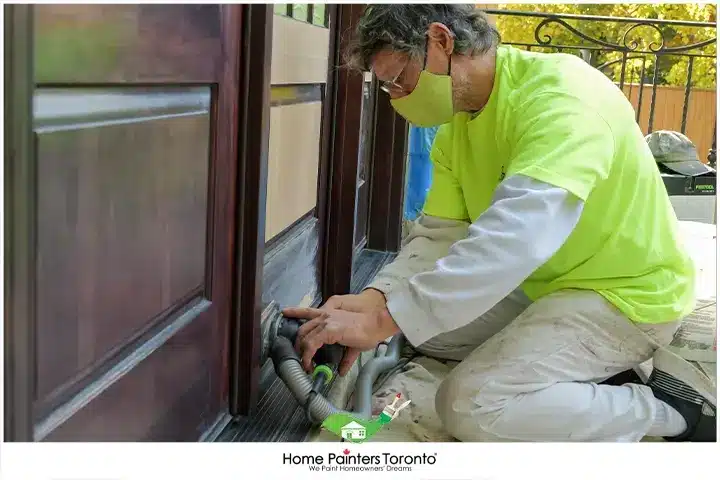
Proper prep — inspection, washing, scraping, sanding, and priming — is the step that determines whether your paint job lasts two years or ten.
How Much Does It Cost to Paint Exterior Wood in Toronto?
Cost is one of the most-searched questions about exterior painting, and one of the most difficult to answer without knowing the project. Here is an honest breakdown for Toronto homeowners in 2026.
DIY Cost Estimate
- 100% acrylic exterior primer: $50 to $80 per pail (covers approximately 40 to 50 sq ft per coat on bare wood)
- Premium exterior topcoat (Sherwin-Williams Duration or Benjamin Moore Aura): $70 to $110 per 3.78L can
- Scrapers, sandpaper, brushes, roller covers, extension poles: $60 to $120 if you do not already own them
- Power washer rental (if needed): $60 to $90 per day
- Exterior-grade caulk, wood filler, masking materials: $30 to $60
- Total DIY materials for an average Toronto detached home (approximately 800 to 1,200 sq ft of exterior wood surface): $500 to $900 CAD
Professional Cost Estimate
Professional exterior wood painting in Toronto typically ranges from $1,500 to $5,500 CAD for a full residential job, depending on the size of the home, the condition of the existing paint, the amount of carpentry or repair work required, and accessibility (multi-storey homes with complex rooflines cost more to paint safely).
The premium for professional work covers labour, commercial-grade products, proper scaffolding or ladder equipment, and the guarantee that prep work is done correctly. Exterior painting is one of the areas where cutting corners on product or prep leads to early failure, and many homeowners who attempt exterior wood painting as a DIY project end up with a job that looks acceptable at first but begins failing within two or three seasons.
For a precise quote based on your specific home and its current condition, request a free estimate from Home Painters Toronto. Our team has been painting Toronto exteriors since 1987. For reference, our full exterior painting cost guide covers pricing across all exterior surfaces and project types.
Real Project: Exterior Wood Siding and Trim Painting in Toronto
Central Toronto Semi-Detached: Full Exterior Wood Repaint with Carpentry Repairs
The situation: The homeowner contacted Home Painters Toronto after noticing that the existing exterior paint on the wood siding and trim was cracking, lifting, and in some areas peeling away entirely. The home had not been repainted in over twelve years. There was visible moisture staining on the fascia boards and some soft spots on the sill plates below the front windows, which indicated early-stage wood degradation.
What the job involved: Our team began with a full inspection of all exterior wood surfaces. The soft spots on the sill plates were addressed through our exterior carpentry service before any paint work began, as painting over deteriorating wood would have been cosmetic at best. Once the carpentry repairs were complete, the entire exterior was pressure washed and allowed to dry for 48 hours. All loose and peeling paint was scraped and sanded back, nail holes and minor cracks were filled with exterior-grade filler, and all seams and window joints were re-caulked with a paintable exterior caulk. An oil-based primer was applied to all bare wood areas, with particular attention to the cedar trim and fascia boards where tannin bleed was a concern. Two coats of Sherwin-Williams Duration Exterior in the homeowner's chosen colour were then applied to all siding and trim surfaces.
The result: A clean, uniform finish on all exterior wood surfaces, with no bleed-through, no lap marks, and none of the lifting that had characterized the previous paint job. The combination of proper carpentry repairs, correct surface prep, and a premium acrylic topcoat gives this job an expected service life of eight to ten years under normal Toronto conditions.
For more completed projects like this one, visit our Toronto painting projects page.
Frequently Asked Questions About Exterior Paint for Wood
For most exterior wood surfaces in Toronto, a 100% acrylic exterior paint from Benjamin Moore or Sherwin-Williams is the professional standard. Products like Benjamin Moore Aura Exterior and Sherwin-Williams Duration Exterior are formulated specifically to flex through freeze-thaw cycles, resist UV fading, and hold adhesion on wood over multiple seasons. The specific product should be matched to the surface, with satin or semi-gloss finishes for trim and doors, and flat or low-lustre finishes for siding.
With proper prep and a premium product, a quality exterior paint job on wood should last 7 to 10 years on protected surfaces like siding, and 5 to 7 years on higher-exposure surfaces like decks, fences, and south-facing trim. The single biggest variable is not the paint brand but how well the surface was prepared before painting. A premium paint applied over inadequate prep will fail faster than a mid-range paint applied over excellent prep.
Yes, in almost every case. Raw or bare wood is porous and will absorb the first coat of paint unevenly, resulting in poor adhesion and uneven colour. An exterior-grade primer seals the wood, blocks tannin bleed on species like cedar, and provides the chemical base the topcoat needs to bond properly. On cedar or redwood, an oil-based primer is specifically recommended to prevent orange or brown bleed-through that can stain a light-coloured topcoat.
It depends on the temperature. Most exterior latex and acrylic paints require a minimum application temperature of 10 degrees Celsius, and the surface must stay above that temperature for the full cure period, typically 24 to 48 hours after the last coat. Toronto winters are generally too cold for outdoor painting from November through March. Late spring through early fall is the reliable window. If you are planning a fall project, check the extended forecast before starting, as temperatures can drop sharply overnight and interrupt curing.
Soft or spongy wood when you press on it, visible rot or crumbling fibres, and areas where water has visibly soaked into the wood grain rather than beading off are all signs that the wood needs to be repaired or replaced before painting. Paint cannot protect wood that is already compromised, and painting over rot simply hides the problem while it continues to worsen. If you are unsure, our team can assess the condition of your exterior wood surfaces as part of a free estimate. See our wood siding repair service for what repair work typically involves.
Satin and semi-gloss finishes are recommended for exterior trim, doors, window frames, and sills because the higher sheen is more washable, more water-resistant, and more durable on surfaces that see direct contact or high moisture exposure. Flat or low-lustre finishes are better suited to large siding areas because they minimize surface imperfections and look more natural on wood. Using a semi-gloss on large siding panels can make every minor dent and nail head pop visually.
For large, flat siding areas, spraying followed by back-rolling is the most efficient method and produces excellent coverage. For trim, doors, window frames, and any detailed work, brush application gives more control and ensures the paint reaches into all joints, grooves, and edges where brush application is the only way to get full coverage. A professional exterior painting job typically uses a combination of both methods. For DIY painters, a brush and roller approach across all surfaces is perfectly effective on most homes, though it takes longer than spray application.
More Interesting Blogs Related to What Is The Best Paint For Wood
Get a Free Quote for Exterior Wood Painting in Toronto
If you reside in Toronto and the GTA and need some help figuring out the interior painting costs per square foot, don't hesitate to call us! We will help you pick the colours you want and show you the latest painting and home renovation trends. Our home painting services with the best pro painters have been around now for over 37 years. Call 416.494.9095 or email [email protected] for a FREE quote for your home painting needs.