

How Often Does Deck Staining in Toronto Actually Need to Be Done?
Deck staining in Toronto follows a tighter schedule than in most Canadian cities, and Toronto's climate is the reason why. Humid summers, freezing winters, and repeated freeze-thaw cycles in the shoulder seasons break down protective finishes faster than in milder regions. For most wood decks in the GTA, a re-stain every two to three years is the practical baseline.
The real answer depends on your stain type, wood species, sun exposure, and the quality of your last application. A semi-transparent penetrating stain on a cedar deck in full sun will wear faster than the same product on a shaded pressure-treated deck. Getting the timing right protects the wood and keeps your costs predictable.
Our professional deck and fence staining service covers everything from initial assessment to final coat, so you never have to guess where your deck stands.
What this guide covers:
- How often to re-stain based on stain type and wood species
- How Toronto's climate affects your re-staining schedule
- The warning signs that tell you it is time to act
- What happens when you skip a re-staining cycle
- Why professional prep and application make the biggest difference
- The best time of year to re-stain in the GTA
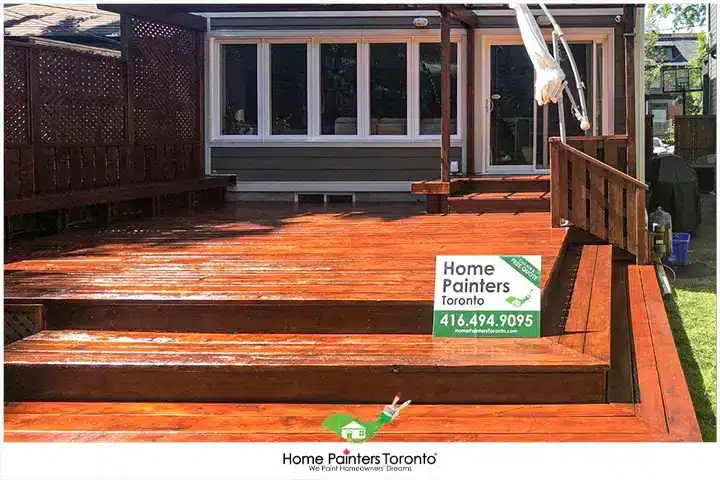
For most Toronto decks, a professional re-stain every two to three years is the practical baseline — but the water-bead test always tells the real story
Why Toronto's Climate Demands a Tighter Deck Maintenance Schedule
Toronto homeowners face a specific set of weather challenges that make exterior wood maintenance more demanding than in warmer or drier climates. Understanding those challenges helps you make smarter decisions about timing and product choice.
The Freeze-Thaw Problem
Southern Ontario regularly experiences freeze-thaw cycles, especially in March, April, and November. Each cycle stresses wood fibres. Moisture works its way into the grain, freezes, expands, and then contracts as it thaws. Over dozens of cycles per season, this creates surface checking, raised grain, and eventually cracks and soft spots.
A properly maintained stain coat acts as a moisture barrier, slowing that process considerably. A worn or failed stain offers almost no protection against this damage. This is why Toronto decks often show wear faster than the same product would in drier climates.
Humidity, UV, and Foot Traffic
Toronto summers bring high humidity combined with strong UV exposure. Both degrade stain faster than dry or temperate conditions. Add foot traffic, pollen, pooling water, and de-icing salt tracked onto decks from winter boots, and the wear compounds quickly.
The Canadian Wood Council confirms that no coating lasts indefinitely and that all need to be reapplied periodically. The protective value of any coating depends entirely on proper, consistent maintenance.
How Often Should You Re-Stain a Deck? The Answer by Stain Type
There is no single number that applies to every deck. Stain type is the biggest variable in how long your finish lasts. The table below reflects general industry guidance. Your specific results will vary based on prep quality, wood species, sun exposure, and product brand.
| Stain Type | Typical Lifespan (Horizontal Surfaces) | Best For |
|---|---|---|
| Transparent / Clear | 1 to 2 years | New, naturally beautiful wood |
| Semi-Transparent | 2 to 3 years | Cedar, pine, pressure-treated in good condition |
| Semi-Solid | 2 to 3 years | Slightly weathered decks with minor discolouration |
| Solid Stain | 3 to 5 years | Older, weathered decks; maximum UV protection |
Note: vertical surfaces such as railings and fence boards last roughly twice as long as horizontal deck floors, because they shed water rather than pooling it. A semi-transparent stain lasting two years on your deck floor may hold four or more years on a fence panel.
Wood Species Also Matters
The Canadian Wood Council's research on performance factors confirms that coatings tend to last longer on dimensionally stable species such as western red cedar, eastern white cedar, and Alaska yellow cedar. These species shrink and swell less with moisture changes, putting less stress on the coating bond over time.
In the GTA, the most common decking materials are pressure-treated lumber and cedar. Both perform well with the right stain and a consistent maintenance schedule.
6 Warning Signs Your Toronto Deck Needs Re-Staining Now
Do not wait until your deck looks obviously damaged. By then, the issue may have moved beyond cosmetics into wood deterioration. Watch for these signs each spring.
- Water Soaks Into the Wood Instead of Beading This is the most reliable test available to any homeowner. Sprinkle a small amount of water on your deck boards. If it beads up and rolls off within a few seconds, your sealant is still working. If the water absorbs into the wood within a minute or two, your protective layer has worn through, and re-staining is overdue.
- Fading or Greying Colour UV exposure bleaches the stain over time. A grey or washed-out appearance means the pigment has failed. Beyond aesthetics, this signals reduced UV and moisture protection for the wood below.
- Peeling, Flaking, or Lifting Stain Peeling almost always points to inadequate prep or a film-forming product that could not flex with the wood's natural movement. It also signals that a proper strip-and-refinish may be needed before any new product can be applied. Our blog on how to stain a deck walks through the full prep process in detail.
- Mould, Mildew, or Dark Staining Between Boards Black or grey patches between boards are often mould, particularly on shaded or north-facing decks. An unprotected deck holds moisture and becomes a breeding ground for fungal growth. Left untreated, mould can spread to the structural members below.
- Soft or Spongy Spots Underfoot If you feel any give when walking on the deck, structural integrity may already be compromised. This goes beyond a staining job. Board replacement or structural repair may be needed before re-staining. Our wood deck repair service addresses these issues first so the staining work lasts.
- Visible Cracking or Raised Grain Surface checking (thin hairline cracks along the grain) is an early sign of moisture damage. Raised grain means the wood fibres have swollen from repeated water exposure. Both indicate that the current finish has failed, and re-staining cannot wait another season.
At Home Painters Toronto, we regularly inspect decks where the homeowner assumed the stain was still holding up because it looked fine from a distance. Up close, the water-bead test tells a different story. Do a simple spring water test each April before booking anything: sprinkle a handful of water on your deck boards and watch what happens. If it soaks in within 60 seconds, do not wait. Re-staining now is almost always cheaper than a catch-up refinish next year.

Greying colour, peeling stain, and dark mould patches between boards are all clear signals that re-staining is overdue — catching them early prevents structural damage
What Happens When You Skip a Re-Staining Cycle in Toronto
Skipping one cycle can feel like a smart way to save money. In practice, it tends to cost more. Here is what typically happens when maintenance is deferred.
A failing stain allows water into the wood. Over a Toronto winter with its repeated freeze-thaw cycles, that moisture expands and contracts inside the fibres. By spring, you may have surface checking, cupping, or board separation that did not exist the previous fall.
The next re-staining job then requires additional prep: sanding, stripping, and in some cases full board replacement before any new product can be applied. That adds significant time, labour, and cost to what should have been a straightforward maintenance coat.
Staying on schedule, by contrast, usually means simpler prep and a faster job. Regular maintenance almost always costs less than restoration. If you keep up the maintenance of your deck, the cost of upkeep can be significantly lower than if you were to completely replace your deck. Protecting that investment starts with not letting maintenance slide.
Best Time of Year to Re-Stain a Deck in Toronto
Timing your re-stain correctly is almost as important as the product you choose. Toronto's short exterior painting season means there are only two reliable windows each year.
The most reliable window in the GTA. Temperatures consistently above 10°C, manageable humidity, and the full summer ahead for curing before winter stress.
Possible but not ideal. Direct hot sun causes stain to dry before it penetrates. Schedule work for early morning or shaded periods and avoid full-sun surfaces at peak heat.
A viable second window before overnight temperatures drop. Requires at least 48 hours of dry weather after application for proper curing.
Cold temperatures prevent proper penetration and curing. Toronto winters do not provide the conditions needed for a quality application.
The exterior painting season in Ontario is genuinely short, and quality crews book up quickly once the weather turns. At Home Painters Toronto, we recommend reaching out in March or April to schedule your deck assessment. Waiting until June often means competing for limited spots with dozens of other homeowners who had the same idea. Booking early gives you better scheduling flexibility and ensures the job happens during the optimal weather window, not after it.
Choosing the Right Stain Type for Your Toronto Deck
Product selection directly affects how long your finish lasts and how much work the next re-staining job requires. Here is how each major stain type performs in a Toronto context.
Allows the full natural wood grain to show through. Least UV and moisture protection. Best suited to new, high-quality wood with tight grain and no weathering.
The most popular choice for Toronto decks. Balances natural wood appearance with solid UV and moisture resistance. Penetrates rather than sits on top, so far less prone to peeling.
More pigment for stronger UV protection while still allowing some wood texture to show. Suits decks with some weathering or slight discolouration.
Maximum UV and weather protection. Works best on older, weathered wood. Can build up over multiple applications and eventually require stripping before the next coat.
If you are unsure whether to stain or switch to a painted finish, our guide on painting over stained wood explains when that transition makes sense and what prep it requires.
The Prep Work Is What Makes Deck Staining Last
Here is something many homeowners learn the hard way. The longevity of a deck stain depends far more on preparation than on the product itself. A premium stain applied over dirty, uneven, or contaminated wood will fail faster than a mid-grade product applied to properly prepped surfaces.
Professional prep typically includes:
- Thorough cleaning with a wood-specific cleaner to remove dirt, mildew, and oxidation
- Pressure washing at a controlled setting to open the wood grain without damaging fibres
- Sanding rough, raised, or splintered areas to create an even surface
- Wood brightening to restore the natural pH and improve stain absorption
- Full dry time of at least 48 to 72 hours before any product is applied
- Spot repairs to boards or structural elements as needed before staining begins
When a professionally stained deck outlasts a DIY job, prep is almost always the reason. Most DIY re-stains skip or rush one or more of those steps, which shortens the life of any stain, regardless of quality. Our exterior residential painting team includes the preparation phase as a non-negotiable part of every exterior project.
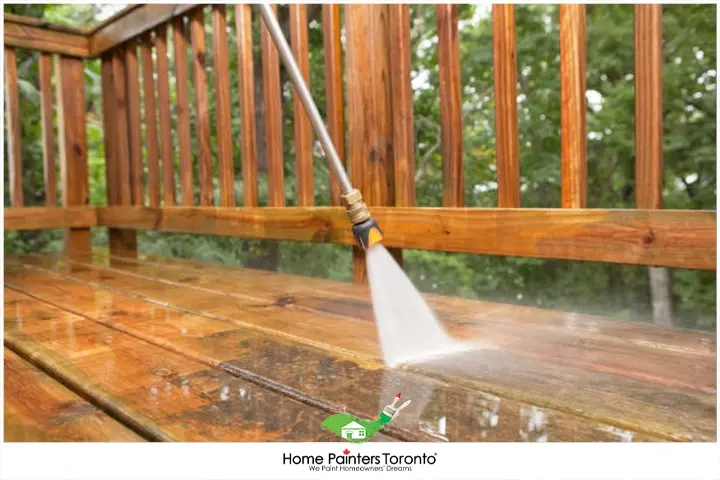
Thorough prep — cleaning, pressure washing, sanding, and brightening — is what separates a two-year finish from a five-year one, regardless of the product used
Why Professional Deck Staining in Toronto Makes Financial Sense
Some homeowners approach re-staining as a weekend project. It can be done that way. But there are real risks to cutting corners, and the financial calculation often favours hiring a professional crew.
Consider what a proper DIY re-stain actually involves:
- Renting or buying a pressure washer and wood cleaner
- Purchasing the correct prep products, stain, and application tools
- Sanding and completing any minor structural repairs
- Masking and protecting adjacent surfaces
- Two to three full days of physical labour, often in summer heat
- Proper disposal of materials
Add up material costs, rental fees, and your time, and the gap between DIY and professional narrows quickly. More importantly, a professional application done with proper prep extends the stain's lifespan, which means fewer cycles and lower total cost over the life of your deck.
Home Painters Toronto has been staining decks and fences across the GTA for over 38 years. All work is completed by in-house painters, not subcontractors, which means consistent quality and clear accountability on every project. If your property also includes wood fencing, our guide on the best paint and stain for fences covers product and timing considerations for vertical exterior wood surfaces.
Frequently Asked Questions About Deck Staining in Toronto
Most Toronto decks benefit from re-staining every two to three years. Semi-transparent penetrating stains on horizontal surfaces typically last two to three years in the GTA climate. Solid stains can stretch to three to five years. Transparent finishes may need attention every one to two years. The most reliable indicator is always the water-bead test: if water soaks into the wood rather than beading on the surface, re-staining is due.
Late May through June is the most reliable window in the GTA. Temperatures are consistently above 10 degrees Celsius, and humidity is manageable. Early fall (late August through mid-September) is a workable second option. Avoid application in hot direct sun, immediately after rain, or when overnight temperatures are expected to drop significantly within 48 hours of application.
Do the water test. Sprinkle water on the deck boards. If it soaks in within a minute or two rather than beading up, your protective finish has worn through. Other signs include faded or grey colouration, peeling or flaking stain, mould or mildew growth between boards, soft spots underfoot, and visible surface cracking or raised grain.
Generally, yes. The difference comes down almost entirely to preparation. Professionals clean, sand, and properly treat the wood before applying any product, which allows the stain to penetrate fully and bond correctly. Skipping or rushing prep is the most common cause of premature stain failure on DIY jobs. A well-prepped professional application can meaningfully extend the lifespan of the same product.
Home Painters Toronto prices deck staining starting at $1,495 + HST. General ranges are approximately $1,600 to $2,200 + HST for small to medium decks, $2,200 to $3,000 + HST for medium to large, and $3,000 to $5,000+ + HST for large to extra-large decks. Exact pricing depends on the deck's condition, size, and the prep work required. The best way to get an accurate number is to request a free quote.
Yes. Home Painters Toronto handles both deck and fence staining together. Scheduling them as a single project is often more efficient and can reduce total cost. Our team provides colour consultation as part of the assessment and works with leading brands including Benjamin Moore and Sherwin Williams. For more on fence-specific products and considerations, see our guide on exterior wood siding and wood surface finishes.

Deck Staining Toronto Homeowners Can Count On
Deck staining in Toronto is one of the most cost-effective ways to protect a significant outdoor investment. Most GTA decks need re-staining every two to three years, but the real signal is always the condition of the wood and the current finish rather than a fixed date on the calendar. The spring water-bead test takes 30 seconds and tells you exactly where things stand.
Toronto's freeze-thaw cycles, humid summers, and strong UV exposure accelerate finish wear faster than in milder Canadian climates. Staying on schedule with proper prep and professional application is almost always cheaper than catching up after neglect. When you factor in materials, time, and the quality difference between a rushed DIY job and a correctly prepared finish, the value of working with an experienced team is clear.
Home Painters Toronto has been protecting GTA decks and fences for over 38 years. Our in-house team handles everything from initial assessment and prep to colour consultation and final coat, with a 3-year exterior warranty on qualifying projects.
Get a Free Deck Staining Quote Today
If your deck is showing any of the warning signs covered in this guide, do not wait another season. Contact Home Painters Toronto today and get your deck protected before the weather makes the decision for you.
Get Your Free Quote