

Knowing the best time for exterior painting paint application is not just about finding a sunny week on the calendar. It involves understanding the temperature and humidity conditions paint needs to cure properly, reading the physical signs that tell you a repaint is overdue, and knowing how the Toronto climate specifically shortens paint life compared to milder regions.
This guide covers both dimensions of the timing question: when during the year conditions are right for exterior painting, and when your home's exterior is telling you it needs to be repainted regardless of the season.
- The visual signs that tell you it is time to repaint your home's exterior
- How long exterior paint actually lasts by surface type in Toronto conditions
- Why Toronto's freeze-thaw climate accelerates paint failure
- The best season and month for exterior house painting in Toronto
- The exact temperature and humidity conditions to target
- How surface orientation affects how fast paint fades and fails
- Surface-specific repainting timelines for wood siding, brick, stucco, aluminum, and vinyl
- What exterior painting costs in Toronto in 2026
- A real project case study
- FAQ answers to the most common homeowner questions
Is your home ready for a refresh? Get a free estimate now!
When you're deciding on exterior painting or repainting, one of the first things to consider is when to paint your home. Timing is everything with exterior painting. To ensure a beautiful, long-lasting finish, you need the right weather conditions and the right time of year.
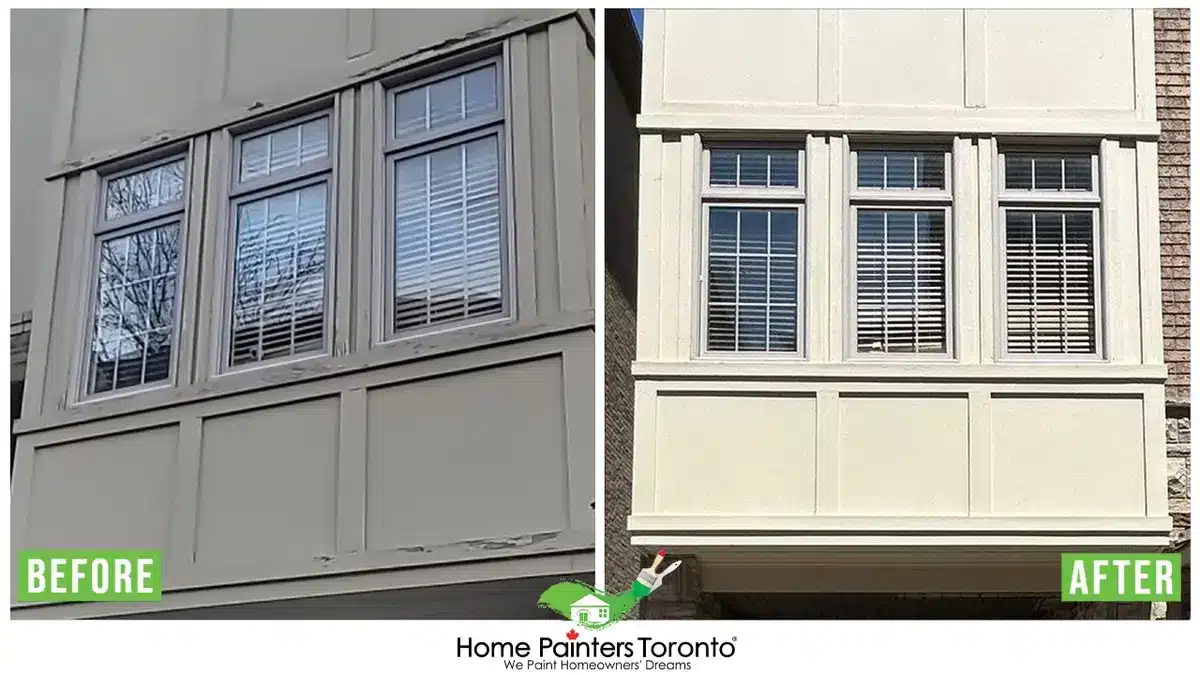
Catching the signs early — chalking, minor fading, hairline caulk cracks — means a straightforward repaint. Waiting until peeling is extensive means carpentry repairs before any paint goes on.
Signs It's Time to Repaint the Exterior of Your Home
Peeling and flaking paint is one of the most visible indicators that it's time to repaint. Not only does peeling paint look unsightly, but it can also leave your home vulnerable to further damage if left unaddressed. Paint peels when its bond with the underlying surface fails, often due to moisture intrusion, inadequate surface preparation, or the natural breakdown of the paint film over time.
In Toronto specifically, peeling is often a symptom of freeze-thaw cycling. Moisture that gets behind the paint film through hairline cracks in caulk or through failed paint edges expands when it freezes and forces the paint away from the substrate. Once this process begins, it accelerates rapidly. A small area of peeling in October often reveals a significantly larger affected area by the following spring.
Peeling paint is also a warning sign for the substrate beneath. When paint peels and exposes bare wood, that wood begins absorbing moisture directly. In Toronto conditions, bare wood left exposed through even one winter can develop early-stage rot within a single freeze-thaw season. The rule of thumb our team applies is straightforward: visible peeling is an urgent sign, not something to address next year.
Over time, the colour of your home's exterior paint will begin to fade due to exposure to UV rays and other environmental factors. Fading is a sign that the paint's protective qualities are diminishing and it is time for a fresh coat. On south-facing and west-facing elevations, which receive the most direct afternoon sun, colour fading often occurs significantly faster than on north-facing walls.
Dark colours absorb more UV radiation and fade faster than light or neutral tones. A deep charcoal or navy blue on a south-facing siding can show visible fading within three to four years even with a quality product. Light greys and off-whites on the same exposure may look consistent for seven years or more. This is not a sign that the paint job was done poorly. It is a physical consequence of UV degradation that affects pigments regardless of brand.
The practical test for fading: compare the current colour on a protected surface (under an eave, or behind a downspout) with the exposed face. If the difference is noticeable from a few metres away, the pigment has degraded enough that the protective resin is also compromised, and the surface is approaching the end of its service life.
Chalking occurs when the paint's binders break down and its pigments begin to erode, resulting in a powdery residue on the surface of the paint. To test for chalking, simply run your hand across the surface of your home's exterior; if you see a powdery residue on your hand, it's a sign that the paint is chalking.
Chalking is one of the earliest warning signs that precedes visible peeling and fading. Once chalking is present, the paint film has lost a significant portion of its protective capacity. Rain washes the chalk from the surface but also carries it down the wall, sometimes staining other surfaces below. The film that remains after chalk has begun developing is significantly thinner and more porous than when the paint was first applied.
When chalking is caught early, the remediation is relatively simple: thorough cleaning to remove the chalk residue, a full prep and priming sequence, and a fresh topcoat. When chalking is left until the film has deteriorated significantly, the prep work is more extensive because the remaining paint must be assessed for adhesion and removed in areas where it has become too thin or compromised to serve as a substrate for the new coat.
Mould and mildew thrive in damp, shaded areas and can cause significant damage to your home's exterior if left untreated. If you notice dark streaks or patches on your home's exterior, it may be a sign of mould or mildew growth, which may indicate that it is time to repaint.
In Toronto, north-facing and heavily shaded exterior surfaces are particularly susceptible to mould growth because they receive less direct sunlight and dry more slowly after rain. Homes in mature neighbourhoods where large trees shade much of the exterior, particularly in areas like The Annex, Roncesvalles, and established North York neighbourhoods, often show mould growth on siding and trim within three to five years of a paint job, regardless of paint quality.
The important point about mould on exterior surfaces is that painting over it without treating the underlying biological growth is a guaranteed early failure. The mould grows through the new paint film, typically within one to two seasons, and the problem returns larger than before. The correct sequence is: kill the mould with a diluted bleach solution, rinse thoroughly, allow to dry completely, apply a mould-resistant primer, and then topcoat with a paint containing a mildewcide additive. For more on proper exterior surface prep, see our guide to preparing your home for exterior painting.
Caulk plays a crucial role in preventing moisture from entering your home's exterior and causing damage. Over time, caulk can crack, shrink, or fall out, leaving gaps that allow moisture to enter. If you notice cracked or missing caulk around your home's windows, doors, and other openings, it's a sign that it's time to recaulk and possibly repaint.
Failed caulk is one of the most important early warning signs on any Toronto home exterior, and one that homeowners frequently overlook because it does not look dramatic from a distance. A hairline crack in the caulk bead at a window frame allows water to enter behind the siding or behind the window frame itself. Through a Toronto winter of freeze-thaw cycling, that small entry point expands as moisture freezes inside it. By spring, what was a hairline crack in October has often become a significant gap that is allowing water directly into the wall cavity.
The spring walk-around after snowmelt is the most important time to inspect caulk condition. Press on all caulk runs at window and door frames. Caulk that has lost its flexibility and has hardened to the point of crumbling when pressed has failed, regardless of whether the crack is visible yet. Failed caulk should be removed and replaced before any paint work begins. Our exterior caulking service handles full caulk inspection and replacement as part of our standard exterior painting scope.
Even if your home's exterior doesn't show any obvious signs of damage or wear, it's important to repaint it every few years to maintain its protective qualities. Most exterior paints have a lifespan of 5 to 10 years, depending on the quality of the paint, the climate, and the preparation of the surface before painting.
How Long Does Exterior Paint Last by Surface Type in Toronto?
The repainting timeline varies significantly by surface material. Toronto's freeze-thaw cycling and UV exposure mean that timelines at the shorter end of these ranges are more realistic for this climate than manufacturer specifications sometimes suggest.
| Surface Type | Typical Repaint Timeline | Toronto-Specific Notes |
|---|---|---|
| Wood siding and trim | 5 to 7 years | Shorter on south and west-facing elevations with direct sun |
| Aluminum siding | 5 to 7 years | Chalking and fading are the primary signs; check for corrosion at joints |
| Vinyl siding (painted) | 7 to 10 years | Vinyl expands and contracts more than wood; paint adhesion is the key variable |
| Stucco | 5 to 7 years | Cracks in stucco must be addressed before every repaint cycle |
| Painted brick | 7 to 10 years | Elastomeric coatings last longer; earlier failure near mortar joints is common |
| Exterior doors and trim | 4 to 6 years | High-contact areas wear faster; south-facing doors show earliest UV degradation |
| Decks (painted) | 2 to 4 years | Foot traffic and UV combine to degrade deck paint faster than siding |
| Fences | 3 to 5 years | Penetrating stains generally outperform paint in longevity on fence surfaces |
These timelines assume proper prep and application of a premium 100% acrylic exterior product. Poor prep, a single coat instead of two, or incorrect product for the surface can reduce any of these timelines by 30 to 50 percent.
Why Toronto's Climate Shortens Exterior Paint Life
Toronto homeowners painting their homes need to understand one fundamental fact about the city's climate: it is significantly harder on exterior paint than most of North America.
Toronto experiences more than 100 freeze-thaw cycles per year. Every time the temperature rises above 0 degrees Celsius after a cold period, and then drops below freezing again, any moisture that has entered the paint film or the substrate beneath it expands and contracts. Over 100 cycles per year, this mechanical stress is relentless. Paint that is flexible enough to accommodate this movement, specifically 100% acrylic latex paint in premium formulations, handles it well. Paint that has become brittle from age, UV degradation, or poor formulation cracks and lifts with each cycle.
The combination of freeze-thaw stress and Toronto's high summer humidity (regularly above 70 to 80 percent relative humidity in July and August) means the exterior paint film is under stress at both ends of the seasonal calendar. The summer humidity prevents the film from achieving maximum hardness, and the winter freeze-thaw cycling exploits any weakness that remains.
This is why a paint job done in Toronto with proper prep and premium products, at the right time of year, typically lasts 7 to 10 years. The same paint job done with inadequate prep or applied outside the ideal temperature and humidity window may last as few as 2 to 3 years before requiring attention.
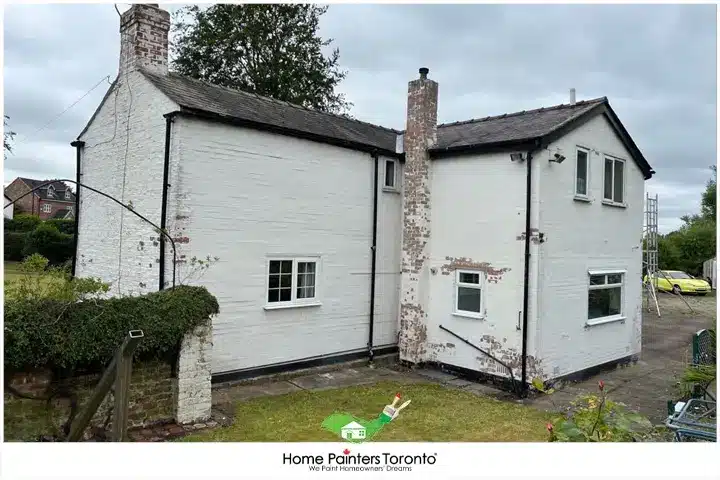
South and west elevations face the most UV and temperature stress; north elevations face moisture and mould risk. Inspect each elevation independently when planning a repaint.
What Is the Best Time for Exterior House Painting in Toronto?
Spring
Spring is the ideal time for exterior painting in Toronto. The temperatures are mild, which helps the paint to adhere properly to the surface, and the lower humidity levels ensure that the paint will dry and cure correctly. Additionally, spring is the perfect time to address any damage that may have occurred during the winter months.
The precise spring window that delivers the most reliable results in Toronto is mid-May through mid-June. By mid-May, overnight temperatures have consistently risen above 10 degrees Celsius, which is the minimum curing threshold for standard 100% acrylic exterior latex paints. Humidity is moderate rather than high, and the surfaces have had enough time since snowmelt to dry at depth, not just at the surface.
The specific risk in early spring (March and April) is the overnight temperature. Daytime highs may reach 12 to 14 degrees Celsius in April, which looks acceptable, but overnight lows of 2 to 5 degrees Celsius during the same period fall below the minimum curing threshold. Paint applied in acceptable daytime conditions but exposed to sub-threshold overnight temperatures before the film has cured will have adhesion and coalescence problems that only become visible several months later.
According to Benjamin Moore's temperature guide for exterior painting, the recommended range for exterior painting is between approximately 4 and 38 degrees Celsius, with the surface and air temperature needing to remain within this range for the full cure period. For standard latex paints in Toronto, waiting for consistent nighttime temperatures above 10 degrees Celsius is the most reliable approach.
For a full guide to spring exterior painting timing and preparation, see our spring exterior painting guide.
Summer
While summer can be a good time for exterior painting, there are some things to keep in mind. The high temperatures and humidity can affect the quality of the paint job, so it's important to choose the right time of day to paint and to take breaks if necessary.
The summer risk in Toronto is concentrated in July and August when relative humidity regularly peaks above 70 to 80 percent. At these humidity levels, exterior latex paint takes significantly longer to cure than the label suggests. The surface skins over as the top layer evaporates, but the underlying film remains soft and vulnerable much longer than in lower-humidity conditions.
The practical summer strategy is to work with the shade. Start each day on the elevation that is in shade in the morning and move around the house as the sun moves. Never apply exterior paint to a surface that is in direct peak-afternoon sun. The surface temperature of a west or south-facing wall in direct July sun can reach 40 to 50 degrees Celsius even when the air temperature is 28 degrees, and paint applied to a surface that hot will skin over before it has levelled, leaving a rough, uneven film.
Work from approximately 7 to 11 in the morning when temperatures are cooler and humidity is at its daily low. Avoid application after 2 or 3 in the afternoon on hot July and August days when temperatures and humidity are both peaking. For comprehensive guidance on how our team manages summer exterior painting conditions across Toronto, see our full seasonal timing guide.
Fall
Fall is another great time for exterior painting in Toronto. The temperatures are mild and the humidity levels are lower, which creates ideal conditions for painting. Additionally, painting in the fall ensures that your home will be protected from the harsh winter weather.
September through mid-October is our professional team's preferred exterior painting window, and it is one that most Toronto homeowners underuse. September in Toronto combines stable temperatures in the 18 to 24 degree Celsius daytime range with overnight lows above 10 degrees Celsius and the lowest humidity levels of the painted season. Surfaces that have dried out through summer are at their annual lowest moisture content, which is ideal for adhesion.
The critical management requirement in fall is monitoring the October overnight temperature. As the month progresses, overnight lows increasingly drop toward and below the 10 degree Celsius minimum curing threshold. By late October, standard exterior painting should not proceed in most years. As Sherwin-Williams guidance on late-season exterior painting notes, a common mistake is painting when daytime temperatures are acceptable but overnight lows drop below the minimum, stopping the coalescence of the paint film before it is complete. The result is a structurally compromised film that fails early in the first freeze-thaw season.
For homes going to market in spring, painting in early fall is almost always the smarter investment than waiting for the following spring. The exterior is protected through winter and looks fresh in March and April when listing photos are taken and the spring market opens. For a comprehensive guide to fall exterior painting, see our fall exterior painting guide.
Winter
Winter is not typically a good time for exterior painting in Toronto due to the low temperatures and harsh weather conditions. Painting in winter can result in poor adhesion, slow drying times, and even damage to the paint if it freezes before it has had time to cure.
The practical reality for Toronto is that exterior painting is not feasible from approximately November through March for most residential projects using standard exterior latex products. During these months, daytime temperatures rarely stay above 10 degrees Celsius consistently, overnight lows are regularly at or below zero, and the freeze-thaw cycles that are so damaging to uncured paint are at their most frequent.
Some low-temperature specialty formulations can be applied down to approximately 2 degrees Celsius, but these are purpose-built products that require both precise surface monitoring and favourable overnight forecasts. They are not a general-purpose workaround for winter painting and should not be substituted for standard exterior paints in marginal conditions.
If you have urgent exterior painting needs in winter, the right answer is to address what can be addressed (interior surfaces, garage interiors, any heated-space work) and schedule the exterior project for the first available spring window. A rushed exterior paint job in below-minimum winter conditions will fail within the first season and require complete rework.
How Surface Orientation Affects Paint Life on Toronto Homes
One of the most practically useful pieces of information for Toronto homeowners planning repainting projects is that not all elevations of the same house age at the same rate. Surface orientation relative to the sun significantly affects how quickly paint fades, chalks, and fails.
South-facing and west-facing elevations receive the most direct UV radiation and the highest surface temperatures during Toronto summers. These are the elevations where paint typically shows the earliest fading and chalking, and where peeling is first seen. On a home last painted 8 years ago, the south and west elevations may be approaching end of service life while the north elevation still looks acceptable.
North-facing elevations receive the least direct sun and stay cooler and damper. They are less susceptible to UV-driven fading but more susceptible to mould and mildew growth and to the effects of moisture retention. North-facing surfaces often look structurally sound from a distance but show biological growth and moisture-driven adhesion problems on close inspection.
East-facing elevations are in the middle. They receive morning sun that is lower in intensity than the afternoon sun hitting the west face, and they benefit from better drying conditions after morning dew than the north face.
When assessing your home for a repainting project, inspect each elevation independently rather than assessing the whole home as a single condition. It is common and entirely appropriate to repaint selected elevations that have failed early while leaving other elevations that are still in acceptable condition. Our team provides elevation-by-elevation assessments as part of every exterior painting estimate.
What Physical Signs Show Your Exterior Paint Is Failing?
Exterior paint failure usually shows up before the coating completely breaks down. Chalking, cracked caulking, soft wood, bubbling, lifting paint, and major colour fading are all warning signs that the exterior finish is no longer protecting the home properly.
These signs matter because exterior paint is more than a cosmetic finish. It helps protect siding, trim, fascia, window frames, and wood surfaces from moisture, UV exposure, and seasonal movement. When the coating begins to fail, water can enter gaps, wood can soften, and small surface problems can turn into larger repair costs.
For Toronto homeowners, these warning signs are especially important because freeze-thaw cycles, winter moisture, summer humidity, and direct sun exposure can speed up paint failure. A professional inspection helps confirm whether the home needs repainting, caulking, wood repair, or deeper surface preparation before a new coating is applied.
DIY vs. Professional Exterior Painting: What the Timing Decision Means for Each
The timing requirements for exterior house painting are the same regardless of whether the work is done by a homeowner or a professional crew. The difference is in the ability to execute on those requirements reliably.
A professional crew has flexibility to follow the weather: scheduling around temperature and humidity forecasts, starting and stopping according to conditions, and managing the sequence of work so each coat goes on under the right conditions. A homeowner who can only paint on weekends has less ability to respond to a weather window that arrives on a Tuesday.
For straightforward repaints on accessible single-storey homes with surfaces in good condition, DIY exterior painting is a viable option when the homeowner understands and respects the temperature and humidity requirements. For projects involving multi-storey access, significant peeling or damage, wood rot repair, or lead paint on pre-1978 homes, professional execution produces significantly better results.
Our team provides free estimates for any exterior painting scope. Call 416.494.9095 or request a free estimate online for an honest assessment of what your home needs and what it will cost.
How Much Does Exterior House Painting Cost in Toronto in 2026?
DIY Cost Estimate
- Premium 100% acrylic exterior topcoat (Sherwin-Williams Duration or Benjamin Moore Aura Exterior): $70 to $110 per 3.78L
- Exterior-grade primer (wood or masonry as applicable): $55 to $85 per 3.78L
- Exterior caulk: $8 to $15 per tube (most homes need 4 to 8 tubes for a full exterior)
- Sandpaper, scrapers, wood filler, painter's tape: $40 to $70
- Brushes, rollers, roller covers, extension poles, drop cloths: $50 to $100
- Pressure washer rental: $60 to $90 per day
- Total DIY materials for a standard Toronto detached home exterior: $600 to $1,200 CAD depending on scope and surface condition
Professional Cost Estimate
Professional exterior painting in Toronto for a standard residential project runs $2,500 to $8,500 CAD depending on the size of the home, the number of surfaces being painted, the condition of the existing paint and wood, and whether any carpentry repairs are required before painting.
The variables that push a project toward the higher end of that range are: significant peeling or adhesion failure requiring extensive scraping, soft wood or rot requiring carpentry repair, multi-storey or difficult-access elevations requiring scaffolding, and pre-1978 homes requiring lead-safe handling protocols.
For a precise quote based on your specific home, see our exterior painting cost guide. Home Painters Toronto backs all exterior painting work with a 3-year warranty and all brick staining with a 15-year warranty.
Real Project: Timing an Exterior Repaint Correctly in Toronto
Leslieville Detached: Elevation-by-Elevation Assessment and September Repaint
Here is a summary of a recent exterior repainting project our team completed on a detached home in Leslieville that illustrates how timing and surface assessment interact in practice.
The situation: The homeowner contacted Home Painters Toronto in late August after noticing that the south and west elevations of their home were showing significant chalking and some early peeling at window frame edges. The home had been painted approximately nine years prior. The north elevation showed lighter chalking and no peeling. The east elevation was between the two, showing moderate chalking.
Our assessment: The south and west elevations were at end of service life and needed a full repaint sequence including scraping of all loose paint, sand, caulk replacement, primer, and two topcoats. The north elevation had moderate chalk that would clean off with power washing and benefit from a fresh topcoat over the existing sound film. The east elevation fell between and received the same full sequence as the south and west.
The timing decision: Work was scheduled for the third week of September. Power washing was completed on September 10th with a 72-hour drying window. Painting proceeded from September 13th through September 19th. Daytime temperatures averaged 20 degrees Celsius with overnight lows consistently above 12 degrees Celsius.
The result: All four elevations completed in September with full cure time before the first Toronto frost in late October. The homeowner noted that the north elevation, which had been done with a single topcoat over the existing film rather than a full strip and prime, was indistinguishable in finish quality from the full-sequence elevations.
For more completed projects, visit our Toronto painting projects page.
Frequently Asked Questions About the Best Time for Exterior House Painting
Mid-May through mid-June and September through mid-October are the two most reliable windows. Both offer temperatures consistently in the 15 to 24 degree Celsius range, manageable humidity, and stable overnight lows above the 10 degree Celsius minimum curing threshold for standard exterior latex paints. September is our team's preferred month for the reasons outlined throughout this guide: lowest humidity of the painted season, surfaces at their annual driest, and often better contractor availability than the peak spring window.
Look for chalking (powdery residue when you run a hand across the surface), fading colour compared to protected areas under eaves, peeling or bubbling paint at joints and edges, cracked or missing caulk at windows and door frames, mould or dark staining on north-facing and shaded surfaces, and soft wood at sills, fascia boards, and trim corners. Any two or more of these signs together indicate the home needs attention before another winter cycle.
With proper prep, premium 100% acrylic product, and application in appropriate temperature and humidity conditions, exterior paint on a Toronto home should last 7 to 10 years on siding and masonry. Trim and doors, which receive more direct contact and UV stress, typically need attention every 5 to 7 years. Poor prep or application outside the right conditions can reduce any of these timelines by 30 to 50 percent.
Straightforward repaints on accessible, single-storey homes with surfaces in good condition are achievable as a careful DIY project. The requirements are the same regardless of who does the work: proper surface prep, correct primer for the surface type, and application within the right temperature and humidity window. Projects involving multi-storey access, significant wood damage or rot, lead paint (pre-1978 homes), or complex masonry surfaces benefit strongly from professional execution.
Standard 100% acrylic exterior latex paints require a minimum of 10 degrees Celsius at application and for at least 24 to 48 hours after the final coat. Below this threshold, the latex particles cannot coalesce properly and the film will be structurally weak. Some premium formulations including Sherwin-Williams Duration and Resilience can be applied down to approximately 2 degrees Celsius, but these require careful overnight temperature monitoring and are not general-purpose workarounds for painting in cold conditions.
If the exterior shows signs of failure (peeling, chalking, failed caulk), repainting before winter is always the right decision. Exposed wood, failed caulk, and compromised paint films are damaged further by every freeze-thaw cycle. Deferring to spring while the surface is actively failing means incurring more damage, more prep work, and more expense by the time the project is finally completed. If the exterior is in good condition and the timing is about preference rather than urgency, early fall painting protects the home through winter and produces a fresh exterior for the spring market. Spring painting maximizes the time before the paint faces its first winter.
For most Toronto homeowners, the single most important piece of advice we can give is this: do not wait until the paint is obviously failing before repainting. Catching the signs early, chalking, minor fading, hairline caulk cracks, means a straightforward repaint project. Waiting until peeling is extensive or bare wood is exposed means carpentry repairs before any paint can go on, significantly more prep work, and a higher total project cost.
More Interesting Blogs Related to Exterior Painting: When to Paint Your Home
Not Sure If Your Home Needs Repainting? Let's Find Out Together.
Home Painters Toronto has been assessing and painting Toronto and GTA exteriors since 1987. We provide free estimates and honest advice on what your home actually needs. Call 416-494-9095 or email [email protected] for a FREE quote.