

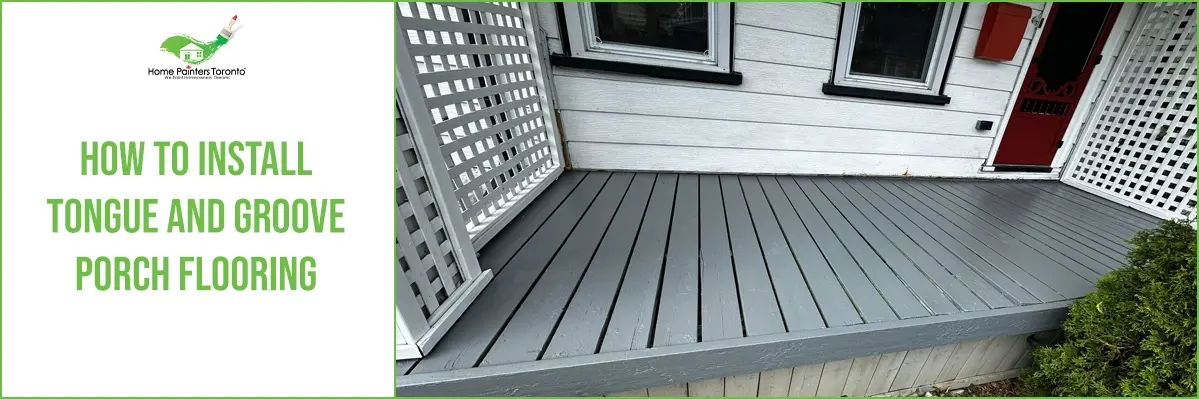
Installing Tongue and Groove Porch Floor in Toronto
Tongue and groove porch floor installation in Toronto is one of the most common exterior carpentry requests for Victorian and Edwardian homes throughout Leaside, Riverdale, The Annex, and Roncesvalles, where the original front porch flooring has reached the end of its service life after a century or more of freeze and thaw cycling. Home Painters Toronto, the HomeStars Best of Award 2026 winner with over 1,200 positive reviews and 37 years serving the GTA, replaces and finishes tongue and groove porch floors across the city every season. The choice of material and the drainage slope set during installation are the two decisions that determine how long the floor will last and how little maintenance it will require. Everything else in the installation scope is secondary to getting those two decisions right.
Tongue and Groove Porch Floor Installation in Toronto: Why Material and Slope Are the Two Decisions That Determine Everything
Most guides on tongue and groove porch floors focus on fastening methods and board spacing. Those details matter, but they matter far less than the two decisions made before a single board is installed: what material the boards are made of, and what slope the floor drains at. A correctly sloped pressure treated floor with suboptimal fastening will outlast a perfectly fastened cedar floor installed perfectly level by many years in Toronto's climate.
The reason slope is the primary determinant of porch floor longevity is simple. A flat or back sloped porch floor on a Toronto home pools water at the house wall after every rain and snowmelt. That pooled water saturates the wood at the innermost boards and the ledger connection every time it rains. Over several seasons, the saturation cycle produces rot at exactly the point where the floor meets the house, which is the most expensive section to replace because it requires disconnecting the ledger. A correctly sloped floor drains immediately and stays dry between precipitation events.
According to CMHC's guidance on home maintenance and protecting investment value, moisture management at all exterior wood connections is one of the most critical factors in preserving the structural integrity and long term value of a Canadian home. A correctly sloped and properly finished tongue and groove porch floor is a direct expression of that principle.
Tongue and Groove Porch Flooring Materials: Pressure Treated, Cedar, Composite, and PVC Compared for Toronto Conditions
Pressure Treated vs Cedar vs Composite: Which Holds Up Best in Toronto's Freeze and Thaw Climate
Pressure treated lumber is the most widely used material for tongue and groove porch floors in Toronto because it is the most cost effective option that handles the city's freeze and thaw cycling reliably. According to Natural Resources Canada's guidance on treated wood, pressure treated wood uses preservative chemicals that protect the wood fibres against decay fungi and insect damage. For above grade exterior applications like a front porch floor, the correct preservative retention level is UC3B (above ground, exposed to weather). PT lumber in 5/4 x 6 tongue and groove profile is the standard specification for Toronto porch floors and provides a 20 to 25 year service life when correctly installed and maintained.
Western red cedar is the premium natural wood alternative. Cedar has natural tannins that resist decay without pressure treatment, and it accepts stain finishes beautifully. The trade off is cost and seasonal movement: cedar is significantly more expensive than PT and moves more dimensionally across the grain through Toronto's humidity swings, which can produce cupping in boards that are wider than 4 inches if moisture content is not managed carefully during installation. Cedar 5/4 x 4 tongue and groove is the correct profile for Toronto to minimize cupping risk.
Composite decking products are sometimes used on covered porches but are generally not recommended for front porch floors in Toronto's climate. Most composite products specify a minimum slope requirement that is difficult to achieve on the shallow pitch of a covered porch floor, and composite's thermal expansion in summer sunlight produces more visible gapping and joint movement than natural wood. PVC decking products are the most moisture resistant option but are significantly more expensive and look visually different from the natural wood appearance appropriate for Victorian and Edwardian heritage homes.
| Material | Service Life | Cost | Finishing | Best For |
|---|---|---|---|---|
| Pressure treated 5/4 x 6 T&G | 20 to 25 years with maintenance | $ | Solid stain or porch enamel paint after 60 to 90 day drying period | Most Toronto front porches; best value for money |
| Western red cedar 5/4 x 4 T&G | 15 to 20 years with maintenance | $$$ | Semi transparent or solid stain; no paint | Heritage homes where natural wood appearance is priority |
| Composite decking | 25 to 30 years with minimal maintenance | $$$$ | No finish needed | Covered porches with sufficient drainage slope; modern home styles |
| PVC decking | 30 plus years | $$$$$ | No finish needed | Highest moisture exposure situations; contemporary home styles |
What Professional Tongue and Groove Porch Floor Installation Actually Involves in Toronto
Professional tongue and groove porch floor installation begins with full removal of the existing failed flooring and a thorough inspection of the substructure: the joists, ledger board, beam, and post bases. Substructure inspection is the most important step in the project because installing new flooring over a compromised substructure produces early failure at the points where the new boards have no solid support beneath them.
Any joists showing soft spots, discolouration from moisture staining, or visible fungal growth are sistered or replaced before new flooring is installed. The ledger connection to the house is inspected for rot at the fastener holes, which is the most common moisture entry point on a Toronto porch. The post bases are checked for deterioration at the concrete interface, where standing water concentrates and accelerates decay.
Tongue and Groove Porch Floor Installation: Why the 1/4-Inch-Per-Foot Slope Rule Matters in Toronto
The standard drainage slope for a covered porch floor is 1/4 inch of drop per foot of porch width, measured from the house wall outward to the porch edge. On a standard 6 foot wide Toronto front porch, this produces 1.5 inches of total drop across the width. This slope is steep enough to drain water immediately after rain but shallow enough that it is imperceptible when walking on the floor.
Installing new tongue and groove boards over an existing substructure that has zero slope or a back slope toward the house requires shimming the joists to introduce the correct drainage pitch before flooring is installed. Shimming takes additional time but is not optional on any porch where water management at the house wall is a concern. On a Victorian or Edwardian Toronto home where the ledger connects directly to a masonry foundation or brick wall, water pooling at the inner floor edge accelerates mortar joint deterioration in addition to wood rot.
For homes where the substructure has deteriorated beyond what shimming and sistering can address, full substructure replacement precedes flooring installation. Our porch wood repair and replacement service covers all substructure assessment and repair work throughout the GTA. Our exterior carpentry service handles the complete project from substructure to finish coat.
What is Tongue and Groove Porch Flooring?
Tongue and groove flooring is a type of flooring system where each board has a protruding ridge, called a tongue, on one side and a corresponding groove on the other. When the boards are fitted together, the tongue of one board fits into the groove of the adjacent board, creating a seamless and stable surface. This interlocking system helps prevent gaps and movement between the boards, resulting in a sturdy and smooth floor surface.
Tongue and groove porch flooring is specifically designed for outdoor use, typically made from durable wood species or composite materials. It is commonly used for covered porches, verandas, and outdoor decks. The design of tongue and groove flooring allows for slight expansion and contraction of the wood with changes in temperature and humidity, which is a critical advantage in Toronto's climate where those changes are significant throughout the year.
Benefits of Tongue and Groove Porch Flooring
- Stability: The interlocking system of tongue and groove flooring provides a stable surface that resists warping, buckling, and shifting.
- Aesthetics: Tongue and groove porch flooring offers a classic and attractive appearance that enhances the visual appeal of any porch or outdoor area. It comes in a variety of wood species and finishes to match different architectural styles, including Victorian and Edwardian homes throughout Toronto.
- Durability: Made from weather resistant materials, tongue and groove porch flooring is built to withstand the elements, including rain, snow, and the freeze and thaw cycling that Toronto experiences over 100 times per year.
- Easy Installation: The interlocking design of tongue and groove flooring simplifies the professional installation process, allowing for accurate alignment and a professional finish.
- Low Maintenance: With the right finish and periodic cleaning, tongue and groove porch flooring requires relatively little maintenance compared to other outdoor flooring options.
Finishing and Painting a Tongue and Groove Porch Floor
The finishing sequence for a newly installed tongue and groove porch floor depends on the material. Cedar can be stained within a few weeks of installation once surface moisture normalizes. Pressure treated lumber requires a minimum drying period before any finish is applied, because the preservative treatment process saturates the wood fibres with water during manufacturing. Applying stain or paint to lumber that has not dried adequately produces a finish that peels within the first season as the retained moisture migrates through the coating.
Painting vs Staining a Tongue and Groove Porch Floor: Which Lasts Longer in Toronto
Solid colour stain is the preferred finish for tongue and groove porch floors in Toronto. Solid colour stain penetrates the wood surface rather than forming a film over it, which means it does not peel the way paint peels when moisture moves through the wood. On a porch floor that experiences foot traffic, furniture contact, and seasonal moisture cycling, a penetrating solid stain lasts 3 to 5 years before recoating is needed. A porch enamel paint produces a harder, more reflective finish but begins to peel at the wood joints within 2 to 3 years as the boards move seasonally.
Semi transparent stains are appropriate for cedar floors where the natural grain appearance is desired. They provide less colour coverage and less UV protection than solid stains, and recoating is needed every 2 to 3 years. Semi transparent stains are not recommended for pressure treated wood because the green tint of the preservative treatment shows through the lighter colour coverage.
Benjamin Moore Arborcoat in solid exterior stain formulation is the product our team specifies most frequently for Toronto porch floors. It is available in a wide colour range, penetrates the wood fibres effectively, and produces a durable finish that recoats cleanly when maintenance is due. For all porch and deck finishing needs, see our deck and fence staining service.
How Tongue and Groove Porch Floors Are Professionally Installed
Professional tongue and groove porch floor installation follows a consistent sequence that ensures both structural integrity and finish quality. The sequence begins with substructure inspection and repair and ends with finishing, typically across two to four days depending on porch size and substructure condition.
Maintaining a Tongue and Groove Porch Floor Through Toronto's Seasons
A correctly installed and finished tongue and groove porch floor in Toronto requires inspection and cleaning twice per year: once in spring after the snowmelt season and once in fall before temperatures drop. Spring inspection checks for any boards that have lifted or cupped through the winter, any fasteners that have worked loose, and any finish areas where peeling or wear has exposed bare wood.
Exposed bare wood on a porch floor should be spot stained as soon as it is identified. Bare wood left through a single winter absorbs moisture at a rate that accelerates greying and surface checking, both of which reduce the adhesion of subsequent finish coats. Annual cleaning with a deck wash product removes mould and mildew that accumulate through Toronto's humid summers and prevent the finish from breathing correctly.
A full recoat of solid stain on a Toronto porch floor is needed every 3 to 5 years depending on sun exposure, foot traffic volume, and the quality of the previous finish application. Our deck and fence staining service covers porch floor maintenance recoats throughout the GTA. For the specific visual indicators that a porch floor is past its maintenance window, see our guide on signs your house needs painting which covers exterior wood finish failure indicators.
Real Project: Tongue and Groove Porch Floor Replacement in Leaside
Leaside Victorian Front Porch: Zero-Slope Douglas Fir Replaced With Sloped Pressure Treated 5/4 x 6, Two Sistered Joists, and Two Seasons of Zero Cupping
A homeowner on a Leaside street contacted Home Painters Toronto after noticing soft spots and visible rot at the inner three boards of their Victorian front porch floor, at the point where the flooring met the house wall. The original tongue and groove boards were Douglas fir, installed at zero slope, with no drainage pitch away from the house. Over the porch's century of service, the flat installation had pooled rainwater and snowmelt at the inner boards every season, gradually saturating and rotting the wood at the ledger connection.
Our team removed all existing flooring and inspected the substructure. Two joists showed moisture staining and softening at the ledger end and were sistered with new pressure treated lumber before flooring was reinstalled. The replacement substructure was shimmed to introduce a 1/4 inch per foot slope across the 6 foot porch width, producing 1.5 inches of total drop from the house wall to the outer edge.
New pressure treated 5/4 x 6 tongue and groove was installed throughout. The boards were left to dry for 90 days before our finishing crew returned. Moisture content was confirmed at 17 percent throughout before Benjamin Moore Arborcoat solid exterior stain in a warm brown tone was applied in two coats. Two full seasons have passed since completion with no board lifting, no cupping, and no peeling at any joint.
Home Painters Toronto is WSIB compliant, fully insured to $5 million in general liability, and exterior carpentry work is backed by a written warranty. For completed projects, visit our Toronto painting projects page. Same day free estimates are available seven days a week across the GTA.
Cost of Professional Tongue and Groove Porch Floor Installation in Toronto in 2026
Home Painters Toronto is WSIB compliant, fully insured to $5 million in general liability. All prices below are in CAD and exclude HST. For a broader exterior cost overview, see our painting cost guide.
| Scope | Estimated Cost (CAD) | Notes |
|---|---|---|
| Standard front porch floor replacement (PT, 5/4 x 6, up to 60 sq ft) | $1,500 – $2,500 | Includes substructure inspection, board replacement, slope correction, and finish coat |
| Larger porch floor replacement (60 to 120 sq ft) | $2,500 – $4,500 | Same scope; cost scales with board footage and substructure repair required |
| Substructure repair only (joist sistering or ledger repair) | $400 – $1,200 | Quoted after inspection; added to flooring scope when needed |
| Finish coat only (staining or painting an existing floor) | $400 – $900 | Benjamin Moore Arborcoat solid stain; two coats; includes moisture content confirmation before application |
| Cedar upgrade (5/4 x 4 T&G throughout) | Add $400 – $800 to flooring scope | Material premium for cedar over pressure treated |
Frequently Asked Questions About Tongue and Groove Porch Floor Installation
Pressure treated 5/4 x 6 tongue and groove is the best choice for most Toronto front porches. It is the most cost effective material that handles freeze and thaw cycling reliably and provides a 20 to 25 year service life when correctly installed and maintained. Western red cedar 5/4 x 4 is the premium natural wood alternative for homeowners who prefer the appearance and natural decay resistance of cedar, at a higher material cost.
Pressure treated tongue and groove porch flooring should dry for a minimum of 60 to 90 days after installation before any stain or paint is applied. The preservative treatment process saturates the wood fibres with water during manufacturing, and applying a finish before adequate drying produces early peeling as the retained moisture migrates through the coating. A wood moisture meter reading below 19 percent throughout the floor confirms the lumber is ready for finishing.
The standard drainage slope for a covered porch floor is 1/4 inch of drop per foot of porch width, measured from the house wall outward to the porch edge. On a 6 foot porch this produces 1.5 inches of total drop. This slope drains water immediately after rain and is not perceptible when walking on the floor. A flat or back sloped porch floor pools water at the house wall and produces rot at the inner boards and ledger connection over several seasons.
Solid colour stain is the better choice for most Toronto porch floors. Stain penetrates the wood surface and does not peel the way paint peels when moisture moves through the boards seasonally. Solid stain lasts 3 to 5 years before recoating on a Toronto porch floor. Porch enamel paint produces a harder, more reflective surface but begins peeling at the board joints within 2 to 3 years as the boards move through seasonal humidity cycles.
A standard front porch floor replacement with pressure treated 5/4 x 6 tongue and groove on a covered porch up to 60 square feet runs $1,500 to $2,500 in Toronto. Larger porches from 60 to 120 square feet run $2,500 to $4,500. Substructure repair adds $400 to $1,200 depending on what the inspection reveals. A finish coat on an existing floor runs $400 to $900. All quotes from Home Painters Toronto are free and provided the same day.
A correctly installed and maintained pressure treated tongue and groove porch floor in Toronto lasts 20 to 25 years. Cedar lasts 15 to 20 years. The single biggest factor in longevity after material selection is drainage slope: a correctly sloped floor that does not pool water at the house wall significantly outlasts a flat or back sloped floor of the same material. Regular maintenance recoating every 3 to 5 years extends the finish life and protects the wood substrate.
More Interesting Blogs Related to "Installing Tongue and Groove Porch Floor in Toronto"
Ready to Replace or Refinish Your Porch Floor?
Home Painters Toronto is the HomeStars Best of Award 2026 winner with a warranty backed on all exterior carpentry, and 37 years serving the GTA. Call 416-494-9095 or email [email protected] for a FREE same-day estimate. We are open seven days a week.