

Your exterior garage door is one of the most visually dominant features on the front of your home. On a standard Toronto detached or semi-detached house with an attached garage, the garage door can make up 30 to 50 percent of the street-facing facade. A faded, peeling, or rusted garage door undermines every other exterior improvement you have made, while a freshly painted door in the right colour can transform the entire appearance of the home for a fraction of the cost of replacing it.
Painting an exterior garage door is one of the most achievable curb appeal improvements on any home, but the material of the door (steel, wood, aluminum, or fibreglass) determines what prep steps and products are needed. Skip the prep or use the wrong primer and the paint will peel off within one winter. Get it right and a quality paint job on a garage door should last five to seven years.
This guide covers everything you need to know: signs your door needs painting, prep and application steps for every door material type, product and colour recommendations, how Toronto's climate affects the job, and what it costs to have it done professionally.
- Signs your exterior garage door needs painting or repainting
- How Toronto's climate affects garage door paint life
- Step-by-step prep and painting process
- Material-specific guidance: steel, wood, aluminum, and fibreglass
- Best paint and primer products by door material
- Colour ideas and how to coordinate with your home's exterior
- Spray vs. brush and roller: which approach gives better results
- DIY vs. professional: what each realistically involves
- What exterior garage door painting costs in Toronto in 2026
- A real project case study
- FAQ answers to the most common homeowner questions
Want it done professionally with a spray finish? Get a free estimate now!

A freshly painted garage door in the right colour can transform the entire front elevation of a Toronto home for a fraction of the cost of replacement.
Why Paint Your Exterior Garage Door?
Your garage door is one of the first things people notice about your home. A fresh coat of paint can significantly improve your home's curb appeal and even increase its value. Here are some reasons why you should consider painting your exterior garage door:
- Rust and Corrosion: For metal doors, rust and corrosion are clear indicators that the protective paint has deteriorated, and a new layer is needed to protect the door's integrity.
- Wood Rot: If your garage door is made of wood, look for signs of rot or warping. Painting can protect against further decay.
- Refreshing with a new coat of garage door paint offers several benefits beyond aesthetics: Protection Against the Elements: A quality layer of paint provides a protective barrier against rain, snow, and sun, preventing rust, corrosion, and decay.
- Increased Curb Appeal: A freshly painted garage door can dramatically enhance the look of your home's exterior, making it stand out in the neighbourhood.
- Improved Home Value: Along with increased curb appeal, a well-maintained and vibrant garage door can also increase the overall value of your home.
- Cost-Effective Update: Painting your garage door is a relatively inexpensive way to update your home's exterior without the need for significant renovation.
How Toronto's Climate Specifically Affects Garage Door Paint Life
Toronto's garage doors face one of the most demanding weathering environments of any major Canadian city. The combination of more than 100 freeze-thaw cycles per year, summer humidity regularly above 70 percent, UV exposure from May through September, and road salt spray in winter creates conditions that stress exterior paint films from every direction.
For steel garage doors, the combination of freeze-thaw cycling and salt spray from winter road treatment is particularly aggressive. Salt spray accelerates corrosion at any point where the paint film has been compromised by a nick, scratch, or peeling edge. A steel door with a minor paint scratch in October can have visible rust spread around that point by the following spring.
For wood garage doors, Toronto's wide temperature swings, from minus 20 in winter to above 30 in summer, cause significant seasonal expansion and contraction in the wood panels and frames. Paint that lacks sufficient flexibility to accommodate this movement will crack at panel edges and joints. Once cracking begins, moisture enters the wood and accelerates both the paint failure and the underlying wood deterioration.
Understanding these conditions is what drives the product and prep choices described throughout this guide. Primer matched to the door material, two topcoats of a premium flexible exterior product, and application in the right temperature window are the three variables that separate a garage door paint job that lasts five to seven years from one that starts peeling before the second winter.
How to Paint an Exterior Garage Door: Step-by-Step
Before painting, it is crucial to prepare the surface of the garage door. Start by cleaning the door with warm, soapy water to remove dirt, grime, and any mildew. For stubborn spots, TSP (trisodium phosphate) can be a helpful cleaning agent. Be thorough in your cleaning process to ensure that the paint will adhere properly. After cleaning, allow the door to dry completely before proceeding to the next step.
For steel and aluminum doors, the cleaning step should also include a degreaser wipe-down after the soap wash. Automotive-grade degreasers work well for this purpose. Oils, road film, and residues from weatherstripping lubricants all prevent primer adhesion. Any surface contamination that remains after cleaning will become a weak spot in the paint film.
For wood doors, check the surface after cleaning for raised grain and soft spots. Raised grain from moisture absorption is normal and is addressed in the sanding step. Soft spots, where you can press a fingertip or screwdriver into the wood, indicate moisture damage or early rot that must be repaired with an exterior epoxy wood filler before painting. For wood doors with significant rot, our exterior wood repair and carpentry service handles structural repairs before the painting begins.
After the door is clean and dry, remove any loose or flaking paint using a scraper. Be careful not to gouge the door's surface in the process. Once the loose paint has been removed, sand the entire door surface with medium-grit sandpaper (around 100 grit) to smooth out rough edges and create a surface that will hold the paint better. Following the initial sanding, do a second sanding with fine-grit sandpaper (around 220 grit) to further smooth the surface. Remove all sanding dust with a dry cloth before moving on.
For steel doors with rust, the sequence is: wire brush to remove loose rust, medium-grit (100 to 120-grit) sandpaper or orbital sander to remove remaining rust and feather the edges of intact paint, then a rust converter treatment applied to any remaining rust before primer. Rust converter chemically transforms iron oxide into a stable compound rather than simply painting over it. This prevents rust from continuing to spread beneath the new paint system. Allow the rust converter to dry fully per product instructions before priming.
For dents and gouges in steel or aluminum doors, a two-part auto-body filler is the right repair material. Mix per instructions, apply while still pliable, and sand flush with 120-grit followed by 220-grit once hardened. Focus particularly on the bottom edge of steel doors, which typically accumulates the most impact damage and moisture exposure.
For aluminum doors specifically, the sanding step is not optional even on a door that looks in good condition. Aluminum has a factory-applied finish or clear anodized surface that standard primer cannot grip without mechanical preparation. Sanding with 220-grit creates the surface profile the bonding primer needs.
Once the surface has been sanded, use painter's tape to mask off any areas that you don't want painted, such as windows, door hardware, and weatherstripping. Lay down a drop cloth to protect your driveway from paint drips or spills.
A few masking points specific to garage doors:
Do not paint over weatherstripping. Weatherstripping is flexible rubber or vinyl designed to compress and seal the door perimeter. Paint on weatherstripping causes it to bond to the door frame when the door closes, tearing the paint and the stripping simultaneously. Tape carefully along the edge of the weatherstripping rather than over it.
Do not paint the door tracks, hinges, springs, or sensors. These are mechanical components that need to operate freely. Paint on tracks causes the door to bind and can damage the opener mechanism. Mask these areas thoroughly before any primer or paint is applied.
Keep the door in the closed position during painting for the most practical access to the full face. If painting the sides and edges of the panels, the door can be partially raised on its tracks to expose the panel gaps. Allow the door to cure for 24 to 48 hours before opening and closing normally to prevent the panels from bonding together where fresh paint contacts adjacent surfaces.
Once the masking is in place, it is time to apply a primer. Use a primer that is specifically designed for the material of your garage door, whether it is metal, wood, or fibreglass.
Primer is the step most commonly skipped on DIY garage door paint jobs and the primary reason those jobs fail early. The right primer depends on what the door is made from.
According to Benjamin Moore's guide to painting garage doors, spot priming any bare areas is essential before topcoat application, and an acrylic exterior primer creates the adhesion base the topcoat needs to bond to properly.
Once the primer is completely dry, it is time to apply the paint. Use a roller for larger flat areas and a brush for edges and panel recesses. When applying the paint, start at the top of the door and work your way down, using long, smooth strokes to create an even finish. Apply a second coat of paint once the first coat is completely dry, following the same method as the first coat. This will ensure a more durable and longer-lasting finish.
Two coats of topcoat are non-negotiable on an exterior garage door. A single coat does not provide sufficient film thickness to withstand Toronto's freeze-thaw cycling, road salt exposure, and UV degradation. The first coat seals the primer and establishes the colour. The second coat builds the film thickness and provides the protective durability.
As Sherwin-Williams guidance on garage door painting recommends, start at the top panel and work panel by panel downward. Use a brush on all recessed areas, panel borders, and edges first, then follow with a roller on the flat panel faces. This sequence ensures every surface gets coverage without the lap marks that appear when flat areas are rolled over before edges are cut in.
Allow the manufacturer's specified dry time between coats, typically 4 to 6 hours for premium 100% acrylic exterior products in normal conditions. In fall painting when temperatures are lower, drying times extend. Do not apply the second coat until the first is fully dry to the touch with no tackiness.
Primer by Door Material: Quick Reference
| Door Material | Primer Type | Specific Products | Notes |
|---|---|---|---|
| Steel | Rust-inhibiting metal primer | Rust-Oleum Clean Metal Primer, Benjamin Moore HP Acrylic Metal Primer | Apply to all bare metal and rust-treated areas; essential for rust prevention |
| Aluminum | Self-etching or bonding primer | Rust-Oleum Self-Etching Primer, Sherwin-Williams Extreme Bond Primer | Self-etching primer creates chemical bond with aluminum surface |
| Wood | Exterior wood primer | Sherwin-Williams Exterior Latex Wood Primer, Benjamin Moore Fresh Start | Oil-based primer for tannin-rich species; acrylic exterior primer for painted wood in good condition |
| Fibreglass | Bonding primer for non-porous surfaces | Sherwin-Williams Extreme Bond Primer, Zinsser Bulls Eye 1-2-3 | Light sanding required before priming to create adhesion profile |
Apply primer by brush on all panel profiles, recessed edges, and joints where a roller will not make full contact. A 4-inch foam roller can then cover the flat panel faces efficiently. One coat of primer is standard. Two primer coats may be needed on heavily weathered bare steel or on wood that shows significant grain open-ness after sanding.
Best Paint Products for Exterior Garage Doors in Toronto
| Paint Type | Product | Finish | Notes |
|---|---|---|---|
| 100% acrylic exterior | Benjamin Moore Aura Exterior | Satin or semi-gloss | Excellent flexibility, UV resistance, and colour retention for Toronto climate |
| 100% acrylic exterior | Sherwin-Williams Duration Exterior | Satin or semi-gloss | Premium durability; rated for application down to 2°C for fall painting |
| Water-based alkyd | Sherwin-Williams Emerald Urethane Exterior | Semi-gloss | Hard enamel finish; excellent for doors with high UV and direct sun exposure |
| Direct-to-metal enamel | Rust-Oleum Protective Enamel | Gloss or semi-gloss | Good option for steel doors; primer and topcoat in one for straightforward repaints |
| 100% acrylic exterior | Sherwin-Williams SuperPaint Exterior | Satin or semi-gloss | Reliable workhorse product at a mid-range price point |
For garage doors in Toronto, semi-gloss is the recommended sheen. It is more moisture-resistant than satin, reflects UV better (which reduces heat-induced fading on south-facing doors), and is easier to clean. High-gloss is an option if you want maximum sharpness but requires near-perfect surface preparation because it amplifies every surface imperfection.
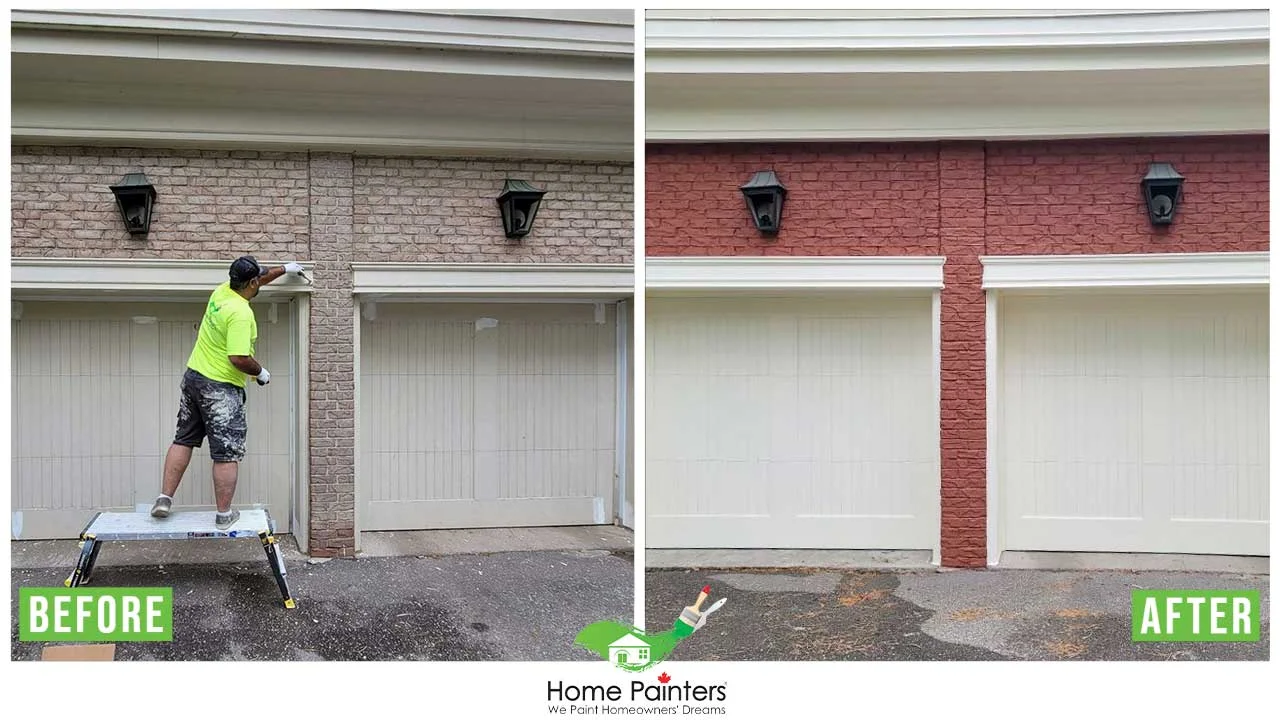
Rust converter, rust-inhibiting primer, and two topcoats applied in the right sequence is what separates a garage door paint job that holds up through Toronto winters from one that peels by spring.
Material-Specific Guidance for Exterior Garage Doors
Painting a Steel Garage Door
Steel is the most common garage door material on Toronto homes, and the one that requires the most attention to rust prevention. The sequence is: clean, degrease, wire-brush any rust, sand all over with 120 to 150-grit to dull the existing finish and feather any paint edges, rust converter on any rust areas, rust-inhibiting primer, two topcoats of 100% acrylic exterior in satin or semi-gloss.
The most important area on any steel garage door is the bottom panel and bottom edge, which receives the most road salt, snow, and splash-back moisture. This is where rust typically begins and where paint fails first. Extra attention to cleaning, rust treatment, and primer coverage at the bottom edge extends the service life of the full paint job significantly.
Painting a Wood Garage Door
Wood garage doors require the most prep work of any material type but also deliver the best visual results when done correctly. The full prep sequence is: clean, allow to dry fully, sand all surfaces with 120-grit to remove old finish and raise the grain, sand again with 220-grit to smooth, fill any holes, dents, or rot-damaged areas with exterior epoxy wood filler, caulk all panel joints and frame seams with exterior paintable caulk, prime with an exterior wood primer (oil-based for bare wood), and apply two topcoats.
For wood garage doors with stained rather than painted finishes, see our exterior front door restaining and refinishing service for guidance on the stain rather than paint approach.
Painting an Aluminum Garage Door
Aluminum does not rust but it does oxidize over time, producing a chalky, dull surface that needs treatment before painting. The prep sequence is: clean with detergent, wipe with a degreaser solution, light sand with 220-grit to remove oxidation and create adhesion profile, wipe clean with a tack cloth, and apply a self-etching or bonding primer specifically rated for non-ferrous metals. Without the correct primer, paint on aluminum will fail in adhesion within one to two winters.
Painting a Fibreglass Garage Door
Fibreglass doors are low-maintenance and do not rust or rot, but they do fade with UV exposure over time. Prep involves cleaning, light sanding with 220-grit to dull the factory finish and create adhesion, and a bonding primer before topcoats. Fibreglass painting is relatively forgiving once the primer is applied correctly. The main risk is applying the first topcoat before the primer has fully cured.
Colour Ideas for Exterior Garage Doors
When it comes to choosing the right colour for your garage door, there are several key factors to consider. The most important one is that the colour of the garage door should complement your home's exterior. This means taking into account the colour of your siding, roof, and trim. If your home has a neutral-coloured exterior, you have the flexibility to choose a garage door colour that either blends in or stands out as a statement piece.
Exterior Garage Door Colour Trends for Toronto Homes in 2026
The garage door colour choices our team sees most frequently requested on Toronto homes in 2026 fall into three clear directions.
Classic white or off-white remains the most popular choice, particularly on homes in Etobicoke, North York, and Scarborough where traditional architectural styles predominate. Benjamin Moore White Dove OC-17 and Sherwin-Williams Extra White SW 7006 are both reliable choices. White garage doors work with every exterior colour combination and read as clean and maintained from the street.
Matching the garage door to the home's body colour has become increasingly popular on modern and renovated homes, particularly in east-end Toronto neighbourhoods. When the garage door disappears into the facade by matching the siding or stucco colour, the front door becomes the undisputed focal point and the overall exterior reads as more architecturally composed.
Bold contrast colours, specifically deep charcoal (Benjamin Moore Kendall Charcoal HC-166, Sherwin-Williams Iron Ore SW 7069), deep navy (Benjamin Moore Hale Navy HC-154), and forest green (Benjamin Moore Black Forest Green 2041-10), are the statement direction for homes where the homeowner wants the garage door to create visual interest. These work best when coordinated with a matching or complementary front door colour, creating a composed entrance composition across the full front of the home.
Garage Door Colour Coordination Guidelines
- Match garage door colour to the trim colour for a traditional look where the door blends with the architectural framework
- Match to the body colour for a modern, architectural look where the door recedes and the front door becomes the focal point
- Use a bold contrast colour on the garage door to create visual interest, but coordinate it with the front door and any shutters
- For homes with brick or stone accents, choose garage door colours that reference the warm or cool tones in the masonry rather than fighting them
- Avoid painting a vinyl garage door in a colour with a Light Reflectance Value (LRV) below 55, as very dark colours cause vinyl to absorb excessive heat and warp
For current exterior colour trend guidance and how garage door colour fits into a full exterior colour scheme, see our guide to picking exterior paint colours.
Spray vs. Brush and Roller: Which Gives Better Results on a Garage Door?
The application method matters significantly on garage doors and is one of the areas where professional results often differ from DIY results.
Spray application, specifically with an airless sprayer, produces the most uniform film thickness and the smoothest finish on a garage door. It gets into all the recessed panel edges and joints evenly and eliminates brush marks and roller texture on the flat panels. This is the application method our professional team uses on garage door projects.
The trade-offs with spray are masking requirements and overspray risk. Everything adjacent to the door, including the driveway, landscaping, siding, weatherstripping, hardware, and vehicles, must be masked thoroughly before spray application. On a residential driveway on a Toronto lot, that masking process requires care and experience. Wind above 15 to 20 km/h makes spray application impractical regardless of how thorough the masking is.
For DIY painting, a brush and roller combination produces good results with more forgiveness on masking. Use a 4-inch foam roller on flat panel faces and a 2 to 2.5 inch angled brush on all recessed areas, joints, and edges. Work from top to bottom and maintain a wet edge across each full panel before stopping. A foam roller produces a smoother surface than a fabric roller on smooth steel and aluminum door surfaces.
DIY vs. Professional Exterior Garage Door Painting
| Factor | DIY | Professional |
|---|---|---|
| Cost | Lower materials cost: $100 to $250 in primer and paint for a standard double door | $700 to $1,500 for a professionally sprayed finish with prep, prime, and two topcoats |
| Time | Half to full day for prep; additional day for painting | Typically one to two days including all prep, prime, and finish coats |
| Finish quality | Good with brush and roller; no brush marks on flat panels with foam roller | Best with airless spray; smooth, uniform film on all surfaces including recessed panels |
| Rust assessment | Risk of missing early rust that will spread under new paint | Systematic assessment; all rust treated before priming |
| Product matching | Available at any hardware store | Commercial-grade products; rust-inhibiting primers matched to door material |
| Warranty | None | Home Painters Toronto: 3-year warranty on all exterior painting |
| Best for | Sound door in reasonable condition, single door, homeowner comfortable with prep | Any rust, significant peeling, double doors, or where a spray finish is the quality goal |
When Is the Best Time to Paint an Exterior Garage Door in Toronto?
The same temperature and humidity requirements that govern all exterior painting apply to garage doors. The minimum application temperature for standard 100% acrylic exterior latex paints is 10 degrees Celsius, with the surface and air temperature staying above this threshold for at least 24 to 48 hours after the final coat.
In Toronto, the reliable painting window runs from mid-May through mid-October. Spring (May to June) and fall (September to early October) offer the most consistently favourable conditions: temperatures in the 15 to 22 degree Celsius range, humidity below 70 percent, and stable overnight lows.
Avoid painting in direct afternoon sun on a south-facing door. The surface temperature of a steel garage door in direct July sun can exceed 50 degrees Celsius even when the air temperature is 28 degrees. Paint applied to a surface that hot will skin over before it levels, leaving a rough and uneven film. Work on south-facing doors in the morning before direct sun hits the surface.
For a full guide to Toronto's exterior painting seasons and the specific conditions to target each month, see our best time of year to paint exterior guide.
How Much Does It Cost to Paint an Exterior Garage Door in Toronto?
DIY Cost Estimate
- Rust-inhibiting or bonding primer (depending on door material): $20 to $45 per can or small pail
- Premium 100% acrylic exterior topcoat (Benjamin Moore Aura Exterior or Sherwin-Williams Duration): $65 to $110 per 3.78L (a standard double garage door requires approximately 1 to 1.5L per coat)
- Rust converter (for steel doors with rust): $15 to $30
- Auto-body filler or epoxy wood filler (for dents or damage): $20 to $40
- Sandpaper, wire brush, tack cloths, painter's tape, drop cloth, brushes, foam roller: $40 to $70
- Total DIY materials for a standard double steel garage door: $180 to $300 CAD in good condition; $250 to $400 CAD if rust treatment and dent repair are needed
Professional Cost Estimate
Professional exterior garage door painting in Toronto ranges from $700 to $1,500 CAD depending on:
- Single door vs. double door (double doors run approximately 20 to 30 percent more)
- Door material and current condition (steel in good condition is the most efficient; wood with peeling paint or steel with significant rust requires more prep and costs more)
- Application method (spray finish includes masking labour and achieves a higher-quality result than brush and roller)
- Whether the job is part of a full exterior painting scope (combining garage door with a full exterior repaint can reduce the door-specific cost)
Compared to garage door replacement, painting saves 80 to 90 percent of the cost while achieving a comparable visual result when done correctly. A new standard steel double garage door in Toronto runs $1,500 to $4,000 installed. A professional spray-painted door runs $1,000 to $1,500. If the door is structurally sound and mechanically functional, painting is almost always the right economic choice.
For a precise quote based on your specific door material and condition, request a free estimate from Home Painters Toronto. For broader exterior painting costs, see our exterior painting cost guide.
Real Project: Exterior Garage Door Painting in Toronto
North York Detached: Double Steel Garage Door Repaint with Rust Treatment
Here is a summary of a recent garage door painting project our team completed on a detached home in North York that shows what a full professional scope involves.
The situation: The homeowner contacted Home Painters Toronto to repaint a double steel garage door that had visible rust at the bottom two panels and along the left panel edge, as well as significant paint peeling at the same areas. The door was approximately 12 years old and had not been repainted since installation. The homeowner wanted to change the colour from the original builder-grade beige to a deep charcoal to match a front door that had recently been refinished.
What the job involved: Our team began with a full assessment of all rust areas. The rust was confirmed to be surface-level on the panel faces but had progressed deeper along the bottom edge channel. The bottom edge channel rust was treated with a rust converter applied to all exposed metal, allowed to cure, then primed with a rust-inhibiting bonding primer. All loose and peeling paint across the full door face was scraped back, the entire surface was sanded with 120-grit to dull the existing finish and feather all edges, then wiped clean with a tack cloth. One full coat of rust-inhibiting bonding primer was applied by brush and roller to all surfaces. Two coats of Sherwin-Williams Duration Exterior in a deep charcoal semi-gloss were applied by airless spray with all adjacent surfaces, weatherstripping, hardware, and the driveway fully masked.
The result: A uniform, smooth deep charcoal finish that matched the recently refinished front door and created a composed, high-contrast entrance composition against the home's light grey brick. The homeowner noted a dramatic improvement in the front elevation of the home. The rust treatment and thorough prep work, particularly at the bottom edge where the previous paint had failed, addressed the root cause rather than simply covering it.
For more completed projects, visit our Toronto painting projects page.
Frequently Asked Questions About Painting Exterior Garage Doors
The paint must be a 100% acrylic exterior formulation in satin or semi-gloss finish. General exterior acrylic paints from Benjamin Moore (Aura Exterior) and Sherwin-Williams (Duration Exterior, SuperPaint Exterior) perform well on garage doors in Toronto's climate. For steel doors with any rust history, using a paint over a rust-inhibiting primer is essential. For aluminum doors, a bonding primer compatible with non-ferrous metals must be applied before any topcoat.
Yes, always. The primer must be matched to the door material. A rust-inhibiting primer for steel, a self-etching or bonding primer for aluminum, an exterior wood primer for wood, and a bonding primer for fibreglass. Standard exterior primer is not formulated for metal garage doors and will not provide adequate adhesion or rust protection on steel or aluminum surfaces.
With proper prep, material-matched primer, and two coats of premium 100% acrylic exterior topcoat, a garage door paint job should last five to seven years in Toronto conditions. Steel doors in areas exposed to significant road salt spray may show early rust at chips and scratches sooner than the topcoat otherwise fails. Prompt touch-up of any chips or scratches prevents rust from spreading and extends the overall service life.
Yes, for a door in reasonable condition with surface paint failure but no significant rust or structural issues. The requirements are the same regardless of who does the work: clean, sand, prime with the correct material-specific primer, and apply two coats of exterior topcoat. DIY results with a brush and foam roller on a steel or aluminum door are good when the prep sequence is followed. For doors with significant rust, multiple peeling areas, or where a spray finish is the quality goal, professional execution with an airless sprayer produces better and longer-lasting results.
Remove all existing rust before priming, treat remaining rust with a rust converter, apply a rust-inhibiting primer, and apply two full topcoats of exterior paint. Annual inspection and prompt touch-up of any chips or scratches, particularly at the bottom edge of the door, prevents new rust from establishing. Road salt spray in Toronto winters is the primary rust accelerator at the bottom of steel doors; keeping the bottom edge sealed with intact paint is the most important ongoing maintenance step.
The right colour depends on your home's exterior colour scheme and what visual role you want the door to play. Matching the door to the trim creates a traditional, architectural look where the door recedes into the facade. Matching the door to the body colour creates a modern, minimalist look. A bold contrast colour (charcoal, navy, forest green) makes the garage door an intentional design feature. For homes with front-facing garages where the door is one of the most prominent exterior features, a strong colour that coordinates with the front door creates the most cohesive and intentional front elevation.
Painting your exterior garage door is a cost-effective way to boost your home's curb appeal and protect the door from the elements. By following these steps and choosing the right products, you can achieve a long-lasting and professional finish. If you're not comfortable taking on this project yourself, Home Painters Toronto can help!
More Interesting Blogs Related to How to Paint an Exterior Garage Door
Want Your Garage Door Painted Professionally?
Home Painters Toronto has been painting garage doors and full exteriors across Toronto and the GTA since 1987. Call 416-494-9095 or email [email protected] for a FREE quote.