

How To Fix A Broken Banister
A broken banister is one of the most common carpentry repairs in Toronto homes, and one of the most urgent because a damaged railing is a safety risk before it is a cosmetic one. Home Painters Toronto, the HomeStars Best of Award 2026 winner with over 1,200 positive reviews and 37 years serving the GTA, handles banister repairs and full staircase carpentry across North York, Etobicoke, Leaside, and Riverdale every season. Banisters take more daily impact than most structural elements in the home, absorbing hand pressure, body weight during stumbles, and the accumulated movement of children and pets over years of use. This guide covers every damage type, the correct repair approach for each, adhesive selection, Toronto building code requirements, and realistic repair costs.
Broken banisters are a common occurrence in active households. Constant daily movement, children running along railings, and years of gripping pressure all contribute to fractures, loose spindles, and detached handrail sections. Despite the volume of contact they absorb, well constructed banisters hold up remarkably well in most Toronto homes.
Understanding what type of damage has occurred determines whether the repair is a straightforward adhesive and clamping job or a more involved carpentry scope requiring mechanical fasteners and structural reassessment.
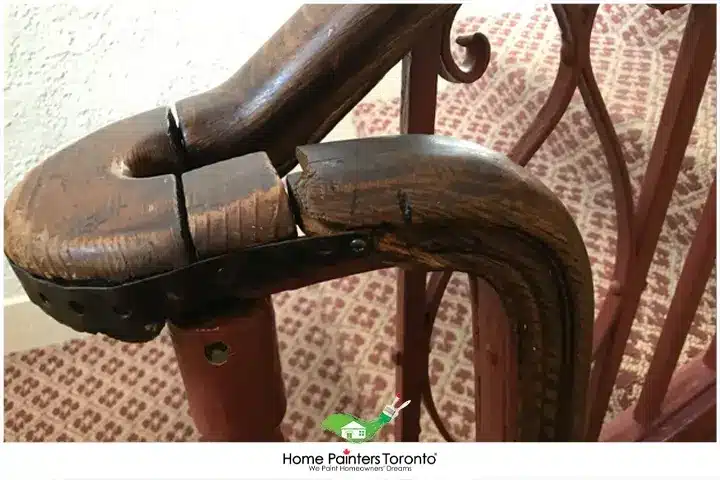
Identifying the damage type before starting is the most important step in banister repair — a loose newel post needs draw bolts, not just glue, and adhesive alone on a structural connection will fail again within weeks.
Understanding The Essential Role Of A Broken Banister Repair in Toronto Homes
What is a Banister?
A banister, also commonly referred to as a handrail or balustrade, is a structure designed and installed along the side of staircases, balconies, or decks to provide support and safety. The banister typically consists of a continuous handrail, a series of vertical posts called newel posts, and smaller vertical pillars known as balusters or spindles.
Handrails are positioned at a height that provides a reliable grip for ascending or descending stairs. More detail on banister components, staining, and refinishing is covered in our stair railings and banisters guide. Balusters or spindles, spaced equally between the newel posts, create the protective barrier that prevents users from falling sideways off the stairs.
The Material Composition of Stair Banisters
Material choice for banisters varies by home style and era, which directly affects how each material fails and how repairs are approached. Banisters are constructed from wood, metal, glass, or stone, with the general design and structural layout of the home determining the original material.
| Material | Common Toronto Home Era | Typical Failure Mode | Repair Approach |
|---|---|---|---|
| Wood (oak, pine, maple) | 1940s to present; most common in GTA homes | Cracked spindles, loose newel posts, split handrail joints | Wood glue and clamping for cracks; draw bolts for structural looseness; replacement for rot |
| Wrought iron / steel | 1960s to 1980s; heritage homes | Loose welds, corroded joints, spindles pulling from base plate | Welding or mechanical refastening; surface rust treatment before refinishing |
| Aluminum | 1990s to present; modern builds | Bent spindles, loose base brackets, oxidised finish | Bracket replacement or mechanical refastening; cleaning and repainting |
| Glass panels | 2000s to present; contemporary condos | Cracked glass, loose channel fixtures, failed silicone seals | Full panel replacement; never repair cracked structural glass |
| Stone or concrete | Heritage and exterior installations | Cracked coping, loose balusters in mortar | Mortar repair or full baluster replacement; structural engineer assessment on load bearing failures |
The Aesthetic Aspect of Banister Repair
Despite being a functional safety element, a banister contributes significantly to a home's visual appeal. It is among the first features noted about a staircase and directly impacts the overall ambiance of the entry area.
A beautifully crafted wooden staircase with well maintained banisters creates a feeling of grandeur appropriate to the heritage homes common across older Toronto neighbourhoods. A smooth, sleek glass balustrade suits the contemporary condo renovations our team completes across the GTA. Matching the repaired section to the existing material and finish is the standard our team applies on every banister repair project.

Draw bolts installed at the newel post base and stringer restore the structural connection to Ontario Building Code requirements — the step that adhesive-only repairs consistently skip and fail to replicate.
Safety and Building Code Requirements for Banister Repair in Toronto
The primary purpose of a banister is safety, and Ontario Building Code requirements govern the design and structural performance of all stair railings in residential properties. Any banister repair that addresses a structural failure, specifically a loose newel post, a detached handrail, or missing spindles, must restore the railing to the original code compliant load capacity.
According to the Ontario Building Code requirements for guards and handrails, handrails on residential stairs must be capable of withstanding a horizontal load of 0.9 kN per linear metre and must be continuous along the full length of the stair flight. Spindle spacing must not exceed 100 mm clear to prevent children from passing through or becoming trapped. Any repair that does not restore these specifications fails the safety standard, regardless of how cosmetically acceptable the finished result appears.
Toronto homes built before modern code revisions sometimes have original banisters that do not meet current spindle spacing requirements. A repair project on these banisters creates an opportunity to bring the spacing into compliance, which is particularly important in homes with young children.
Broken Banister Repair: Matching the Damage Type to the Right Fix
Not every banister failure requires the same repair. Applying the wrong approach, such as using wood glue on a structurally loose newel post that needs mechanical fastening, produces a cosmetic fix that fails within weeks and leaves the safety risk unresolved.
| Damage Type | Cause | Correct Repair Method | Urgency Level |
|---|---|---|---|
| Cracked or split spindle/baluster | Impact, wood movement from seasonal humidity cycling | Resin or polyurethane adhesive; clamping pressure until cured | Medium: spindle damage is cosmetic if one unit; urgent if multiple adjacent spindles are compromised |
| Loose spindle (not cracked) | Failed adhesive at base or top connection over time | Clean joint, reapply appropriate adhesive, clamp until cured | Medium: replace spindle if wood at connection point is deteriorated |
| Loose newel post | Base connection failure; most common at bottom newel post | Draw bolts drilled into floor or stringer; adhesive alone insufficient for structural posts | High: newel posts bear the primary load of the railing system |
| Detached handrail section | Loose bracket, failed joint, or complete rail separation | Resin adhesive at joint; mechanical bracket replacement; draw bolts if needed | High: handrail continuity is required by Ontario Building Code |
| Rotted wood at banister base | Moisture infiltration over extended period; common near exterior doors | Full section replacement; rotted wood cannot be repaired with adhesive alone | High: structural integrity compromised; replacement is the only correct approach |
| Painted over loose joint | Multiple paint layers concealing a loose connection for years | Remove paint at joint, assess structural condition, repair accordingly | Variable: assess after paint removal to determine correct approach |
How to Fix a Broken Banister Spindle in a Toronto Home
Spindle repair is the most frequent banister repair our team addresses in Toronto homes. Most spindle damage results from direct impact or from wood movement caused by Toronto's seasonal humidity swings, which run from 20 to 30% under forced air heating in winter to over 60% in summer. That repeated expansion and contraction stresses glue joints and causes wood to crack along the grain.
The repair adhesive selection determines how long the fix holds. Two products are commonly used on wood banister repairs: resin glue and polyurethane adhesive (commonly known as Gorilla Glue). Each has specific strengths that match different damage scenarios.
Materials Used in a Professional Banister Repair
A professional banister repair scope typically involves the following materials and tools, selected based on the damage type identified during the initial assessment.
- Polyurethane adhesive (Gorilla Glue) or two part resin glue
- Draw bolts (for structural newel post and handrail connections)
- Hammer and screwdrivers
- Wrench and clamps
- Putty knife (for cleaning joint surfaces before adhesive application)
- Cordless drill (for draw bolt installation)
- Safety glasses (mandatory during any cutting or drilling on wood)
The Professional Banister Repair Process: What a Proper Fix Involves
A professional banister repair begins with a full assessment of all damage before any repair work starts. Attempting to repair one visible crack without assessing the condition of adjacent joints and connections frequently leads to a second failure at a nearby point within months.
All debris, loose wood fibres, and old adhesive residue are removed from the split or cracked area before new adhesive is applied. A clean joint surface is essential for any adhesive to form an effective bond. Chunks of deteriorated wood and any material preventing the crack from closing fully are addressed at this stage.
Outer bullnose pieces, the rounded trim sections on the side of the banister, are carefully removed to allow access to the full repair area and to ensure the surfaces are even before adhesive is applied. All pieces are numbered during removal so they are restored to their original positions.
Loose spindles are detached and repaired individually before reinstallation. Attempting to re glue spindles in place without detaching them produces a poor adhesive contact surface and a weak repair. Each spindle connection is cleaned, re glued with the appropriate adhesive, and held under clamping pressure for the full cure time.
Draw bolts are the correct mechanical fastener for newel post and handrail structural connections. Adhesive alone is insufficient for load bearing connections because it cannot resist the shear forces applied when a person grips the handrail during a stumble or fall. Draw bolts are drilled into the base of the banister according to manufacturer specifications, then installed with adhesive to create a combined mechanical and adhesive bond. This dual fastening approach is the professional standard for structural banister repairs in Ontario.
Gorilla Glue for Banister Repairs: When It Is the Right Choice
Gorilla Glue, also known as polyurethane adhesive, is available at Home Depot Canada and is a strong choice for wood to-wood banister repairs where the joint can be fully closed under clamping pressure. Its primary characteristic is expansion: polyurethane adhesive foams up as it cures, filling small gaps within the joint and creating a bond that is stronger than the wood itself when applied correctly.
The expansion property is also its main limitation. Excessive adhesive application creates a foam overflow that requires cleanup and can interfere with the joint closure if not managed correctly. Gorilla Glue is waterproof and tolerates the humidity variations common in Toronto homes, making it a practical choice for both interior and semi exterior banister applications such as covered porch railings.
Skin contact should be avoided during application. The adhesive bonds to skin and is difficult to remove once cured.
Resin Glue for Banister Repairs: When It Is the Right Choice
Resin glue is the preferred adhesive for precision wood to-wood banister repairs where superior bonding strength and dimensional stability are the priority. Its water thin consistency allows it to penetrate deeply into hairline cracks and fine splits where thicker adhesives cannot reach, making it particularly effective for cracked spindles and split handrail sections.
Cure time for resin glue runs up to ten hours at room temperature, which is significantly longer than polyurethane adhesive. Clamping pressure must be maintained throughout that cure window. The result is a bond that is exceptionally hard and stable, making resin the preferred choice on high contact components like handrails that experience repeated gripping force throughout the day.
Final Steps in a Professional Banister Repair
Once all adhesive joints have fully cured, the structural connections are reinforced with draw bolts where required. Spindles are seated firmly into their top and bottom connections, with adhesive at each end securing them in position. All bullnose trim pieces are restored to their original positions using adhesive and screws.
The completed repair is tested by applying lateral and downward pressure at the newel posts and along the handrail to confirm the repair meets load requirements. Any movement detected at this stage is addressed before the project is considered complete.
When a Broken Banister Requires Professional Carpentry in Toronto
Some banister damage scenarios fall outside the scope of a straightforward adhesive repair and require professional assessment and intervention. Attempting structural repairs without the correct tools, materials, or knowledge of Ontario Building Code requirements creates liability for the homeowner if the repair fails and causes an injury.
| Scenario | Why Professional Assessment Is Required |
|---|---|
| Newel post completely detached from floor or stringer | Load bearing structural connection; draw bolt installation requires correct placement to meet code load requirements |
| Multiple adjacent spindles missing or broken | Spindle spacing must meet Ontario Building Code 100 mm maximum; full section replacement may be required |
| Wood rot visible at newel post base or handrail ends | Rotted wood cannot be repaired with adhesive; replacement is required before any finishing work |
| Banister was installed incorrectly or does not meet current code | Repair without code compliance creates safety and liability risk; professional assessment determines correct scope |
| Metal or glass banister failure | Welding, structural glazing, and metal fabrication are specialist trades; incorrect repairs create additional safety hazards |
| Heritage home with original banister profile no longer available | Profile matching and wood milling requires specialist carpentry skills to maintain heritage character of the home |
Our team at Home Painters Toronto handles the full scope of wood railing and banister repairs across Toronto and the GTA, from single spindle replacements to complete newel post reconstruction.
Cost of Banister Repair in Toronto in 2026
Banister repair cost in Toronto depends on the type of damage, the number of components requiring repair or replacement, whether painting or staining is included in the scope, and whether the repair involves structural components requiring draw bolts or full replacement sections. Home Painters Toronto is WSIB compliant, fully insured to $5 million general liability, and all carpentry work carries a warranty. All prices below are in CAD and exclude HST.
| Repair Scope | Estimated Cost (CAD) | Notes |
|---|---|---|
| Single spindle or baluster repair (adhesive) | $150 – $350 | Clean joint, adhesive, clamp, and refinish the repaired section |
| Multiple spindle repairs (3 to 10 units) | $400 – $900 | Each spindle assessed individually; replacement included where needed |
| Loose newel post repair with draw bolts | $400 – $800 | Structural connection restoration; surface refinishing included |
| Detached or cracked handrail section | $350 – $750 | Adhesive and mechanical fastener repair; length of section affects cost |
| Full banister section replacement (one flight) | $1,200 – $3,000 | New spindles, handrail section, and newel post where required; painting or staining quoted separately |
| Complete staircase banister replacement | $3,000 – $7,000 | Full replacement of all railing components; includes carpentry and painting or staining |
| Painting or staining after repair | Quoted separately | See our staircase painting and staining service for scope and pricing |
For a full breakdown of staircase carpentry and painting costs, see our interior carpentry and handyman service and our interior painting cost guide.
Real Project: Banister Repair and Refinishing in a Leaside Heritage Home
Leaside 1940s Detached: Newel Post Draw Bolt Repair, Cracked Spindle Replacement, and Full Banister Refinish
A homeowner in Leaside contacted Home Painters Toronto after discovering the bottom newel post on their 1940s detached home staircase had separated from the floor, leaving the entire handrail section visibly unstable when gripped. The original banister was turned oak, a profile that is no longer a standard stocked item, and the homeowner wanted to preserve the original character of the staircase.
Our team assessed the full banister system before any repair began. The newel post base had completely separated from the floor mounting due to a failed original fastening combined with decades of seasonal wood movement. Four adjacent spindles had also loosened at their base connections, and two had cracked along the grain from the movement caused by the unstable newel post. The handrail itself was structurally sound but had accumulated paint buildup at the joint connections that was concealing the extent of the looseness.
Draw bolts were installed into the newel post base and into the stringer below the bottom tread, restoring the structural connection to current Ontario Building Code requirements. The two cracked spindles were replaced with matching turned oak profiles sourced from a specialty millwork supplier in the GTA. All remaining loose spindles were cleaned, re glued with resin adhesive, clamped for twelve hours, and tested under lateral load before release. The entire banister assembly was then sanded, primed with Benjamin Moore Fresh Start oil based primer, and finished with two coats of Benjamin Moore Advance in Semi Gloss finish to match the existing trim throughout the stairwell.
Home Painters Toronto is WSIB compliant, fully insured to $5 million general liability, and all carpentry and painting work carries a warranty. For completed projects, visit our Toronto painting and carpentry projects page. Same day free estimates are available seven days a week across the GTA.
Conclusion
Banister repair is both a safety obligation and a practical carpentry task that maintains the character of Toronto's heritage stairways. Proper assessment of the damage type, correct adhesive selection, and structural restoration using draw bolts where required produce a repair that meets Ontario Building Code standards and holds up under daily household use.
Frequently Asked Questions About Fixing a Broken Banister
Broken banister spindles are repaired by cleaning all debris and old adhesive from the damaged surfaces, applying resin or polyurethane adhesive to the crack or joint, and holding the repair under clamping pressure for the full adhesive cure time. Resin adhesive requires up to 10 hours of clamping; polyurethane adhesive typically cures in 1 to 2 hours. Spindles with significant wood rot or missing sections are replaced rather than repaired, as adhesive repairs on deteriorated wood do not hold under load.
Gorilla Glue (polyurethane adhesive) expands as it cures, filling gaps within the joint and creating a strong bond across slightly uneven surfaces. It cures faster than resin and is waterproof, making it suitable for repairs on semi exterior banisters. Resin glue cures to a harder, denser bond and penetrates more deeply into fine cracks due to its lower viscosity. Resin is the preferred choice for precision repairs on handrails and tight crack repairs. Both products produce bonds stronger than the surrounding wood when applied correctly on clean, dry surfaces.
Draw bolts are required whenever the damage involves a structural connection between a newel post and the floor, stringer, or wall, or between a handrail section and a newel post cap. Adhesive alone cannot resist the shear forces applied to these connections under normal use. Ontario Building Code requires handrails to withstand a horizontal load of 0.9 kN per linear metre. Adhesive only repairs at structural points do not reliably meet this requirement.
Yes. Any repair that addresses a structural failure in a banister must restore the assembly to Ontario Building Code specifications. This includes handrail height between 865 mm and 965 mm above the stair nosing, spindle spacing of no more than 100 mm clear, and structural load capacity at all connection points. Cosmetic repairs, such as re gluing a cracked spindle, do not trigger code review. Structural repairs, such as newel post reattachment, must meet code standards.
Single spindle adhesive repairs in Toronto run from $150 to $350. Multiple spindle repairs cost $400 to $900 depending on count. A loose newel post repair with draw bolt installation runs $400 to $800. Full banister section replacement for one flight of stairs costs $1,200 to $3,000. Complete staircase banister replacement is $3,000 to $7,000. All quotes from Home Painters Toronto are free and provided same day. Painting or staining after repair is quoted as a separate scope.
Yes, and combining both scopes in one project visit is more cost effective than scheduling them separately. Our team handles the carpentry repair first, allows all adhesive to fully cure, then applies primer and finish coats to the repaired components to match the existing staircase finish. See our staircase painting and staining service for details on how we approach combined carpentry and painting projects.
Most single newel post or spindle repair projects are completed in one day, including assessment, structural repair, adhesive cure monitoring, and a final load test of the completed repair. Projects involving multiple spindle replacements, profile matching, or full section replacement typically take two days. Combined carpentry and painting projects require additional time for the paint to cure before the staircase is returned to full use.
More Helpful Blogs Related to How To Fix A Broken Banister
Need Professional Banister Repair in Toronto?
Home Painters Toronto is the HomeStars Best of Award 2026 winner with a warranty on all carpentry and interior painting. Call 416-494-9095 or email [email protected] for a FREE same-day estimate.